Google's AI Interview Policy Explained
Google's AI interview policy now requires Gemini in a new code comprehension round. Here is what it tests and how top employers already prepare.
TL;DR: Google's AI interview policy now includes a piloted "code comprehension" round for junior and mid-level SWE candidates, where Gemini is required, not banned. You get an unfamiliar codebase, 60 minutes, and Google's own model — no outside tools. Interviewers score prompt engineering, output validation, and debugging, not raw code recall. Google isn't first: Meta, Canva, Shopify, and Rippling already run similar formats. If a company you're interviewing at hasn't announced this yet, it's worth assuming one round might look like this soon anyway.
For a decade, the instruction before a Google technical interview was some version of "no outside resources, no AI, no looking anything up." In May 2026, Google quietly reversed that for one specific round — and started grading candidates on how well they used the tool it had spent years telling them to put away.
What Google's Pilot Actually Requires
The new format is called a code comprehension round, and it's narrower than the "AI interview" headlines make it sound. Here's what's confirmed:
- Scope: Junior and mid-level software engineering candidates, on select US teams — the pilot started with Google Cloud and the platforms and devices unit.
- Format: Candidates receive an unfamiliar codebase, roughly 200 to 500 lines, inside CoderPad. In 60 minutes, they read it, debug an issue, discuss the design, and propose improvements.
- The tool: Gemini, and only Gemini. Google provides the assistant; candidates can't substitute Claude, GPT-5, or anything else into this round.
- What's unchanged: Google's traditional coding round — the one without any AI assistance — still exists in the same loop. This pilot adds a round; it doesn't replace the old one.
- Timeline: Announced in early May 2026, expanding through the second half of the year if results hold up.
The context makes this less surprising than it looks in isolation. Sundar Pichai disclosed in an April 2026 post that roughly 75% of new code at Google is now AI-generated and engineer-approved, up from about half the previous fall. A company where three-quarters of shipped code already goes through an AI tool has a straightforward reason to stop pretending interviews should look like they did in 2015.
Google Isn't the First — It's the Fourth
If your search brought you here because a recruiter mentioned an "AI round" and you assumed it was a Google-only oddity, it's worth knowing the fuller picture. Google is at least the fourth major employer to formalize AI-assisted technical interviewing:
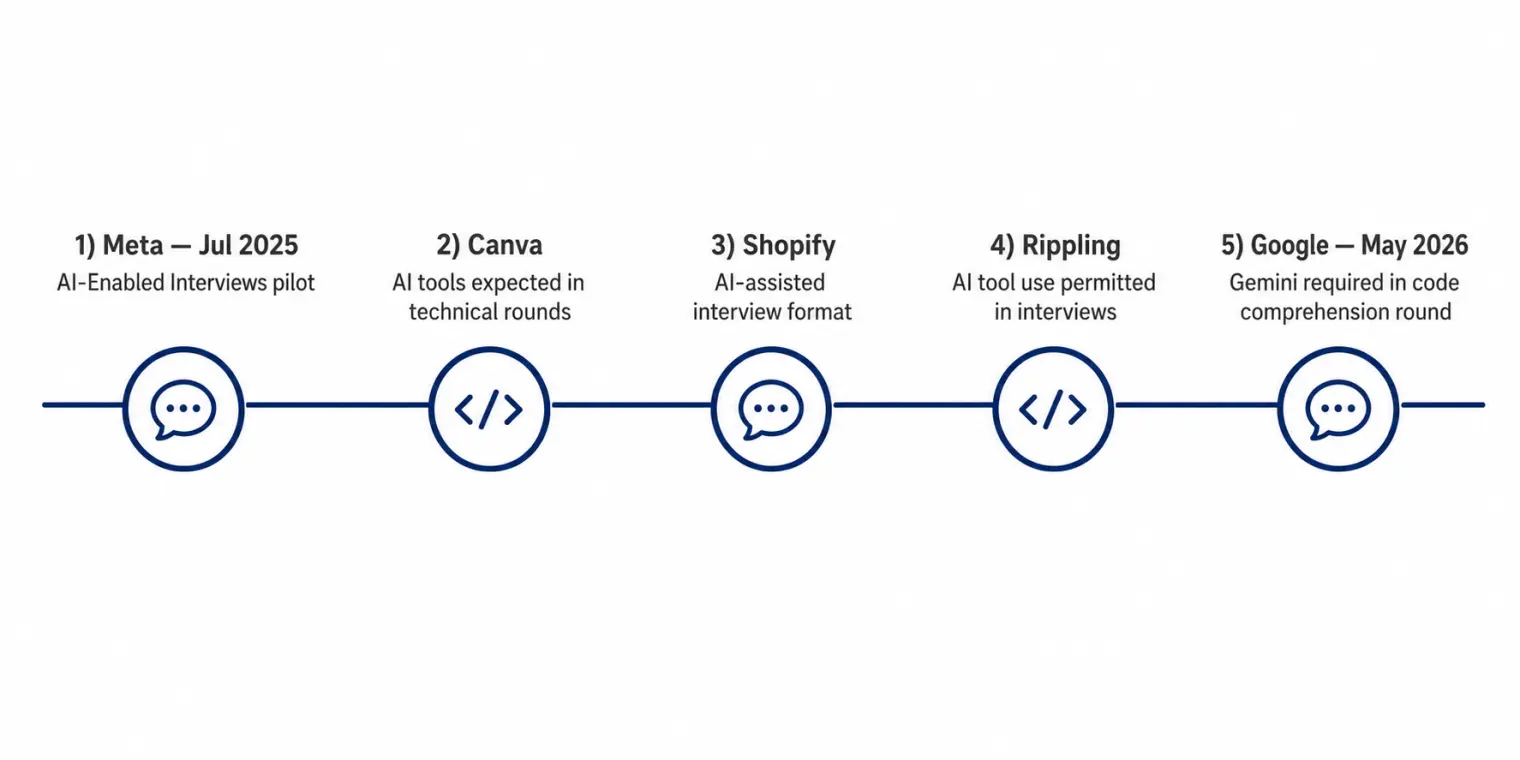
- Meta has run an "AI-Enabled Interviews" pilot since July 2025, also built on CoderPad, but with a choice of models — GPT-5, Claude, Gemini, or Llama 4 — rather than one mandated assistant. Meta has been expanding the format toward backend and infrastructure roles through 2026.
- Canva and Shopify have both moved to formats that expect candidates to use an AI tool during a technical round, treating fluency with it as part of the job rather than an exception to it.
- Rippling permits AI tool use in its technical interviews on a similar premise.
The detail worth sitting with: Meta lets candidates choose their model, Google doesn't. That's not a small difference. Choosing your own tool tests something closer to your actual daily workflow; being handed one tool you may never have used tests something closer to adaptability under a constraint you didn't pick. If you're preparing for one of these rounds, find out which version you're facing before you assume your ChatGPT habits transfer directly.
What Interviewers Are Actually Scoring
None of this is graded like a normal coding round with AI bolted on. Google's stated evaluation criteria are specific:
Prompt engineering. Can you direct Gemini toward the actual problem instead of asking it something too broad to be useful? "What does this function do" gets a worse signal than "trace how this function's return value is used three calls downstream, and tell me if there's a case where it could be null."
Output validation. This is the one candidates underweight. Gemini will occasionally produce a plausible-sounding explanation that's subtly wrong, or miss an edge case entirely. Interviewers are watching whether you catch that — not whether you blindly relay the model's answer as your own conclusion.
Debugging skill, unassisted by the model. You still have to trace the actual bug through actual code. The AI can help you navigate an unfamiliar file faster; it can't substitute for you understanding why the bug happens once you've found it. Candidates who let Gemini do the explaining and add nothing on top tend to be the ones interviewers flag.
Notice what's absent from that list: raw memorization, algorithm recall under time pressure, or writing a data structure from scratch. This round is measuring a genuinely different skill than a LeetCode-style interview, which is exactly why treating it as "the same interview but with a cheat code" is the mistake most candidates will make.
The Fairness Debate, Briefly
Not everyone thinks this is a clean improvement. Emily Cohen, head of people operations at AI-coding startup Cognition, gave Business Insider a blunt framing: testing engineers without the AI tools they use daily is "like asking a kid to take a math test without a calculator" — the old interview format, in her view, had already stopped matching the job.
The counterargument, made mostly by critics of the new format rather than Google itself, is narrower: a single company-mandated model in a timed 60-minute round measures something different from how engineers actually use AI day to day, where they pick their own tools and aren't on a clock set by an interviewer. Both points are reasonable, and Google hasn't published data settling which one is closer to true. What's not in dispute is that the skill being tested — directing a model, checking its output, debugging what it gets wrong — is now something a real employer scores, whether or not you think it should be.
If you want the fuller mechanics of how AI-conducted and AI-assisted interviews get scored across platforms more broadly, our guide to passing an AI interview breaks down HireVue, Mercor, Apriora, and Ribbon the same way — different companies, same underlying shift toward AI having a formal role in the loop rather than being contraband.
How to Actually Prepare for This
Reading about prompt engineering doesn't build the skill; using it under time pressure does. A few things that transfer directly:
Practice with an unfamiliar codebase, not your own. The whole point of the round is that you don't know the code going in. Pull a mid-size open-source repo you've never touched, give yourself 60 minutes, and force yourself to navigate it with an AI assistant instead of reading every line yourself.
Rehearse catching the model when it's wrong, on purpose. Ask your AI tool a deliberately ambiguous question about a codebase and see what it gets subtly wrong. Training yourself to notice a plausible-but-incorrect answer is the specific skill Google says it's grading — most candidates have never practiced this because most practice is "get the AI to give me the right answer," not "notice when it doesn't."
Rehearse the live-pressure version, not just the untimed version. This is the part AceRound's mock interview mode is built for — an adaptive AI interviewer that follows up on what you say, under an actual clock, so the first time you're managing a model, a timer, and an interviewer's attention isn't the real interview.
Know which model you'll actually get. If a recruiter can tell you whether your round is Gemini-only (Google's format) or a choice of models (Meta's format), prepare with that specific tool beforehand. A workflow you've built around GPT-5 doesn't transfer cleanly to a mandated Gemini session if you've never used Gemini's interface under pressure.
For the broader question of what these systems can and can't see, our breakdown of AI interview cheating detection covers the separate, older debate about tools used against a company's wishes — worth reading if your target company hasn't published a policy like Google's and you're unsure where the line sits.
FAQ
Does Google allow AI in interviews? Yes, for a specific pilot. Since May 2026, Google has been testing a code comprehension round for junior and mid-level software engineering roles on select US teams, starting with Google Cloud and the platforms and devices unit. Candidates are given an unfamiliar 200-500 line codebase in CoderPad and use Gemini, which Google provides, to read, debug, and discuss it. Google's regular coding round, where outside tools aren't allowed, still runs alongside it.
Can I use ChatGPT or my own AI tool in a Google interview, or only Gemini? Only Gemini, in the pilot round where AI use is permitted. Google provides the model and the CoderPad environment; candidates cannot bring Claude, ChatGPT, or any other assistant into that specific round. Google's traditional coding interview, evaluated separately, still does not allow any AI tool.
Is Google the only company doing this? No. Meta has run an AI-Enabled Interviews pilot since July 2025 using CoderPad with a choice of models including GPT-5, Claude, Gemini, and Llama 4, and has been expanding it toward backend and infrastructure roles through 2026. Canva, Shopify, and Rippling have also moved to interview formats that expect or require candidates to use an AI tool during a technical round. Google is the fourth major tech employer to formalize this, not the first.
What does Google actually score in the code comprehension round? Three things: prompt engineering (how you direct Gemini to investigate the codebase), output validation (whether you catch when Gemini's suggestion is wrong or incomplete), and debugging skill (whether you can still trace a bug through unfamiliar code without the model doing that work for you). It is not scored on how much code you can produce from memory.
Is it fair to require AI in a job interview? It's contested. Emily Cohen, head of people operations at AI-coding startup Cognition, told Business Insider that testing engineers without their usual AI tools is "like asking a kid to take a math test without a calculator" when that's not how the job is actually done anymore. Critics counter that a company-mandated single model in a timed round measures something narrower than day-to-day AI-assisted work. Neither position is settled; the practical reality is that more employers are scoring this skill regardless of the debate.
Will this format spread beyond Google and Meta? Both companies are still piloting rather than rolling this out company-wide, and Google's own plan is to expand only if the current results hold up. But four separate large employers moving the same direction in twelve months is a pattern, not a coincidence, and it's a reasonable bet that more technical interview loops add an AI-assisted round over the next year even if the exact format varies.
Author · Alex Chen. Career consultant and former tech recruiter. Spent 5 years on the hiring side before switching to help candidates instead. Writes about real interview dynamics, not textbook advice.
Related Articles
OpenAI's AI Interview Policy: Banned, Required, or Team-Dependent
OpenAI sells AI coding agents, then bans most candidates from using one. Here's the round-by-round policy, including the new agentic round that flips it.
Does Harver Detect Cheating? What Its Proctoring Actually Checks
Does Harver detect cheating on its pre-employment assessments? A candidate look at Harver's Proctoring add-on, what gets logged after a flag, and what happens next.

Micro1's Zara AI Interview: What It Actually Tests (And Why Timing Gets Flagged)
Micro1's AI interviewer Zara has run 300,000+ interviews for remote roles. Here's why it flags response latency as a cheating signal, and what that means for AI prep.