How Do You Work With AI Agents? (Answered)
A new 2026 interview question is catching candidates off guard: how do you decide what to delegate to an AI agent? Here's how to actually answer it.
TL;DR: "How do you work with AI agents?" is a new 2026 interview question that really means: how do you decide what to delegate to an AI agent versus handle yourself? It's not the same as "how do you use ChatGPT" — interviewers are testing judgment and trust calibration, not tool fluency. Answer it with a concrete framework (recurring, bounded, reversible, verifiable) and one real story of a time you got the call right — or caught it when you got it wrong.
A recruiter on r/cscareerquestionsEU posted something in July 2026 that summed up the mood: "I recently applied for a role mid-senior level and the first step is literally a technical one with some 'AI Agent,' isn't it crazy?" Three weeks later, a different thread — this one behavioral, not technical — asked candidates flat out: what would you actually hand to an AI agent, and what would you never let it touch?
If you haven't heard this question yet, you will soon. It's not a trick question about AI ethics. It's a judgment test, and most candidates walk in with the wrong prepared answer.
Why this question exists now
Gartner forecasts that 40% of enterprise applications will embed task-specific AI agents by the end of 2026, up from under 5% a year earlier. That's not a slow rollout — it's most companies going from zero AI agents to several, inside one hiring cycle. Whoever they hire next will inherit those agents on day one, whether the job posting mentions it or not.
Fortune covered the management side of this shift in August 2026, in a piece called "Your AI agent can be a teammate. But it still needs a boss." The core argument: treating an AI agent as just another "employee" — assigning it work and walking away — actually makes people worse at catching its mistakes. Executives are being told to hire and train people who manage agents like a boss, not a passive user. That's the exact skill this interview question is fishing for.
So the question isn't "do you know how to prompt an AI agent." It's "do you know when not to trust one" — and whether you have a real answer or a rehearsed one.
It's a different question from "how do you use AI at work"
If you've already prepped for "how do you use ChatGPT in your workflow", you might assume this is the same question with different words. It isn't, and answering it like it is will read as a miss.
"How do you use AI tools" is about fluency — can you get useful output out of Copilot, ChatGPT, or an internal tool. "How do you work with AI agents" is about delegation and oversight — can you hand off an entire task to something that runs semi-autonomously, and still catch it if it goes wrong. One tests whether you're a competent operator. The other tests whether you'd be safe to put in charge of something that can act without asking first.
Interviewers who ask this question are usually picturing a specific failure mode: someone who either (a) refuses to delegate anything and becomes a bottleneck, or (b) delegates everything and stops paying attention. They want proof you're neither.
Steal this framework: the four-factor delegation test
You don't need a philosophy of AI to answer this well. You need a repeatable test you can apply to any task, live, in the interview. Digital Applied's 2026 breakdown of enterprise AI-agent rollouts distills it into four properties worth checking before you hand a task to an agent:
| Factor | The question to ask | Example that passes | Example that fails |
|---|---|---|---|
| Recurring | Does this happen often enough that automating it is worth the setup cost? | Weekly status report compilation | A one-off, never-repeated migration |
| Bounded | Does the task have a clear start and end, with a defined scope? | "Summarize these 40 support tickets" | "Improve customer satisfaction" |
| Reversible | If the agent gets it wrong, can you undo it cheaply? | Drafting an email you'll review before sending | Sending an email directly to a client |
| Verifiable | Can you actually check the output against something objective? | Formatting data to match a template | Judging whether a design "feels right" |
A task that clears all four is a good delegation candidate. A task that fails even one — especially "reversible" or "verifiable" — is one you keep, or you delegate with a hard checkpoint before anything ships.
This matters because a real-world poll backs up how most people actually feel about this. When HackerNoon asked readers what they'd let an AI agent do completely unsupervised, the top answer — at 31% — was "none of it." Booking travel, writing and deploying code, and managing personal finances all polled well behind "nothing."
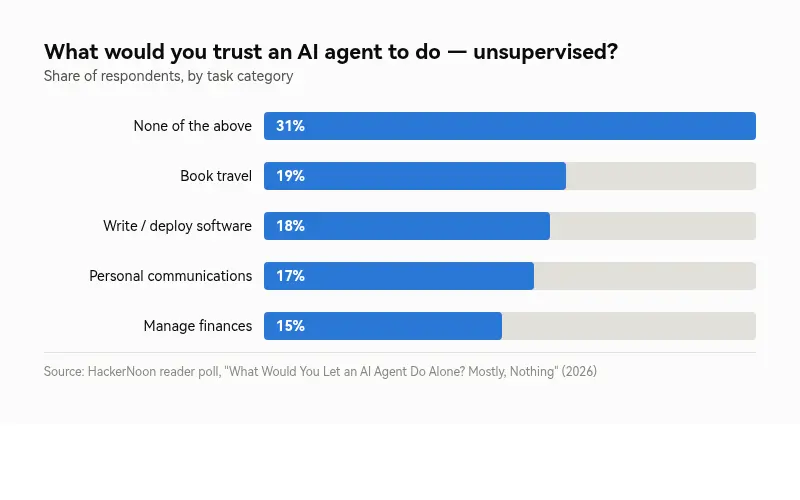
That instinct isn't wrong, but "I don't trust AI agents with anything" is also not an answer that gets you hired for a 2026 role. The strongest candidates land somewhere more specific: not blanket trust, not blanket refusal, but a rule they can explain and defend.
Three sample answers, from weakest to strongest
Weak — the tool-fluency answer (misses the question):
"I use AI a lot. I have ChatGPT open all day for drafting emails and summarizing docs."
This answers a question nobody asked. It's the "how do you use AI tools" answer wearing an "AI agent" costume, and an interviewer paying attention will notice the dodge.
Better — the framework answer (solid, a little generic):
"I'd delegate recurring, bounded tasks with a clear way to check the output — like generating a first draft of a weekly report — but I'd keep anything irreversible, like sending client communications, in a human review loop."
This shows you have a real mental model. It's honest, defensible, and better than most answers the interviewer will hear that day.
Strongest — the framework plus a real story:
"On my last team, we set up an agent to triage incoming support tickets and draft first-pass responses. It was recurring, bounded, and easy to verify — I could always see the original ticket next to its draft reply. About three weeks in, I caught it mis-categorizing a billing dispute as a technical issue, twice in the same week. Because the loop had a human check before anything sent, it cost us nothing but ten minutes of correction — but it told me the agent needed a narrower scope on ambiguous tickets, so I tightened the categories it was allowed to choose from."
This works because it does three things at once: proves you've actually operated an agent (not just used a chatbot), shows the framework in action without reciting it like a definition, and ends with a specific corrective action — which is what "manages agents like a boss" actually looks like in practice.
If you've never worked with an agent in a production setting, don't fabricate one. Use a smaller, honest example — an AI-assisted workflow tool, a scheduling automation, even a personal project — and be upfront that you're reasoning from first principles rather than battle scars. Interviewers can tell the difference between an invented war story and honest extrapolation, and the second one reads better than a lie that falls apart under a follow-up question.
Common mistakes candidates make
- Answering with pure enthusiasm. "AI agents are amazing, I trust them with everything" signals exactly the naive-oversight failure mode Fortune's piece warns employers about. It's the fastest way to fail a question designed to test judgment.
- Answering with pure fear. The opposite extreme — "I don't trust any AI with anything important" — reads as someone who won't be able to work inside a company that's already committed to agent adoption. Neither pole answers the actual question: how do you decide.
- Confusing this with the coding-agent question. If you're interviewing for an engineering role, don't assume this is secretly about GitHub Copilot or an AI pair-programmer. Those tools assist your own work; an "agent" in this context usually means something that runs a task with less supervision. Ask a clarifying question if the interviewer's phrasing is ambiguous — "when you say agent, do you mean something operating with a specific task and limited human review?" is a fine thing to ask out loud.
- Skipping the "what changed after" part. A story about catching a mistake is good. A story about catching a mistake and what you did differently afterward is what separates a pass from a strong pass.
Practicing this live
The tricky part of this question isn't knowing the framework — it's applying it on the spot to whatever task the interviewer throws at you, the same way you'd need to think on your feet for any of the harder situational interview questions ("okay, would you delegate performance reviews to an agent? What about meeting scheduling?"). That's a real-time reasoning exercise, and it's easy to freeze on the follow-up even when you nailed the opening answer.
That's the exact moment AceRound is built for — it listens alongside you during a live interview and surfaces a structured way to reason through a follow-up you didn't specifically rehearse, without you having to stop and think from scratch. It won't invent your delegation story for you, but it can keep the four-factor framework in front of you while you build the rest of the answer live. Worth knowing about before you're mid-follow-up, not after.
FAQ
Is this question only for technical or AI-adjacent roles? No. Gartner's 40% forecast is enterprise-wide, not limited to engineering teams. Support, operations, marketing, and finance roles are all seeing agent rollouts in 2026, so the question shows up well outside of software jobs now.
What if I've genuinely never worked with an AI agent? Say so, then reason from a smaller example — a scheduling automation, an AI-assisted research tool, anything where you handed off a task and had to decide how closely to supervise it. Interviewers care more about your decision process than your resume having "AI agent" on it.
What's the one thing I should never say I'd delegate? Anything irreversible and hard to verify at the same time — final decisions about people (hiring, firing, performance ratings), anything sent externally without review, or financial transactions without a checkpoint. Naming one of these as an "I'd never fully automate this" example is a strong, specific answer.
How is this different from a technical AI-agent interview round (like building agent orchestration)? Completely different skill. That round tests whether you can build agentic systems. This one tests your judgment as a user and manager of an agent someone else built. Don't over-engineer your answer with architecture talk if the question is really about trust calibration.
Should I bring up specific tools by name? Only if you've actually used them and can speak to specifics. A vague tool-drop ("we use an agent platform") without a real story attached is weaker than a concrete, tool-agnostic example.
Is "I'd let it do everything, I trust the process" ever a good answer? No — that's the naive-oversight answer Fortune's reporting specifically flags as a failure mode. Even in a highly automated team, the strongest candidates can name at least one category of task they'd keep human-reviewed.
Author · Alex Chen. Career consultant and former tech recruiter. Spent 5 years on the hiring side before switching to help candidates instead. Writes about real interview dynamics, not textbook advice.
Related Articles
OpenAI's AI Interview Policy: Banned, Required, or Team-Dependent
OpenAI sells AI coding agents, then bans most candidates from using one. Here's the round-by-round policy, including the new agentic round that flips it.
Does Harver Detect Cheating? What Its Proctoring Actually Checks
Does Harver detect cheating on its pre-employment assessments? A candidate look at Harver's Proctoring add-on, what gets logged after a flag, and what happens next.

Micro1's Zara AI Interview: What It Actually Tests (And Why Timing Gets Flagged)
Micro1's AI interviewer Zara has run 300,000+ interviews for remote roles. Here's why it flags response latency as a cheating signal, and what that means for AI prep.