Goldman Sachs, JPMorgan, Walmart Global Tech, and SAP Labs India: GCC Interview Process Compared
Goldman Sachs, JPMorgan, Walmart Global Tech, and SAP Labs each run a different GCC hiring process — none of them look like a TCS-style aptitude test.

For campus and off-campus freshers with an interview coming up at Goldman Sachs, JPMorgan Chase, Walmart Global Tech, or SAP Labs in India. Lateral hires: the OA and eligibility cutoffs below are fresher-specific and mostly won't apply to you — the technical and managerial rounds are the parts that carry over. If you're deciding between one of these and a TCS/Infosys/Wipro-style offer instead, our IT-services breakdown covers that pipeline; if a Big Four delivery center is also in the mix, see that comparison here.
TL;DR: Goldman Sachs, JPMorgan Chase, Walmart Global Tech, and SAP Labs India are all "GCCs" — India-based engineering hubs multinationals run as full offices, not outsourced vendor relationships like TCS or Infosys — and each runs its own fresher hiring process. Goldman Sachs pairs a two-question HackerRank OA with a Superday-style behavioral close. JPMorgan runs a separate Code for Good hackathon funnel alongside its standard Super Day loop. Walmart Global Tech is the only one of the four that scores SQL as its own dedicated round. SAP Labs India filters hardest on paper — 60%-plus marks, zero backlogs — before you even see the OA. None of it looks like the TCS NQT-style aptitude test you may have already prepped for.
What a "GCC" Actually Is
A GCC is a multinational's own India-based office doing real engineering work for the parent company, not a vendor contract the way TCS or Infosys serve their clients. Candidate-reported pay data consistently puts these roles 20-35% above comparable IT-services offers — that gap is the practical reason this cluster gets its own guide rather than a footnote in a TCS-prep article.
Goldman Sachs: Two DSA Questions, Then the Superday
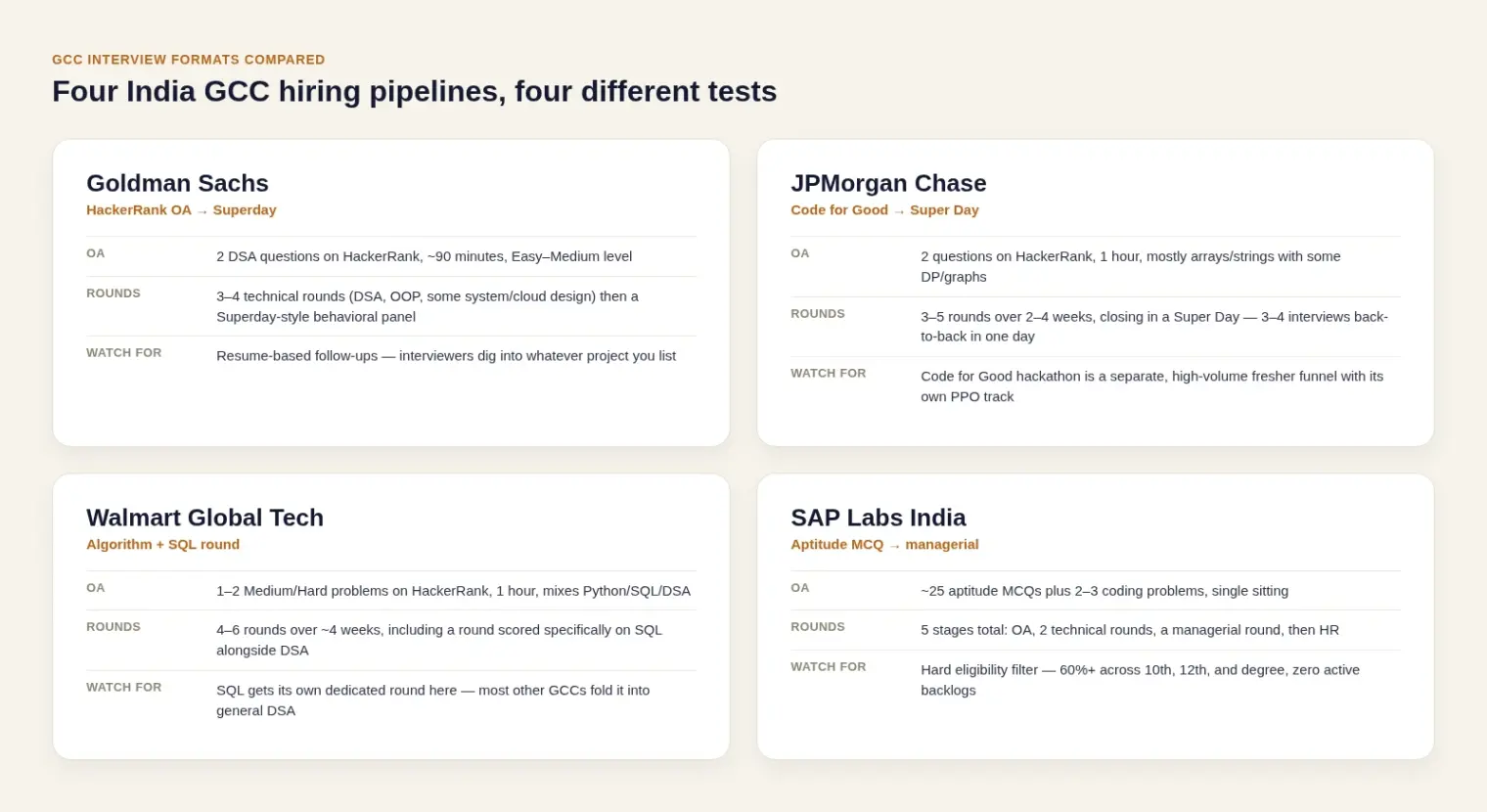
Goldman Sachs's Bengaluru technology hiring runs a HackerRank OA first — two DSA questions, roughly 90 minutes, sitting at an Easy-to-Medium difficulty band rather than a LeetCode Hard grind. Candidates who clear it move into three to four technical rounds covering data structures and algorithms, object-oriented design questions, and occasionally a lightweight system or cloud-deployment question depending on the team. The loop closes with a Superday-style round — a compressed, higher-intensity behavioral and technical session that Goldman Sachs uses across its global offices, not just India.
On Glassdoor, about 67.5% of reviewers describe a positive experience and the difficulty averages 3.28 out of 5 — moderately selective, and the part that trips people up in practice isn't usually the algorithm questions. It's the resume-based follow-ups: interviewers routinely pick a project off your resume and probe it in detail, so listing something you can't defend under questioning costs more than a shaky DSA answer.
JPMorgan Chase: A Standard Pipeline, Plus a Separate Hackathon Funnel
JPMorgan's India Technology Analyst hiring runs a HackerRank OA — two questions in a one-hour window, weighted toward arrays and strings with some dynamic-programming and graph problems mixed in — followed by three to five rounds spread across two to four weeks. The process closes in a Super Day: three to four interviews scheduled back-to-back in a single day rather than spaced out, a real change of pace from a track that's otherwise spread over weeks. Several campus drives are reported to apply a CGPA cutoff above 8.5 before candidates even see the OA, though the exact number shifts by campus and year and isn't officially published.
JPMorgan also runs Code for Good — an annual hackathon where student teams build real technology for nonprofit partners over a multi-day event, drawing a reported 10,000-plus applicants a year. It sits outside the standard OA-to-Super-Day pipeline entirely: strong performers can be offered a path to a pre-placement offer without repeating the full interview loop. Applications open and close well before the event itself, so treating Code for Good as a parallel track worth applying to early — rather than a fallback if the standard process doesn't pan out — is the more useful way to plan around it.
Walmart Global Tech: The One With a Dedicated SQL Round
Walmart Global Tech runs four to six rounds over roughly four weeks, opening with a HackerRank OA — one to two Medium-to-Hard problems in a one-hour window that mixes Python, SQL, and general DSA rather than pure algorithms. The format quirk worth knowing before test day: Walmart Global Tech scores SQL as its own dedicated interview round, separate from general technical questioning. Amazon, Flipkart, and most of the other product-based and GCC loops covered on this site fold SQL into a broader technical round instead of giving it a standalone slot, so if your SQL is rustier than your DSA, this is the company that will expose the gap directly rather than let it slide by.
Reviewer sentiment on Glassdoor sits around 60.4% positive with a difficulty rating near 2.98 out of 5 — the most moderate of the four in reported difficulty, though "moderate" here still means a real DSA-plus-SQL bar, not an easy pass.
SAP Labs India: The Hardest Eligibility Filter Before You Even Sit the OA
SAP Labs India is the one where the filtering happens earliest. Before you're eligible to sit the online assessment, candidates need 60%-plus marks across 10th, 12th, and degree with zero active academic backlogs — a harder paper-eligibility bar than any of the other three on this list, and one that eliminates candidates before the technical rounds even start. Clear that, and the OA itself runs roughly 25 aptitude MCQs alongside two to three coding problems in one sitting. From there it's two technical rounds, a managerial round, and a closing HR round — five stages total.
Where SAP Labs breaks from the other three: the managerial round. It's less about coding under time pressure and more about how you'd operate inside a team and prioritize competing asks — a format candidates coming from a pure product-company or IT-services prep plan tend to underrate, since it's closer in spirit to the Big Four's combined technical-plus-HR rounds than to Amazon's Bar Raiser.
Where the Four Actually Differ
| OA format | Distinct stage | Fresher gate before the OA | |
|---|---|---|---|
| Goldman Sachs | 2 DSA Qs, HackerRank, ~90 min | Superday-style behavioral close | No published CGPA cutoff |
| JPMorgan Chase | 2 Qs, HackerRank, 1 hr | Code for Good hackathon (separate funnel) | CGPA above 8.5 at several campuses |
| Walmart Global Tech | 1-2 Medium/Hard, HackerRank, 1 hr | Dedicated SQL round | No published CGPA cutoff |
| SAP Labs India | ~25 MCQs + 2-3 coding, 1 sitting | 60%+/no-backlog eligibility filter, managerial round | 60%+ in 10th, 12th, and degree; zero backlogs |
Difficulty by the numbers, Glassdoor: Goldman Sachs 3.28/5 (67.5% positive), Walmart Global Tech 2.98/5 (60.4% positive). JPMorgan and SAP Labs don't have a large enough India-specific sample to report a comparable score. These are candidate-reported figures, not official disclosures — a sense of relative difficulty, not a number to prep against.
Why This Isn't the Same Test as TCS, Big Four, or Amazon
Three things separate this cluster from what you may already be prepping for. First, against TCS, Infosys, and Wipro: none of these four run an aptitude-heavy screening test — every one of them opens straight into DSA or role-relevant coding on HackerRank, so "aptitude test prep" doesn't transfer here at all. (All four OAs run in HackerRank's actual coding environment, which is also the platform OA Copilot supports if you want to practice inside the real interface instead of a lookalike.) Second, against the Big Four's delivery centers: GCCs skip the Group Discussion stage entirely and lean harder on individual technical depth, closer to a product company's bar than a consulting firm's. Third, against Amazon, Flipkart, and Microsoft's off-campus loops: the overlap is real — these are also DSA-first, OA-then-rounds pipelines — but Walmart Global Tech's dedicated SQL round and SAP Labs' eligibility filter are format quirks specific enough that treating "product-based company prep" as one undifferentiated bucket will leave you underprepared for either.
The pay premium these roles carry over IT-services offers is also worth weighing against how CTC actually gets structured once you're in — our CTC negotiation breakdown for freshers covers fixed-versus-variable pay and joining-bonus terms that apply just as much to a GCC offer letter as to a services-company one.
A Realistic Prep Split
If Goldman Sachs is in your pipeline: don't just re-derive your resume bullet points — actually rehearse defending the specific technical decisions behind whatever project you've listed, since that's where the Superday round tends to dig.
If JPMorgan is in your pipeline: decide early whether you're going through the standard OA-to-Super-Day track or applying to Code for Good — the hackathon's application window closes well before the event, so treating it as a same-season backup plan usually means missing it entirely.
If Walmart Global Tech is in your pipeline: put real prep time into SQL specifically, not folded into general DSA revision — joins, window functions, and query optimization are the kind of thing a standalone round exposes fast if you've only been grinding LeetCode.
If SAP Labs India is in your pipeline: confirm your eligibility numbers before investing prep time — the 60%-plus, no-backlog filter is checked ahead of the OA, and prepping hard for a round you're not eligible to sit is wasted effort.
Every one of these four closes with at least one live, multi-round conversation rather than just an OA score — Goldman's Superday, JPMorgan's Super Day, and the technical-plus-managerial rounds at Walmart Global Tech and SAP Labs all put you on camera answering follow-up questions in real time, which is a different skill from solving a problem alone at your desk. A rehearsed run with a friend covers most of it; a mock interview tool is there if you want a timed session without asking someone to sit through it with you.
FAQ
Do you have to be a Code for Good finalist to get a JPMorgan pre-placement offer?
Public reporting doesn't clearly settle this — some candidate accounts describe finalists getting the PPO track, others describe it going to anyone who performs strongly during the event regardless of final placement. The safer read is to treat "apply early and perform well" as the reliable strategy rather than assuming the PPO is gated strictly behind reaching the finals.
Does SAP Labs India's 60% cutoff apply to each of 10th, 12th, and degree separately, or as an average?
Candidate reports don't specify this clearly either, and it likely varies by campus drive. Treat it as 60%-plus in each of the three individually rather than an average across them — that's the stricter reading, and clearing it under that assumption means you clear it either way.
GCC vs IT services — which is better for freshers?
Neither wins outright; it's a trade-off. Strong CGPA and coding rounds make the ~20-35% GCC pay premium worth chasing, but IT-services mega-drives absorb far more hires per cycle, so they still offer better odds if landing any offer this season matters more than which one. Our service-based vs. product-based breakdown walks through a closely related version of this decision if you're weighing multiple tracks at once.
Can you apply off-campus to these four if you graduated last year or have an academic gap?
None of the four publicly restrict off-campus applications to the current graduating batch the way some on-campus drives do, but eligibility windows (which years qualify, gap-year handling) change per drive and aren't published in one stable place — check the specific job posting on each company's own careers page rather than assuming last year's rule still applies.
Author · Alex Chen. Career consultant and former tech recruiter. Spent 5 years on the hiring side before switching to help candidates instead. Writes about real interview dynamics, not textbook advice.
Related Articles
Two Sigma Software Engineer Interview: The Hidden Test Case Problem
Two Sigma's HackerRank OA fails candidates who pass every sample case they can see. Here's how the hidden-test-case gate actually works, round by round.

Deloitte USI, EY GDS, KPMG GDC, and PwC AC: India Hiring Process Explained
Deloitte USI, EY GDS, KPMG GDC, and PwC AC run four separate hiring processes — HireVue, group exercises, and Eduthrill included — and none of them match a TCS-style aptitude test.
Virtual Onsite Interview Loop: How to Survive 4-6 Back-to-Back Rounds
What a virtual onsite interview loop is, why round 4 is where candidates fall apart, and how to prepare for 4-6 back-to-back video rounds in one day.