Service-Based or Product-Based? Deciding When You Have Both Live at Once
TCS offer in hand, product company interview next week — here's the actual decision framework, not another generic service vs product comparison table.
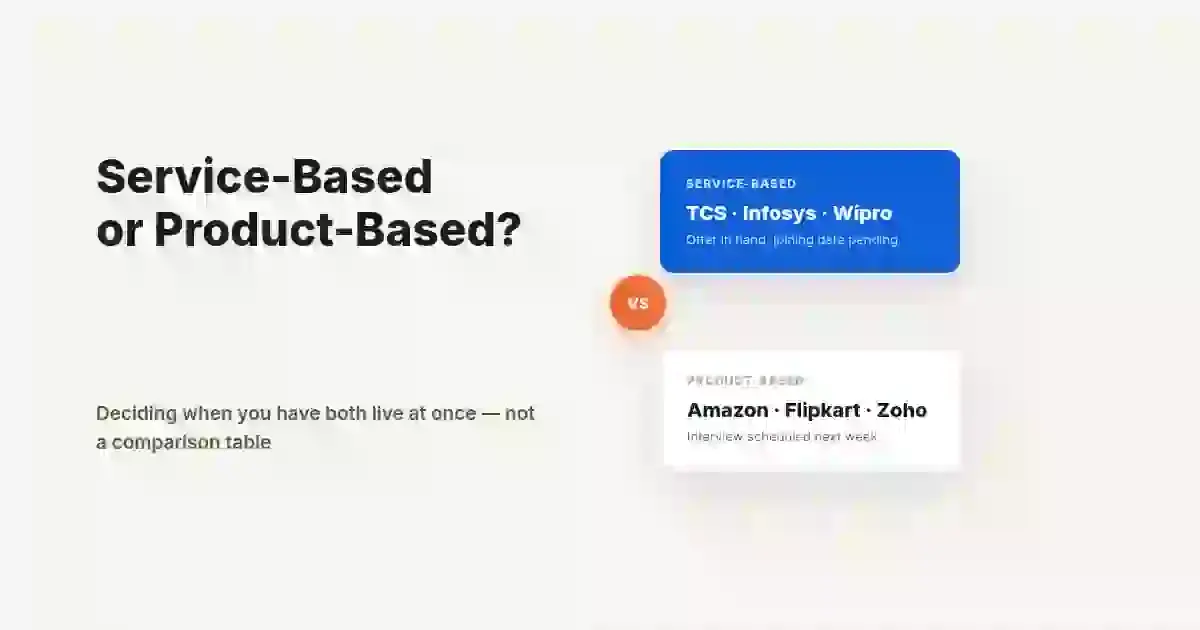
TL;DR: Most "service-based vs product-based" content is a static comparison table written as if you're choosing in a vacuum. The real dilemma looks nothing like that: you already have a TCS or Infosys offer — or you're mid-process — and a product-based company's OA or interview lands in the same two-to-three-week window. That's a sequencing problem under a deadline, not a definitional one. The actual gate isn't the employer, it's your placement cell's "one offer" or "dream offer" rule, which usually locks the moment you click accept on the portal — not when you actually join. And IT-services onboarding delays through 2025–2026 mean a service offer letter in hand often doesn't turn into a paycheck for months, which is frequently more runway than freshers realize they have to also chase the product-company result.
Search "service based vs product based company" and you get the same article restructured a dozen ways: work culture, salary bands, learning curve, which one is "better." All written as if you're comparing two abstract categories with no clock running. If you're actually living this — a TCS or Infosys offer already accepted or close to it, and a product-based company's assessment or interview showing up in the same window — none of that content tells you what to actually do this week.
The Gate Isn't the Employer — It's Your Placement Cell
Before any of the salary or career-track comparisons matter, there's a gate that decides whether you even have a choice: most Indian colleges run a "one offer" or "dream offer" policy, and the lock is usually the portal-accept action itself, not your eventual joining date — you can hold an offer letter for months before joining and still be barred from further drives the moment you clicked accept. We've covered the exact mechanics of that rule, including what typically counts as a qualifying "dream" offer, in our guide to surviving overlapping placement drives. The point for this specific dilemma: if a product-based process is still live, check your cell's rule before you accept a service-based offer, not after — that single decision point matters more than anything that happens afterward.
The Timeline That Changes the Math: Onboarding Delays
Here's a detail most decision-framework content misses entirely: getting an offer letter from TCS, Infosys, Cognizant, or Wipro has not reliably meant a fast start in the last two years. Onboarding delays have been widely reported through 2025 and 2026 — joining dates pushed by months after the offer letter, and in some documented cases, candidates waiting close to a year, with labor rights groups filing complaints on affected candidates' behalf.
This cuts in an unexpected direction for the dilemma: if your service-based offer letter isn't actually converting to a paycheck for months, that gap is real runway — time you can spend prepping for and sitting product-company interviews without it costing you the service offer, provided your placement cell's rules don't block the attempt outright. Freshers who treat the offer-letter date as the joining date often assume they have far less time than they actually do.
Prep Can't Be Shared — The Rounds Are Testing Different Things
Even once the timeline and placement-cell questions are settled, there's a real constraint most comparison content skips: you can't meaningfully prep for both loops in the same block of hours.
Service-company rounds — TCS, Infosys, Wipro, Capgemini, Accenture, HCLTech — weight aptitude, communication, and foundational coding. It's a format that's genuinely coverable with a few focused days of mock practice, because the ceiling on difficulty is intentionally moderate; these are high-volume hiring pipelines, not deep technical filters.
Product-based company loops — Amazon, Flipkart, Zoho-tier, and similar — test DSA depth, and increasingly basic system-design thinking even at the fresher level. That's not a few-days problem. It needs sustained practice over weeks, and trying to "also" prepare for it during the same week as a TCS interview typically means shortchanging whichever one comes second.
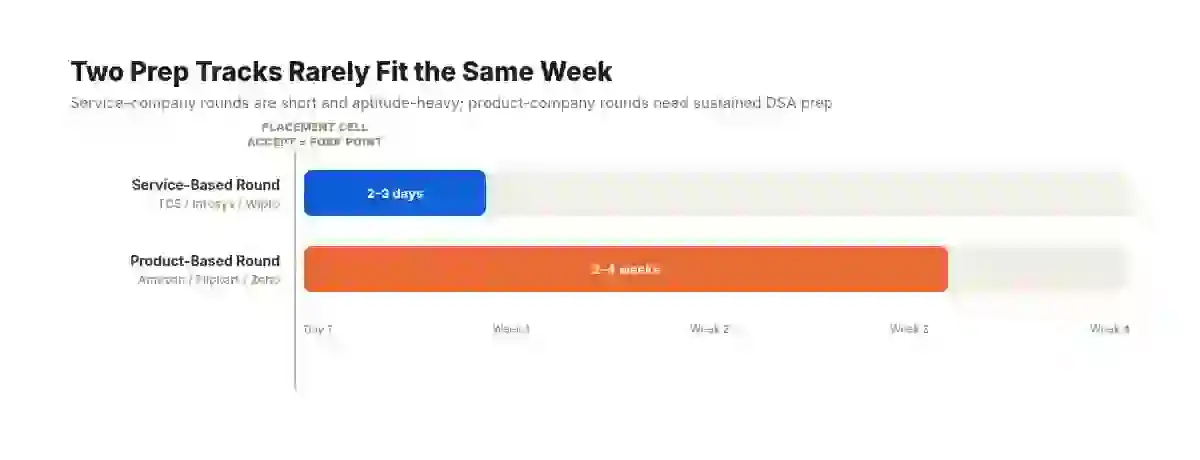
If both are live at once, the practical move is triage: treat the service-company round as the one you can sharpen in the final 48–72 hours, and protect a longer, separate block for the product-company DSA prep rather than splitting every evening evenly between both.
The Bond Question Is Weaker Than Most Freshers Assume
A common reason freshers hesitate to even attempt a product-company interview after accepting a service offer is a service bond — the fear of being financially locked in. In practice, this is outdated for most mainline fresher tracks: flagship programs like TCS's and Infosys's core hiring tracks are largely bond-free today, with the older ₹50,000–2 lakh bond fear applying mainly to smaller service firms rather than the big-name pipelines most freshers are actually in. Where a bond genuinely exists elsewhere, some product companies — particularly well-funded startups — will reimburse it as part of a joining bonus if you raise it during negotiation. "I'm bonded, I can't try" is, for most freshers in flagship tracks, a weaker constraint than it feels like.
What Forum Consensus Actually Says
Community sentiment on r/developersIndia-adjacent forums and platforms like TeamBlind and Fishbowl converges on a specific, non-obvious answer: take whichever offer is real and immediate, and keep working toward product companies on the side rather than turning down a confirmed offer to gamble on a pending one. The reasoning isn't about which company is "better" — it's that being unemployed while waiting for a preferred outcome is judged worse than joining a service company and lateral-switching within a year or two, at which point you're evaluated as near-fresher rather than a full experienced hire competing on parity with candidates who have 3+ years in.
Job security sentiment favors service companies — mass layoffs are rare there, though bench time (3 to 6 months without a billable project) is a real, commonly reported risk. Pay growth and hybrid flexibility sentiment favors product companies and startups, with a caveat worth knowing: even product-side hybrid policies have been tightening across the industry, not just at services firms.
If You're Actively Juggling Both Right Now
The decision framework matters, but so does not blowing either interview because you split your attention wrong in the final days. AceRound AI runs a rehearsal mode built for exactly this kind of compressed, high-stakes window: the Interview Copilot for running through likely HR and technical questions for whichever round is closer, and an OA Copilot for the DSA-heavy assessment format product companies actually use, so you're not walking into either cold because you spent the week deciding instead of preparing. If the service-company side of your dilemma involves TCS, Infosys, or Wipro specifically, our guide to that trio's actual process covers the format in more depth, and our product-company OA breakdown does the same for Amazon, Flipkart, Microsoft, and Zoho.
FAQ
Should I accept a TCS or Infosys offer or wait for a product-based company result?
The honest answer from forum consensus (r/developersIndia, TeamBlind) leans toward taking whichever offer is real and immediate, then continuing to prep for product companies afterward — unemployment while waiting for a "perfect" offer is judged worse than joining a service company and lateral-switching within 1–2 years, where you're evaluated as near-fresher rather than full experienced hire. The exception is if your college's placement cell rules would actually block you from a later product-company drive once you accept — check that policy before you decide, not after.
Can I sit for a product-based company interview after accepting a service-based offer letter?
Depends entirely on your placement cell's policy, not the employer. Most Indian colleges run a "one offer" or "dream offer" rule: once you accept an on-campus offer through the portal, you're typically barred from further placement drives unless the new opportunity is specifically tagged "dream" — usually requiring 1.5 to 2 times the CTC you already accepted. The portal-accept action is usually the actual lock, not your eventual joining date, so check your cell's exact rule before clicking accept.
How long does it take TCS or Infosys to give a joining date after the offer letter?
Onboarding delays have been widely reported through 2025–2026 — offer letters issued with joining dates pushed by months, and in some reported cases candidates waiting close to a year, prompting labor complaints filed on affected candidates' behalf. Practically, this means a service offer letter in hand often doesn't convert to an actual paycheck for months, which can be exactly the window to prep for and sit product-company interviews, if your placement cell rules allow it.
Do I need to disclose an existing bond to a product company during salary talks?
Most mainline fresher tracks at TCS, Infosys, and similar majors are bond-free today — the older ₹50,000–2 lakh service-bond fear mostly applies to smaller service firms now, not the flagship fresher programs. Where a bond does exist, some product companies (particularly well-funded startups) will reimburse it as part of a joining bonus if you negotiate for it, so a bond is a weaker reason to skip a product-company attempt than most freshers assume.
Is the interview prep the same for service-based and product-based companies?
No, and this is the actual planning problem, not the eventual salary comparison. Service-company loops test aptitude, communication, and foundational coding — largely coverable in days of focused mock practice. Product-company loops (Amazon, Flipkart, Zoho-tier, and similar) test DSA depth and, increasingly, basic system design even at fresher level — that needs weeks of dedicated practice, not something you fit in the same week as a TCS interview without shortchanging one of them.
Is job security really better at service-based companies than product-based ones?
That's the prevailing sentiment on forums like TeamBlind and Fishbowl, though it comes with a real caveat: service companies rarely do mass layoffs but do carry meaningful bench risk (3–6 months without a project isn't unusual). Product companies and startups pay and promote faster on average but carry higher individual layoff risk. Neither is safe in an absolute sense — they're different shapes of risk, not different amounts of it.
Author · Alex Chen. Career consultant and former tech recruiter. Spent 5 years on the hiring side before switching to help candidates instead. Writes about real interview dynamics, not textbook advice.
Related Articles
Interviewing While Employed: How to Actually Prepare With Zero Time
Job searching while employed means near-zero prep time, not just staying discreet. Here's a 20-minute prep script, plus what the counteroffer statistics actually show.
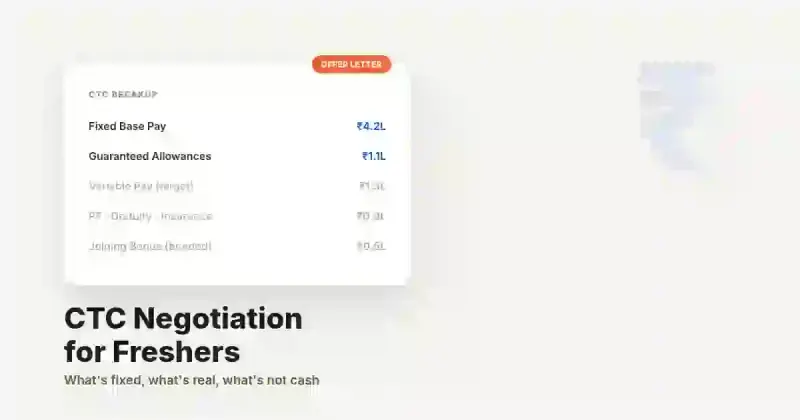
CTC Negotiation for Freshers in India: What's Actually Negotiable
Most fresher CTC negotiation advice ignores that TCS, Infosys, and Wipro set fixed pay bands. Here's what's really negotiable, and where lowball offers hide.

Attending Job Interviews While Serving Notice Period in India
The real logistics of interviewing for your next job while still clocking in at your current one — notice period math, buyouts, and where prep time goes.