Off-Campus OA Prep for Product-Based Companies: Amazon, Flipkart, Microsoft, and Zoho Compared
Amazon, Flipkart, Microsoft, and Zoho run off-campus OA very differently. Here's what each one actually tests, and how to prepare for the one you'll face.
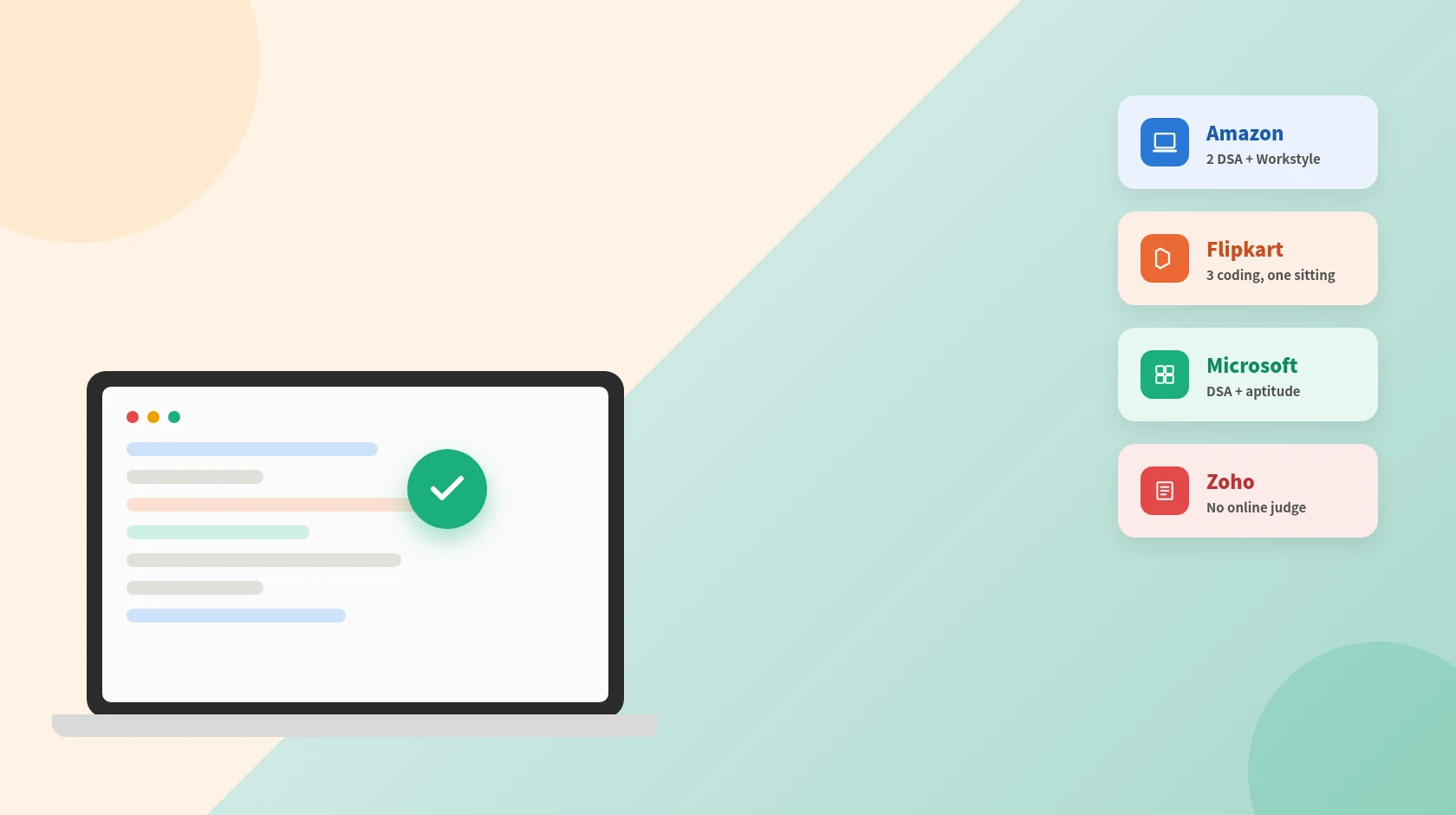
TL;DR: Amazon, Flipkart, Microsoft, and Zoho all hire off-campus, and every guide that lumps them together as "OA prep" is hiding the fact that their tests don't look alike at all. Amazon runs two DSA problems plus a behavioral Workstyle Assessment. Flipkart runs three pure-coding problems in one sitting. Zoho skips the online judge entirely and tests you on paper-style C output prediction and hand-written code. If you're prepping for "product-based company interviews" as one undifferentiated category, you're going to walk into at least one of these underprepared.
Most off-campus prep content for Indian engineering students falls into two buckets: generic "how to crack DSA rounds" advice, or company-specific interview-experience threads that assume you already know which company you're targeting. What's missing is the piece in between — a clear comparison of what actually changes company to company, so you know which muscle to train for which test.
This is also a different animal from the service-based-company off-campus process. If you're prepping for Cognizant, Accenture, Capgemini, or HCL through AMCAT or eLitmus, our guide to that pipeline covers the aptitude-cutoff-then-interview structure those companies use. Product-based companies skip that gate entirely and go straight to code.
Amazon SDE-1 Off-Campus: Two DSA Questions, Then the Leadership Principles Show Up Everywhere
The core of Amazon's off-campus OA, per candidates who've documented their experience, is two DSA coding questions in about a 70-minute window — commonly pulling from graphs, hashmaps, sliding-window problems, and interval/overlap questions (a "burning tree" or "overlapping intervals" style problem shows up often enough to be worth practicing specifically). Alongside that sits a Workstyle Assessment: a behavioral questionnaire, not a coding task, that some candidates describe taking up to two hours (though most finish well under that).
Some threads also describe a debugging section and a separate work-simulation module — an inbox/portal roleplay exercise — bundled into the same OA link. Whether you get these extra sections seems to depend on the specific drive and role, so the reliable thing to prepare for is the two DSA questions and the behavioral component; treat anything beyond that as a possible bonus round rather than something to panic-prepare for blind.
What most freshers get wrong about the rounds that follow: Amazon doesn't run a separate "Leadership Principles round" the way company-specific guides imply. The 16 LPs get folded into every interview — the DSA-focused round, the round that mixes behavioral questions with a lightweight design question (a "parking lot" or similar exercise is common at the fresher level), even follow-ups inside a coding round. A candidate who nails the algorithm but answers "have you ever disagreed with a manager" with a one-line non-answer loses ground they didn't know was being scored. Freshers usually expect 2 technical rounds; some loops run a third, including a Bar Raiser — an interviewer from outside the immediate hiring team with veto power over the final decision.
Flipkart Off-Campus: Three Pure-Coding Questions, No Aptitude Filler
Flipkart's OA is more straightforward on paper and harder in practice: three coding questions, medium-to-high difficulty, in a single roughly 90-minute sitting with no option to reopen once you've started. Problems that come up in shared experiences include greedy-plus-graph-traversal combinations, sorting/hashmap implementation problems, and dynamic-programming variants in the "cherry pickup" family. There's no separate aptitude or CS-fundamentals MCQ layer bolted on — it's coding, start to finish, which is exactly why candidates who split their prep time between quant drills and DSA (a habit built from AMCAT-style service-company prep) tend to underperform here relative to their actual coding ability.
Clear the OA and the pattern that follows is: two DSA-focused technical rounds, then a hiring-manager round that's genuinely non-technical — resume, past projects, "why Flipkart." Freshers who treat that last round as a formality after two technical rounds are the ones who stumble on it; it's evaluated as seriously as the coding rounds, just on different criteria.
Microsoft Off-Campus: Less Documented, More Referral-Driven
Microsoft's off-campus process has noticeably fewer first-person interview-experience threads circulating compared to Amazon and Flipkart, so treat specifics here as commonly repeated rather than independently verified against a transcript. The reported pattern: an online coding test (through Codility, HackerRank, or Microsoft's own portal) with two to three DSA questions plus some aptitude/reasoning, followed by up to three technical interview rounds covering data structures, algorithms, and a lighter system-design conversation, then an "As Appropriate" round with a senior leader who can veto the hire, and finally HR.
The more consistently repeated piece of advice, and the one worth actually acting on: off-campus applicants apply through careers.microsoft.com or LinkedIn, and a referral is described as the strongest lever available at this stage — more so than for Amazon or Flipkart, where the OA score does more of the filtering work on its own.
Zoho: The One With No DSA Online Judge
Zoho breaks the pattern entirely, and it's the one candidates are most likely to walk into unprepared because they've spent all their prep time on LeetCode. There's no autograded coding-judge OA:
- Written test (roughly 1–2 hours): a mix of aptitude/logical-reasoning MCQs and C-language questions where you predict the output of a code snippet or spot the bug — no code execution, no online judge. The exact split of question types is reported to vary by drive and batch year, so don't over-anchor on any single count you find online.
- Coding round: you write actual C or C++ programs by hand for a set of problems, rather than submitting to an autograder that runs test cases for you.
- Application-level programming round: a scenario-based exercise closer to applied product thinking than a pure DSA problem — you're building something that resembles a small feature, not solving an isolated algorithm.
There's also a separate content-writer track with essay-style prompts for candidates applying to writer roles specifically — worth knowing exists, but not something to prepare for if you're going in as an SDE candidate; don't let it distract from the C-fundamentals prep that actually matters for that track.
The practical implication: if your algorithmic problem-solving is strong but you haven't hand-traced C code output in a while, Zoho is where that gap costs you, not Amazon or Flipkart.
The Pattern That Doesn't Repeat
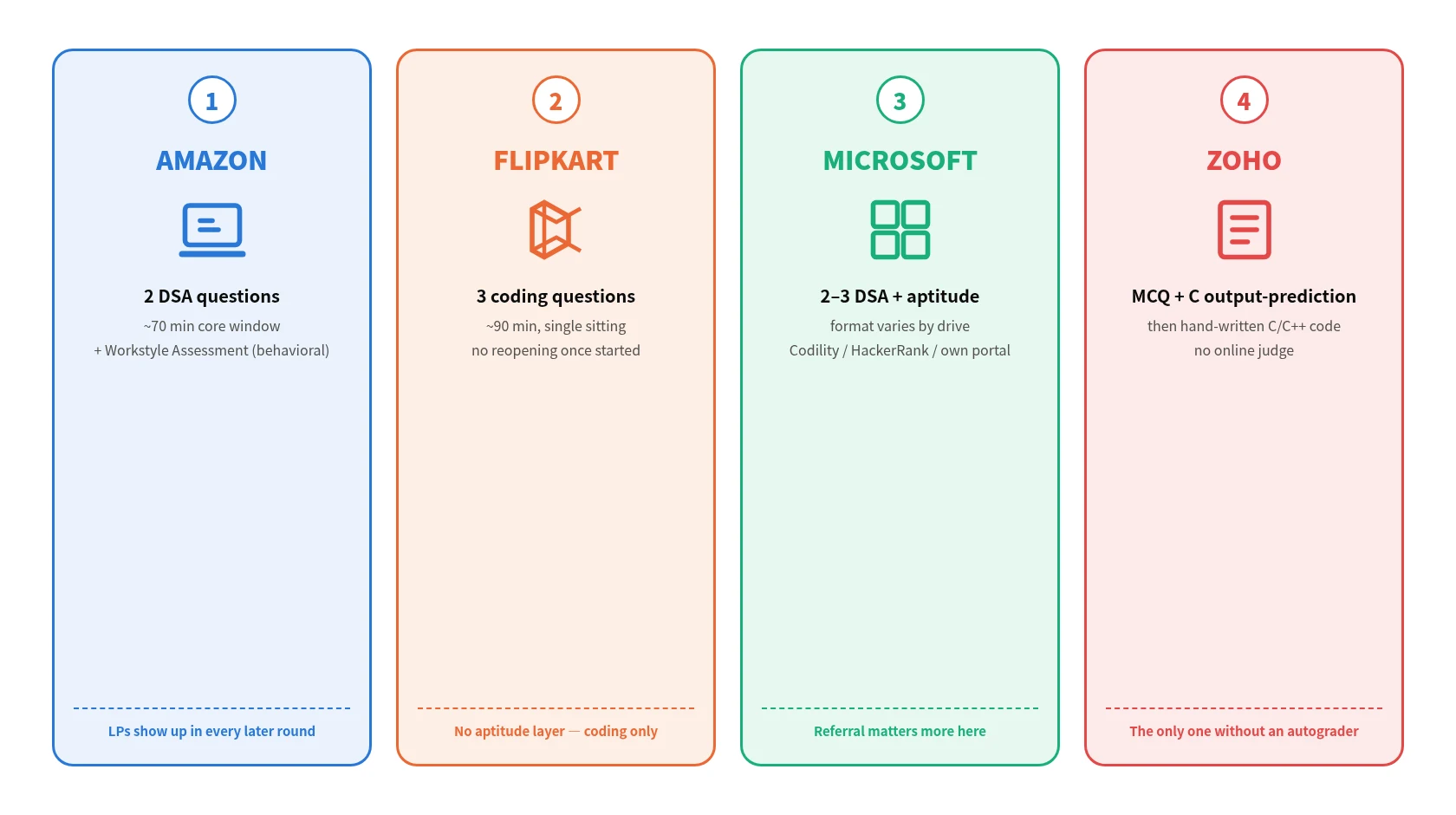
| OA format | Time | What's distinctive | |
|---|---|---|---|
| Amazon | 2 DSA + Workstyle Assessment | ~70 min core | LPs woven into every later round, not a separate round |
| Flipkart | 3 pure coding | ~90 min, no reopening | No aptitude layer — coding only |
| Microsoft | 2–3 DSA + aptitude | Varies | Referral matters more than for the others |
| Zoho | MCQ + C output-prediction, then hand-written code | ~1–2 hrs Round 1 | No online judge at all |
The one thing that is consistent: none of these run through Superset, the placement-cell platform many Indian colleges use to manage campus drives. Superset is a campus tool. Off-campus, you're finding these openings yourself — company careers pages, LinkedIn postings, or a referral — and there's no campus pre-filter doing any of the screening work for you that an on-campus batch gets for free.
Where AI Practice Actually Helps Here — and Where It Can't
The honest limitation first: none of these OAs are something you use an AI tool during. Amazon's and Flipkart's platforms are proctored coding environments; Zoho's written round is proctored on paper or a locked-down portal. Whatever you know going in is what you have.
Where preparation software earns its place is in the two things static problem sheets don't train: talking through your approach out loud the way Amazon's technical rounds expect, and rehearsing the specific format of the test you're about to sit, not just its topic list. AceRound AI's Coding Test Copilot is built for exactly the OA-shaped part of this — timed practice against a format that matches what you'll actually see, rather than a generic LeetCode set. For the interview rounds that follow the OA — the Amazon LP-woven technical rounds, Flipkart's hiring-manager conversation, Zoho's applied-programming discussion — the mock interview mode lets you run through the verbal, think-aloud version of the same material before you're in front of an actual panel. If you're deciding between service-based and product-based tracks generally, the broader India AI interview assistant guide covers the full landscape.
A 4-Week Plan If You're Targeting More Than One of These
Weeks 1–2: Identify which companies you're actually likely to sit for this season, and split prep accordingly — DSA volume for Amazon/Flipkart, C fundamentals and output-prediction drills for Zoho, a referral push for Microsoft. Don't spread evenly; spread by what each test actually tests.
Week 3: Timed mock OAs matching each format — two questions in 70 minutes for Amazon-style practice, three questions in 90 minutes for Flipkart-style, hand-written C code review (no compiler) for Zoho.
Week 4: Verbal practice for the rounds after the OA — think-aloud DSA explanation, a prepared answer bank for 5–6 Leadership Principles if Amazon is in your pipeline, and your project walkthrough tightened to under two minutes.
The week of: Stop drilling new problems. Review your weak patterns, confirm your test-link logistics, and sleep.
FAQ
What is asked in Amazon's off-campus OA for SDE-1 freshers?
Candidates who've shared their experience report two DSA coding questions in a roughly 70-minute window, alongside a separate Workstyle Assessment — a behavioral questionnaire, not a coding round. Some accounts describe an additional debugging section and a work-simulation module on top of that, but the exact minute counts vary between drives and years, so treat the two-DSA-question core as the reliable part and the rest as "it depends on your specific OA link."
How many coding questions are in Flipkart's off-campus OA?
Interview-experience posts consistently describe three coding questions at medium-to-high difficulty, run in a single sitting of around 90 minutes with no reopening once started. It's pure coding — no separate aptitude or CS-fundamentals MCQ section bundled in, unlike Zoho or the service-based-company tests.
Does Zoho ask DSA questions like Amazon or Flipkart?
Not in the same format. Zoho's first round is a written test mixing aptitude/logical-reasoning MCQs with C-language output-prediction and debugging questions — no online judge. Round two has you write actual C/C++ programs by hand rather than submitting to an autograder, and round three is an applied, scenario-based programming exercise closer to product thinking than pure algorithms. If your DSA is strong but your C fundamentals are rusty, Zoho is the one that will expose that gap.
What CGPA cutoff do these companies expect for off-campus applications?
There's no officially published number from any of these companies. Placement-prep communities commonly cite roughly 6.0–6.5 CGPA (60–65%) as the informal floor for Amazon and Flipkart, and something closer to 7.5 gets mentioned for Microsoft — but these are aggregator estimates, not company policy, and off-campus applications in practice tend to be judged more on the OA score than the transcript.
How is off-campus hiring different from on-campus for these companies?
On-campus, your college's placement cell negotiates the eligibility bar and schedules the drive — you're only competing against your own batch. Off-campus, you find the opening yourself through the company's careers page, LinkedIn, or a referral, and you're competing nationally with no campus pre-filter. Superset, the platform many colleges use for campus drives, is a campus tool — it isn't where off-campus applications go, so don't wait for it to show you an Amazon or Flipkart posting.
Do Amazon's Leadership Principles come up in off-campus fresher interviews?
Yes, and this catches freshers off guard more than the DSA rounds do. Amazon doesn't run a separate "LP round" — the Leadership Principles get woven into both the technical and behavioral parts of every round, for off-campus freshers exactly as much as for experienced hires. "Tell me about a time you disagreed with a decision" can show up right after a coding problem, not just at the end.
Author · Alex Chen. Career consultant and former tech recruiter. Spent 5 years on the hiring side before switching to help candidates instead. Writes about real interview dynamics, not textbook advice.
Related Articles

The Amazon Bar Raiser Interview: What They Actually Do (2026 Guide)
Amazon's Bar Raiser interview explained: what the role actually is, how the veto really works, how Amazon selects Bar Raisers, and how to prepare for one.
Predictive Index Test: How to Actually Prepare for the PI Cognitive and Behavioral Assessment
The Predictive Index test is really two assessments. Here's what the 12-minute Cognitive test and the untimed Behavioral checklist actually measure, score, and allow.

Microsoft Growth Mindset Interview Questions: A Real Prep Guide
Microsoft names growth mindset as a hiring criterion on its careers site. Here's how it shows up across the loop, real candidate questions, and how to answer them.