Deloitte USI, EY GDS, KPMG GDC, and PwC AC: India Hiring Process Explained
Deloitte USI, EY GDS, KPMG GDC, and PwC AC run four separate hiring processes — HireVue, group exercises, and Eduthrill included — and none of them match a TCS-style aptitude test.

For anyone with a Deloitte USI, EY GDS, KPMG GDC, or PwC Acceleration Center application in the pipeline — campus or off-campus, fresher or 1–3 years in. If none of those four names apply to you, our TCS/Infosys/Wipro breakdown is the more relevant read.
TL;DR: "Big Four" campus content almost always means Deloitte, EY, KPMG, and PwC's global consulting and audit brands — but the hiring pipeline most Indian graduates actually sit for is their India-based delivery arms: Deloitte USI, EY GDS (Global Delivery Services), KPMG's GDC (Global Delivery Center), and PwC's Acceleration Centers. These run four separate processes. Deloitte USI screens through a HireVue recorded-video round. EY GDS and PwC both still run a Group Discussion stage most IT-services companies dropped years ago. KPMG's technical round leans SQL and DBMS over pure DSA. PwC's online test runs on a platform called Eduthrill, not the more commonly cited Mercer Mettl or HireVue. None of it is the TCS-NQT-style aptitude test you've probably already prepped for.
Most prep content treats these four as a footnote — one line in a listicle, usually confusing the delivery-center hiring pipeline with the client-facing consulting/audit roles that get all the LinkedIn attention. The delivery-center roles are the ones actually hiring in volume from campus and off-campus drives, and each of the four runs its own process, worth knowing before you walk in prepped for the wrong one.
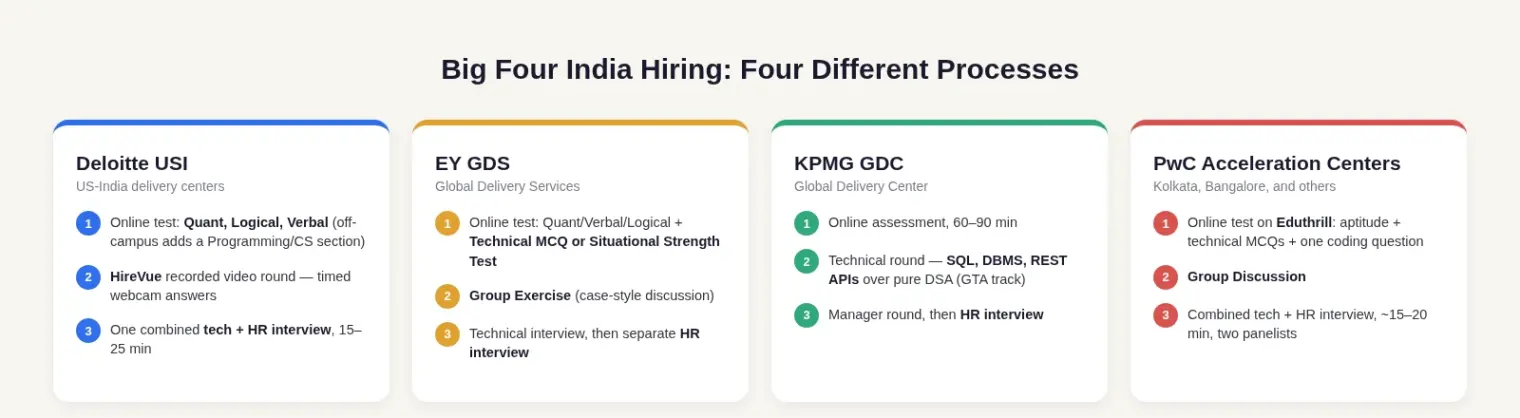
Deloitte USI: HireVue Does the First Real Screening
Deloitte USI — United States India, the shared-services arm serving Deloitte's US member firm — runs profile shortlisting straight into an online test: Quant, Logical Reasoning, and Verbal, roughly 75 questions in 95 minutes, no negative marking. Off-campus applicants get an additional Programming/Computer Fundamentals section (around 30 MCQs spanning basic CS, networking, cloud, and security).
Candidates who clear the test move to a video round built on HireVue — you record timed answers to a set of prompts, typically around 30 seconds to read the question and 2–3 minutes to answer, with no live interviewer on the other end. That's followed by one combined technical-and-HR interview, usually 15–25 minutes, weighted heavily toward your final-year project and the tech stack you list on your resume. Older prep guides mention a Group Discussion or JAM (Just A Minute) round — those existed in Deloitte USI's process before 2021 but appear to have been dropped from most current drives; don't spend prep time on a stage you likely won't sit for.
Analyst-track roles are the standard entry point, with candidate-reported CTC clustering around ₹7 LPA (see the comparison table below for the full range and how it stacks against the other three). Reported notice period has shifted to 90 days for more recent joiners, up from 60 days for earlier cohorts — a detail that causes real confusion in candidate forums, since which one applies depends on when you joined, not when you're reading this.
EY GDS: The Group Exercise Nobody Warns You About
EY GDS (Global Delivery Services) runs out of Bengaluru, Hyderabad, Kochi, and Kolkata, covering technology, consulting, finance operations, and risk work for EY's global network. The online test covers Quant, Verbal, and Logical Reasoning as a base, then branches: technical roles get a Technical MCQ section (OOP, DBMS, CS fundamentals, roughly 65 questions in 65 minutes), while consulting, assurance, and advisory roles get a Situational Strength Test instead. Some technical drives layer one or two coding problems on top of the MCQ section.
The stage most competing guides skip is what comes next: a Group Exercise — a case-style group discussion where you're assessed alongside other candidates, not the one-on-one format IT-services hiring has mostly moved to. That's followed by a standalone technical interview, then a separate HR interview — four total stages where TCS or Infosys would run three.
The most consistently repeated complaint across Glassdoor and Fishbowl threads is a 90-day notice period applied uniformly across ranks — worth knowing before you accept if you're weighing multiple offers with different exit timelines.
KPMG GDC: SQL and DBMS, Not DSA Marathons
KPMG's Global Delivery Center runs an online assessment (60–90 minutes) followed by a technical round and an HR round. For engineering freshers, the entry point is typically the GTA (Global Technology and Analytics) track under KPMG's Advisory practice — and the technical round reflects that: expect SQL joins and normalization, REST API basics, and elementary statistics rather than the LeetCode-style DSA grind that Amazon- or Flipkart-tier interviews run. Interview panels typically move Supervisor/Associate level first, then Manager, then Senior Manager, closing with one HR round. Campus-to-offer timelines run roughly 2–4 weeks based on candidate reports.
One number worth flagging honestly: KPMG GDC Analyst salary is commonly reported around ₹3.5–4 LPA on AmbitionBox — noticeably below the other three (full breakdown below). Some candidates online describe KPMG's video round as "HireVue-style," but it may actually run on a different, unlicensed platform — we couldn't independently confirm the vendor. The practical fix: don't prep against a named platform you haven't verified. Check the domain in your actual interview-invite link before test day — if it isn't hirevue.com, treat it as an unnamed timed-video format and rehearse the generic version (read a prompt, answer on camera within a time limit, no live interviewer) rather than assuming any one vendor's specific quirks apply.
PwC Acceleration Centers: Eduthrill, Group Discussion, Then a Fast Combined Round
PwC's India Acceleration Centers — Kolkata and Bangalore among others — run four stages: an online test, a Group Discussion, a technical interview, and an HR interview. The online test itself runs on a platform candidates report as Eduthrill: aptitude and Excel-style MCQs, a technical section (OS, DBMS, Computer Networks, algorithms — around 30 MCQs in 30 minutes), and one coding question. That's a distinct named vendor from Deloitte's HireVue or the Mercer Mettl / Talview infrastructure that gets cited generically for "Big Four-style" testing — the platforms genuinely differ company to company, so a mock run on the wrong one doesn't transfer as much as you'd hope.
The technical-plus-HR round is often combined into one 15–20 minute conversation with two managerial-level panelists — fast, and easy to underprepare for because it doesn't feel like the main event. Reported CTC runs from around ₹6–6.4 LPA for fresher Analyst roles up to ₹24 LPA for senior or specialist Associate roles — a wider band than the other three, which is worth knowing if you're weighing which track to apply into.
Where the Four Actually Differ
| Test platform | Group round? | Technical focus | Reported fresher CTC* | |
|---|---|---|---|---|
| Deloitte USI | In-house test + HireVue video | No (dropped pre-2021) | Project + tech stack discussion | ~₹7 LPA (₹4.5–9L range) |
| EY GDS | In-house test | Yes — Group Exercise | OOP/DBMS or situational reasoning | ~₹5–7 LPA |
| KPMG GDC | In-house test | No | SQL, DBMS, REST APIs (GTA track) | ~₹3.5–4 LPA |
| PwC Acceleration Centers | Eduthrill | Yes — Group Discussion | OS/DBMS/networks + 1 coding Q | ~₹6–6.4 LPA |
*Candidate-reported figures from AmbitionBox and Glassdoor discussion threads, not official company disclosures. Treat these as a sense of tier, not a number to negotiate against — confirm on your own offer letter.
Why This Isn't the Same Test as TCS or Infosys
Two things separate this cluster from the TCS/Infosys/Wipro or Capgemini/Accenture/HCLTech IT-services pipelines you may already be prepping for — or from the service-based vs. product-based tradeoff if you're weighing both tracks at once. First, EY and PwC both still run a Group Discussion or Group Exercise stage — a format most IT-services firms phased out in favor of straight one-on-one interviews. If you've never sat through a GD, staying visible in a multi-candidate conversation without dominating or disappearing isn't something an AMCAT or eLitmus off-campus test prepares you for at all — see the FAQ below for concrete openers. Second, the technical bar for these delivery-center roles is domain and business reasoning — SQL, DBMS, case logic — not the DSA-heavy coding rounds product-based companies like Amazon or Flipkart run, or the platform-specific aptitude formats TCS's NQT uses. Prepping "IT services aptitude" generically for a Big Four delivery-center interview means practicing the wrong thing entirely.
A Realistic Prep Split
If Deloitte USI is in your pipeline: rehearse the HireVue-style recorded format specifically before test day — answering into a camera with no live interviewer reacting is a different skill from a normal conversation. A few timed practice runs, even just with your own phone propped up, catches most of the awkwardness before it costs you a real attempt.
If EY GDS or PwC is in your pipeline: the Group Discussion or Group Exercise stage is the one most candidates walk into cold, and it rewards a specific set of moves. Open in the first 30 seconds with a one-line restatement of the topic plus a clear position — panelists are scoring who structures the conversation early. If the discussion moves on without you, re-enter with a bridge ("building on that point about X, the bigger issue is Y") instead of waiting for silence. What's actually being scored is whether you build on others' points, whether you can pull a stalled discussion back on track, and whether you stay composed when talked over — not who talks the most.
If KPMG GDC is in your pipeline: shift your technical prep toward SQL, DBMS fundamentals, and REST API basics — a DSA-only prep plan will leave you underprepared for what's actually asked. Also check your interview-invite link's domain before assuming it's HireVue; treat it as a generic timed-video round if it isn't.
If you're a 1–3 year lateral candidate at any of the four: ask your recruiter directly which stages you're skipping — the online test and GD/Group Exercise stages are commonly waived for experienced hires, but the video-interview format and domain-focused technical questioning tend to carry over regardless.
Almost every stage past the online test — Deloitte's HireVue round, the technical-plus-HR interviews at all four, and increasingly the Group Discussion/Group Exercise stages themselves — now runs as a video call rather than in person for off-campus hires. Rehearsing out loud on camera before test day is the one piece of prep that transfers across all four regardless of which one you land; a friend on a video call works, and so does a mock interview tool if you want a timed run without asking someone to sit through it with you.
FAQ
What is the Deloitte USI interview process for freshers?
An online test (Quant, Logical, Verbal, plus a Programming section for off-campus candidates), a HireVue recorded video round, then one combined technical-and-HR interview focused on your project and tech stack. The older GD/JAM stage appears phased out for most 2026 drives.
What is the EY GDS assessment test pattern?
Quant/Verbal/Logical plus a Technical MCQ or Situational Strength Test depending on your track, followed by a Group Exercise, then separate technical and HR interviews — four stages in total.
How do you prepare for the Group Discussion round at EY GDS or PwC?
Claim your position in the first 30 seconds — restate the topic in one line and stake out a clear stance, since panelists score who structures the conversation early, not just who talks most. If the discussion moves on without you, re-enter with a bridge line like "building on that point about X, the bigger issue is Y" instead of waiting for a pause. Panelists are typically watching whether you build on others' points, whether you can redirect a stalled discussion, and whether you stay composed when talked over.
Is KPMG India GDC salary for freshers lower than Deloitte or EY?
Candidate-reported figures put it around ₹3.5–4 LPA, below Deloitte USI's ~₹7 LPA and EY GDS's ~₹5–7 LPA range. Role, location, and track move the number — your offer letter is the only source that matters.
Does the Big Four hiring process work differently for lateral or experienced hires?
Partly. The online-test stage is usually waived or shortened for 1–3 year experienced candidates, and the GD/Group Exercise stage at EY and PwC is typically skipped too. The video-interview format and domain-focused technical questioning tend to carry over regardless. Confirm with your recruiter which stages apply to your specific role.
Are Big Four India interviews conducted online or in person?
Overwhelmingly online — the assessment stage is remote by default, and the technical-plus-HR and group-discussion stages for off-campus and delivery-center hires are almost always live video calls.
Author · Alex Chen. Career consultant and former tech recruiter. Spent 5 years on the hiring side before switching to help candidates instead. Writes about real interview dynamics, not textbook advice.
Related Articles
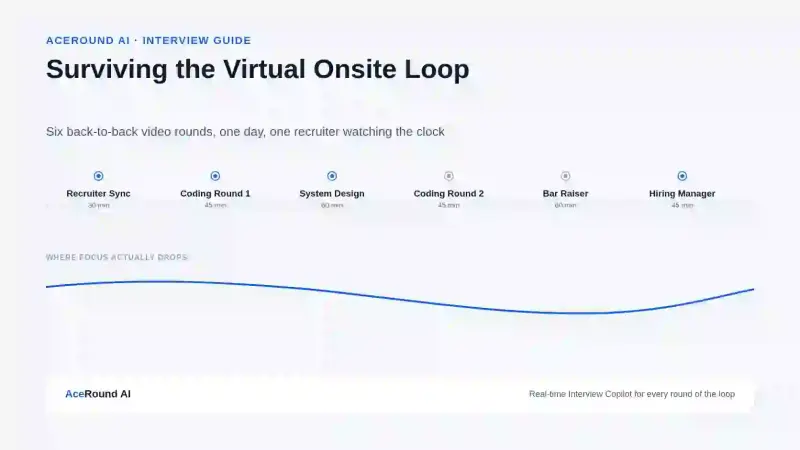
Virtual Onsite Interview Loop: How to Survive 4-6 Back-to-Back Rounds
What a virtual onsite interview loop is, why round 4 is where candidates fall apart, and how to prepare for 4-6 back-to-back video rounds in one day.
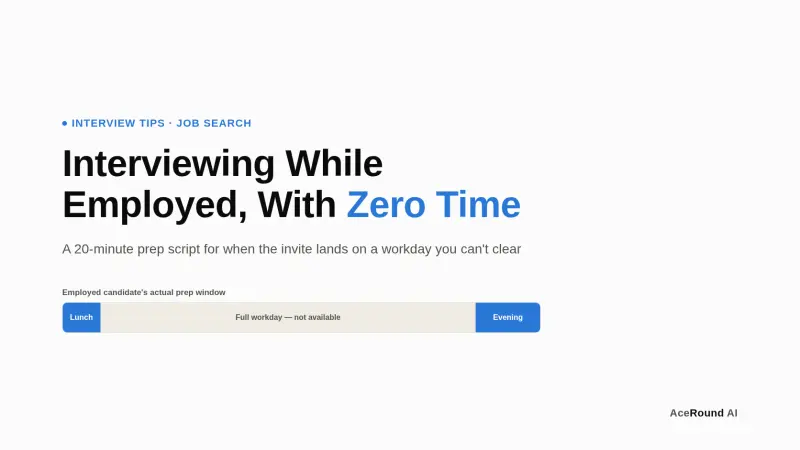
Interviewing While Employed: How to Actually Prepare With Zero Time
Job searching while employed means near-zero prep time, not just staying discreet. Here's a 20-minute prep script, plus what the counteroffer statistics actually show.
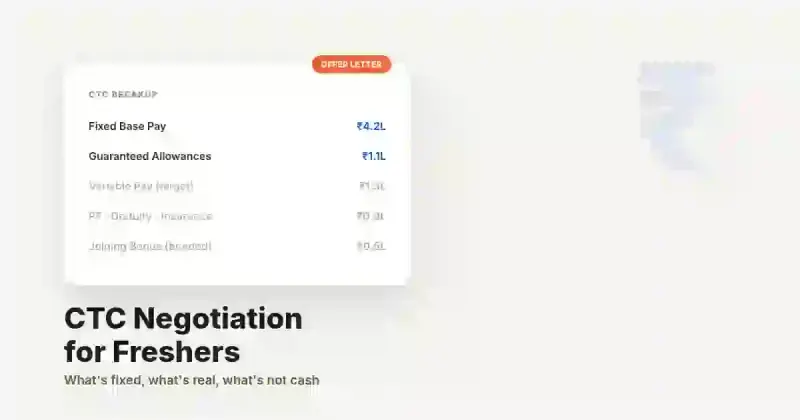
CTC Negotiation for Freshers in India: What's Actually Negotiable
Most fresher CTC negotiation advice ignores that TCS, Infosys, and Wipro set fixed pay bands. Here's what's really negotiable, and where lowball offers hide.