CTC Negotiation for Freshers in India: What's Actually Negotiable
Most fresher CTC negotiation advice ignores that TCS, Infosys, and Wipro set fixed pay bands. Here's what's really negotiable, and where lowball offers hide.
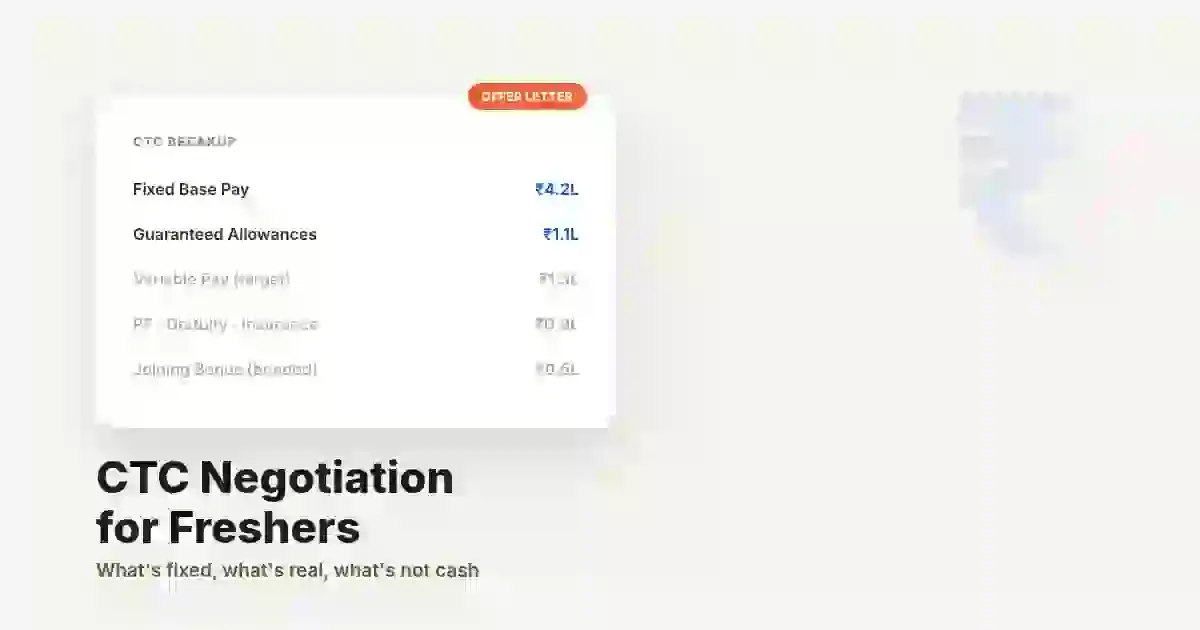
TL;DR: Most CTC negotiation advice treats every offer the same way — explain the formula, then say "negotiate with data." It skips the split that actually matters: at TCS, Infosys, Wipro, and similar IT-services majors, fresher pay runs on fixed bands set centrally, so there's nothing to negotiate after the offer exists — your only lever was your test score, before the offer was generated. At product companies and startups, individual negotiation is real, but it's gated almost entirely on a written competing offer. Layered on top of both: variable pay isn't guaranteed take-home (IT majors have paid out only 70–85% of target in real quarters), joining bonuses come with 12–24 month bond clauses that claw back on early exit, and 15–25% of headline CTC is notional cost that never reaches your account. Only 28% of freshers even attempt to negotiate — of those who do, 62% get something, averaging 8% of CTC.
Most fresher salary advice in India reads like the same article copy-pasted with a different company name swapped in: here's what CTC stands for, here's the formula, now go negotiate confidently. It skips the part that actually decides whether negotiation is even a real option for you — and freshers only find out the hard way, usually after signing something they didn't fully read.
Fixed Bands vs. Real Negotiation: A Split Most Advice Skips
TCS, Infosys, Wipro, Capgemini, Accenture, and HCLTech don't negotiate fresher CTC one candidate at a time. Each runs a small number of fixed pay tracks — TCS Ninja versus Digital, Infosys's System Engineer versus Digital Specialist Engineer, and equivalents at the others — with the CTC for each track set centrally, the same number for every fresher who lands in it. There's no individual negotiation to be had once your offer letter is generated, because the number was never yours to move in the first place.
The negotiation that actually matters at these companies happens earlier and looks nothing like negotiation: it's your test and interview performance deciding which track you're placed into. Score well enough on the coding and technical rounds, and you land in the higher-paying track before any offer letter exists. Score into the standard track, and no amount of asking afterward changes the number — there's no manager with discretion to move it, because the band isn't a starting point, it's the whole system.
Product companies, GCCs, and well-funded startups work differently — individual negotiation is normal there. But it's almost entirely gated on one thing: a written competing offer. Recruiters at these companies anchor hard to "what else do you have," and without a real, documented number to point to, even a good recruiter has little internal justification to move yours. A Naukri survey from 2025 found only about 28% of campus-placed freshers attempt any negotiation at all — and among those who did, 62% got some improvement, averaging roughly 8% of CTC. The gap between those two numbers is the actual story: most freshers who could ask something, don't.
What's Actually On the Table Even When Base Pay Isn't
If you're in a fixed-band offer, base pay itself isn't moving — but a few things around it usually are, and most freshers never ask about any of them:
- Joining date or batch. Pushing into a later batch can matter if you have a certification or a pending exam to finish first.
- Joining bonus amount or payout timing. Some offers have room here even when base doesn't.
- Relocation reimbursement. Frequently unstated by default, occasionally available if you ask.
- Your first performance review timing. Getting it moved to 6 months instead of the standard 12 gets you to your first raise faster, without touching the signed number at all.
None of these change your CTC on paper. All of them change what you actually get in year one.
Variable Pay Is Not a Guaranteed Number
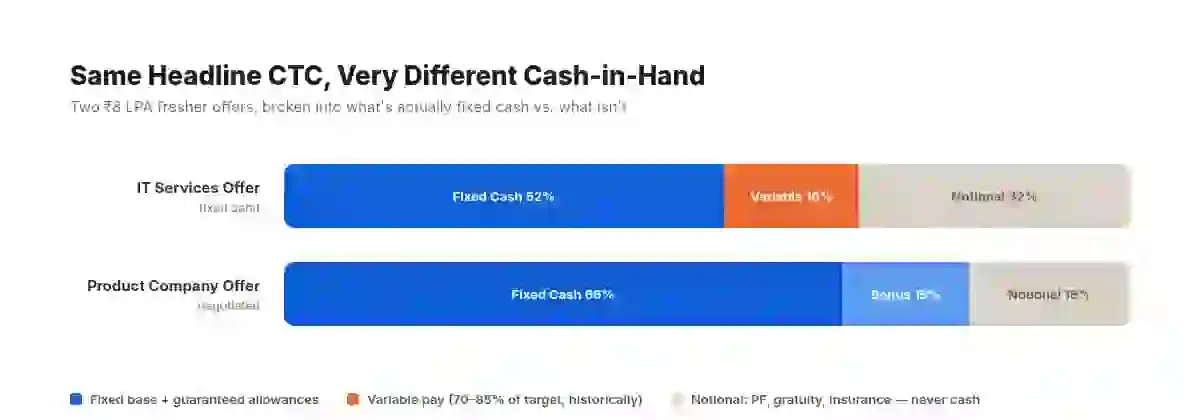
Every explainer covers what variable pay is — a percentage of CTC tied to performance, paid quarterly or annually. Almost none mention that "performance" mostly means company-wide margin, not your individual rating. TCS, Infosys, and Wipro have all paid out only 70 to 85 percent of target variable pay in real quarters between 2022 and 2024, tied to broader business performance rather than anything an individual fresher controlled.
Practically: if an offer letter quotes ₹8 LPA CTC "including 15% variable," you are not comparing an ₹8 LPA offer to a fully-fixed ₹7.5 LPA offer at face value. Discount the variable slice by what's realistically been paid out in recent cycles before you decide one number beats the other — otherwise you're comparing a number that includes optimism against a number that doesn't.
The Bonus Clause That Bites Later
Joining and retention bonuses get listed in offer breakdowns as pure upside — extra cash, no catch mentioned. In practice, they almost always come bundled with a 12-to-24-month service bond. Leave before that window closes, and the bonus is clawed back through your full-and-final settlement, sometimes chased separately afterward if FnF doesn't cover the whole amount.
This is the single most common surprise freshers report discovering — not during the offer stage, but months later when they're already trying to leave. Read the bond clause before you count a joining bonus as spendable, not after you've spent it.
Why Your In-Hand Number Never Matches the CTC You Were Quoted
A typical fresher CTC has 15 to 25 percent sitting in components that are real cost to the employer but never reach your bank account: employer PF contribution, gratuity accrual, group insurance premium, meal cards. These don't move regardless of how well you negotiate anything else, and they're the reason two offers with similar headline CTC can produce noticeably different in-hand pay.
The fix is comparing offers on their fixed cash component — base plus guaranteed allowances — rather than the headline number. It's a five-minute recalculation that catches more lowballing than any negotiation script does, because most lowball tactics aren't about the number being false, they're about which parts of it are cash and which parts never were.
Where Prep Time Actually Goes When the Offer Itself Isn't Moving
For most freshers reading this, the honest takeaway is that the leverage was earlier than you think — in the test score and interview rounds that decided your track, not in a conversation you have after the offer letter arrives. That makes the actual prep problem less about negotiation scripts and more about the interview and assessment rounds you still have coming up, whether that's an off-campus AMCAT or eLitmus screen, a product company's OA, or the technical and HR rounds that follow. AceRound AI runs both sides of that: an OA Copilot for timed coding-and-aptitude practice against the same format you'll actually sit, and an Interview Copilot with a rehearsal mode for the technical and HR rounds afterward — useful for the round that actually decides your track, which is a better place to spend prep energy than a negotiation conversation that, at most fixed-band employers, was never going to happen. If you're still working out which off-campus pipeline you're even in, our AMCAT/eLitmus guide covers how those screens feed into which companies.
FAQ
Is CTC negotiable for freshers in India?
It depends entirely on who's hiring. At TCS, Infosys, Wipro, Capgemini, and similar IT-services majors, fresher CTC runs on fixed per-track pay bands set centrally — there's no room to negotiate the number itself after your offer is generated, only what track you land in, which gets decided by your test and interview score before the offer exists. At product companies, GCCs, and startups, individual negotiation is normal, but it's almost entirely gated on holding a written competing offer — without one, even a good product-company recruiter has little reason to move the number.
How much can a fresher actually negotiate in India?
A 2025 Naukri survey found only about 28% of campus-placed freshers even attempt to negotiate. Of those who did, roughly 62% got some improvement — base, joining bonus, or a benefit — averaging around 8% of CTC. The attempt rate is low and the payoff for trying is disproportionately good, which mostly reflects how many freshers assume negotiation is pointless and never ask.
Is variable pay in my CTC guaranteed every month?
No, and this is the single most common way headline CTC misleads freshers comparing offers. Variable pay is tied to company-wide margin performance, not individual rating, and TCS, Infosys, and Wipro have all paid out only 70–85% of target variable in real quarters between 2022 and 2024. An offer quoting ₹8 LPA "including 15% variable" isn't guaranteeing you ₹8 LPA — discount the variable slice before comparing it to a fully-fixed offer.
What happens if I leave before my joining bonus bond period ends?
You typically owe it back, in full or on a pro-rated schedule depending on the offer letter's exact wording. Joining and retention bonuses almost always carry a 12–24 month service bond, and the clawback is recovered through your full-and-final settlement when you exit — sometimes chased separately afterward if FnF doesn't cover the full amount. Read this clause before you count a joining bonus as spendable money, not after you've already spent it.
Can I negotiate my joining bonus at TCS, Infosys, or Wipro?
Base pay, no — but joining bonus amount or timing, your joining date or batch, relocation reimbursement, and pulling your first performance review earlier (6 months instead of 12) are the levers that are actually on the table even at employers with fixed pay bands. None of these change your fixed CTC number, but they change what you actually get in the first year.
Why is my in-hand salary so much lower than my CTC?
Because 15–25% of a typical fresher CTC is notional — employer PF contribution, gratuity accrual, group insurance premium, meal cards — components that are real cost to the employer but never touch your bank account regardless of how well you negotiate. When comparing two offers, compare the fixed cash component (base plus guaranteed allowances), not the headline CTC number, or you'll be comparing two different things that happen to look similar.
Author · Alex Chen. Career consultant and former tech recruiter. Spent 5 years on the hiring side before switching to help candidates instead. Writes about real interview dynamics, not textbook advice.
Related Articles
Interviewing While Employed: How to Actually Prepare With Zero Time
Job searching while employed means near-zero prep time, not just staying discreet. Here's a 20-minute prep script, plus what the counteroffer statistics actually show.
Service-Based or Product-Based? Deciding When You Have Both Live at Once
TCS offer in hand, product company interview next week — here's the actual decision framework, not another generic service vs product comparison table.

Attending Job Interviews While Serving Notice Period in India
The real logistics of interviewing for your next job while still clocking in at your current one — notice period math, buyouts, and where prep time goes.