How to Answer 'How Do You Use AI at Work?'
How do you use AI in your work? In 2026, some interviewers ask this live, not just as a spoken question. Here's how to answer both versions well.
TL;DR: How do you use AI in your work is now one of the most common interview questions across every function, and in 2026 it stopped being purely a spoken question — some interviews now test your AI use live, watching how you direct and verify a tool rather than just listening to a rehearsed answer. Structure your spoken answer around one specific task, one AI action, and one measurable outcome, and separately prepare for the possibility that you'll have to demonstrate it, not just describe it.
A recruiter at a mid-size SaaS company put it bluntly in a 2026 hiring roundtable: the question isn't really "do you use AI" anymore, it's "can we trust your judgment about when to use it." That shift matters because most candidates still walk in with a 2024-era answer — a list of tools — when interviewers have moved on to something harder to fake.
Why This Question Changed in 2026
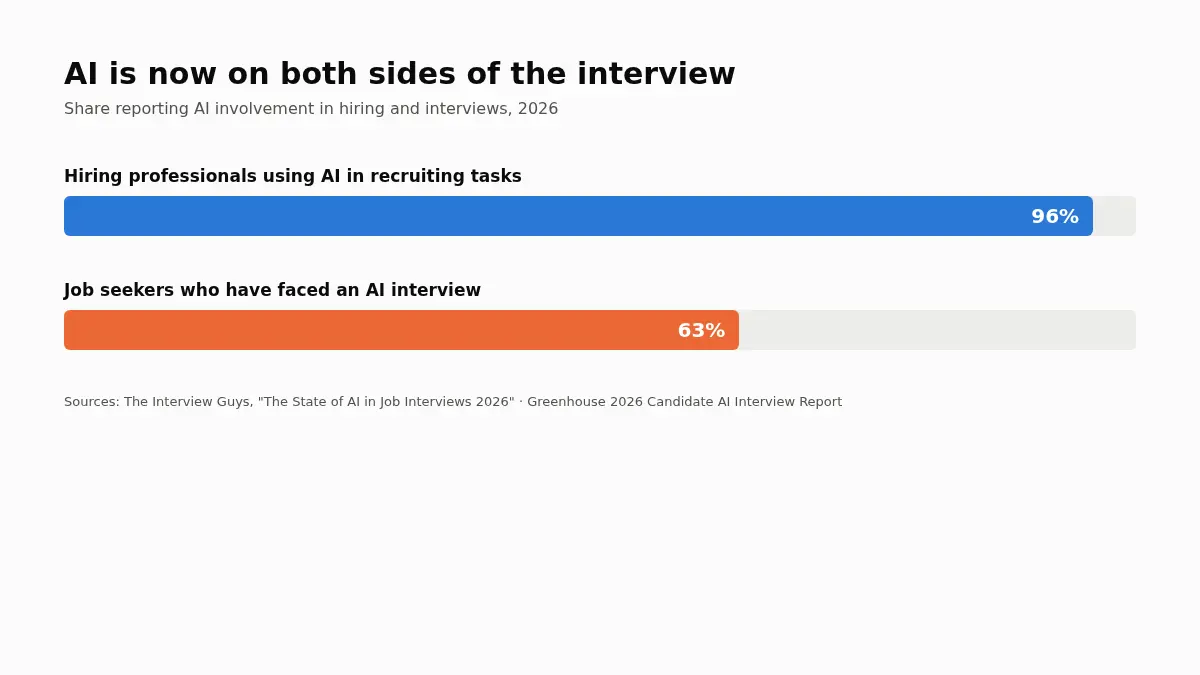
Two numbers explain why "how do you use AI in your work" went from an occasional curveball to a near-default interview question. Greenhouse's 2026 Candidate AI Interview Report found that 63% of job seekers have now faced some form of AI-related interview question or format — a majority-crossing threshold reached this year, not before. On the other side of the table, a 2026 industry analysis put AI adoption among hiring professionals at 96%.
Put those together and the picture is simple: almost every interviewer you talk to is already using AI somewhere in their own workflow, and most candidates they're screening have too. Asking how you use AI isn't a trick question anymore — it's how they figure out whether you're a force multiplier on a team or the person who'll spend four hours on a task AI could shorten to fifteen minutes.
The Answer That Still Works: One Task, One Action, One Result
The classic advice for this question hasn't gone stale, it's just gotten more specific. Frame your answer around outcomes, not tools: "I use AI to cut research time by 40%" beats "I use ChatGPT daily" every time, because the second version tells the interviewer nothing about your judgment.
A tight structure works well here:
- Name a real task — something you actually did recently, not a hypothetical.
- Say what the AI action was — drafting, summarizing, checking, generating a first pass.
- Say what you did with the output — this is the part people skip, and it's the part that matters most. Did you edit it, fact-check it, reject part of it?
- Give the result — time saved, error caught, better first draft, whatever is real and specific.
Keep the whole thing under 90 seconds. If you're prepping this alongside other classic prompts, it pairs naturally with behavioral interview questions that use the same "specific situation, specific action, specific result" shape — this is really a behavioral question wearing an AI costume.
The New Twist: Some Interviews Now Test It Live
Here's the gap almost no interview-prep content covers: in 2026, some interviewers stopped asking about your AI use and started watching it happen. Meta's move to allow AI tools during live coding rounds sparked a widely shared discussion thread on Blind, where candidates described the shift directly — one commenter noted "the interviewers are not well calibrated on this new format yet," and another admitted landing multiple offers while using ChatGPT during the actual coding round. Whether or not that specific tactic is wise, it signals something real: the question has moved from the resume stage into the live interview room.
If your technical round allows or expects AI tool use, the skill being evaluated changes completely. It's no longer "can you solve this problem," it's "can you direct an AI tool, catch when it's wrong, and course-correct out loud, under time pressure, while someone watches." That's a different muscle than solo problem-solving, and it's the exact muscle a real-time assistant like AceRound is built to support — not by solving the problem for you, but by helping you narrate and verify your AI-assisted process clearly while it's happening, the same way it helps with any live technical or behavioral round. For the format basics, our guide on HackerRank's AI-assisted interview mode and on Google's own AI interview policy cover what specific platforms currently allow.
Follow-Up Questions to Expect
Interviewers rarely stop at the first answer. The follow-ups are where they actually test judgment:
- "How do you decide when to use AI versus doing it yourself?" — this is checking for a real decision framework, not a rule of thumb you memorized.
- "How do you verify what the AI gives you?" — answer with a concrete habit (cross-checking a source, running a test, re-reading against the original request), not "I always double-check everything."
- "Tell me about a time AI got something wrong." — this one is designed to catch candidates who've never actually caught an AI mistake. If you can't think of a real example, that's worth fixing before your next interview, not during it.
Answers That Backfire
Three patterns come up again and again in hiring-side accounts of this question, and all three are avoidable:
- "I don't really use AI." Reads as resistance to change, or worse, a lack of curiosity about the most discussed tool of the decade.
- A tool list with no story. "I've used ChatGPT, Gemini, and Copilot" answers a different question than the one being asked.
- An answer that sounds AI-generated. Ironic, but real — interviewers increasingly notice when a candidate's spoken answer sounds like it was drafted by the same tool they're describing using.
How AceRound Helps With This Question
For the spoken version of this question, AceRound listens in real time during your interview and can surface a structured prompt — task, action, outcome — if you're mid-answer and losing the thread, the same way it helps with any behavioral question. For the live-demonstration version, where an interviewer is watching you actually use AI tools during a technical round, it works alongside you the same way it does for any real-time technical interview: surfacing suggestions you can act on and verify yourself, not typing answers for you. Either way, the honest scope is the same — it helps you structure and stay calm, it doesn't replace having actually thought about how you use AI before you walk in.
FAQ
Is "How do you use AI in your work?" now a standard interview question?
Close to it. Greenhouse's 2026 Candidate AI Interview Report found 63% of job seekers have now faced an AI-related interview question or format, and a separate 2026 industry survey put AI adoption among hiring professionals at 96%. It's asked across roles now, not just engineering — marketing, ops, finance, and customer-facing jobs all get some version of it.
What should I avoid saying when asked how I use AI?
Three answers reliably backfire: claiming you don't use AI at all (reads as resistant to change, not principled), listing tools with no outcome ("I've used ChatGPT, Gemini, and Copilot" tells the interviewer nothing about your judgment), and reciting an answer that sounds AI-written itself. Specificity beats a tool list every time — one task, one action, one measurable result.
What follow-up questions do interviewers ask after this one?
The most common follow-ups probe judgment, not tool familiarity: how do you decide when to use AI versus doing something yourself, how do you verify or fact-check what AI gives you, and can you describe a time AI output was wrong and what you did about it. Prepare a short answer for each — interviewers use these to check whether you actually think about AI use or just repeat a script.
Do some companies now test AI use live instead of just asking about it?
Yes, and this is the part most interview-prep advice still misses. Some technical interviews (Meta's coding rounds are a widely discussed 2026 example) now allow or require candidates to use AI tools live, and the interviewer watches how you use them, not whether you can solve the problem unassisted. The evaluation criteria shift from "can you code this" to "can you direct, verify, and correct an AI tool under time pressure."
What if I don't really use AI at work yet?
Be honest, but pair it with initiative. Say plainly that your current role hasn't required much AI use, then name one specific way you've explored it on your own — a personal project, a free tool you tried for a task, or a course you took. Interviewers are checking for curiosity and adaptability, not a resume full of AI tools; a resistant-sounding "I don't need it" is the answer that actually hurts you.
Author · Alex Chen. Career consultant and former tech recruiter. Spent 5 years on the hiring side before switching to help candidates instead. Writes about real interview dynamics, not textbook advice.
Related Articles
OpenAI's AI Interview Policy: Banned, Required, or Team-Dependent
OpenAI sells AI coding agents, then bans most candidates from using one. Here's the round-by-round policy, including the new agentic round that flips it.
Does Harver Detect Cheating? What Its Proctoring Actually Checks
Does Harver detect cheating on its pre-employment assessments? A candidate look at Harver's Proctoring add-on, what gets logged after a flag, and what happens next.
Micro1's Zara AI Interview: What It Actually Tests (And Why Timing Gets Flagged)
Micro1's AI interviewer Zara has run 300,000+ interviews for remote roles. Here's why it flags response latency as a cheating signal, and what that means for AI prep.