"Describe a Situation Where You Identified an Issue in AI Output" — Answer Guide
Two things get graded: what the AI got wrong, and the steps you took to fix it. A four-step structure, three worked examples, and a 90-word form-box version.

TL;DR: This question has two graded halves: the issue (specific, and a real defect in the output rather than a badly written prompt) and the steps you took to correct it (a sequence, with a source outside the AI and a rule that survived). Use one real story and structure it as catch, contain, correct, change. Spoken, keep it to about 90 seconds; written, 90 to 130 words.
The reason it is being asked is not curiosity. In O'Reilly's 2026 survey of 2,000 UK workers, only 24% confirmed an AI answer before acting on it, and 39% had already acted on one that turned out to be inaccurate or unsuitable. Employers are hiring for the 24%, and a story is the only way to prove which group you are in.
By late 2026 the question arrives in two shapes. Spoken, it sounds like "Tell me about a time an AI tool gave you something wrong." Written, it looks like this:
"Describe a situation where you identified an issue when using the output generated by an AI tool. Explain what the issue was and steps you took to correct it."
The written version turns up in application forms and in AI-usage screening, including for roles that are not technical. The spoken version has moved into structured screens too: candidate reports collected on PracHub in October 2026 describe an Amazon software-engineering phone screen whose behavioral segment was entirely about AI use at work — how you make sure generated output is correct, a time your AI work helped the whole team, and a time you found an AI result wrong and investigated it. That last part is this question, and it arrives with a follow-up that ends most answers: how did you know it was wrong?
Most candidates prepare a position ("I always double-check") instead of a story. The position survives about four seconds.
Why this question exists now
The economics changed. AI output is fluent enough that errors no longer announce themselves, so the cost of a wrong answer shows up downstream: a market-share figure that doubles in a deck, duplicate rows in a table nobody re-counted, a support answer that is correct in one state and wrong in the next. The person who catches those before they ship is worth more than the person who generates more of them.
The hiring data says that person is rare. Nearly two-thirds of US job seekers (63%) have already been through an AI interview, according to Greenhouse's 2026 candidate report, so AI screens are no longer unusual. What a screen of that kind cannot test with "which tools do you use?" is whether anyone verifies. This question tests exactly that, with a story as the evidence.
It also matches how the work is organized now. The scarce skill is not getting output; it is deciding which output is safe to ship. That happens at a specific moment, with a specific number, which is why the question is behavioral instead of technical.
The two halves, and which one gets graded
Every version of this question asks for two things, and candidates routinely deliver only one.
Half one: the issue. It has to be a defect in the output. "The AI misunderstood my prompt" is a different story: it is about your instructions, and it hands the interviewer a reason to doubt your judgment instead of your tool's. Use a prompt-failure story only when you supplied the context and the tool ignored it, and say so explicitly.
Half two: the steps. Plural, in order, and at least one of them a check against something outside the AI. "I looked it over and fixed it" is the sentence that loses the point. What did you check, against what, and in what order?
The result matters less than the sequence. Interviewers are not scoring whether you saved the company a million dollars. They are scoring whether the correction was a process you can run again.
The four-step answer: catch, contain, correct, change
This is the structure that survives follow-ups, because each step answers a question the interviewer is already forming.
1. Catch: the tell
Start with the moment of doubt, not the background. What made you look twice? The strongest tells are concrete and slightly uncomfortable: the number was too round, the total did not reconcile with last month's, the function passed the happy-path test but the row count came back doubled, the citation's title did not exist when you searched it.
The interviewer's question this answers: how did you know it was wrong? If your answer is "I just had a feeling", the story dies there.
2. Contain: what you did in the next ten minutes
The output was already in motion. Was it in a draft, a slide, a pull request, a queue? Say what you stopped. This step is short and it is where ownership shows: you did not quietly fix the number and hope nobody had seen the earlier version.
The interviewer's question this answers: who else was exposed, and what did you do about it?
3. Correct: the fix, and the source you checked it against
Name the primary source: the filing, the internal dashboard, the official policy page, the test suite, the schema. Then say what the right answer was and how you replaced the wrong one. One number or one concrete detail here is worth a paragraph of adjectives.
The interviewer's question this answers: was the correction real, or did you just ask the model again?
4. Change: the rule that survived
End with something durable: a check added to a template, a reconciliation step in a query, a standing instruction in your prompt, a rule that any number going into a client document gets traced. "I'm more careful now" is not a change. "Row counts get reconciled before any aggregation leaves the notebook" is.
The interviewer's question this answers: will this happen again next month?
Six issue types that work in any role
If you are blanking on material, pick the one closest to your actual work and rebuild the real details. Every one of these is a defect in the output, which is what the question asks for.
| Issue | Where it shows up | The tell | What a strong correction sounds like |
|---|---|---|---|
| Fabricated fact or citation | Research, marketing, analyst work | The source does not exist, or exists with different numbers | Traced the claim to the primary document, replaced the figure, added a "no source, no stat" rule |
| Stale version | Code, policy, tax and compliance answers | The answer is right for last year's rules or last release | Checked the current documentation or policy page by date, replaced the example, pinned the version in the prompt |
| Context-blind recommendation | PM, HR, ops, consulting | The advice ignores a constraint the tool was never told | Re-ran with the constraint supplied, then wrote the constraints into the template |
| Silent logic error | Engineering, data | Happy-path tests pass; a count, a total or an edge case does not | Isolated the failing input, added the test, rewrote the join or the null handling |
| Misread input | Support, ops, anything voice or file based | A name, a term or a unit came through wrong | Compared against the original recording or file, corrected the record, changed how input is captured |
| Confidently wrong customer answer | Support, sales, onboarding | The policy cited sounds plausible and is not the current policy | Checked the system of record, corrected the reply before it went out, added the policy page to the reference set |
Keep the version you actually lived through. A small true story with a real tell beats an invented one that collapses under "how did you know?"
Verification that survives a follow-up
If the question comes in its other form, how do you make sure AI-generated output is correct?, there is no story to tell: describe the check you run per output type. This is also the answer that follows the first question when the interviewer pushes on process.
- Numbers: trace to the primary source, then check the unit and the period. Most AI numeric errors are a right number from the wrong quarter, or the wrong denominator.
- Code: run it, then run the edges: empty input, nulls, duplicates, a join that matches more than once. Read the diff rather than the summary. A model that says it changed one function has often changed three.
- Prose: verify names, dates, titles and quoted sentences. A quoted phrase is the fastest check that exists: search it.
- Data and analysis: reconcile totals against the source system before any chart leaves your machine. Re-run with a second filter and see whether the story holds.
- Policy, HR, legal, pricing: go to the system of record, not the model. The model is a good first draft of what the policy probably says and a bad authority on what it says today.
- Anything customer-facing: one other reader, before it ships. This is the cheapest control and the one most teams skip.
Three worked answers
Analyst, market research. "I was using an AI research tool to pull comparison data for a client pitch. It gave me a market-share figure that fit the narrative too neatly, which is what made me check the source instead of the number. The figure was almost double the published one; the tool had merged two reporting periods. I pulled the slide, replaced it from the firm's own report, and told the account lead before the deck went out. Since then every number doing real work in a client document gets traced to its source, no exceptions."
Engineer, data pipeline. "I had a coding assistant write a dedupe step for a customer table. It passed the sample tests, but when I reconciled the row count against the source system the total was about 4% higher than it should have been. The join matched multiple records per customer and duplicated them. I rewrote it with a window function, added a row-count assertion to the pipeline's tests, and the check has caught two similar queries since."
Support or operations, policy answer. "I used an AI drafting tool to answer a billing question about a state we had just expanded into. The answer was right for our home state and wrong for the new one. I caught it because the reply cited an effective date I did not recognize, so I checked the policy page before sending. I corrected the reply, and we added the current policy pages to the tool's reference set so the next answer starts from the right document."
Each of these is under 130 words, names a tool category, states a specific defect, and ends on a rule. That is the whole shape.
If it arrives in a form box: the 90-word version
Application forms rarely give you room for a narrative. Write four sentences and stop.
"While preparing a quarterly review I used an AI assistant to summarize competitor pricing. It reported a discount that applied only to annual plans as if it applied to all plans. I checked the competitor's pricing page, corrected the table before the deck circulated, and now every price in that template links back to the source page and shows the plan it belongs to."
That is 64 words and it contains all four steps: task and tool, issue, correction with source, change. Add one result sentence if the box allows ("it stopped a wrong figure reaching a client"). Do not spend the box on how important the project was.
The same question, five phrasings
| Phrasing | What shifts |
|---|---|
| "Describe a situation where you identified an issue when using the output generated by an AI tool" | Written form. Both halves are explicit: the issue, then the steps. Use the four sentences above. |
| "Tell me about a time you caught an AI tool making a mistake" | Spoken. Lead with the tell; the interviewer is listening for the moment of doubt. |
| "Describe a specific moment where the AI helped, or failed, you" | If you get the choice, take the failure. Help stories rarely differentiate, and the interviewer has heard the productivity version from every candidate. |
| "How do you make sure AI-generated output is correct?" | No story required. Give the per-type checks, then one 20-second example of a check firing. |
| "Describe how you use AI in your work" | A different question about fluency, not failure. That one is here. |
Adjacent questions in the same family are worth preparing together, because interviewers mix them in one loop: a time you disagreed with an AI recommendation, delegating work to AI agents, and where you would not use AI at all.
What the interviewer writes down
Four things, usually in this order:
- Specificity. A named tool, a named source, a number. Vague stories read as invented.
- Ownership. You caught it. Not a reviewer, not a customer, not an automated alert you did not configure.
- Calibration. You neither worship the tool nor refuse it. You know which output types need which checks.
- Transfer. The rule you added. This is the difference between a candidate who had one good incident and a candidate who changed how the team works.
Follow-ups to have ready
"How did you know it was wrong?" Have the tell ready in one sentence. This is the question that decides the answer.
"What would have happened if you had not caught it?" Name the smallest real consequence: a client seeing a wrong figure, a duplicated charge, a broken report. Do not inflate it.
"Who else was affected?" Shows you understand blast radius. If nobody was, say nobody was, and explain what you did to keep it that way.
"Have you caught one since?" A second, smaller example proves the habit rather than the anecdote. Keep one in reserve.
Mistakes that sink an otherwise good story
- Stopping at "I caught it." The correction steps are the answer. A story that ends at the catch answers half the question.
- Making it a lecture on hallucination. The interviewer is not grading your understanding of transformers. They are grading what you did.
- Describing a prompt error as a tool error. Honest candidates get credit for the distinction; the reverse reads as blame-shifting.
- Choosing a mistake with no stakes. "It was wrong but it did not matter" tells the interviewer you have only used AI where nothing was at risk.
- Claiming a story you cannot defend. The follow-up "what did you check it against?" exposes a fabricated one immediately. A smaller true story always wins.
FAQ
What is this question actually testing? Whether verification is a habit or a claim. Almost everyone says they double-check AI output; in O'Reilly's 2026 survey of 2,000 UK workers only 24% had actually confirmed an AI answer before acting on it, and 39% had already acted on one that turned out to be wrong. The interviewer wants the moment you doubted the output, what tipped you off, and what you changed afterwards.
How long should the answer be? About 90 seconds spoken, or 90 to 130 words written. That is enough for the issue, two or three correction steps and the result. Anything longer usually turns into a tour of the project instead of the correction.
What if I have genuinely never caught an AI tool being wrong? That is worth fixing before the interview rather than during it. Every tool produces errors, so not having a story usually means you have not been checking closely enough. Go back through a month of AI-assisted work, find one output you accepted without verifying, and verify it now. If it holds up, you still have an honest answer about the check you ran.
Can I use an example from interview prep rather than from work? It works in a pinch, but a work example is stronger because the mistake had real stakes: a deadline, a client, a teammate. If prep is your only material, say plainly that it is a smaller-scale example and spend the time on the verification process rather than inflating what was at risk.
Should I criticize the AI tool in my answer? No. Describe the mistake the way you would describe a junior colleague's: you caught it, you fixed it, you adjusted how you work with that person. Trashing the tool reads as someone who resents having to check work, which is the opposite of what this question rewards.
How is this different from 'tell me about a time you made a mistake'? The mistake belongs to the tool, but your judgment is still what is graded. The strongest answers make clear that you, not a reviewer or a customer, caught it, and that something in your process changed afterwards. Centering your own error instead of the output's is the most common way to miss.
What if it is a written application question with a word limit? Write it as four sentences: the task and the tool, the specific issue, the correction steps with the source you checked, and the rule that came out of it. Keep one number and one tool name. A 90-word answer with those four parts beats a 300-word answer that only describes the project.
Does admitting I lean on AI heavily hurt me? No. The question exists because interviewers already assume you do. What they are scoring is whether a verification habit is attached to that usage. Heavy use with a real catch is a stronger answer than light use with no story at all.
Where AceRound fits
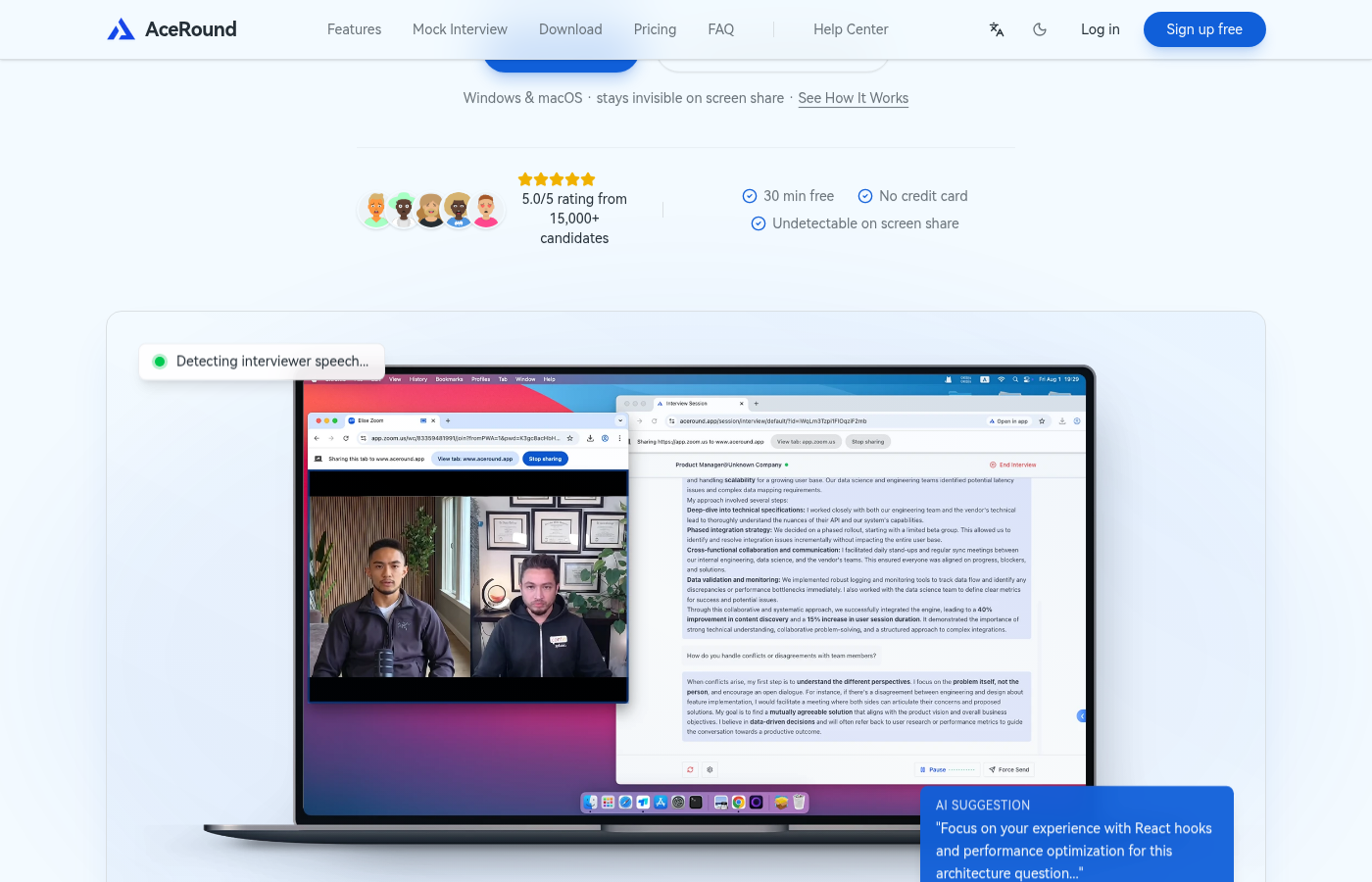
The habit this question scores is the same one that makes AI assistance useful in a live interview. Interview Copilot drafts a structured answer on your overlay within the first seconds of a question and keeps the lead line at the top, so you start speaking from a skeleton rather than a script. What you say is yours to check: a figure the model supplies about your own project is a draft until you confirm it, which is exactly the judgment being graded here. If you would rather rehearse the story first, mock interview practice runs the behavioral loop end to end, including the follow-up about how you knew.
Related reading: the STAR method, and where it breaks on AI questions, the 30 behavioral questions interviewers actually reuse, and whether using AI in an interview counts as misrepresentation.
Author · Alex Chen. Career consultant and former tech recruiter. Spent 5 years on the hiring side before switching to help candidates instead. Writes about real interview dynamics, not textbook advice.
Related Articles
How Do You Use AI in Your Work? Interview & Application Answers
Spoken or written, the answer needs four parts: the task, what the AI did, what you checked yourself, and the result. Includes 50, 100, and 150-word versions.

When You Disagree With an AI Recommendation
A new 2026 interview question tests whether you defer to AI or actually check it first. Here's how to structure a real answer, with scenarios.
How Do You Work With AI Agents? (Answered)
A new 2026 interview question is catching candidates off guard: how do you decide what to delegate to an AI agent? Here's how to actually answer it.