When Would You Not Use AI? Interview Question, Answered
A 2026 interview trust test asks where you draw the line on AI. Here's a 4-part framework with real example answers, not a vague list of principles.
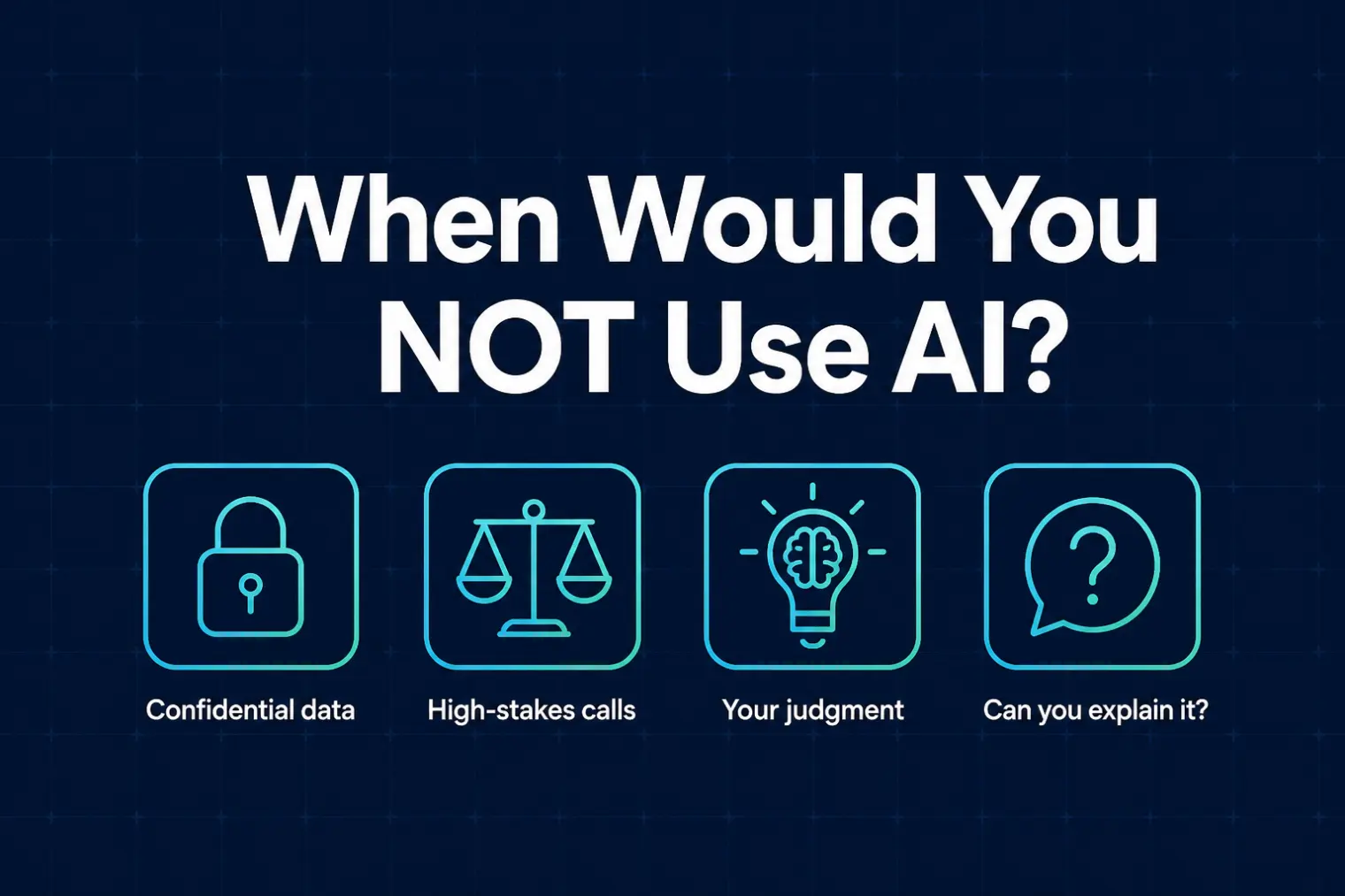
TL;DR: "When would you not use AI?" is a 2026 interview trust test, not a trick question — employers already assume you use AI and want to know if you have real limits. The strongest answer names four concrete lines (confidential data, high-stakes final calls, work where the thinking is the deliverable, anything you couldn't explain afterward) backed by one real example, not a vague "I'm always careful."
In 2023, Samsung engineers pasted proprietary source code into ChatGPT to help debug it. The code left the building the moment they hit enter, and the company banned the tool company-wide soon after. It's the anecdote hiring managers now reach for when they want to know if you'd do the same thing.
That's the real question behind "when would you not use AI?" It's not testing whether you're anti-AI. A 2026 workplace data survey found close to 40% of AI interactions at work already involve sensitive company data, and most of it happens through personal accounts that bypass corporate controls entirely — meaning your interviewer has almost certainly seen this go wrong somewhere. They're not screening for AI skepticism. They're screening for whether you have a line at all.
Why this question is spreading now
By 2026, AI interview prep site ClearRound had catalogued this as one of the standard questions in the "trust" category of AI-era interviewing, alongside "would you paste confidential data into ChatGPT" and "should you disclose AI use to a client." The framing they and other hiring guides converge on: candidates who answer with pure enthusiasm — "AI changed how I work, I use it for everything" — read as a risk, not a strength, because it implies no filter at all. A separate January 2026 manager survey found companies already tracing real financial losses and workflow breakdowns to employee over-reliance on AI, which is exactly the pattern this question is trying to screen out before it costs anyone anything.
Some employers have gone further than informal guidance. Official UK public-sector hiring policy states plainly that candidates "must not use AI in any qualifying test, selection day, or other live assessment," explicitly naming drafted answers and situational-judgment responses as prohibited uses. When institutions write hard boundaries into policy, it's a signal that "no boundary" is no longer an acceptable answer in an interview either.
First, make sure it's actually this question
Before you answer, check which question is being asked — the phrasing is easy to confuse:
- "When would you not use AI at work?" — a workplace-judgment question about your daily habits and standards. This is the one this article answers.
- "Did you use AI during this interview?" — a conduct question about the process you're in right now. Using AI in interviews is increasingly treated as a form of misconduct when undisclosed, because it prevents the employer from evaluating your actual thinking in the moment.
Answering the first question with material meant for the second (or vice versa) is a common way candidates fumble what should be an easy point.
The four lines worth drawing
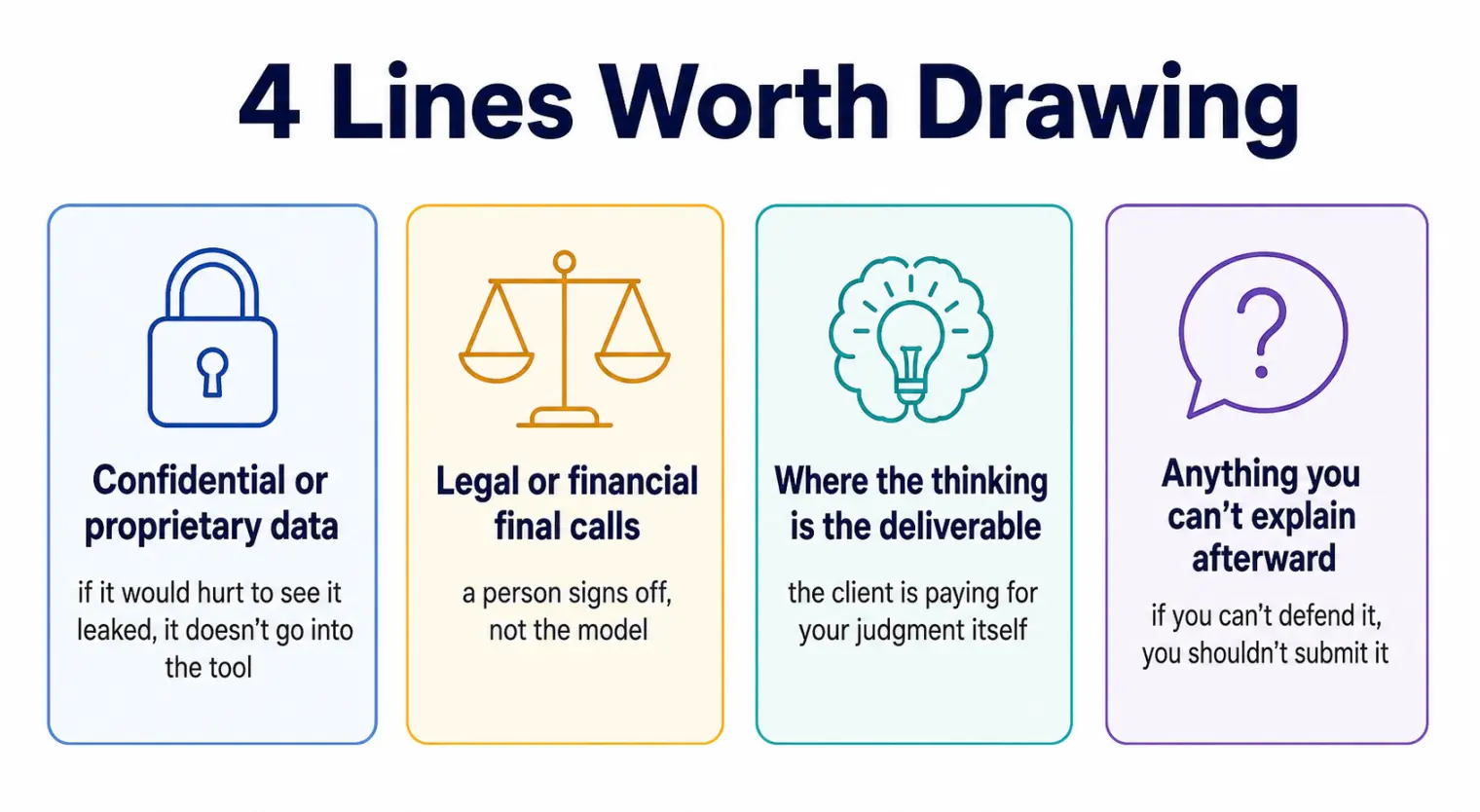
Most advice online lists these as bullet points and moves on. That's not enough to survive a follow-up question. Here's each one with a real example you can adapt.
1. Confidential or proprietary data
If it would hurt your employer, your client, or a coworker to see it show up outside the company, it doesn't go into a public AI tool. Full stop.
Example answer: "I had a client contract with unusual liability terms I wanted a second pair of eyes on. I didn't paste it into any AI tool, even to just 'summarize the structure,' because contract language can be re-identified from surprisingly small fragments. I asked a colleague who'd seen similar contracts instead."
This isn't paranoia — it's the default risk with consumer AI tools. Once text leaves your environment, it's processed and retained on someone else's servers under their terms, not yours, and even "just summarizing" often means pasting the whole document in first.
2. Final calls that carry legal, financial, or safety weight
AI can help you get to a recommendation. It shouldn't be the thing that makes the call when the outcome affects someone's job, money, health, or legal standing.
Example answer: "A forecasting tool I use flagged a vendor as low-risk based on historical payment data. Before I signed off on increasing their credit line, I pulled their last two quarters of filings myself, because the number the model was optimizing for wasn't the number that mattered for this specific decision."
The tell here is who's accountable if it's wrong. If the honest answer is "the model," you've crossed the line; if it's "me, because I checked," you haven't.
3. Work where the thinking itself is the deliverable
Some tasks aren't valuable because of the output — they're valuable because you did the thinking. Outsourcing the thinking defeats the purpose even if the output looks identical.
Example answer: "A junior engineer asked me to review a design doc I could have run through an AI summarizer to save time. I read it properly instead, because the value I was providing wasn't 'feedback exists' — it was catching the thing only someone who'd actually thought it through would catch. That doc had one edge case in it that a summary would have flattened."
This is the category people skip most often, because it's less about risk and more about what you're actually being paid for.
4. Anything you couldn't explain afterward
If you can't walk someone through exactly how you got to an answer, you shouldn't be submitting that answer as your own work — AI-assisted or not.
Example answer: "I had AI draft a first pass at a technical explanation for a non-technical stakeholder. Before sending it, I made myself explain it out loud without the doc in front of me. One part didn't hold up under my own explanation, which meant I didn't actually understand it well enough to send it yet — so I rewrote that section myself before it went out."
This is the cleanest catch-all: if explaining it afterward would expose that you don't actually understand your own answer, that's the line.
What a weak answer sounds like
Watch for these in your own draft, because interviewers hear them constantly:
- "I'm always careful" with no example — a mood, not a method.
- A list with no story attached — sounds memorized, not lived.
- Answering the wrong question — talking about AI use during the interview when asked about workplace habits, or vice versa.
- Zero limits at all — "I use it for everything and it's always worked out" reads as no filter, which is the exact risk this question exists to catch.
Building your own answer
You don't need four rehearsed stories. You need one real instance from any of the four categories above, told in three sentences: what the task was, why you drew the line, and what you did instead of using AI. If you're also prepping how you use AI in your work day-to-day or how you work with AI agents, this question is the flip side of those — same interviewer, testing whether your AI fluency comes with actual judgment attached.
The same judgment matters live, too — including in interviews themselves, where the temptation to lean on a suggestion without checking it against your own experience is exactly the pattern this question is screening for. AceRound is built to surface a starting point during a live interview, not a script to repeat verbatim, because the same rule applies to our own suggestions: treat them as a draft to verify against what you actually know, not a final answer.
FAQ
Is this the same as being asked if I used AI during the interview itself? No, and mixing them up will cost you. "When would you not use AI at work" is a workplace-judgment question about your daily habits. "Did you use AI to answer live" is a conduct question about the interview process itself, and increasingly treated as misrepresentation if undisclosed. Answer the one actually asked; don't wander into the other.
Would you paste confidential company data into ChatGPT? No, and say why in one sentence: once it leaves your company's environment it's processed and logged on a third party's servers under their terms, not yours. If you've used an enterprise tool with a no-retention agreement, say so specifically; it's a stronger answer than a blanket "I'm always careful."
Is it ethical to use AI for a task in my field? Where is the line? Draw the line at disclosure and the deliverable's nature, not at the tool itself. If the client or employer is paying for your judgment, using AI to shortcut the judgment itself (not just the drafting around it) crosses the line even if the output looks fine. When in doubt, the honest test is whether you'd be comfortable explaining exactly how you used it.
Should you disclose AI use to a client or manager? Default to yes when the AI materially shaped the output, no when it was incidental (spellcheck-level assistance). The safer failure mode is over-disclosing; being caught not disclosing costs more trust than the disclosure itself would have.
What if I genuinely can't think of a time I didn't use AI? That's a different problem worth noticing before the interview, not during it. It usually means you're treating every task as AI-eligible by default rather than making the call each time. Pick one category from the framework above, find a real instance, and build from there.
Author · Alex Chen. Career consultant and former tech recruiter. Spent 5 years on the hiring side before switching to help candidates instead. Writes about real interview dynamics, not textbook advice.
Related Articles
OpenAI's AI Interview Policy: Banned, Required, or Team-Dependent
OpenAI sells AI coding agents, then bans most candidates from using one. Here's the round-by-round policy, including the new agentic round that flips it.
Does Harver Detect Cheating? What Its Proctoring Actually Checks
Does Harver detect cheating on its pre-employment assessments? A candidate look at Harver's Proctoring add-on, what gets logged after a flag, and what happens next.
Micro1's Zara AI Interview: What It Actually Tests (And Why Timing Gets Flagged)
Micro1's AI interviewer Zara has run 300,000+ interviews for remote roles. Here's why it flags response latency as a cheating signal, and what that means for AI prep.