Does SHL Detect Cheating? The Assessment-Centre Catch
Does SHL detect cheating on Verify tests? Browser and webcam monitoring matter less than the in-person re-sit that catches score inflation. Here's how it actually works.
TL;DR: Does SHL detect cheating? Yes — browser monitoring, clipboard logging, screenshot capture, and webcam checks run during the online Verify test, but the layer that actually catches most inflated scores is the in-person assessment-centre re-sit that most large employers run before an offer. A big gap between your online score and your supervised re-sit score is what triggers an integrity review, not just what the online proctoring flags in the moment.
You've just finished an SHL numerical reasoning test with help you wouldn't want on record, and now you're wondering whether anyone will ever actually know. Most of what ranks for this question either lists generic proctoring features in a scolding tone or is written for HR teams selling SHL's assessment suite, not candidates trying to understand their real exposure. The honest answer has less to do with what the online test can see in the moment and more to do with what happens weeks later, in a room with a supervisor and a laptop that isn't yours.
What SHL's Online Monitoring Actually Watches
SHL's TalentCentral platform — the delivery system behind Verify and its other assessments — can enable several digital signals during an online session, depending on how the specific employer configured that test:
- Browser focus and tab-switching — leaving the test window is logged.
- Clipboard monitoring — copy-paste in and out of the test can be flagged.
- Periodic screenshot capture — not continuous recording in every configuration, but timed snapshots.
- Webcam checks — looking for a second face in frame, a candidate leaving view, or other visual anomalies.
- Statistical pattern analysis — unusually fast completion times paired with unusually high accuracy is itself a signal, independent of anything visual.
These are broadly similar to what shows up across the rest of the assessment-platform field — comparable in spirit to what we've documented for Mercer Mettl and Vervoe. What's different about SHL is what comes next.
The Assessment-Centre Re-Sit: SHL's Real Detection Layer
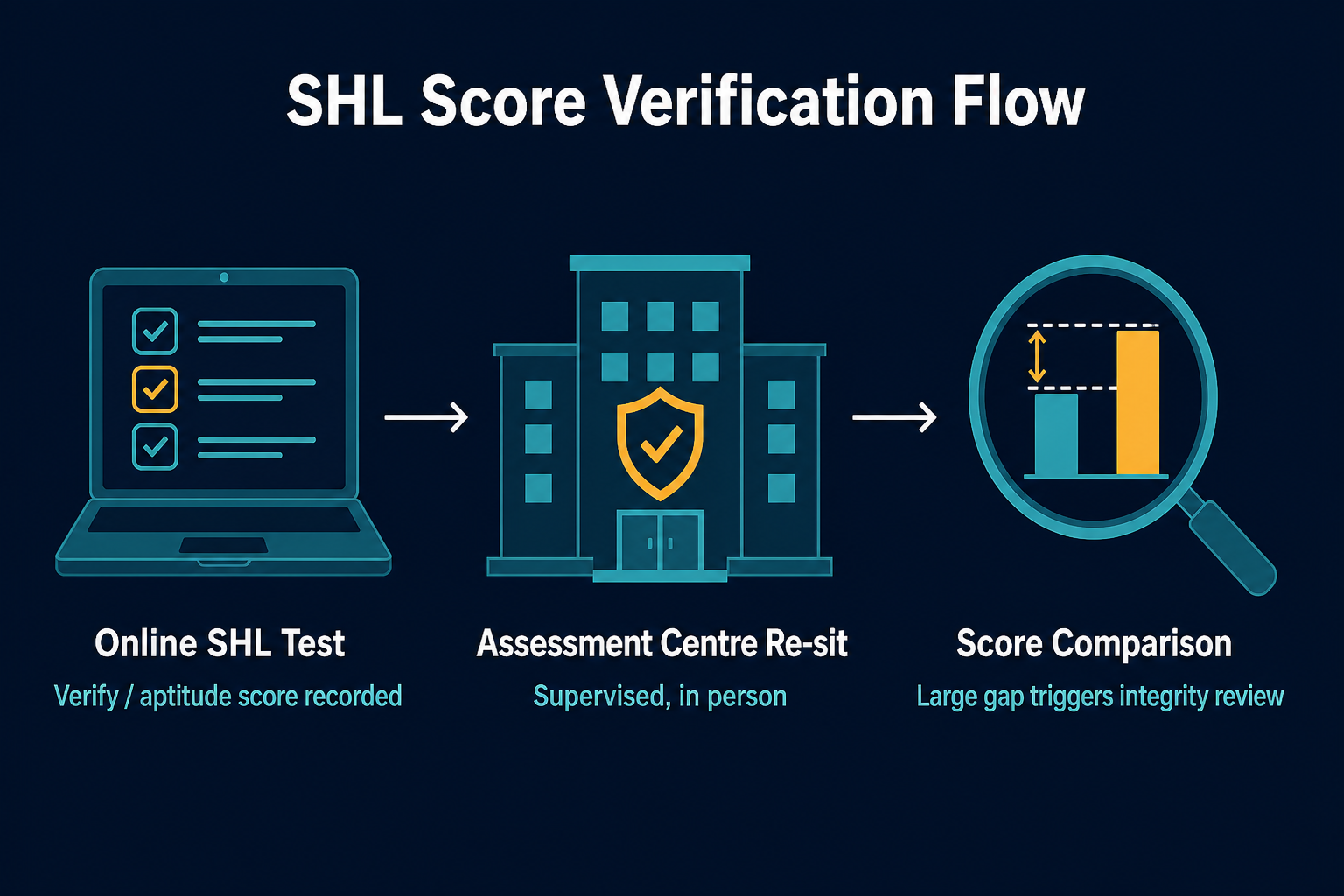
Here's the mechanism most guides skip, because it isn't a digital feature at all: SHL is used overwhelmingly for large-scale graduate and campus hiring — the kind of pipeline run by firms like Deloitte, Unilever, and major banks — and almost none of them treat your online score as the final word. The standard next step is a supervised re-sit, or a closely related verification exercise, at an in-person assessment centre.
That re-sit is the actual catch. If your online result and your supervised result are close, nobody looks twice. If there's a significant gap — you score well above your typical range online, then noticeably worse under supervision — that discrepancy itself is the flag, and it's a much harder thing to explain away than a browser-tab log. HR doesn't need to prove how the online score was inflated; they just need to show the two numbers don't match, and ask why.
One long-running candidate forum thread on Whirlpool captures this dynamic directly, describing a candidate at a PwC assessment centre who scored well below their online result: "there was a PWC guy who went to his AC, he absolutely got owned at the verification test there and he was pointed and told off by the HR... SHL is to test ur honesty as well, not just brilliance." Whatever the exact circumstances, the pattern candidates describe consistently is the same one SHL's own process is built around: online score first, supervised confirmation second, and a gap between the two is what actually matters.
Can AI Tools Like ChatGPT Boost Your Score?
Not as reliably as it might seem. SHL's own blog on ChatGPT and talent assessment describes internal testing where ChatGPT got a meaningful share of Verify items wrong — so leaning on an AI tool mid-test doesn't guarantee a better score, and it can produce an online result you then can't replicate at the in-person stage. Combined with the re-sit mechanism above, that's a worse position than simply performing at your actual level online: you've created a gap you now have to explain.
Does SHL Refresh Its Question Bank?
Yes. SHL periodically rotates its item banks and flags questions that surface on answer-sharing sites as compromised. This is part of why searching for a static "SHL answer key" is less reliable than it sounds — the specific items you're served aren't guaranteed to match what's circulating online, and using memorized answers for the wrong version of a test is its own way of producing a score that doesn't hold up under a re-sit.
What This Means If You're Prepping for an SHL Test
The version of this that doesn't risk an offer is straightforward: practice enough that your online score and your in-person score would land in the same range regardless of which one someone checked. Where a tool like AceRound AI actually fits your process is a different stage entirely — the live interview rounds that typically follow an SHL screen, where you're explaining your reasoning out loud rather than answering inside a locked-down test window. If your pipeline runs other assessment platforms alongside SHL, our breakdowns of Mercer Mettl's proctoring, Vervoe's detection setup, and HackerEarth's cheating detection cover how each platform's approach differs.
FAQ
Does SHL detect cheating?
Yes, through more than one layer. During the online test, SHL's TalentCentral platform can log browser focus and tab-switching, monitor clipboard activity, capture periodic screenshots, and run webcam checks for multiple faces or a candidate leaving frame. The layer that matters most for graduate-scheme hiring, though, is what happens after: a supervised in-person re-sit at an assessment centre that directly checks whether your online score reflects your own ability.
What is the SHL assessment-centre re-sit and why does it matter more than online monitoring?
Most large employers using SHL for graduate or campus hiring don't treat the online score as final — they bring shortlisted candidates to an assessment centre for a supervised re-sit or a closely related verification exercise. If your in-person result is significantly below your online score, that gap itself becomes the flag, triggering an integrity review regardless of whether the online monitoring caught anything. This catches score inflation that purely digital signals can miss.
Can ChatGPT or AI tools boost your SHL Verify score without getting caught?
SHL's own testing, described on its blog, found that ChatGPT answered a meaningful share of Verify items incorrectly — meaning leaning on AI mid-test doesn't guarantee a higher score, and can actively produce a score you then can't replicate under supervision. Combined with the assessment-centre re-sit, a large online/offline gap is the outcome that actually gets you flagged, not just AI use in isolation.
Does SHL refresh its questions to stop answers from being shared or memorized?
Yes. SHL periodically rotates and refreshes its question banks and flags items that show up on answer-sharing sites as compromised, which is part of why searching for a fixed "answer key" to a current SHL test is less reliable than candidates assume.
What actually triggers an SHL integrity review?
The most consistent trigger described by candidates and reviewers is a material mismatch between your online result and your supervised assessment-centre result — not a single suspicious moment during the online test. A large gap prompts HR to ask, directly, why your two scores don't match, which is a harder conversation to talk your way out of than any browser-monitoring flag.
Author · Alex Chen. Career consultant and former tech recruiter. Spent 5 years on the hiring side before switching to help candidates instead. Writes about real interview dynamics, not textbook advice.
Related Articles
InterviewPal Alternative: What Reviewers Say Before You Switch
Looking for an InterviewPal alternative? No technical-interview support, hard session cutoffs, and slow responses are the top complaints — here's what to check first.
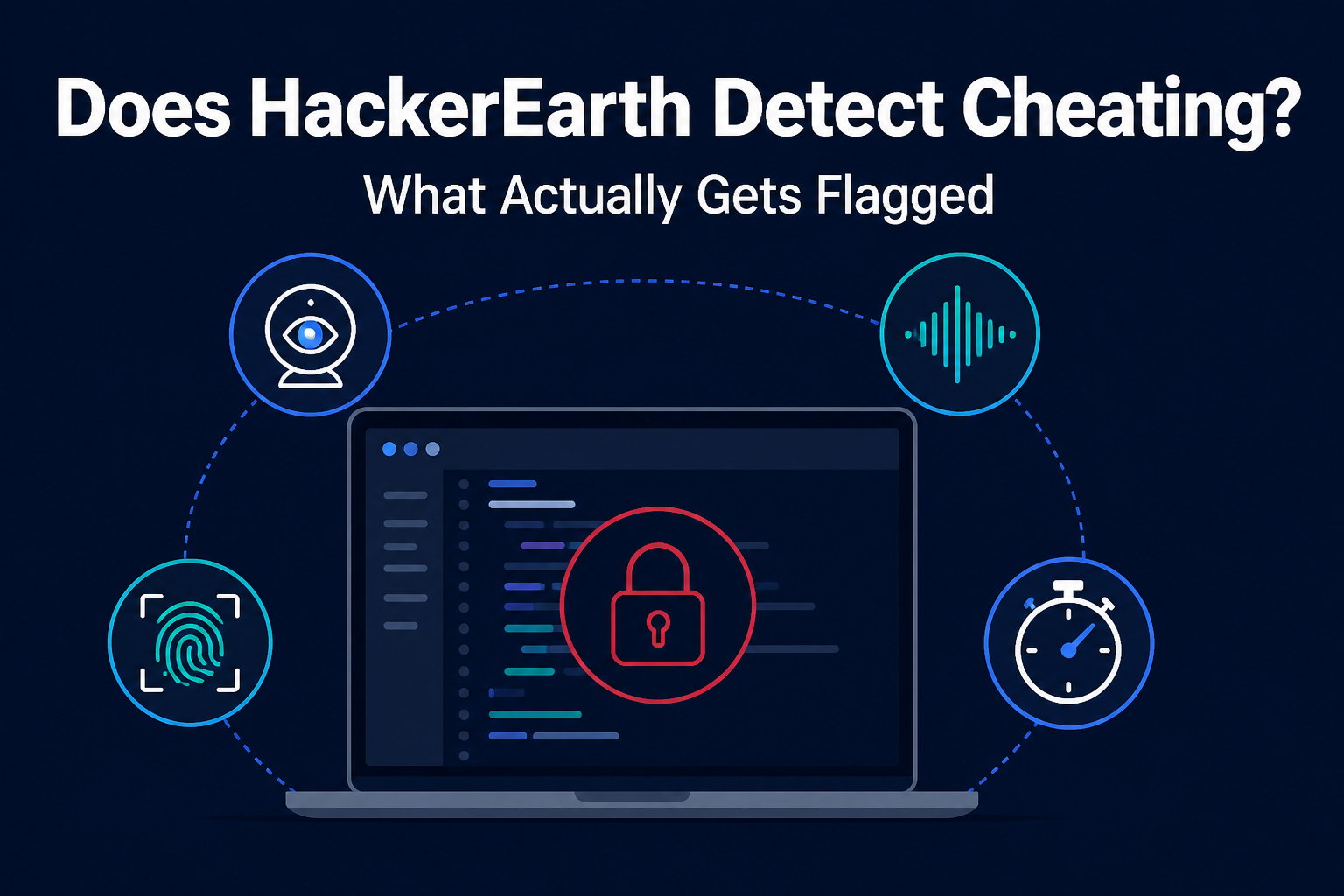
Does HackerEarth Detect Cheating? What Gets Flagged
Does HackerEarth detect cheating? Smart Browser lockdown, AI eyeball tracking, and a plagiarism engine that catches renamed variables — here's what actually gets flagged.

Claims Adjuster Interview Questions (2026)
Claims adjuster interviews run in two stages - a one-way recorded video screen, then a live panel. Here's how to prep for both, with real questions.