Does HackerEarth Detect Cheating? What Gets Flagged
Does HackerEarth detect cheating? Smart Browser lockdown, AI eyeball tracking, and a plagiarism engine that catches renamed variables — here's what actually gets flagged.
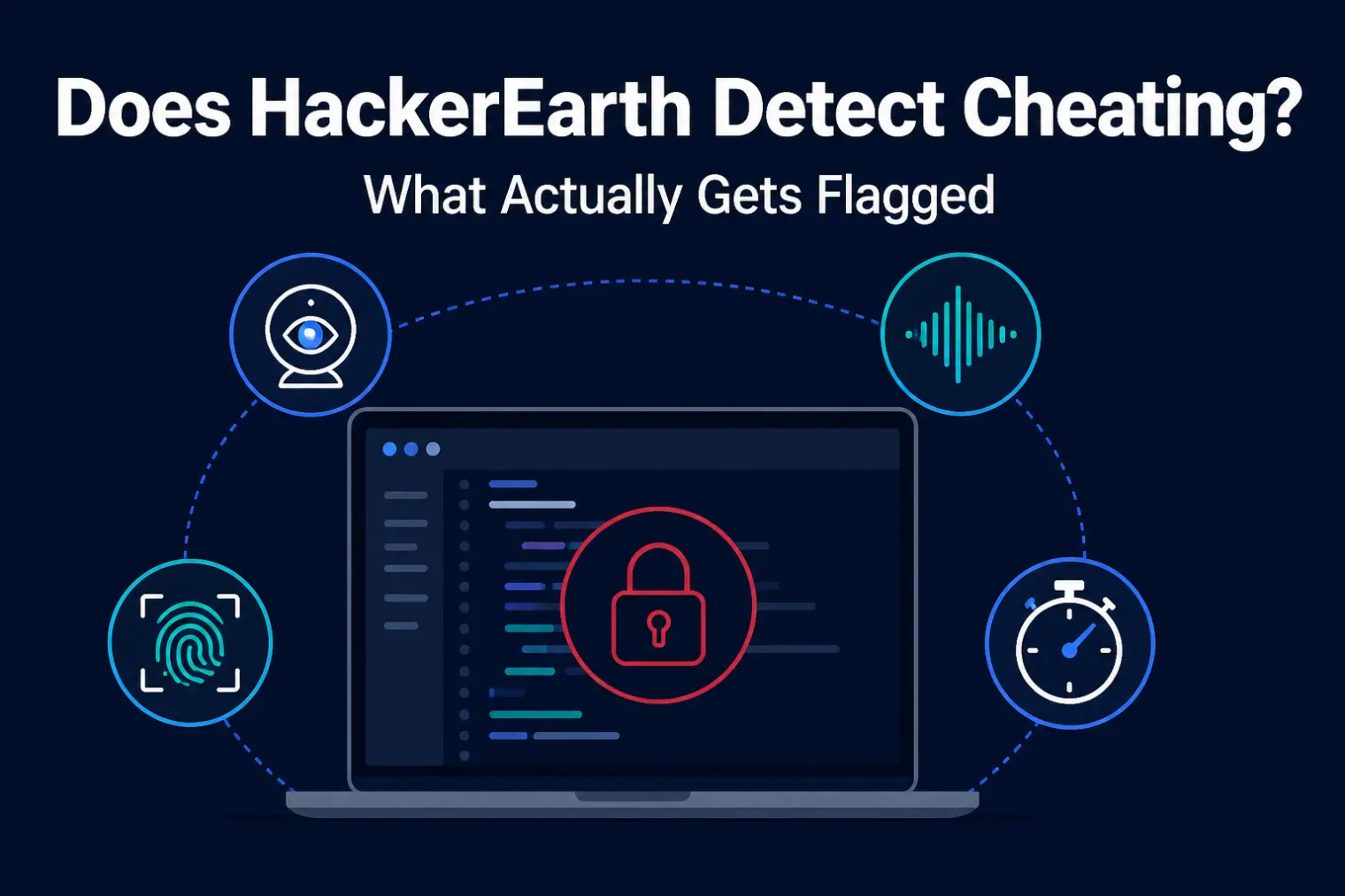
TL;DR: Does HackerEarth detect cheating? Yes — its Smart Browser locks down the test environment, AI-powered webcam snapshots and eyeball tracking watch for suspicious behavior, audio monitoring listens for a second voice, and a machine-learning plagiarism engine catches renamed-variable and reordered-logic copies that simple text matching would miss. The detail most guides skip: submitting a full solution within seconds, or many near-identical "probe" attempts in a row, is what actually draws attention — not just having a second monitor.
You've got a HackerEarth assessment link and a countdown timer, and you have no real idea what the test environment can actually see. That uncertainty is the whole problem. HackerEarth's own proctoring adoption among assessment customers rose from 64% to 77% in the first half of 2026 alone — you're now more likely than not to be monitored on any given HackerEarth OA, and most of what ranks for this question is either HackerEarth's own sales copy aimed at recruiters, or a "how to outsmart HackerEarth proctoring" tool pitch that overstates how invisible anything really is.
What Smart Browser Actually Locks Down
HackerEarth's Smart Browser is a mandatory downloaded application for proctored assessments, not just a browser tab restriction. Per HackerEarth's own feature page, it enforces full-screen lockdown for the duration of the test and blocks:
- Alt+Tab / window switching away from the test
- Virtual machines and screen-sharing software
- Browser developer tools
- Copy-paste in and out of the test window (in the most locked-down configurations)
- Multiple connected monitors, which triggers a visible on-screen warning
Like Mettl and TestGorilla's equivalent lockdown modes, how much of this is actually turned on depends on how the employer configured the specific assessment — a high-volume screening round and a final-round take-home for a senior engineer are not guaranteed to run the same settings.
Does HackerEarth Use Your Camera?
When webcam proctoring is enabled, HackerEarth's AI-powered monitoring captures periodic snapshots and runs eyeball-tracking analysis rather than continuously recording and reviewing full video in every configuration. It's built to flag patterns — repeatedly looking off-screen, a second face entering the frame, or audible conversation — not a single half-second glance away from the screen. HackerEarth's plagiarism and integrity documentation frames these as signals that route into a report, not automatic failures.
Can HackerEarth Detect ChatGPT or AI-Generated Code?
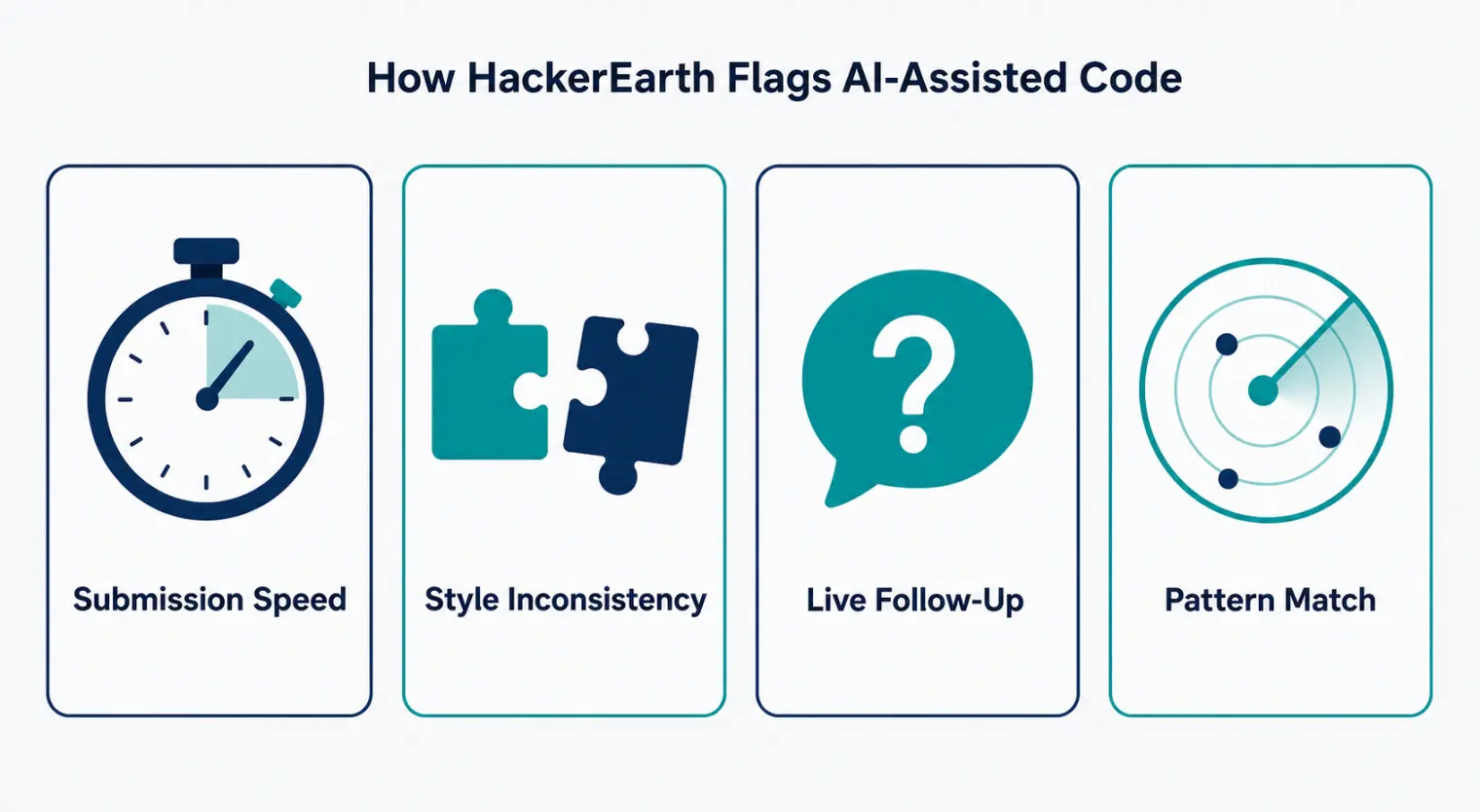
HackerEarth's own blog on ChatGPT in hiring assessments describes several methods aimed specifically at AI-assisted answers, not just copied human code:
- Submission speed — a complete, working solution appearing within seconds of opening a hard problem is a stronger signal than the code itself.
- Style inconsistency — code that doesn't match a candidate's own style and skill level shown earlier in the same test.
- Live follow-up questions — being asked to explain the logic you just submitted, in your own words, in real time.
- Pattern matching against known AI output — comparing submissions against common structures large language models tend to produce for standard problems.
None of these individually proves AI use. Together, they're what a reviewer looks at when deciding whether to flag a submission for a closer look.
The Plagiarism Engine: Why Renaming Variables Doesn't Work
HackerEarth states its plagiarism checks go beyond simple text or string matching to catch structural similarity — the same underlying logic with variables renamed or statements reordered can still register a high match score, because the engine is comparing code structure and pattern, not literal characters. A similarity score above a set threshold flags both submissions for review, whether the match is with another candidate's code or with public code from prior test banks.
The Real Red Flag: Submission Rhythm, Not a Second Monitor
The detail most competing guides don't mention: HackerEarth's system is described as watching submission rhythm, not just final answers. Two patterns are specifically unusual enough to draw attention on their own:
- Instant full-solution pastes — a complete, working answer appearing within seconds of a problem loading, with no visible iteration.
- Rapid "probe" submissions — a burst of 20–50 near-identical attempts in a short window, each tweaking one small condition, which looks more like testing an external answer than writing original code live.
Neither pattern requires webcam access or plagiarism matching to flag — the submission log alone is enough. That's a meaningfully different risk profile than "am I being watched," and it's the one most cheat-tool marketing glosses over.
How to Actually Prepare
The version of this that doesn't put an offer at risk is knowing the material well enough that you don't need a workaround live, on a monitored screen, during a timed OA. Where a real-time copilot like AceRound AI actually fits is the live technical interview that usually follows a HackerEarth-style screen — the round where you're explaining your reasoning out loud to an engineer, not typing into a locked-down test window. If your process runs other assessment platforms alongside HackerEarth, our breakdowns of HackerRank's detection setup, Codility's proctoring stack, and live coding-interview prep with AI cover how the approach differs platform to platform.
FAQ
Does HackerEarth detect cheating?
Yes, through several independent layers rather than one check. HackerEarth's Smart Browser locks down the test environment, AI-powered snapshots and eyeball tracking flag suspicious webcam behavior, audio monitoring listens for coaching, and a machine-learning plagiarism engine compares code structurally, not just line by line. Most flags feed a report a recruiter reviews rather than triggering an instant disqualification.
Does HackerEarth use your camera?
When webcam proctoring is enabled for an assessment, yes — but it's typically periodic snapshots and eyeball-tracking analysis, not continuous recorded video in every configuration. It flags things like looking off-screen repeatedly, another face entering frame, or talking to someone nearby.
Can HackerEarth detect ChatGPT or AI-generated code?
HackerEarth's own blog describes multiple detection methods aimed at AI-assisted answers: unusually fast full-solution submissions, code-style inconsistency versus a candidate's earlier answers, and live follow-up questions that ask you to explain logic you just submitted. None of these prove AI use on their own, but together they build a pattern a reviewer can act on.
Will renaming variables get past HackerEarth's plagiarism check?
No. HackerEarth states its plagiarism detection goes beyond text matching to catch structural similarity — the same logic with renamed variables or reordered statements can still trigger a high similarity score, because the engine compares code structure and pattern, not just literal text.
What actually gets flagged fastest on HackerEarth?
Submission rhythm that doesn't look human: pasting a complete working solution within seconds of opening a problem, or submitting many near-identical "probe" attempts that each tweak one small thing in rapid succession. Both patterns are unusual enough to draw attention on their own, separate from webcam or plagiarism flags.
Author · Alex Chen. Career consultant and former tech recruiter. Spent 5 years on the hiring side before switching to help candidates instead. Writes about real interview dynamics, not textbook advice.
Related Articles
Meesho SDE-1 Interview Process for Freshers: Three 2025 Accounts Compared
Meesho SDE-1 campus accounts from 2025 disagree on test length, round order and design format. Here is what each reported and how to prep for any of them.
Atlassian Software Engineer Interview: Karat Screen, Craft Round and the Values Interview
How Atlassian's engineering loop works, from the Karat screen to the values round, what is official and what candidates report, including the AI-assisted rounds.
LinkedIn's AI-Enabled Coding Interview: What Candidates Report and How to Prepare
LinkedIn reportedly swaps one coding round for a CoderPad session with an AI panel. Here is the reported format, what gets scored, and what is unconfirmed.