Does CoCubes Detect Cheating During the Online Assessment?
CoCubes (an Aon platform) proctors off-campus drives with real AI monitoring — what it actually watches, what candidates report, and where prep helps.
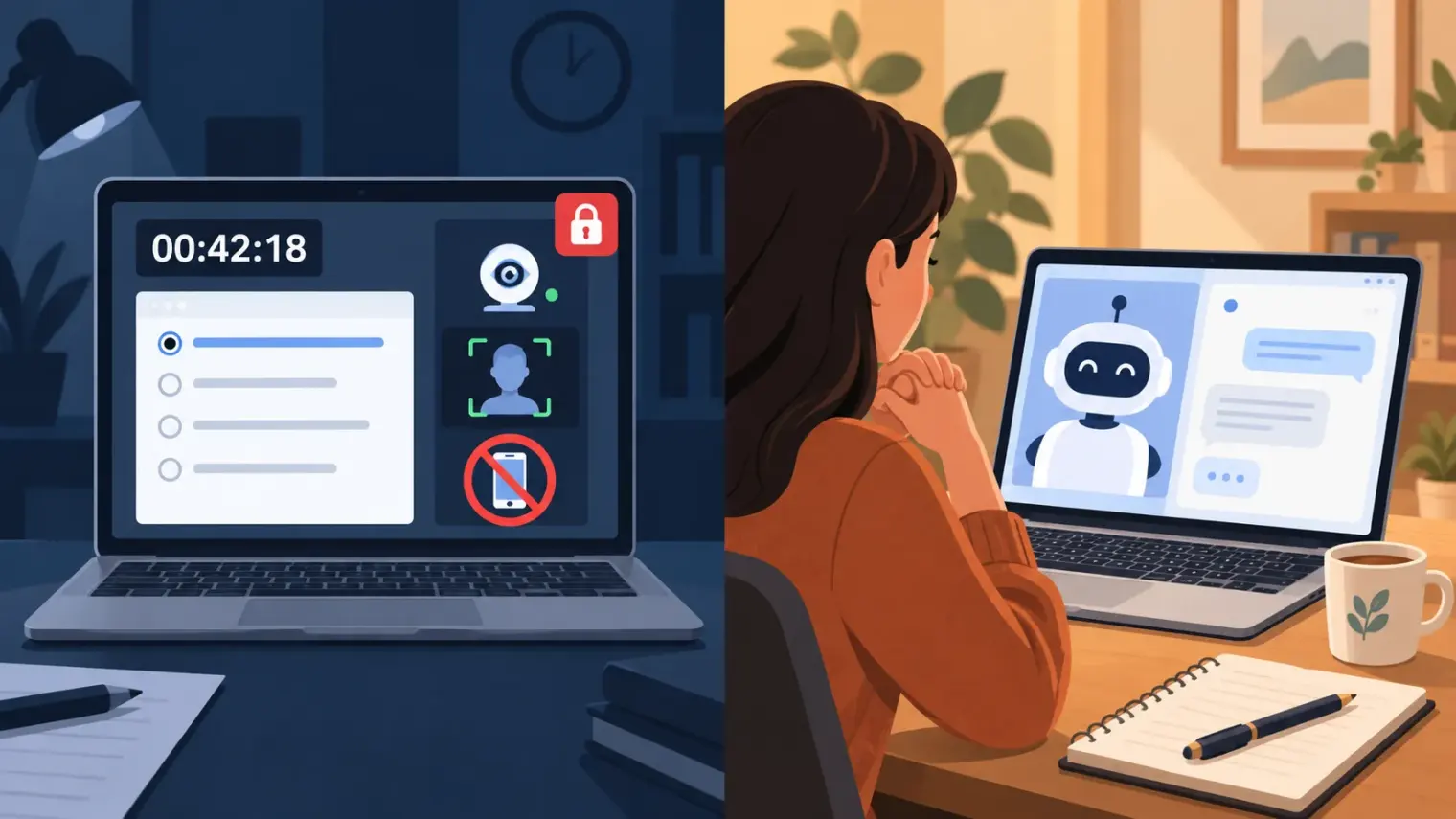
TL;DR: CoCubes — now an Aon-owned platform, still branded and run at cocubes.com — proctors off-campus drives for employers like Cognizant with a real AI monitoring stack: webcam and face detection, tab-switch tracking, object detection for phones and books, audio-anomaly checks, and environment scans. It isn't a rumor or marketing fluff; it's a mix of algorithmic flagging and human review. What candidates actually complain about most isn't clever cheating slipping through — it's the app itself: false "camera not working" warnings, blurry photo captures, and support that's slow to respond. Knowing which part is real risk and which part is just an unreliable app changes how you should actually prepare.
If you've got a Cognizant or other off-campus drive coming up that mentions CoCubes, you've probably already seen the word "proctored" somewhere in the instructions. What most prep content doesn't tell you is what that word actually means in practice — which checks are real, which complaints are about detection versus about the app crashing, and where AI preparation is genuinely fine to use versus a real risk.
What CoCubes Actually Is
CoCubes Technologies was acquired by Aon Hewitt in November 2016 and now operates as part of Aon's assessment business, sometimes referenced as "Aon-CoCubes" in official materials, but still marketed and run under the CoCubes name at cocubes.com. It's used by corporates for both campus and off-campus hiring, mostly aimed at final-year engineering and MBA freshers. Cognizant is the employer most consistently associated with routing its off-campus drive through CoCubes; other large IT-services and product companies use it in some hiring cycles, often alongside proprietary tests or other off-campus gateways like AMCAT and eLitmus, which we've covered separately.
The test itself is modular — CoCubes lets a hiring company configure up to six sections for a given drive: Aptitude (quantitative, logical, verbal reasoning — commonly around 45 questions in 45 minutes), Computer Fundamentals, Psychometric, Domain-specific questions, Coding (typically Python, C++, or Java), and Written English. Not every drive runs every section; what you actually sit depends entirely on what the employer selected.
What CoCubes Actually Monitors
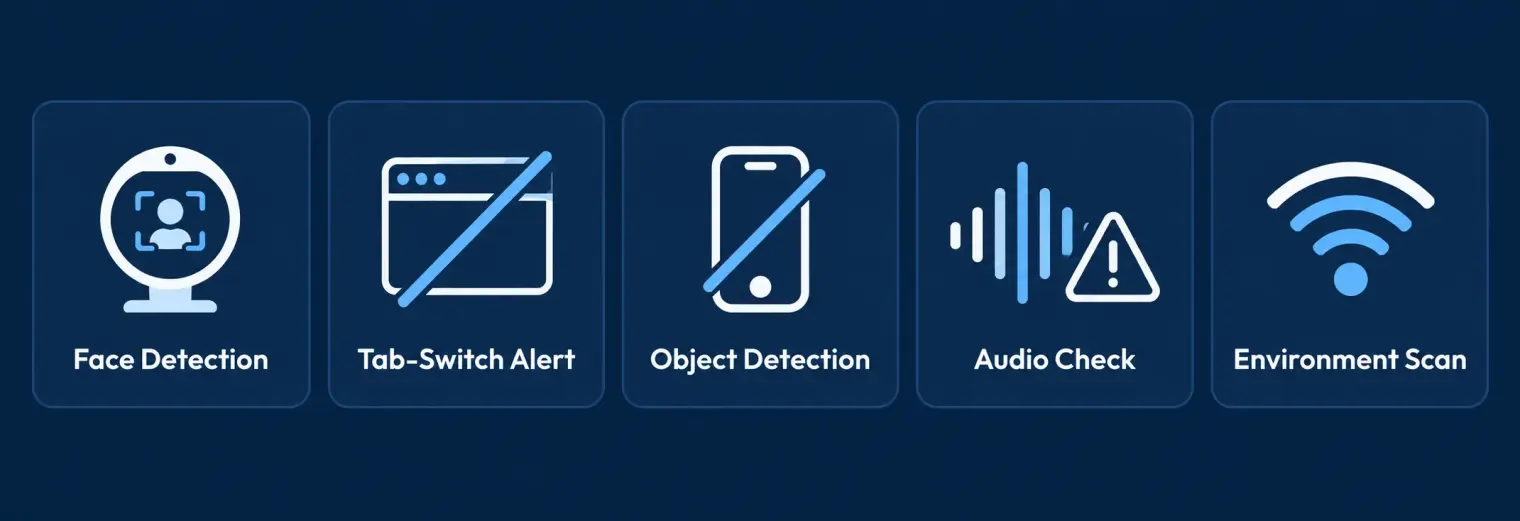
This is where it's worth being precise instead of relying on rumor in either direction. CoCubes' own product pages describe a genuine AI/remote-proctoring stack, not just a locked-down browser window:
- Webcam and mic monitoring runs throughout the test, with continuous face detection that flags when your face isn't visible or when a second face enters frame.
- Tab-switching and window-focus tracking logs when you leave the test window, which is standard behavior across this entire category of remote-proctoring platform — comparable to how HackerRank monitors focus or how TCS iON handles the same problem.
- Object detection is aimed specifically at phones, books, and other physical aids showing up in frame.
- Audio-anomaly detection flags unusual sound patterns — a second voice, background conversation, unexpected volume spikes.
- Environment checks — Wi-Fi, Bluetooth, location, and connected-device status — exist mainly to catch a second device being used to look something up while your primary camera stays fixed on your face.
CoCubes' own marketing language about "proprietary algorithms" and near-perfect accuracy is vendor puffery worth being skeptical of — there's no independently verified detection rate published anywhere, and flags appear to get reviewed by a mix of automated system and human invigilator rather than resulting in instant, guaranteed termination every time.
What Candidates Actually Report
The real-world complaint pattern is telling: it clusters around app reliability, not around clever cheating slipping through undetected. Recurring reports on prep forums and support threads describe the camera being flagged as "not working" while the candidate is clearly sitting in frame, blurry or uneditable photo captures during the ID-check step, and "audio disconnected" warnings appearing well after the initial mic check already passed. None of that is a sophisticated detection failure — it's an unreliable client app, and support response through the listed CoCubes support channel is described as slow.
On the cheating-detection side specifically, a widely-read Quora thread asks directly how candidates who opened a new tab to search for answers on the same computer were still able to submit their test. The honest answer, based on what's actually described there: the attempt got flagged for review after submission rather than blocked instantly and in real time. That's a meaningful nuance for an honest answer to "does CoCubes detect cheating" — the system is watching, but not every violation triggers an immediate, live-blocking response. A flag that surfaces after you've already submitted is still a flag.
Where AI Preparation Actually Fits
The useful distinction, once you see the monitoring clearly: don't touch any live assistance during the actual proctored window. A second window, a second device, or unusual on-camera behavior during a locked session is precisely what this stack — webcam, tab-tracking, object detection, environment scan — exists to catch, whether the consequence lands live or after you submit. That's not a risk worth taking for an aptitude or coding section you can just as easily prepare for ahead of time.
Preparation is a different story entirely, because it happens outside the monitored window. AceRound AI's Coding Test Copilot is built for timed practice against a format that matches what you'll actually sit — useful for calibrating pace against a CoCubes-style aptitude-plus-coding combination before test day, not during it. If your drive pairs the CoCubes test with a technical or HR interview afterward, the mock interview mode lets you rehearse the verbal, think-aloud version of your answers so the live panel isn't the first time you've said them out loud. For the broader off-campus landscape — AMCAT, eLitmus, and how service-based companies structure their pipelines — our AMCAT/eLitmus off-campus guide covers the rest of that gateway.
FAQ
What is CoCubes and which companies use it?
CoCubes is an online assessment and remote-proctoring platform used by corporates for campus and off-campus hiring, primarily targeting final-year engineering and MBA freshers. It was acquired by Aon Hewitt in 2016 and now runs as part of Aon's assessment business, still marketed under the CoCubes name at cocubes.com. Cognizant is the most commonly cited large employer that routes its off-campus drive through CoCubes; other IT-services and product companies use it in some cycles alongside their own proprietary tests or other aggregators like AMCAT and eLitmus.
Does CoCubes actually detect cheating during the test?
Largely, yes — it runs a real AI/remote-proctoring stack, not just a locked browser. That includes webcam and mic monitoring throughout the test, face detection that flags an absent or second face, tab-switch and window-focus tracking, object detection aimed at phones and books, audio-anomaly detection, and environment checks (Wi-Fi, Bluetooth, location) meant to catch a second device being used to look up answers. Flags get reviewed, sometimes in real time and sometimes after you submit, by a mix of algorithm and human invigilator — so it's monitored, but not a flawless, instant lockdown for every violation.
Is there negative marking in the CoCubes test?
Prep-forum consensus (PrepInsta, hitbullseye, faceprep, GeeksforGeeks) repeatedly flags "no negative marking" as a reassurance point for the aptitude section, though the exact rule depends on which sections a given employer configures for their drive — CoCubes lets companies pick from aptitude, computer fundamentals, psychometric, domain, coding, and written-English modules, so always confirm the specifics in your own test instructions rather than assuming a blanket rule.
What happens if my camera or audio has an issue during the test?
This is the most common real complaint, more than sophisticated cheating detection: candidates report the app flagging "camera not working" while they're clearly sitting in frame, or "audio disconnected" warnings appearing after the initial checks already passed. The proctoring stack treats these as environment risks the same way it treats a second face or a dropped connection, so a stable setup — good lighting, a tested webcam and mic, and a private room — matters as much as your actual prep.
Can someone cheat on CoCubes by opening a new tab on the same computer?
A widely-read Quora thread on exactly this question suggests the answer is nuanced: candidates describe attempts getting flagged for review after submission rather than blocked instantly in real time, which means detection isn't always live-blocking. That's not the same as saying it's undetected — it means the review can happen after the fact, and a flagged result is still a flagged result. Treat any tab or window switch outside the test as visible to the system, whether the consequence lands during the test or after.
Is it safe to use AI to prepare for a CoCubes-proctored drive?
Yes, and this is the distinction most guides blur. Using AI live during the proctored test is exactly the kind of thing this monitoring stack exists to catch — a second device, a second window, or unusual behavior during a locked session is a real risk, not a hypothetical one. Using AI beforehand to rehearse the sections you'll actually face, at the pace you'll actually face them, happens entirely outside the monitored window and carries none of that risk.
Author · Alex Chen. Career consultant and former tech recruiter. Spent 5 years on the hiring side before switching to help candidates instead. Writes about real interview dynamics, not textbook advice.
Related Articles
Micro1's Zara AI Interview: What It Actually Tests (And Why Timing Gets Flagged)
Micro1's AI interviewer Zara has run 300,000+ interviews for remote roles. Here's why it flags response latency as a cheating signal, and what that means for AI prep.
Anthropic's AI Interview Policy Explained: Where Claude Is Banned, Where It's Required
Anthropic makes Claude, then bans it from most of its own interview. Here's the stage-by-stage AI policy, and why the take-home test keeps changing.
Wonderlic Test in 2026: Is It Proctored, and Where Does AI Help Fit?
The Wonderlic comes in two formats: a proctored test and an unproctored take-home QuickTest. Here's what separates them and where outside help is possible.