Atlassian Software Engineer Interview: Karat Screen, Craft Round and the Values Interview
How Atlassian's engineering loop works, from the Karat screen to the values round, what is official and what candidates report, including the AI-assisted rounds.
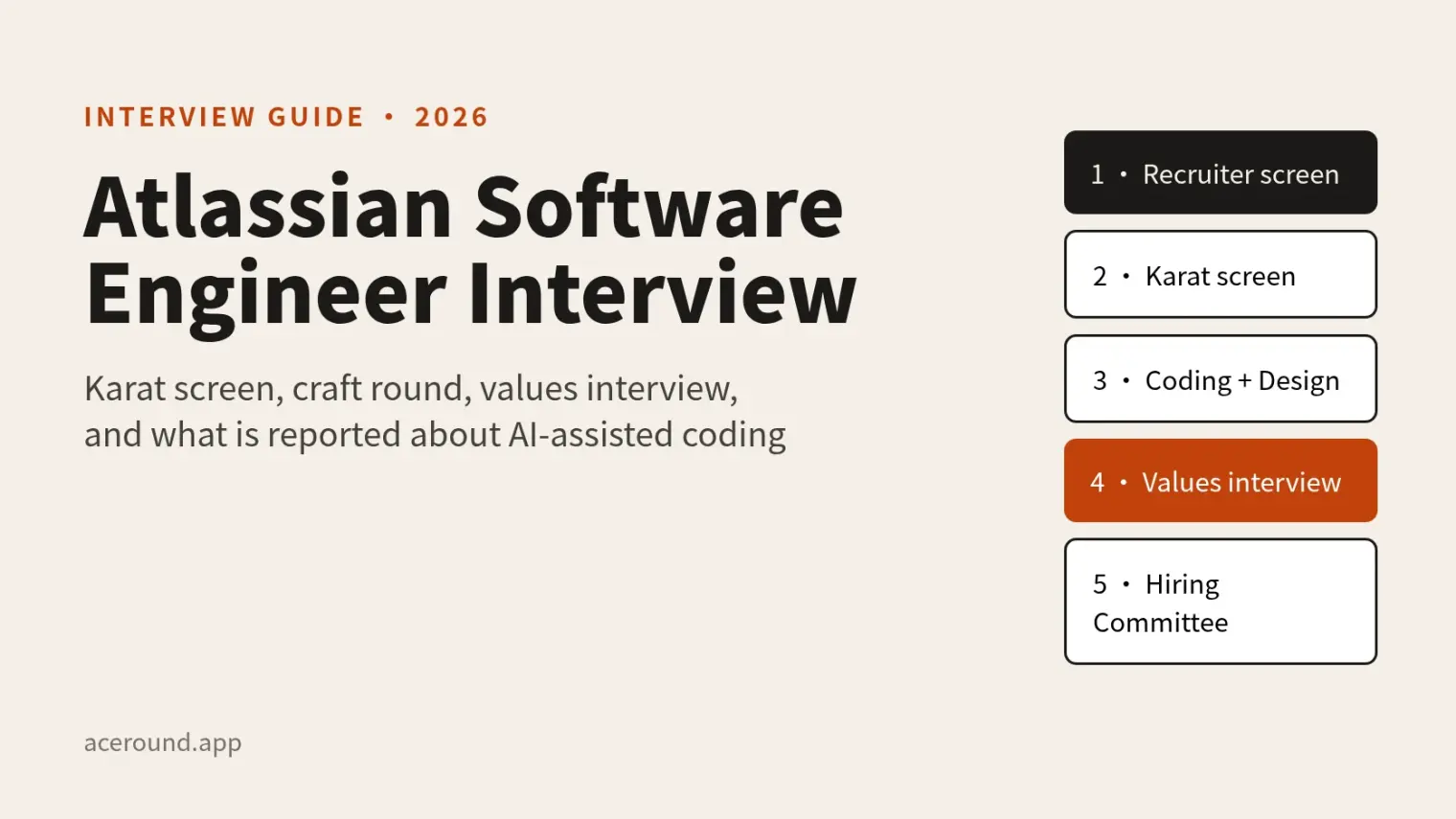
TL;DR: Atlassian publishes more about its engineering interviews than most companies. Coding has two parts (Data Structures and Code Design), system design runs 60 minutes and is built to "ladder" with harder follow-ups, and there's a separate values interview, usually with someone outside your team. Candidates add a Karat-run first screen and, in 2026, repository-style rounds with a built-in AI agent. The first part is official; the second is reported.
Source note: the loop below comes from Atlassian's Engineering Interview Guide and its values page. The Karat details come from Karat's case study of Atlassian. Round lengths other than system design, specific questions and the AI-assisted format come from third-party candidate write-ups and are marked as reported.
Most interview guides for a company this size are a pile of recycled Glassdoor snippets. Atlassian is easier, because the company writes down what each round is for. The useful work is separating what it says from what candidates say, then preparing for the part nobody tells you: how the two fit together.
The Loop, Round by Round
Recruiter call and Karat screen (reported)
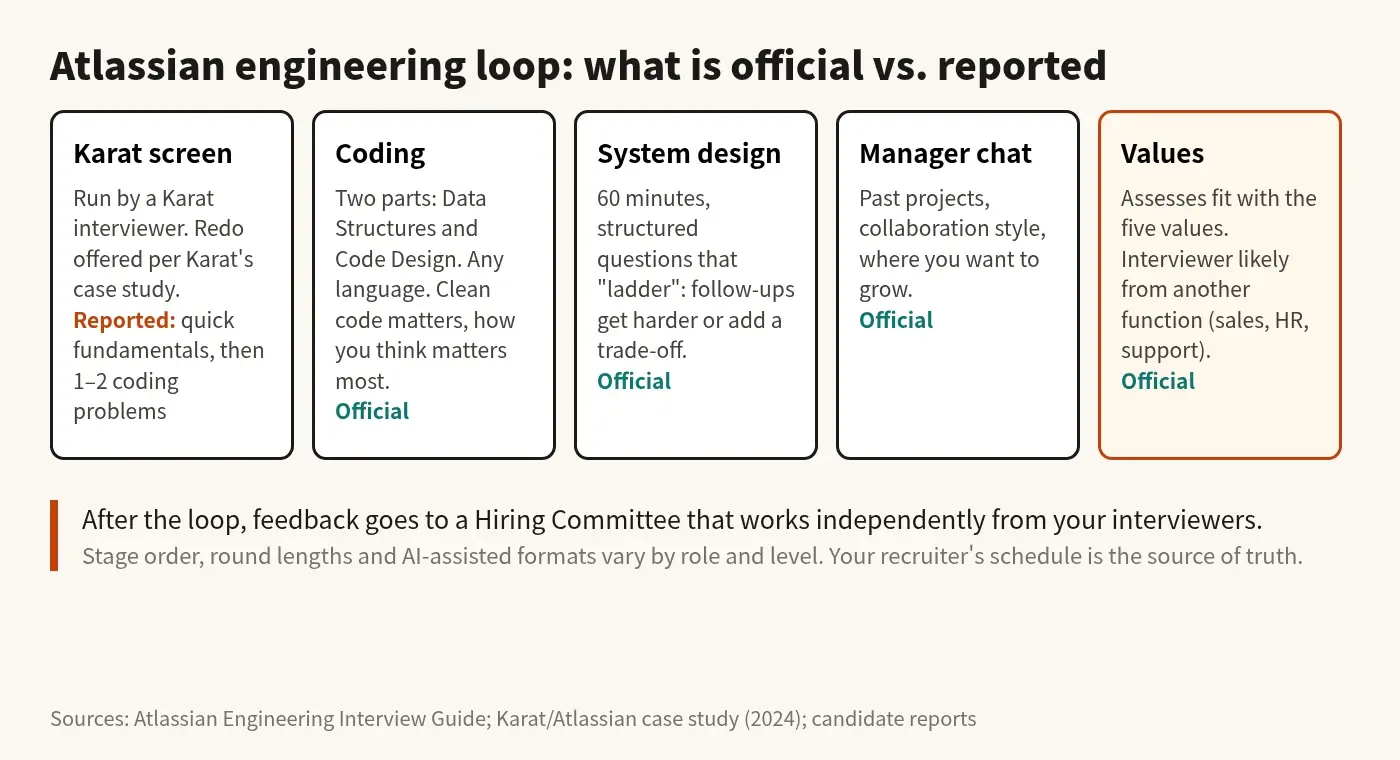
Candidate write-ups describe a recruiter conversation about your background, location and level, then a technical screen run by a Karat interviewer. Karat's case study confirms Atlassian uses Karat's scheduling (including same-day, evening and weekend slots) and Redo interviews, where a candidate can retake the first-round technical interview if they feel they didn't do their best.
Third-party guides say the screen often opens with quick fundamentals questions and then one or two coding problems. That's reported, not published by Atlassian, and Karat's own page doesn't describe the format. If you want a feel for how Karat sessions run, see our Karat interview guide.
Coding: Data Structures, then Code Design (official)
Atlassian says the coding stage has two parts, Data Structures and Code Design, drawn from a bank of questions. Three details from the guide matter:
- You choose the language. The guide says the interviews are different from a traditional technical interview for that reason.
- Clean code matters, but thinking matters more. They want to see how you handle trade-offs "like verbosity versus optimization."
- Missing a line is not a deal-breaker. The guide says it won't cost you the job.
Candidate guides describe the Code Design round as a small real-world build, for example a popularity tracker with increasePopularity and getMostPopular methods, or a debounced search bar for frontend roles. Treat those as examples of the shape, not a question list. The shape is: write extensible, readable code, handle tie-breakers and edge cases, and test it yourself without being asked.
System design (official)
Sixty minutes, with structured questions chosen by the interviewer. Atlassian says the goal isn't code but understanding "how you explore an issue—what questions you would ask, how you'd talk through constraints like reliability and cost, who you might partner with for help, and which technologies you'd use."
The part worth planning around: the questions are designed to "ladder." Follow-ups get harder or easier depending on how you do, and they may add a new trade-off to see how you adjust. Atlassian calls that how it assesses learning agility. So there's no point memorizing one finished architecture. Practice changing your design when a constraint changes. Our system design guide covers the structure.
Manager interview (official)
Usually one-on-one with the hiring manager or a more senior manager. It covers who you are today and where you want to go, plus how you work: expect to describe a past project, who you worked with, the technical challenges and the business reason for it.
Values interview (official)
This is the round candidates talk about most. Atlassian says it assesses alignment with its five values, and that your interviewer likely won't be on the team you're joining. It could be someone from sales, HR or customer support. The questions are a guide for a fairly informal conversation, and the stated goal is to understand your mindset and how it guides your actions.
Several third-party guides claim a weak values result can sink an otherwise strong technical loop. Atlassian doesn't say that, so I'd read it as the reported pattern rather than policy. Either way, prepare for it as a real round.
Hiring Committee (official)
After the interviews, feedback is consolidated and, if there's a fit, reviewed by a Hiring Committee that works independently from your interviewers and sees only specific information such as interview feedback and your CV.
Preparing for the Values Round
The five values, from Atlassian's values page:
- Open company, no bullshit. Openness by default; speaking your mind takes "brains, thoughtfulness and caring."
- Build with heart and balance. "Measure twice, cut once", passion and urgency alongside care.
- Don't #@!% the customer. Consider the customer perspective collectively, not just a handful.
- Play, as a team.
- Be the change you seek.
A practical way to prepare: pick two past projects and for each one write down a moment that fits a value. A time you told a team a hard truth early, a time you slowed down to get something right before shipping, a time you changed a decision because of what customers needed. Then say it plainly. Our behavioral interview guide has a structure for the stories.
What Candidates Report About AI-Assisted Rounds
I couldn't find an Atlassian page that sets a policy on AI tools for interviews. What exists are candidate reports. According to a PracHub guide dated August 2026, some internship candidates described an interviewer-present round with a repository open in HackerRank's IDE, with Plan and Agent modes available, followed by debugging or building a feature. The guide itself says Atlassian's public handbook doesn't describe one universal AI-enabled round for every role or region.
HackerRank's own product supports this kind of session. Its documentation, as summarized in that guide, says interviewers can watch prompts and responses live and the report can include the chat transcript. If you hit this format, your prompts are part of what's being evaluated. Our HackerRank AI-assisted interview guide covers how the environment behaves.
What that means for preparation, if you're told your round is repository-based:
- Read before you prompt. Find the entry point, the tests and the conventions first.
- Keep changes small. One bounded task per prompt, then run the narrowest relevant test.
- Read the diff. Be able to say why each change is there.
- Narrate. Atlassian's guide stresses communication, and it says "we're here to help you, not to stump you. If you don't know what to do, say so!"
Don't assume a tool allowed for someone else is allowed for you. The invitation or the interviewer decides.
A Four-Week Plan
- Week 1: data structures with tests. Solve each problem, then write the tests you would want a reviewer to see.
- Week 2: code design. Build small extensible things: a rate limiter, a leaderboard, a debounced component. Aim for clear names and obvious extension points.
- Week 3: system design with changing constraints. Have someone add "now it must be multi-region" or "now cost is capped" halfway through.
- Week 4: values stories and a full mock loop. Do one repository-style session if you can.
Using AceRound in the Prep
I'd use a tool for the practice side. A mock interview with follow-ups that change the constraint mid-answer is close to how Atlassian says its design questions behave. For live conversations such as the manager and values rounds, Interview Copilot can help you recover a thought when you lose the thread. Whether a tool is allowed in any given round is your call to check with the recruiter; Atlassian hasn't published a rule, so ask rather than assume.
FAQ
What is the Atlassian software engineer interview process?
Atlassian's guide describes coding (Data Structures and Code Design), a 60-minute system design interview, a manager interview, a values interview and a Hiring Committee review. Candidates also report a recruiter call and a Karat screen. Order and presence vary by role and level.
Does Atlassian use Karat?
Karat's case study says Atlassian used its 24/7 scheduling and Redo interviews. Candidates describe the first technical screen as Karat-run. It depends on role and region.
What is the Atlassian values interview?
A conversation about the five values, usually with someone from outside your team.
Can I use AI in an Atlassian interview?
No public policy turned up. Some 2026 internship candidates report a built-in agent in a HackerRank repository task. Use only what the invitation or interviewer allows.
Can I choose my programming language at Atlassian?
Yes, per Atlassian's guide. It adds that missing a line isn't a deal-breaker.
Author · Alex Chen. Career consultant and former tech recruiter. Spent 5 years on the hiring side before switching to help candidates instead. Writes about real interview dynamics, not textbook advice.
Related Articles
Meesho SDE-1 Interview Process for Freshers: Three 2025 Accounts Compared
Meesho SDE-1 campus accounts from 2025 disagree on test length, round order and design format. Here is what each reported and how to prep for any of them.
LinkedIn's AI-Enabled Coding Interview: What Candidates Report and How to Prepare
LinkedIn reportedly swaps one coding round for a CoderPad session with an AI panel. Here is the reported format, what gets scored, and what is unconfirmed.
Samsung R&D and Qualcomm India Interviews: What Past Candidates Reported
What 2019-2024 candidate accounts say about Samsung R&D Bangalore and Qualcomm India fresher interviews: test formats, rounds, and where they disagree.