System Design Interview Questions: The 2026 Prep Guide
System design interview questions for 2026: the 5-step framework, how Amazon, Google, and Meta's rounds differ, and why GenAI questions are now common.

TL;DR: A system design interview is graded on reasoning, not a right answer — five steps (clarify, high-level design, deep dive, scale, wrap-up) cover 90% of what gets asked. The 2026 bar is higher than it used to be: interviewers dig harder on cost and failure modes because more candidates are clearing the loop than there are open roles, and GenAI-flavored questions (RAG pipelines, LLM inference serving) now make up roughly half of FAANG-level rounds. This guide covers the framework, how company rounds actually differ, and where AI mock practice earns its place versus a static reading list.
A candidate who'd read the entire System Design Primer cover to cover still bombed his Meta onsite. Not because he didn't know what a load balancer does — he could draw one from memory. He froze when the interviewer asked, thirty seconds into his answer, "before you go further, how many users are we actually designing for?" He'd memorized architectures. He hadn't practiced being interrupted.
That's the gap this guide is built around. Knowing what a CDN is and knowing how to run a 45-minute conversation about when to use one are different skills, and only one of them gets tested for real in a system design interview.
What a System Design Interview Actually Tests
There's no test suite, no green checkmark, no single correct diagram. That's disorienting for candidates coming out of months of LeetCode grinding, where "correct" has a precise meaning. A system design round is closer to a working session with a skeptical colleague: you propose something, they push on it, and your score is built from how you handle the pushback — not from whether you land on the exact architecture the interviewer had in mind.
What's actually being evaluated:
- Structured thinking under ambiguity — do you ask clarifying questions before diving in, or do you start drawing boxes immediately?
- Trade-off reasoning — every design choice costs something. Interviewers want to hear you name the cost, not just the benefit.
- Communication under interruption — can you hold your structure together when someone stops you mid-sentence to change a constraint?
- Depth on demand — a strong candidate can zoom into any component of their own design and explain it at the level of an actual implementation detail, not just a label on a box.
The 5-Step Framework
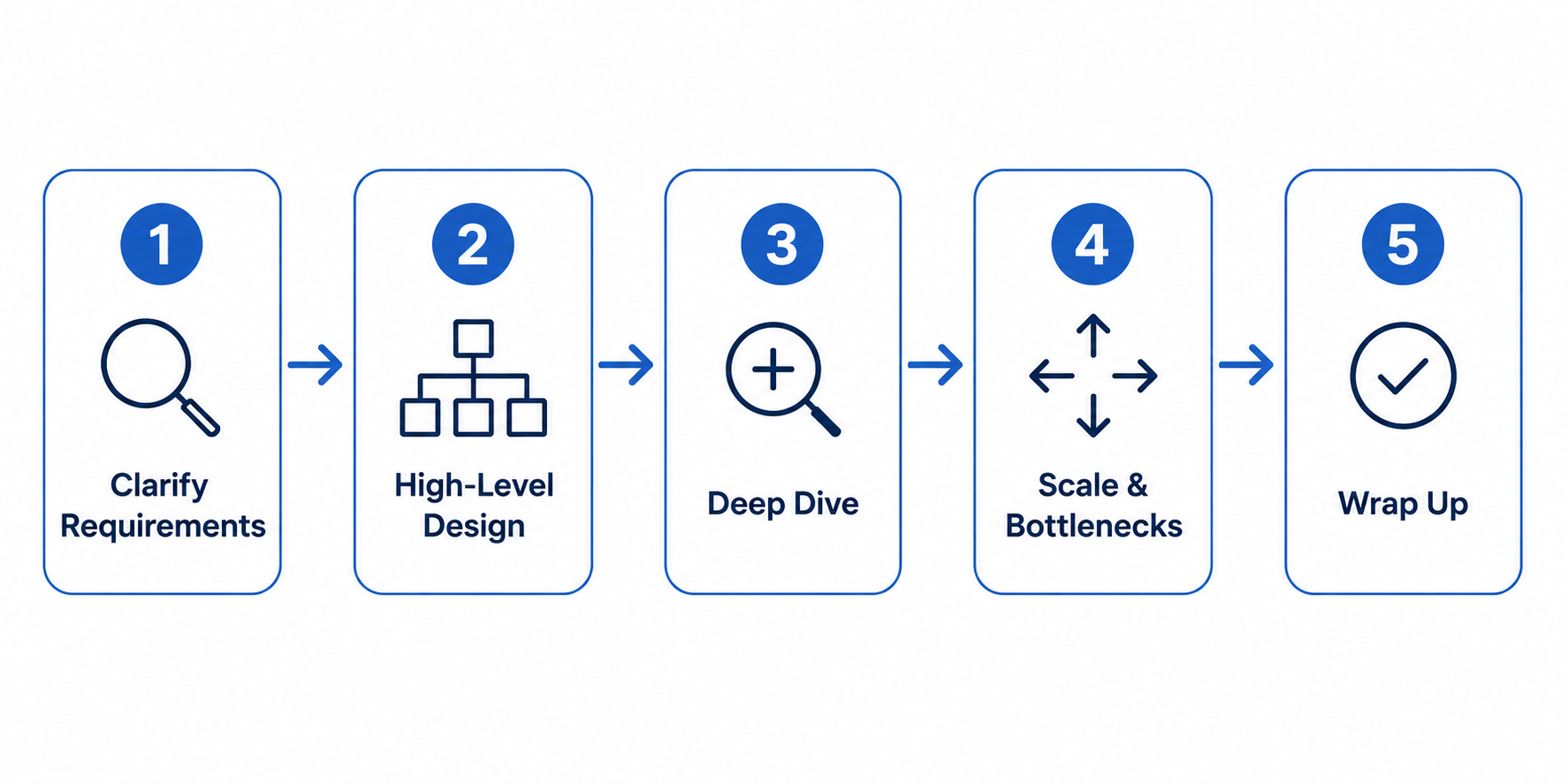
Some prep resources teach an 8-step version of this (often abbreviated RESHADED: Requirements, Estimation, Storage schema, High-level design, APIs, Detailed design, Evaluation, Distinctive feature). It's not wrong, but it's more scaffolding than most candidates need to internalize before a real interview. The five-step shape below is what actually happens in the room, and it maps cleanly onto the 8-step version if you want the extra detail later:
- Clarify requirements. Ask about scale (users, requests per second), read/write ratio, latency expectations, and what's explicitly out of scope. Skipping this is the single most common reason strong technical candidates score low — you can design a technically excellent system for the wrong problem.
- High-level design. Sketch the major components — client, load balancer, application servers, database, cache, queue — and how data flows between them. Keep it at the box-and-arrow level; resist the urge to go deep yet.
- Deep dive. The interviewer will usually steer you toward one or two components that matter most for the problem — database schema, a specific API contract, how a queue handles retries. This is where most of your score actually gets decided.
- Scale and bottlenecks. Walk through what breaks first as load grows, and how you'd address it: sharding, caching layers, read replicas, rate limiting. Naming the failure mode before the interviewer points it out is a strong signal.
- Wrap up. State the trade-offs you made explicitly, and what you'd revisit with more time or more information. Interviewers specifically listen for self-awareness here — a design presented as flawless usually reads as inexperience, not confidence.
Back-of-envelope estimation and the CAP theorem underpin steps 3 and 4 in almost every problem — if you can't quickly reason through "100 million daily active users, each posting twice a day, how many writes per second is that," the deep-dive stage stalls no matter how good your high-level design was.
What Changed in 2026
The reading lists most candidates use to prep are quietly out of date, and it's worth knowing what's actually shifted since 2024:
The bar got harder, not just the questions. Layoffs and a candidate glut mean more people are clearing the technical bar than there are open roles, so interviewers have started grading more strictly on things that used to be optional credit — cost reasoning, operational failure modes, and what happens during a partial outage rather than just at steady-state scale.
GenAI system design is now mainstream, not a specialty track. Designing a RAG (retrieval-augmented generation) pipeline, an LLM inference-serving layer, or an agent-orchestration system has gone from a rare ask in 2024 to roughly half of the system design rounds reported at large tech companies in 2026. If your prep only covers "design Twitter" and "design a URL shortener," you're missing a question type that's now as common as the classics.
Some companies have changed the format entirely. Amazon's newer GenAI-focused architect screens have moved to verbal-only design discussions with no whiteboard at all in some loops, which changes how much you can lean on a drawing to buy thinking time.
How the Rounds Actually Differ by Company
The topics overlap across companies, but what's being scored underneath doesn't:
- Amazon ties the round to its Leadership Principles as much as to architecture — "Ownership" and "Dive Deep" show up as explicit evaluation criteria alongside the technical content, and the interviewer is listening for how you'd operate the system you're designing, not just how you'd build it. See Amazon's own interview prep guidance for what they say they look for.
- Google has pushed system design down to L4 (a level where it used to be optional), with heavier emphasis on distributed-systems fundamentals — consistency models, partitioning strategy — even at questions that sound deceptively simple. Google's own interview tips are worth reading for how explicitly they describe wanting you to think out loud.
- Meta pairs system design with a separate AI-assisted coding round and weighs product judgment more heavily — "why would a user want this" comes up as often as "how would this scale."
- Uber and similarly operations-heavy companies skew toward correctness and real operational scenarios — what happens during a driver-app outage during rush hour is a more likely line of questioning than abstract scale numbers.
Common Mistakes That Cost the Most Points
- Starting to draw before clarifying scope. It signals you'll build the wrong thing quickly rather than the right thing slowly.
- Treating the interviewer's interruption as an attack. It's not adversarial — it's the actual test. Candidates who get flustered by a changed constraint mid-answer lose more points from the reaction than from the content.
- Going deep on one component for too long. A brilliant 20-minute tangent on database indexing that eats half the interview leaves no time to address scale or wrap-up, and both of those are scored.
- Presenting the design as finished. Naming what you'd change with more time is part of the rubric, not an admission of failure.
How AI Practice Fits In
Reading a framework tells you the shape of a good answer. It doesn't tell you whether you can hold that shape together when someone interrupts you 90 seconds in and changes the requirements — and that's the actual skill a real system design interview tests.
Course platforms and static guides are good for the first pass: learning the vocabulary, seeing worked examples, memorizing estimation math. Where most of them stop is the interruption itself — a PDF can't ask a follow-up. Live human mock interviews (interviewing.io-style sessions with real engineers) solve that, but they're expensive and better used for late-stage calibration than repeated practice. AceRound AI sits in between: a conversational AI interviewer that asks the same kind of mid-answer follow-up a real panel does — "what if that service goes down at 3am," "why not just add more read replicas instead" — so you find out whether your five-step structure survives pressure before it matters, without paying per session to find out.
The honest limit: no AI session replicates the specific texture of a real panel's follow-up, and it won't replace working through a handful of sessions with an experienced human interviewer before a high-stakes onsite. What repeated AI practice is good for is the unglamorous part — running the five-step structure enough times, on enough varied problems, that it becomes automatic instead of something you're consciously assembling under time pressure.
If your loop includes a Staff-level design round, the scope is different again — the Staff engineer interview guide covers how cross-team, multi-service design questions get evaluated differently from a standard Senior-level round. And for the technical-round overlap more broadly, the best AI tools for technical interviews breaks down where AI practice helps most across coding and design rounds alike.
FAQ
How long does a system design interview last?
Most rounds run 45–60 minutes, with roughly 40 minutes of actual working time once you subtract intros and questions at the end. That's tight for the amount of ground a good answer needs to cover, which is why interviewers weight how you spend the first five minutes almost as heavily as the technical content.
What are the 5 steps of a system design interview?
Clarify requirements, sketch the high-level design, deep-dive into one or two critical components, address scale and bottlenecks, then wrap up with trade-offs and what you'd do with more time. Some prep sites expand this into an 8-step version (RESHADED), but the 5-step shape is what actually happens in the room.
Is a system design interview hard?
It's hard in a specific way: there's no single correct answer, so you're graded on reasoning quality, not a pass/fail test case. In 2026 the bar is higher than it used to be — more qualified candidates are clearing the coding rounds than there are open roles, so interviewers now grade harder on cost, failure modes, and operational judgment that used to be treated as bonus points.
How do I prepare for a system design interview?
Practice the same five-step structure on 8–10 varied problems until it's automatic, learn back-of-envelope estimation cold, study 2–3 real architectures deeply instead of skimming twenty, and get someone to interrupt you with follow-up questions — reading about system design and being interrogated about it are different skills.
Do FAANG companies ask different system design questions?
The topics overlap, but what's being evaluated doesn't. Amazon leans on operational ownership and ties the round to its Leadership Principles, Google has pushed system design down to L4 with an emphasis on distributed-systems rigor, and Meta pairs it with a separate AI-coding round that tests product judgment alongside architecture.
Are GenAI and LLM questions part of system design interviews now?
Yes, and this is the biggest format shift since 2024. Designing a RAG pipeline, an LLM inference-serving layer, or an agent-orchestration system has gone from a rare, specialized ask to roughly half of the system design rounds reported at large tech companies in 2026.
Author · Alex Chen. Career consultant and former tech recruiter. Spent 5 years on the hiring side before switching to help candidates instead. Writes about real interview dynamics, not textbook advice.
Related Articles

Airline Pilot Interview Questions & AI Prep
Airline pilot interview questions cover four distinct stages, from TMAAT panels to a sim ride. Here's what AI prep can help with, and what it honestly can't.

Principal Engineer Interview Questions: What the Loop Actually Tests
Principal engineer interview questions go beyond system design — real interview loops test org-scale tradeoffs, influence without authority, and why you're Principal and not Staff.
Staff Engineer Interview AI: Prep for the Scope & Influence Bar
Staff engineer interviews test scope and influence, not just system design. Here's the real interview loop, how to build STAR stories that pass the bar, and how AI practice helps.