Karat AI Interview 2026: NextGen Format & How to Pass
Karat's 2026 NextGen interview embeds an AI assistant in the session. How Karat scores you, the 4 question families that dominate, and how to pass legitimately.

TL;DR: Karat interview AI preparation in 2026 is not what it was 12 months ago. Karat's NextGen format now includes an AI assistant inside the interview itself — evaluating whether you can work with AI under pressure, not just whether you can recall syntax. This guide covers how Karat actually scores you, the four question families that dominate the library, and how to use AI tools legitimately to build the "AI-ready engineer" profile that companies using Karat are specifically trying to hire.
In December 2025, Karat launched NextGen interviews — the first human-led, AI-integrated technical screening format at scale. Most prep guides haven't caught up. The advice floating around Reddit and Blind was written for a format that has quietly shifted under it.
According to Karat's own 2026 Engineering Interview Trends report, 62% of candidates already use AI during interviews even when the format doesn't allow it. And 71% of hiring leaders say AI now makes technical skills harder to evaluate. NextGen is Karat's response: stop pretending AI isn't in the room and start measuring whether engineers can work with it intelligently.
That's a fundamentally different interview than the one you'll read about on most prep blogs.
What Karat Is — and Why Your Interviewer Isn't from the Company You Applied To
Most candidates first encounter Karat through a calendar invite from a company they applied to. They join the call and meet someone who doesn't work there. That's by design.
Karat is a third-party technical screening firm. Their employees are "Interview Engineers" — professional interviewers who've run thousands of sessions. The Interview Engineer follows a rubric built for the specific client company (Uber, Slack, Roblox, Intuit, etc.) but is not an engineer at that company. Think of it like a background check firm: authorized, standardized, calibrated — but external.
This creates a specific psychological environment that differs from internal technical interviews:
- The interviewer won't redirect you the way a hiring manager might
- You're being recorded. The recording goes to the company, not to you
- The session follows a script, which limits how much back-and-forth is possible
- The result is a performance report, not a conversation
The famous Blind thread "STOP accepting Karat interviews" has hundreds of comments. Most of the complaints aren't about difficulty — they're about feeling processed. Interviewers who won't signal if you're going the wrong direction. Problems that feel like speed tests, not thinking assessments. The experience of being evaluated by someone who, structurally, has less incentive to root for you than a potential future colleague would.
Understanding this upfront reframes the prep. You're not convincing a hiring manager that you'd be a great teammate. You're performing clearly enough within a rubric that a structured report can make that case on your behalf.
The Karat Interview Format in 2026
Classic Format (What Most Candidates Still Face)
- ~5 min: Intro, "tell me about yourself," warm-up
- ~10 min: Domain knowledge check — role and seniority specific (language questions, CS concepts, system design vocabulary)
- ~40–45 min: Live coding, typically 1–2 multi-part problems that escalate in complexity
- ~5 min: Candidate questions
The coding environment is Karat's proprietary editor — not VS Code, not a full IDE. Notes are allowed. Auto-complete is limited. You type, you think aloud, you're on camera.
Most problems have 3–4 sub-parts. The pacing is intentional: part 1 should feel manageable, part 2 introduces a constraint or complexity increase, part 3 often requires restructuring your earlier approach. Very few candidates complete all parts cleanly. That's not a failure mode — it's calibration.
If you're also preparing for the behavioral component that often follows technical screening, our software engineer behavioral interview guide covers the STAR method and seniority-calibration signals that Karat client companies care about.
NextGen Format (Rolling Out in 2026)
Karat's NextGen launch announcement describes it this way: candidates work in a multi-file project environment with an integrated AI assistant available during the session, while an Interview Engineer observes and probes their reasoning in real time.
The stated goal: evaluate "AI-ready engineers" — those who can direct AI effectively, evaluate its output critically, and still demonstrate clear reasoning under pressure.
If you're interviewing through a company that has adopted NextGen, the rules shift. You're expected to use the AI assistant. The Interview Engineer will ask you to explain why you queried what you queried, what you accepted from the AI response, and what you changed. Raw LeetCode memorization becomes significantly less relevant. AI collaboration fluency becomes the core skill.
You won't always know in advance which format you'll get. Preparing for both is the right call.
The Four Karat Question Families
Karat's question library is larger than the internet gives it credit for, but many problems cluster around recognizable algorithmic families. Based on candidate-reported experiences across multiple years:
1. Badge access / building entry Given a log of employee swipes, determine who can access which floors, or detect anomalies. Tests interval logic, permission hierarchies, and edge case handling. Hash maps are almost always the right first tool.
2. Domain click count / URL analytics Parse an event log, group by URL components (domain, subpath prefix, etc.), and compute counts. Tests string parsing, aggregation, and output formatting. Often has a "normalize the URL" gotcha.
3. Rectangle in matrix Find, count, or validate patterns in a 2D grid. Complexity ranges from simple nested iteration to flood fill or dynamic programming depending on the sub-part.
4. Shared courses / mutual enrollment Given student-course mapping data, find student pairs with shared course counts, or similar group membership calculations. Graph-adjacent but typically solvable with set intersection.
These are not the only question types Karat uses. The library is calibrated by client and seniority, and newer question types are added periodically. But if you are deeply comfortable with hash maps, two-pointer, set operations, and basic grid traversal, you've covered the algorithmic core of most Karat sessions.
What Karat Actually Scores
Most prep guides frame Karat as a speed contest: complete all parts, win. That's not what Karat's own scoring documentation says.
According to Karat's official rubric, evaluators assess five competency dimensions:
- Problem decomposition — Can you break a vague problem statement into solvable subproblems before writing any code?
- Code abstraction — Do you write modular, readable functions, or tangled logic that only you understand?
- Debugging awareness — Can you trace your code mentally, anticipate errors, and catch them before running it?
- Technical communication — Are you explaining your approach clearly while coding, or going silent and hoping the output speaks for itself?
- Domain knowledge — Language fluency, data structure selection, complexity analysis
A candidate who completes 2 out of 3 parts cleanly, explains their reasoning throughout, and correctly identifies the time complexity of their solution will regularly outscore a candidate who rushes through all three parts with poorly named variables and silence.
This has a direct implication for preparation: you should practice narrating at least as much as you practice coding.
Karat Interview AI Preparation — What Actually Works
Let's address the elephant in the room. The top results for "Karat interview AI" are almost uniformly selling screen-capture tools that inject AI-generated answers "undetectably." Some are blunt about it.
Here's the practical problem with that approach in 2026:
In classic Karat format, answer injection gets detected more reliably than it used to (both via session behavior analysis and through interviewer follow-up questions that require you to explain what you wrote). In NextGen format, the entire evaluation hinges on your explanation of what the AI produced — so if you can't articulate the reasoning behind injected code, you fail faster than if you'd gotten it wrong honestly.
There's a more effective and more durable approach: use AI to simulate the Karat environment before you arrive.
Practice Think-Aloud With AI Feedback
The single most underrated Karat skill is narrating while coding. Most engineers are used to thinking in silence and speaking after the fact. Karat inverts this.
Use a mock interview tool (AceRound's simulation mode works well for this) to practice streaming your thought process out loud while solving problems. Have the AI flag when you've gone silent for too long, when your explanation contradicted your code, or when you used imprecise language. This is awkward at first. That's the point.
For a full breakdown of how to use AI for mock interview practice, see our AI interview coach guide.
Simulate Multi-Part Timed Problems
Most LeetCode practice involves single problems. Karat's structure means you have ~40 minutes across 3–4 escalating sub-problems. The discipline to stop cleanly at the end of part 2 and pivot to part 3, rather than over-polishing part 2, is not something you develop by doing individual LeetCode problems.
Set a 40-minute timer. Work through a problem with explicitly structured sub-parts. When time pressure hits, practice saying: "I'm going to describe my approach to part 3 rather than write it incompletely" — this is often the better scoring path.
Build AI-Collaboration Fluency for NextGen
If your interview uses the NextGen format, you'll have access to an AI assistant. Candidates who've never practiced AI-assisted coding under pressure tend to either ignore the tool entirely or over-rely on it without being able to explain the output.
Practice patterns like: look up the correct Python collections.Counter API syntax, validate the suggestion, then implement without looking. Or: describe the algorithmic approach to AI, evaluate whether the suggestion is correct, then re-explain it to the interviewer in your own words.
AceRound AI provides real-time suggestions during live interviews — which means it trains you in exactly this pattern: receiving AI input, evaluating it quickly, and deciding whether to use it. That's the "AI-ready engineer" behavior Karat NextGen is assessing. You're not shortcutting the evaluation; you're building the specific fluency being measured.
Try it: Run a timed mock session on AceRound before your Karat interview. Focus not on getting the right answer but on explaining each line as you write it.
The Psychological Layer Nobody Covers
Three things about the Karat environment that show up in almost every candidate report but appear in almost no prep guides:
1. Silence is the most expensive mistake you can make
Karat scores technical communication explicitly. If you've been quiet for 45 seconds working through a problem, you're burning scoreable time. Even if what you're thinking is obvious — "I'm considering an edge case where the input is empty" — say it out loud. This is not performance. It's scoring.
2. You don't have to finish to pass
The pressure to complete all parts leads candidates to rush part 3 with broken, unexplained code. A clean stop at part 2 with a clear verbal walkthrough of your part 3 approach is often the better move. Karat's multi-dimension rubric means "partial completion, high quality" frequently beats "full completion, low quality."
3. The scripted format is not personal
Interview Engineers follow structured scripts because that's how Karat maintains consistency across thousands of sessions. They may not give you hints even when you're close. They may not react to your jokes. This isn't coldness — it's calibration. Adjust your expectations before you join the call and you'll perform better in the actual session.
FAQ
"Is the 'introduce yourself' section before the technical questions actually scored?"
In classic Karat format, the intro section is recorded but not scored against technical competencies. It's primarily a calibration moment. However, it's still on camera and some interviewers use it to note communication baseline or language fluency. Treat it as professionally as the rest of the session — just with lower stakes.
"Can I use ChatGPT for my technical interview with Karat?"
It depends on the format. In classic Karat, AI code generation is generally not permitted, though documentation lookups are usually fine. Karat's own blog post on this says they encourage AI as a collaborative tool, not a crutch — and that answer reflects their direction of travel with NextGen. In the NextGen format, an integrated AI assistant is built into the environment and you are expected to use it.
"How hard is a Karat interview, honestly?"
Entry-level at mid-tier companies: most candidates report 5–6 out of 10. Senior roles at companies like Uber or Intuit: 7–8 out of 10. The difficulty isn't always algorithmic — the think-aloud requirement and time pressure add a layer that pure LeetCode practice doesn't prepare you for.
"I completed 2 out of 3 parts but still got rejected. What happened?"
Karat's rubric is multi-dimensional, not a completion score. Common failure modes despite partial completion: going silent during coding (hurts technical communication score), writing unclear variable names and functions (hurts code abstraction), and not tracing through edge cases before submitting (hurts debugging awareness). If this happened to you, the next prep session should focus on narration and code quality, not speed.
"Is the Karat interview process fair?"
The answer depends on what you mean by fair. Karat is more standardized than most internal hiring — which reduces certain biases (interviewer mood, subjective impression, cultural fit in the first 30 seconds). But standardization creates its own inequities: the fixed question library can favor candidates who've seen similar problems before, and the scripted interviewer format doesn't accommodate the variability in how different people communicate under pressure. It's more consistent than most alternatives. Consistent isn't the same as fair.
"Why does the hiring company use Karat instead of their own engineers?"
Running a 1-hour technical screen costs an engineering team 3–4 hours total when you factor in prep, the interview itself, and the debrief. At scale, that's an enormous cost. Karat converts it to a flat fee and a structured report. The tradeoff for candidates: you don't meet the actual team until later, and the evaluation is more formulaic. For companies: higher throughput, more consistent signal, less engineer time spent on early-stage screening.
Author · Alex Chen. Career consultant and former tech recruiter. Spent 5 years on the hiring side before switching to help candidates instead. Writes about real interview dynamics, not textbook advice.
Related Articles
Hedy AI Alternative: Pricing, Language Limits & 5 Better Options (2026)
Looking for a Hedy AI alternative? See real 2026 pricing, the documented non-English transcription problem, and how AceRound and other tools compare for interviews.
Interview Sidekick Alternative: Pricing Red Flags & 5 Honest Options (2026)
Interview Sidekick quotes three different prices across its own marketing. Before you buy, see what it actually costs, whether Stealth Mode holds up on screen share, and 5 real alternatives.
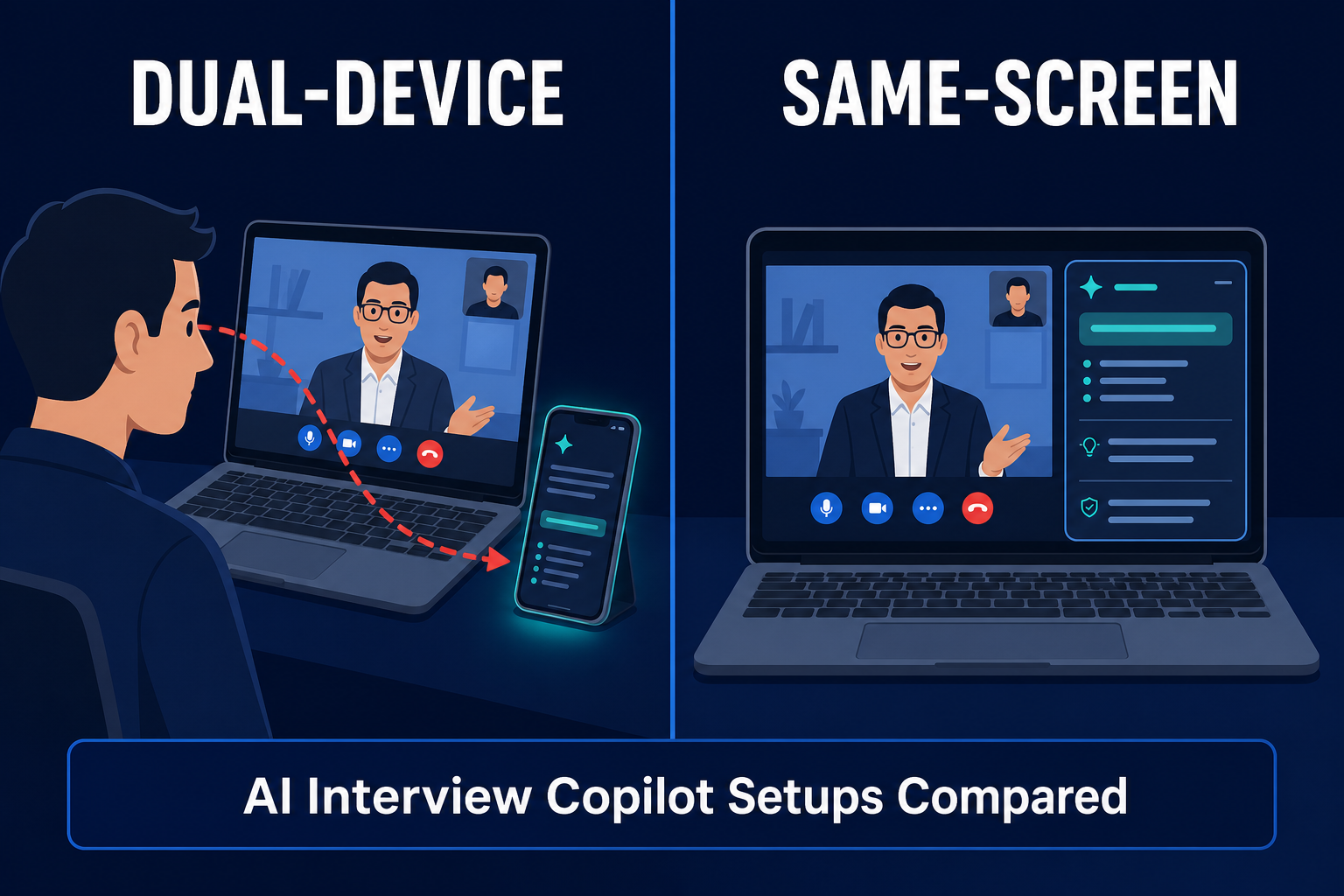
Best InterviewFox Alternatives in 2026: Same-Screen vs. Dual-Device Risk
Looking for an InterviewFox alternative? Compare pricing signals, the dual-device screen-share claim, and same-screen options like AceRound before you buy.