Do AI Interviews Record You? What Mercor, Apriora, Ribbon & HireVue Do (2026)
Yes — AI interview platforms record video, audio, and sometimes your screen. Here's exactly what Mercor, Apriora, Ribbon, and HireVue keep, for how long, and who watches it.
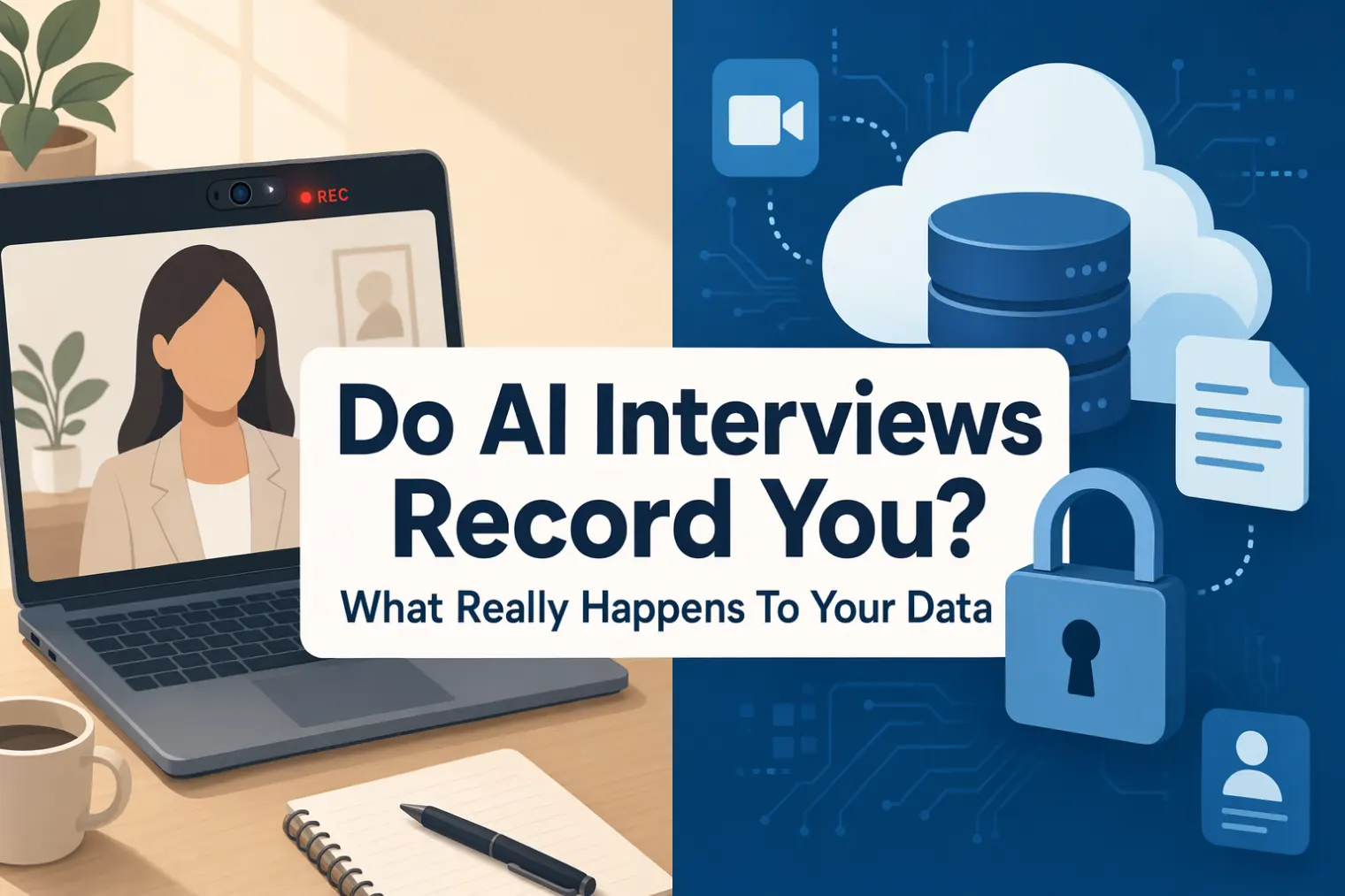
TL;DR: Yes — Mercor, Apriora, Ribbon, HireVue, and virtually every AI interview platform record your video, audio, and sometimes your screen. Retention ranges from months to years depending on the platform and the hiring company, human review is inconsistent, and a March 2026 Mercor breach exposed roughly 40,000 candidates' recordings and biometric data. Here's what each platform actually does with your data.
In March 2026, a supply-chain breach at a vendor connected to Mercor — the AI-screening platform used by thousands of companies to interview remote and contractor candidates — exposed the recorded interviews and facial biometric data of roughly 40,000 people. Lawsuits followed, alleging violations of Illinois's biometric privacy law and California's CCPA, along with claims that the breach wasn't disclosed quickly enough.
If you've done an AI-conducted interview in the last year — one where the interviewer was Mercor, Apriora's "Alex," Ribbon, or a HireVue async video screen — this is the part nobody explains clearly beforehand: your video, your audio, and sometimes a full transcript is being stored somewhere, by a company you likely know very little about, for a length of time you were probably never told.
This isn't a "how to avoid being recorded" article — you can't avoid it and still get the job. It's a plain breakdown of what actually happens to that recording on each major platform, so you can walk in with clear eyes instead of vague unease.
Yes, You're Being Recorded — Here's the Short Answer
Every autonomous AI interviewer platform — Mercor, Apriora, Ribbon — and every async AI-scored video platform — HireVue being the largest — records your video and audio by default. Some also capture your screen during technical assessments. This isn't a rumor or a "worst case" scenario; it's stated in each platform's own terms of service or privacy policy, even when it isn't surfaced clearly to candidates before they click "start."
What varies enormously between platforms is what happens next: how long the recording is kept, whether it trains any AI model, who at the hiring company (if anyone) actually watches it, and how easy it is to get it deleted. That's the part worth understanding platform by platform.
What Each AI Interviewer Platform Actually Does With Your Recording
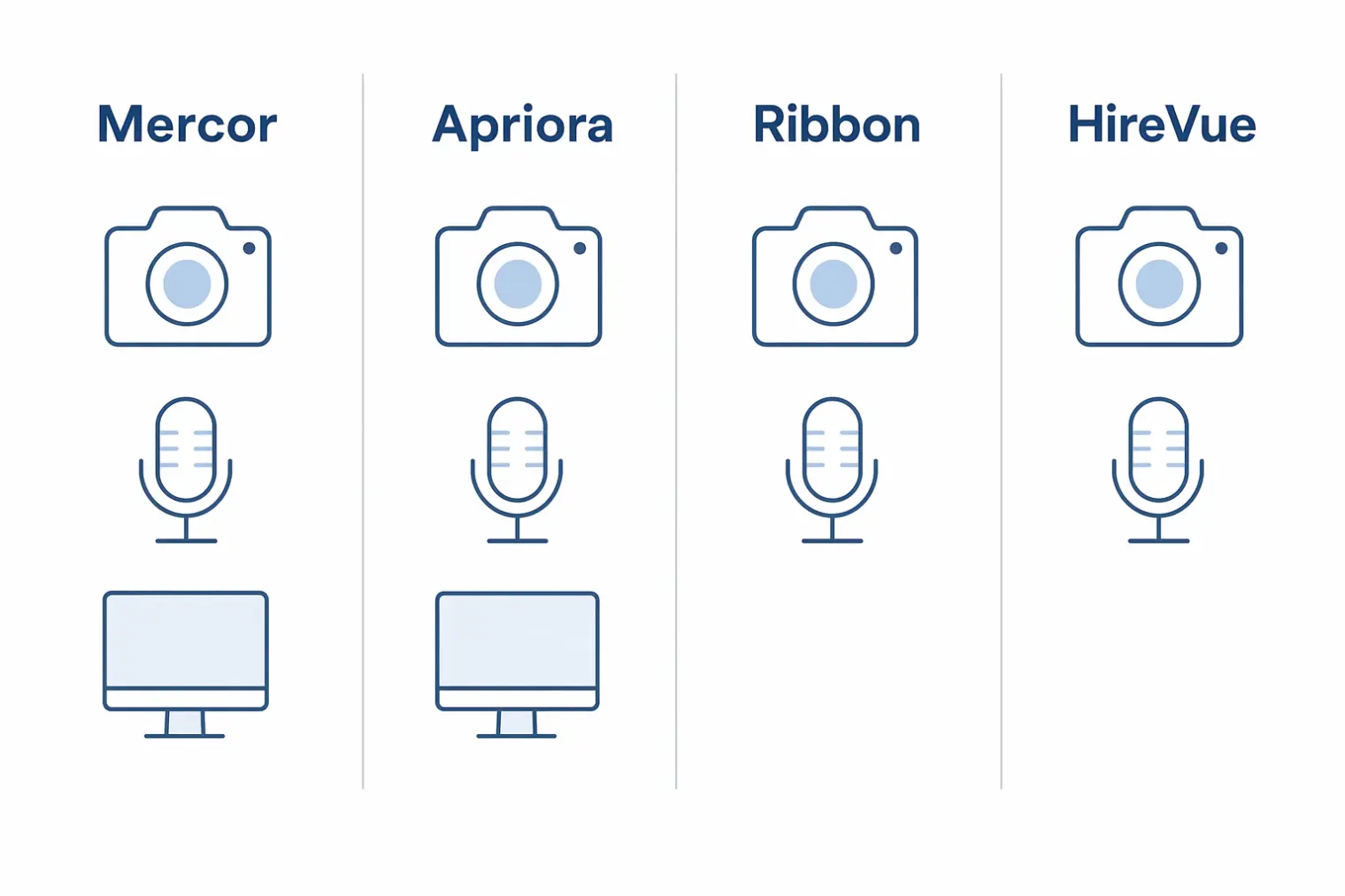
Mercor — records video and audio, and generates an AI transcript of "official" interviews used for evaluation and candidate-employer matching. Mercor's public position is that it does not use interview data to train third-party or external LLMs and doesn't sell recordings. That claim held up fine until the March 2026 breach, which is a useful reminder that a company's stated data policy and its actual data security are two separate things. For more on how Mercor's interview format itself works, see our Mercor AI interview tips guide.
Apriora ("Alex") — a live, real-time conversational AI interviewer, not an async recorded-response tool like HireVue. Because the AI is actively conversing with you, it necessarily captures video, audio, and often screen activity throughout the session, scored live against an employer-defined rubric. Our Apriora interview tips piece covers what the follow-up questions actually probe for.
Ribbon — is the most explicit of the four in its own privacy policy: recordings and transcripts are retained for up to 24 months unless the customer or candidate requests earlier deletion. More notably, Ribbon's terms grant the company a fairly broad license to use submitted content "to improve services, including training AI models" — a more aggressive stance than Mercor's stated non-training policy. Read the Ribbon AI interview tips guide for what the interview itself looks like.
HireVue — the oldest and most-studied platform here. Default retention is up to 3 years, but the actual window is set by the hiring company, not HireVue or the candidate — a point HireVue confirms directly in its own candidate FAQ. HireVue discontinued its automated facial-expression and emotion-analysis scoring in 2021 after FTC scrutiny, so what's captured today is closer to a standard recorded video response than a biometric-scoring engine. We've covered whether HireVue records your screen and whether it detects tab switching in more detail.
Who Actually Watches These Recordings?
This is the part candidates consistently assume wrong in both directions. Some assume a recruiter definitely watches every interview — hence the anxiety. Others assume, once they hear "AI interview," that no human ever sees it. Neither is reliably true.
In high-volume hiring — think hundreds or thousands of applicants for a single role — a common pattern is to have the AI model score every candidate, then route only the top-scoring tier (and separately, any flagged or borderline cases) to a human recruiter for review. The bottom third or so of a candidate pool is frequently scored, ranked, and rejected by the model alone, with no human ever opening the recording. That's not a conspiracy; it's a practical response to volume. But it does mean that for a meaningful share of candidates, the AI's read of your 6-minute answer is the only "opinion" that exists about your interview.
The 2026 Mercor Breach: What Actually Happened
Worth understanding as a concrete case rather than an abstract risk. In March 2026, a third-party vendor in Mercor's data-processing supply chain was compromised, exposing recorded interview video and facial biometric data for an estimated 40,000 candidates. Reporting on the incident noted that affected candidates weren't notified as quickly as biometric privacy laws in states like Illinois typically require, and multiple lawsuits have since been filed alleging BIPA and CCPA violations.
The lesson isn't "never do an AI interview" — for most roles today, you don't get to opt out and still be considered. The lesson is that "your data is stored securely" is a claim, not a guarantee, and it's reasonable to factor that into how much personal detail you volunteer beyond what the role requires.
AI Interviewer Privacy: What "Consent" Really Means
Nearly every platform bundles consent into the act of continuing: you see a notice, you click past it, and that click is treated as informed consent to recording, storage, and — depending on the platform — reuse for model training. The disclosure is usually accurate but rarely prominent, and almost no platform makes you actively opt out of anything before the interview starts, because there typically isn't an opt-out that doesn't also disqualify you from the role.
What you can actually control: reading the privacy policy link (usually in small text near the consent screen) before you click through, knowing that most platforms accept a post-interview deletion request even if they don't advertise it, and treating "I consented" as "I know what I agreed to," not "I have no further questions."
How to Prepare Knowing You're Being Recorded
None of this changes what you should say in the interview — it changes how you should think about the moment before it starts.
- Check the privacy policy link before you click "begin." It takes two minutes and tells you which of these four categories (or a fifth platform not listed here) you're dealing with.
- Assume eventual human review is possible, even if unlikely. Don't say anything in an AI interview you wouldn't want a recruiter to eventually watch — because on any given platform, a recruiter sometimes will.
- Ask for deletion if the process bothers you. It's a normal, unremarkable request. Most platforms have a support address for exactly this.
- Treat the recording as real, not hypothetical, when you prepare. The nerves candidates describe with AI interviewers often come from not knowing what's being captured — once you know it's "everything, standard stuff, sometimes reviewed by a person," the unknown-anxiety usually drops, and you can focus on giving a clear, structured answer instead.
That last point is where most of the actual prep work should go. AceRound AI gives you real-time structural guidance during AI-conducted interviews and live practice sessions — helping with the answer itself, not the privacy question, which is exactly the part within your control. If you're getting ready for an autonomous AI interviewer specifically, how to pass an AI interview covers the scoring and format side in more depth.
FAQ
Are Mercor AI interviews recorded or used for AI training? Yes, Mercor records video, audio, and generates a transcript of official interviews. Mercor states it does not train third-party or external LLMs on your interview data and does not sell recordings — but a March 2026 supply-chain breach exposed roughly 40,000 candidates' recordings and facial biometric data, so "not sold" and "not breached" are different guarantees.
Does HireVue record your screen? No — standard HireVue video interviews capture only camera and audio, not your screen. Screen sharing only happens during coding assessments, and only with your explicit browser permission. See our full breakdown of what HireVue actually records.
How long does an AI interviewer keep your recording? It varies widely by platform and is often set by the hiring company, not disclosed to candidates as a fixed number. Ribbon states up to 24 months in its privacy policy. HireVue's default is up to 3 years, though individual employers can set shorter or longer windows.
Can you ask an AI interviewer to delete your recording? Usually yes, but the process isn't always obvious. HireVue and most GDPR/CCPA-compliant platforms accept deletion requests through their candidate support channels. Ribbon and Mercor's terms mention deletion rights but don't make the request flow prominent — you typically have to email support directly.
Does a human ever watch your AI interview recording? Sometimes, not always. In high-volume hiring, HireVue and similar platforms often have a recruiter watch only top-scoring or flagged candidates — the bottom third of a candidate pool is frequently scored by the AI model alone and never reviewed by a person.
Should you consent to a recorded AI interview? In most cases you don't have a real choice if you want the job — continuing past the consent screen is treated as consent. The more useful question is what you can control: check the platform's privacy policy before you join, know your deletion rights, and prepare as if a human will eventually watch the recording, because sometimes one will.
Author · Alex Chen. Career consultant and former tech recruiter. Spent 5 years on the hiring side before switching to help candidates instead. Writes about real interview dynamics, not textbook advice.
Related Articles
OpenAI's AI Interview Policy: Banned, Required, or Team-Dependent
OpenAI sells AI coding agents, then bans most candidates from using one. Here's the round-by-round policy, including the new agentic round that flips it.
Does Harver Detect Cheating? What Its Proctoring Actually Checks
Does Harver detect cheating on its pre-employment assessments? A candidate look at Harver's Proctoring add-on, what gets logged after a flag, and what happens next.
Micro1's Zara AI Interview: What It Actually Tests (And Why Timing Gets Flagged)
Micro1's AI interviewer Zara has run 300,000+ interviews for remote roles. Here's why it flags response latency as a cheating signal, and what that means for AI prep.