Does LeetCode Detect Cheating? What It Actually Monitors (2026)
LeetCode barely proctors interviews itself — the 'LeetCode-style' OA you're taking usually runs on HackerRank or CodeSignal, where the real monitoring lives.
TL;DR: LeetCode's own platform barely proctors anything beyond logging paste events and tab-focus loss on its contests — it has no webcam monitoring and no published AI-detection system. The catch: most "LeetCode interviews" candidates worry about aren't run on leetcode.com at all. They're company OAs that borrow LeetCode-style questions but run on HackerRank, CodeSignal, or CoderPad — platforms with their own, much more detailed monitoring stacks. Knowing which one you're actually facing changes how you should prepare.
Three days before a screening round, a candidate messaged a hiring forum asking whether their "LeetCode interview" would flag a second monitor with notes on it. The honest answer required a question back: was the test actually hosted on leetcode.com, or was it a link from a recruiter that just looked like a LeetCode problem? Most of the time, it's the second one — and the platform doing the actual watching isn't LeetCode.
This mix-up drives a lot of unnecessary anxiety, and it's worth untangling before you walk into either format.
LeetCode Itself Doesn't Run Most Corporate Interviews
LeetCode is primarily a practice platform — problem sets, contests, and a premium interview-prep product. It does sell LeetCode Interview, a live video-plus-editor tool built for interviewers to run real-time sessions with candidates. But its own product page describes speed, framework support, and connection stability — not browser lockdown, webcam capture, or AI-overlay detection. There's no published proctoring feature listed there.
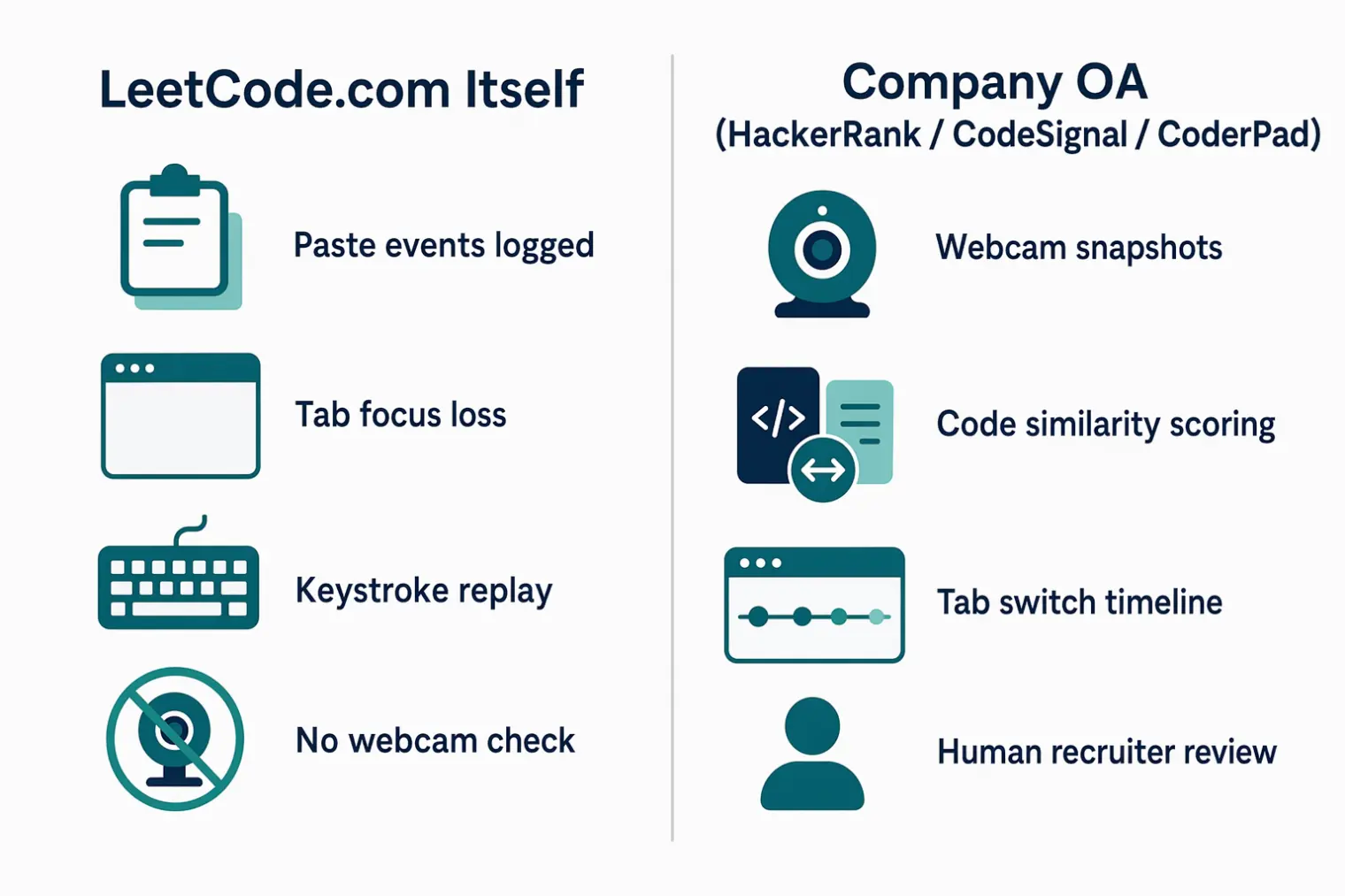
Meanwhile, the majority of what candidates call "a LeetCode interview" is actually a company OA that sources LeetCode-style questions but delivers the test through a different vendor — most often HackerRank, CodeSignal, or CoderPad. Those platforms own the monitoring stack: tab-switch logging, webcam snapshots (if the recruiter enables it), and plagiarism-similarity scoring against a submission database that often includes public LeetCode solutions.
This distinction matters because the two situations call for different preparation:
| LeetCode's own platform (contests, premium assessments) | Company OA using LeetCode-style questions | |
|---|---|---|
| Who's watching | LeetCode's own systems | HackerRank / CodeSignal / CoderPad, chosen by the employer |
| What's logged | Paste events, tab-focus loss, editor keystrokes | Varies by vendor — often webcam, tab switches, code replay, MOSS-style similarity scoring |
| Where to check | URL says leetcode.com |
URL in your test invite is a different domain entirely |
What LeetCode's Own Anti-Cheat System Actually Logs
Based on patterns candidates have reported on LeetCode's own discussion forum (LeetCode does not publish a detailed public proctoring spec), the platform's contest and assessment system tracks:
- Every paste event into the code editor, timestamped
- Tab/window focus loss — leaving the LeetCode tab is logged with duration
- Keystroke-level activity in the editor, which lets reviewers reconstruct how a solution was actually written
LeetCode's own cheating-punishment support article describes the contest penalty policy more narrowly: a first punishment zeroes the contest score, resets LeetCoins, and restricts the account from contests and Discuss for one month; a second punishment can permanently deactivate the account. That's a contest enforcement policy, not a detailed public proctoring spec.
What it doesn't do, based on available product information: there's no webcam requirement on standard contests, no browser-lockdown mode, and no published AI-generated-code detector comparable to what HackerRank or CodeSignal advertise.
What "LeetCode-Style" Company OAs Actually Monitor
If your assessment link points to hackerrank.com, codesignal.com, coderpad.io, or a similar vendor domain — even if the recruiter called it "a LeetCode round" in the email — you're being monitored by that vendor's stack, not LeetCode's.
The HackerRank cheating detection breakdown covers that platform's MOSS-based similarity engine and behavioral logging in detail: tab-switch timelines, copy-paste flagging, and full keystroke replay that a recruiter can watch after the fact. The mechanics differ by vendor, but the general shape is consistent — a recruiter reviews a flag; it isn't an automatic algorithmic rejection.
The practical move: open your test invite and look at the actual domain before you decide how to prepare. "LeetCode interview" in a recruiter's email is often just shorthand for "algorithmic coding round," not a statement about which platform is running it.
If you're not sure which platform you'll actually be tested on, AceRound AI works as a live coding copilot across the major OA and interview platforms — helping you structure an approach out loud, not just produce an answer. Try it free.
The AI Overlay Tool Debate: Does It Actually Beat Screen Share?
A separate, more recent worry has nothing to do with LeetCode's own detection and everything to do with tools like Interview Coder, LeetCode Wizard, and similar AI overlays that promise to feed answers during a shared screen. The rendering mechanism behind these tools is technically real — some overlays draw below the layer that screen-sharing software captures, so a shared screen genuinely doesn't show the overlay window.
What that mechanism doesn't solve: an interviewer watching your face, timing, and follow-up reasoning in real time. The most common way candidates get caught isn't a detection algorithm noticing the overlay — it's a mismatch between how fast and confidently an answer appears and how shakily the candidate explains it when asked "why did you choose that approach?" A flatline response time, a vocabulary jump mid-sentence, or an inability to modify the solution live are all human-judgment tells that no rendering trick avoids. Google's own leadership has floated returning to in-person interviews specifically because of this category of tool, according to CNBC's coverage of the AI-interview-cheating debate — a sign of how seriously large employers are taking the human-judgment side of detection, not just the technical one.
Why the Follow-Up Interview Matters More Than the OA Flag
Whether you're on LeetCode's own contest system or a company OA running through another vendor, the pattern converges at the same place: almost every coding assessment is followed by a live technical round. That round typically includes "walk me through your solution" or "how would you change this for edge case X."
If a submission was flagged for similarity — correctly or as a false positive from a common textbook pattern — the live follow-up is where it gets resolved. Candidates who can't explain their own code under those questions create more risk for themselves in that conversation than any OA flag created on its own. For roles at companies with a hard technical bar (large tech employers across the US, Taiwan, and Korea in particular), that follow-up round is the actual gate, not the automated flag.
The free AI mock interview practice is a fast way to stress-test whether you can explain your own solution clearly before that live round arrives — which matters regardless of which platform's monitoring you're technically subject to.
FAQ
Does LeetCode tell you if you got flagged for cheating? No. On LeetCode's own contests and premium assessments, candidates aren't notified of a flag in real time. You typically find out after the contest through a zeroed score, a LeetCoins reset, and an account restriction — or, if it's a company OA running on a different vendor, through a rejection with no explanation.
Can LeetCode see your second monitor or other browser tabs? LeetCode's own platform logs when you leave its browser tab (focus-loss events) but has no documented mechanism to detect a second physical monitor, a second device, or what's displayed on hardware outside your primary screen.
Does LeetCode detect ChatGPT or Copilot use? LeetCode has no published AI-detection feature of its own. If your "LeetCode interview" is actually a company OA delivered through HackerRank, CodeSignal, or CoderPad, that vendor's AI-code-pattern detection applies instead — and each has different rules.
Is LeetCode the same thing as the coding test my company sent me? Usually not entirely. Many companies write questions in LeetCode's style or pull from similar problem banks, but deliver the actual timed test through a different vendor that owns the proctoring stack. Check the URL in your test invite — if it's not leetcode.com, you're on someone else's monitoring system.
Do invisible AI overlay tools like Interview Coder actually work against screen share? The rendering mechanism is real — some overlay tools render below the capture layer used by screen-sharing software. That doesn't mean the interviewer can't tell something's off from your delivery, timing, or follow-up answers, which is where most people actually get caught.
What happens if LeetCode flags my submission during a company assessment? On LeetCode's own contests, LeetCode's support article says a first cheating punishment zeroes the contest score, resets LeetCoins, and restricts the account from contests and Discuss for one month; a second punishment can permanently deactivate the account. For company OAs on other vendors, a flag goes to a human recruiter for review; it isn't usually an automatic rejection.
Author · Alex Chen. Career consultant and former tech recruiter. Spent 5 years on the hiring side before switching to help candidates instead. Writes about real interview dynamics, not textbook advice.
Related Articles
OpenAI's AI Interview Policy: Banned, Required, or Team-Dependent
OpenAI sells AI coding agents, then bans most candidates from using one. Here's the round-by-round policy, including the new agentic round that flips it.
Does Harver Detect Cheating? What Its Proctoring Actually Checks
Does Harver detect cheating on its pre-employment assessments? A candidate look at Harver's Proctoring add-on, what gets logged after a flag, and what happens next.
Micro1's Zara AI Interview: What It Actually Tests (And Why Timing Gets Flagged)
Micro1's AI interviewer Zara has run 300,000+ interviews for remote roles. Here's why it flags response latency as a cheating signal, and what that means for AI prep.