Razorpay, PhonePe, Swiggy, and CRED: How India's Product Unicorns Interview
Razorpay, PhonePe, Swiggy, and CRED don't run TCS-style aptitude tests or Amazon-style DSA marathons — here's the OA platform, round structure, and ESOP comp each one actually uses.

For anyone with an interview lined up at Razorpay, PhonePe, Swiggy, or CRED — on-campus, off-campus, or lateral. If you're comparing this track against the alternatives, Amazon, Flipkart, Microsoft, and Zoho covers the US-headquartered product companies, Goldman Sachs, JPMorgan, Walmart Global Tech, and SAP Labs India covers the Global Capability Centres, and TCS, Infosys, and Wipro covers the IT-services pipeline.
TL;DR: Razorpay, PhonePe, Swiggy, and CRED are India-origin product companies, and their interview loops don't look like either the aptitude-test-first pipeline at TCS or Infosys, or the DSA-heavy off-campus OA that Amazon and Flipkart run. All four lean hard on machine coding — build a working, reasonably-designed system under a timer, not just solve an algorithm puzzle — and all four pay in base plus ESOP, private-company equity whose real value depends on a buyback or IPO rather than a predictable RSU schedule. CRED's process is the most front-loaded, with a 24-hour take-home before you even reach a live round.
Most prep content for these four either treats them as generic "top startup" entries in a listicle, or is a single candidate's one-off account from a specific year with no context for how typical it is. What's missing is a synthesis of what's actually consistent across multiple independent reports — and an honest flag on what isn't, since round counts and durations genuinely vary by source, role, and year for all four companies.
Razorpay: OA, Then Machine Coding Does the Real Filtering
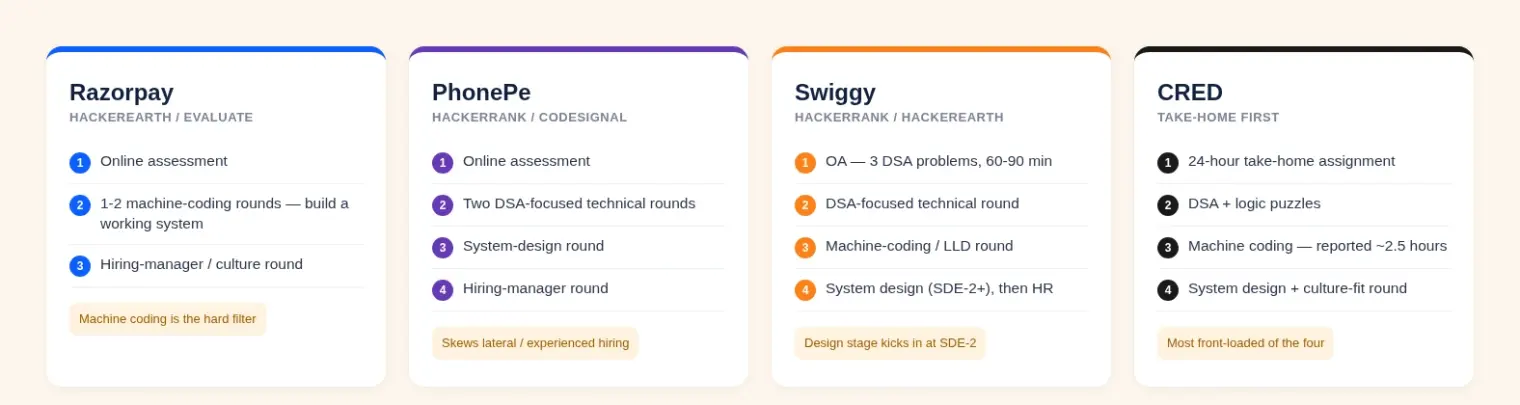
Razorpay's process commonly starts with an online assessment — reports point to HackerEarth or an in-house platform called Evaluate, rather than the HackerRank/Mercer Mettl combination you'd expect from an IT-services aptitude test. What follows is where Razorpay diverges hardest from a typical DSA loop: one or two machine-coding rounds, where you design and build a working mini-system — a rate limiter, an in-memory cache with eviction, a booking or reservation service — under SOLID principles, in a live pairing session or a timed take-home. Candidate reports put the full loop at roughly 3-6 rounds depending on level, closing with a hiring-manager or culture conversation.
The reason this catches strong LeetCode grinders off guard: solving an isolated algorithm problem and shipping a working, reasonably-structured mini-application are different skills. A candidate who can reverse a linked list in six minutes but has never organized a class hierarchy under time pressure will lose ground here that DSA speed doesn't buy back.
PhonePe: Two DSA Rounds, Then System Design
PhonePe's reported structure runs an online assessment (candidate accounts mention both HackerRank and CodeSignal, which suggests the specific platform varies by drive) into two DSA-focused technical rounds, then a system-design round, then a hiring-manager conversation. That's a technically heavier bar per round than most fresher off-campus loops — consistent with PhonePe filling more of its engineering pipeline through lateral and experienced hiring than pure campus intake, so if you're coming in as a fresher, expect the panel to calibrate expectations down on some of it but not to skip the system-design stage entirely for anyone beyond entry level.
Swiggy: An OA With Three DSA Problems, Then Machine Coding, Then Design at SDE-2+
Swiggy's online assessment is commonly reported as three DSA problems in a 60-90 minute window, run on HackerRank or HackerEarth depending on the role. Candidates who clear it move into a DSA-focused technical round, then a machine-coding or LLD (low-level design) round — again, build-a-working-thing rather than solve-a-puzzle — and for SDE-2 and above, a dedicated system-design round ahead of the hiring-manager or HR close.
The machine-coding/LLD stage is the same differentiator showing up a third time: Swiggy, Razorpay, and PhonePe (through its DSA-plus-design combination) all converge on testing whether you can structure and ship real code, not just pass test cases on an isolated function.
CRED: A 24-Hour Take-Home Before You Even Get a Live Round
CRED's reported process is the most front-loaded of the four. Round one is commonly a 24-hour take-home assignment — you're evaluated on working code before anyone talks to you live. Candidates who clear it move into a round combining DSA problems with logic puzzles, then a machine-coding round some reports put at around 2.5 hours — long enough that it functions closer to a scaled-down take-home than a typical 45-minute pairing session — and finally a system-design-plus-culture-fit conversation. Some candidate accounts describe this last round including CRED's Head of Engineering directly for senior roles, which is the closest thing to a founder-adjacent interview stage that's actually documented across this group rather than assumed.
Treat the specific hour counts — 24 hours, 2.5 hours — as commonly reported figures rather than official CRED policy; they show up consistently enough across independent accounts to plan around, but CRED hasn't published them, and any process detail can shift between drives.
Where the Four Actually Differ
| OA platform | Distinctive stage | Technical emphasis | Typical hiring channel | |
|---|---|---|---|---|
| Razorpay | HackerEarth / in-house Evaluate | 1-2 machine-coding rounds | Working system design under SOLID | Campus + off-campus + lateral |
| PhonePe | HackerRank / CodeSignal | Two DSA rounds before design | DSA depth, then architecture | Skews lateral / experienced |
| Swiggy | HackerRank / HackerEarth | LLD round, design at SDE-2+ | DSA → machine coding → design | Campus + off-campus + lateral |
| CRED | Take-home first | 24-hour take-home, ~2.5hr machine coding | Shipped code over live puzzle-solving | Off-campus + lateral, front-loaded |
Round counts, durations, and platform names are candidate-reported and vary by role, level, and drive — not official company disclosures. Confirm your specific loop with your recruiter once scheduled.
Why This Is a Different Test Than TCS or Amazon
Two things separate this cluster from what you may already be prepping for. First, against the IT-services pipeline — TCS, Infosys, Wipro, and the rest run an aptitude test first and rarely go past intermediate DSA in the technical round. None of these four unicorns run an aptitude gate at all; you're tested on code from round one. Second, against Amazon and Flipkart — both run algorithm-heavy OAs, but neither makes you build a complete working system the way Razorpay's or Swiggy's machine-coding round does. A DSA-only prep plan that would carry you through an Amazon off-campus OA leaves a real gap here: you also need reps building something end-to-end under a clock, not just solving for an optimal time complexity.
The ESOP Question: What "Equity" Actually Means at a Private Unicorn
All four commonly include ESOPs (employee stock options) layered on top of base salary, typically vesting over four years with a one-year cliff — the same structural shape you'd see at any startup. Where it differs from other tracks you might be weighing: a GCC offer from Goldman Sachs or JPMorgan pays RSUs in the parent company's publicly traded stock, which you can price and sell on a public exchange the day it vests. IT-services offers typically carry no equity at all. A Razorpay, PhonePe, Swiggy, or CRED ESOP grant is stock in a private company — its paper value only converts to real money at a liquidity event, and those don't happen on a schedule. Razorpay ran a secondary buyback in 2022 that let some employees cash out a portion of their vested shares; Swiggy's November 2024 IPO is the clearest recent example of a full liquidity event turning years of vested ESOPs into tradeable, sellable stock.
The practical takeaway: don't weight an ESOP grant against a straight-cash offer as if it's guaranteed money. Ask what the current 409A or internal valuation is, whether the company has run a buyback before, and what your strike price and vesting cliff actually are — your offer letter and cap table documents are the only real source, not a headline valuation number from a funding-round press release.
A Realistic Prep Split
If Razorpay or Swiggy is in your pipeline: put real hours into the machine-coding/LLD stage specifically — build one complete thing (a rate limiter, an in-memory LRU cache, a booking system) from scratch under a 60-90 minute timer, applying basic SOLID structure without over-engineering it. This is a different rep than another 50 LeetCode mediums.
If PhonePe is in your pipeline: the two-DSA-round-then-design structure rewards depth over breadth — fewer, harder problems solved cleanly, followed by being able to talk through a system's components and trade-offs out loud, not just whiteboard boxes and arrows.
If CRED is in your pipeline: the 24-hour take-home is graded on working, readable code more than raw cleverness — budget realistic time for testing your own submission before the deadline rather than optimizing the algorithm past the point of diminishing returns. For the culture-fit round, prepare to talk concretely about product decisions you've made or would make, since some panels bring in engineering leadership who ask less "tell me about yourself" and more "walk me through a real trade-off."
Across all four: the technical interview rounds and the system-design conversations run as live video calls for off-campus and remote candidates, and thinking out loud on camera is a rehearsable skill separate from knowing the material — a friend on a call works for a first pass, and a mock interview run gives you a timed, pressure-simulating rep without needing someone else's schedule to line up. For the machine-coding and OA rounds specifically, since these run on HackerRank, HackerEarth, or CodeSignal depending on the company, OA Copilot is built to work inside those exact platforms rather than a generic practice environment.
FAQ
How many rounds of interview does Razorpay run?
Candidate reports put it at roughly 3-6 stages, and the range exists because no two loops are identical — level, team, and drive all move the count. Don't expect your loop to match a friend's account from a different role; confirm the stages for your specific band with your own recruiter.
Is the Razorpay interview tough for freshers?
The part that's genuinely different from a DSA round is the temptation to over-plan. In a 60-90 minute machine-coding window, spending the first third sketching an elaborate class hierarchy for requirements you don't have yet is a more common failure mode than running out of time on logic — a working, simple solution beats an elegant, half-finished one.
What is PhonePe's interview process for experienced candidates?
The two-DSA-round-then-design structure is reported consistently, but how each stage is graded shifts with your band — a fresher isn't expected to reason about sharding and consistency trade-offs the way a 5-year candidate is. If you're early-career, it's worth confirming what depth is expected for the design round before you over- or under-prepare for it.
How do you prepare for Razorpay's or Swiggy's machine-coding round?
A pattern that shows up across machine-coding rounds generally: write the simplest version that satisfies the stated requirement first, then add structure only once a second requirement actually demands it. Building the "flexible" version up front, before you know what it needs to flex for, is the more common way candidates run out of time.
What is CRED's interview process like?
The 24-hour take-home format rewards different time management than a live round does. Since nobody's watching you work, the risk isn't panicking under pressure — it's under-testing your own submission because the deadline feels far away until it isn't. Leaving real time to run and re-check your code before submitting matters more here than in a live pairing session.
Do Razorpay, PhonePe, and Swiggy offers include equity, and is it worth anything?
Yes, and because that value stays illiquid until a buyback or IPO, it's worth treating the ESOP-to-cash ratio as a negotiable line item rather than a fixed package — asking whether a larger signing bonus or higher base is available in exchange for a smaller grant is a normal move at any startup, not just these four.
Author · Alex Chen. Career consultant and former tech recruiter. Spent 5 years on the hiring side before switching to help candidates instead. Writes about real interview dynamics, not textbook advice.
Related Articles

Does Cursor Allow AI in Interviews? Anysphere's Two-Sided Policy
Cursor's maker bans AI in round one to test raw skill, then hands you an 8-hour paid project where using AI well is the entire grade. Here's how the two rounds actually differ.

The Internal Transfer Interview: What Actually Changes at Google and Amazon
Fewer rounds doesn't mean lower stakes. How Google and Amazon's internal transfer mechanics — tenure rules, manager notification, bar raisers — actually differ from an external hire.

Databricks Interview: The Concurrency Round Nobody Warns You About
Databricks runs a full hour on multithreading alone, and reportedly grades system design in a Google Doc, not a whiteboard tool. Here's what candidates say.