Why Are You the Best Candidate for This Job?
How to answer 'why are you the best candidate for this job' without sounding cocky, even with less experience than other applicants.

TL;DR: "Why are you the best candidate for this job?" is a harder question than "why should we hire you" because it explicitly asks you to rank yourself against people you've never met. Claiming "I'm the best" outright tends to backfire — the fix is leading with one specific, current strength tied directly to the job description, backed by a concrete result, without trying to out-argue an invisible field of competitors.
A 2014 post by career columnist Alison Green went semi-viral for calling out a real cover letter line: "I am confident I am the best candidate for this job." Her point wasn't that the applicant lacked confidence — it's that telling someone you're the best is a claim they have no way to verify, so it reads as noise instead of evidence. Hundreds of hiring managers piled into the comments agreeing. That's the exact trap this interview question sets: it asks you to make a comparative claim about people you've never met, in a room where the wrong tone reads as either arrogant or hollow.
Why This Isn't the Same Question as "Why Should We Hire You"
Search results treat "why are you the best candidate for this job" and "why should we hire you" as interchangeable, and functionally, a lot of the prep advice is identical — know the job, bring a specific example, keep it short. But the framing is genuinely different, and it changes what a strong answer emphasizes.
"Why should we hire you" is a fit question. It's asking: do you match the team, the culture, the role. "Why are you the best candidate" is a ranking question — it explicitly puts you up against a field of people you'll never see, which is exactly why it triggers more discomfort. You can answer a fit question by describing yourself. You can't honestly answer a ranking question the same way, because you don't have the data to win that comparison — and pretending you do is where the arrogance read comes from.
The practical shift: spend less time on "I'd be a great fit here" and more on "here's the specific, current thing I bring that's genuinely hard to replace." Fit is table stakes. Differentiation is the actual answer to this question.
Why Saying "I'm the Best" Out Loud Backfires
The instinct to answer directly — "I'm the best candidate because X, Y, Z" — feels logical, but it triggers the same skepticism Alison Green's post captured: a claim like that can't be checked, so an experienced interviewer discounts it automatically. It's the interview-answer equivalent of a resume that says "results-driven team player" instead of showing a number.
There's a second layer buried in threads on forums like Blind, where candidates ask what an interviewer's actual mindset is toward someone with less experience than other applicants in the pool. The honest answer most recruiters give: experience is one input, not the whole decision, and a candidate who leads with insecurity about it ("I know I don't have as many years, but...") often does more damage than the experience gap itself. The problem was never the gap. It's answering as if you're litigating it.
The Anti-Arrogance Formula
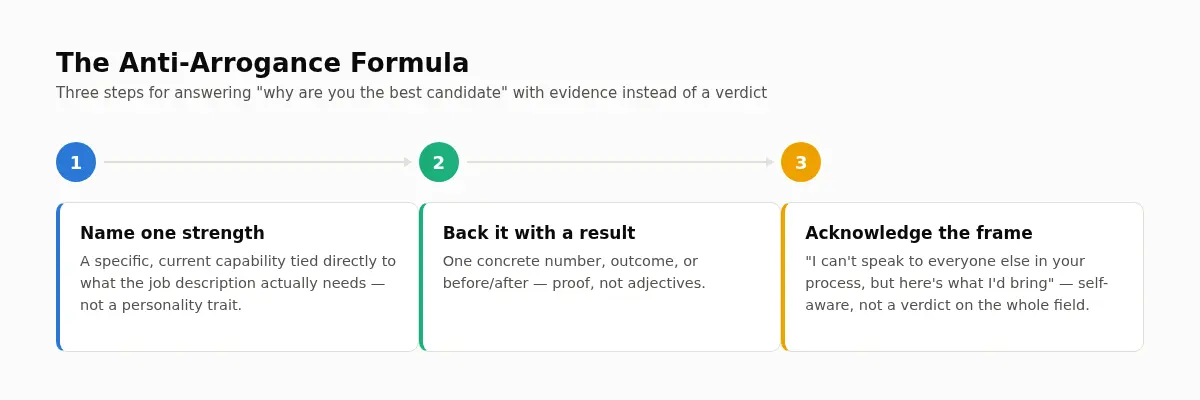
Here's the structural fix competitor advice mostly skips: evidence first, comparison acknowledged, no verdict claimed.
- Name one specific, current strength — not a personality trait, a concrete capability tied to what the role actually needs.
- Back it with one result — a number, an outcome, a before/after.
- Acknowledge the frame without fighting it — a short phrase like "I can't speak to everyone else in your process, but here's what I'd bring" does more work than it looks like. It signals self-awareness instead of overreach.
A worked example: "I can't speak to who else you're considering, but I built and shipped a churn-reduction feature at my last company that cut 30-day cancellations by 12% in one quarter — that's the kind of direct, measurable impact I'd bring to this retention-focused role from day one."
That's one sentence of humility, one sentence of evidence, zero sentences ranking yourself against strangers.
Mirror the Job Description Before You Answer
Generic prep advice says "study the job description," but the useful version is mechanical: pull the 3–4 verbs and nouns that repeat across the responsibilities section (not the generic "team player" language in the intro paragraph), and make sure your one chosen strength maps to one of them directly. If the posting says "own the migration," "reduce incident volume," and "mentor junior engineers" three separate times, your answer should hit the exact same words — not synonyms, the same words — because that's what a hiring manager pattern-matches on when they're reviewing five interview scorecards in one afternoon.
This is also where real-time interview help earns its keep. AceRound reads the live conversation and can surface job-description-specific phrasing in the moment, so you're not trying to memorize a mirrored answer word-for-word beforehand — you're calibrating tone and specificity live, based on what the interviewer actually emphasizes when they ask the question.
What If You Have Less Experience Than Other Candidates?
This is the scenario that shows up constantly in real interview-anxiety threads — candidates worried the hiring manager is quietly comparing them to someone with three more years on paper. You cannot out-argue a candidate you've never met, so don't try. Two things work better than defensiveness:
- Reframe recency as a strength, honestly. "I've spent the last 18 months specifically on [the exact stack/problem this role centers on]" is a real claim a 10-year generalist may not be able to make.
- Let the interviewer do the comparing. Your job is to give them one clear, specific data point to weigh — not to convince them you've already won the comparison. Confidence here looks like precision, not volume.
Sample Answers by Situation
Entry-level / first job: "I can't compare myself to other applicants, but I spent my final semester building [specific project] that solved [specific problem], and I'd bring that same hands-on approach to your team from week one rather than a long ramp-up period."
Experienced hire, similar background to other finalists: "I don't know what the rest of your process looks like, but in my last role I [specific result with a number], and that's the exact kind of outcome your job posting says this role is accountable for."
Career changer: "I know my background looks different on paper, but the skill this role actually needs — [specific transferable skill] — is one I've been doing for [X years] in a different context, just under a different job title."
FAQ
Isn't it arrogant to say I'm the best candidate for the job? Saying it flatly can backfire — a widely-shared piece by career columnist Alison Green argues that directly claiming to be 'the best candidate' invites skepticism rather than confidence, because the interviewer has no way to verify a comparison against people they haven't met. The fix isn't to avoid the question; it's to answer with evidence instead of a verdict. Show what you'd bring instead of ranking yourself against a field you can't see.
What if another candidate has more experience than me? You can't win a head-to-head you can't see, so don't try. Instead, name the specific, current strength you bring — recent hands-on experience with their exact tech stack, fresh perspective, or a track record in a smaller/faster environment — and let the interviewer weigh it against whatever else is in the pool. Trying to out-argue an invisible competitor usually reads as insecure; naming your specific value doesn't.
How is this different from 'why should we hire you'? 'Why should we hire you' is usually framed around fit — do you match the team and the role. 'Why are you the best candidate' is more explicitly comparative — it's asking you to rank yourself against people you've never met, which is exactly why it feels more uncomfortable to answer directly. The practical difference in your answer: lean less on 'I'd fit well here' and more on 'here's the specific thing I'd bring that's hard to replace.'
Can I ask the interviewer what they're looking for before I answer? You generally shouldn't turn the question back on them mid-answer, but you can and should have already gathered that information from the job description, and it's fair game to ask a clarifying reverse-question at the end of the interview about what's most critical for the role's first 90 days. That answer sharpens exactly what to emphasize if you get a second interview.
What's a short answer I can give without sounding scripted? Pick one specific, current strength that maps directly to something in the job description, state it in one sentence, back it with a concrete result in one more sentence, and stop. Long, multi-point answers to this question tend to sound more rehearsed, not less — the confidence signal comes from precision, not volume.
Author · Alex Chen. Career consultant and former tech recruiter. Spent 5 years on the hiring side before switching to help candidates instead. Writes about real interview dynamics, not textbook advice.
Related Articles
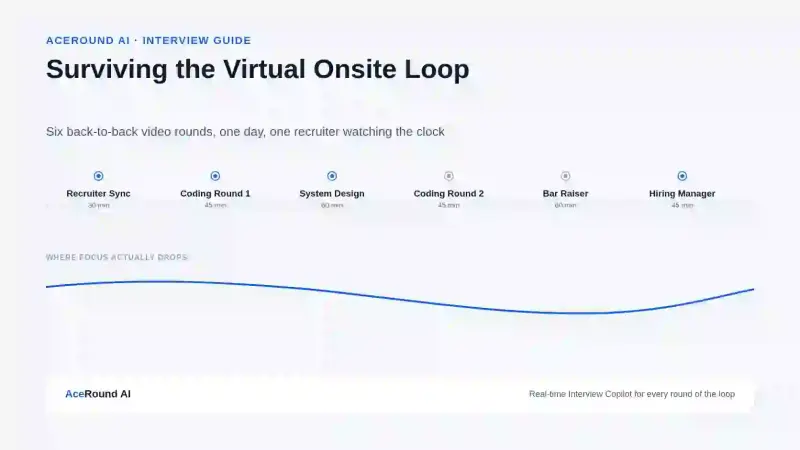
Virtual Onsite Interview Loop: How to Survive 4-6 Back-to-Back Rounds
What a virtual onsite interview loop is, why round 4 is where candidates fall apart, and how to prepare for 4-6 back-to-back video rounds in one day.
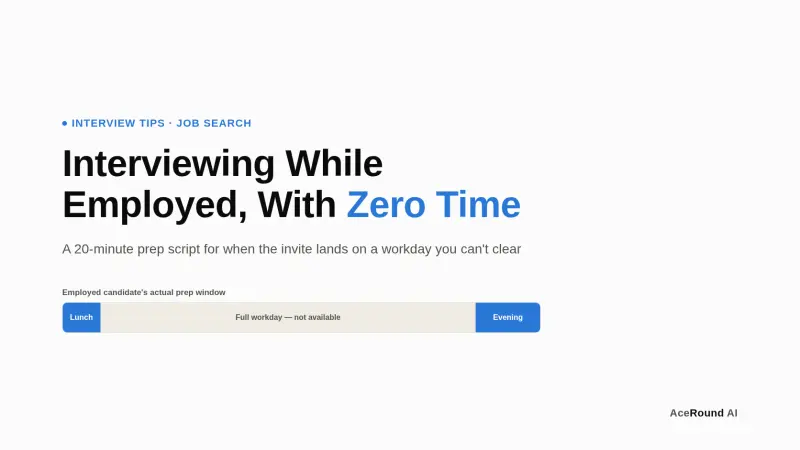
Interviewing While Employed: How to Actually Prepare With Zero Time
Job searching while employed means near-zero prep time, not just staying discreet. Here's a 20-minute prep script, plus what the counteroffer statistics actually show.
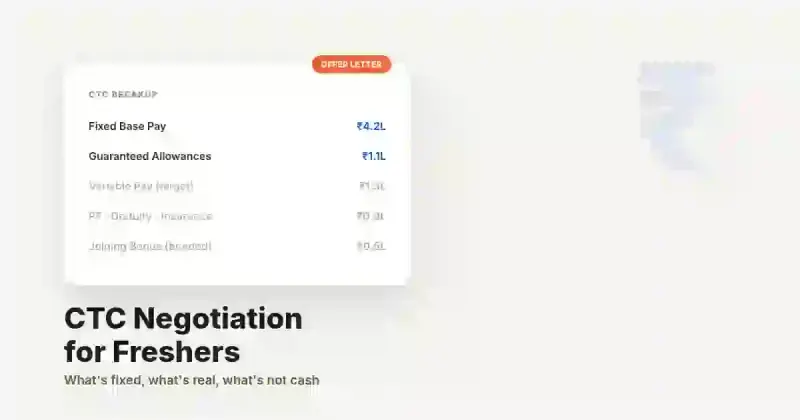
CTC Negotiation for Freshers in India: What's Actually Negotiable
Most fresher CTC negotiation advice ignores that TCS, Infosys, and Wipro set fixed pay bands. Here's what's really negotiable, and where lowball offers hide.