How Do You Measure Success? The Interview Answer That Works
How do you measure success interview answer, decoded: what recruiters vs. hiring managers actually screen for, plus role-specific scripts and a freeze-proof framework.

TL;DR: The strongest how do you measure success interview answer pairs a concrete personal metric with a team or company outcome it fed into — never money or title alone. But the real trick is that the "right" answer changes depending on who's asking: a recruiter screen, a hiring manager, and a skip-level exec are each probing for a different risk. Decode which one you're in front of, then answer with a specific number and a story, not a philosophy.
Twenty minutes into a final-round loop, a hiring manager leans back and asks, "So — how do you measure success?" The candidate has an answer ready. It's a good one, even: "I care about doing quality work and having a positive impact on the team." The hiring manager nods, writes one word on the notepad, and moves to the next question.
That word was "vague." The candidate didn't fail because their values were wrong. They failed because they answered a values question with a values answer, when the interviewer was actually asking a very specific operational question: will the way you define winning match the way I'm going to measure you in this job? That's the gap this guide closes — with a framework that survives a mind-blank moment, and real example answers by role instead of a template you'll recognize as a template.
Why Interviewers Actually Ask "How Do You Measure Success?"
This question sounds philosophical. It isn't. According to research on structured interview design from the U.S. Office of Personnel Management, questions like this exist specifically because structured, criteria-based interviews predict job performance more reliably than free-form conversation — meaning the interviewer isn't fishing for a nice sentiment, they're scoring your answer against a rubric they already have in their head.
What's actually on that rubric depends heavily on who's asking, and generic career-advice articles almost never separate this out:
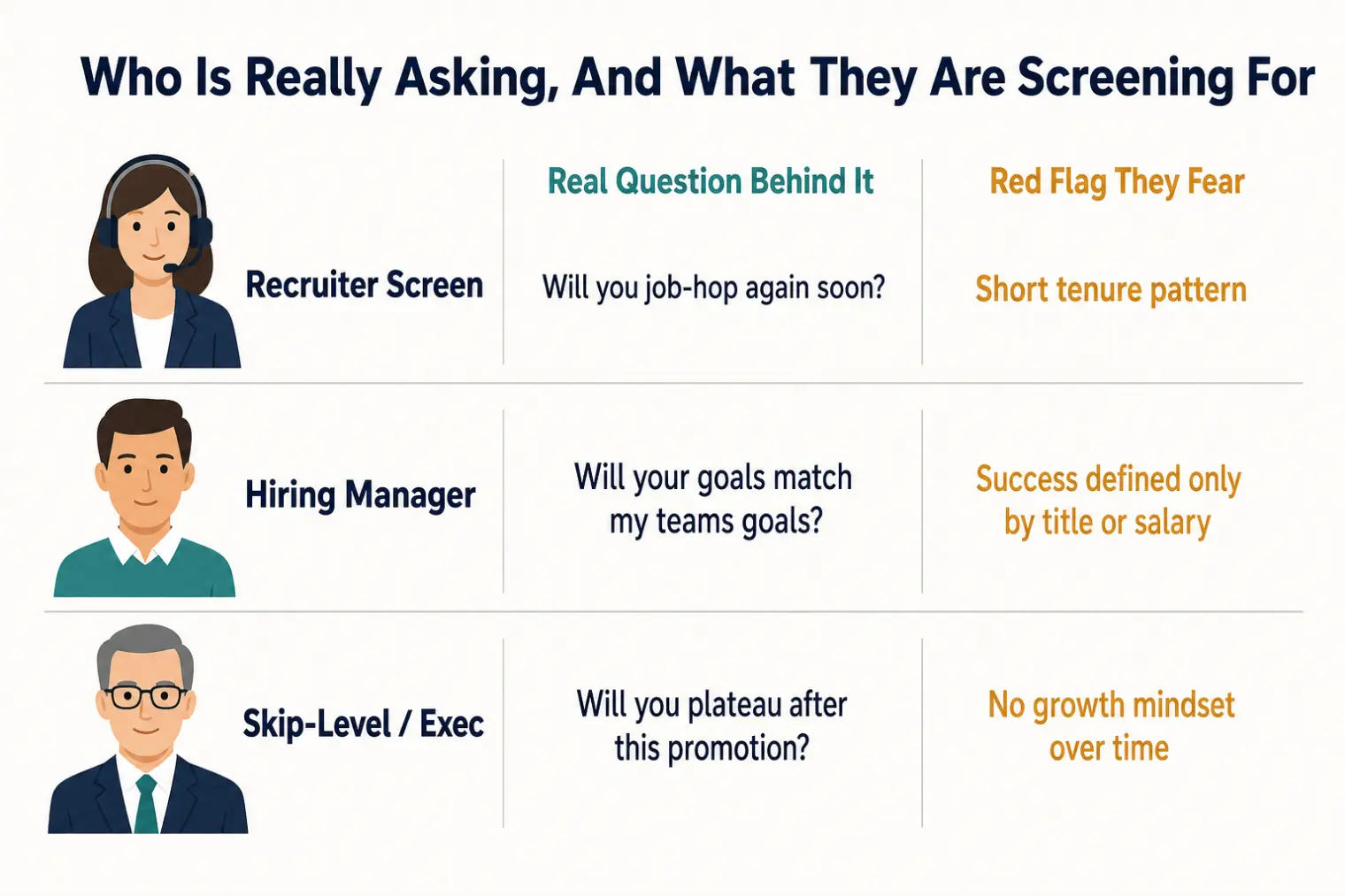
A recruiter screen is usually a filter for tenure risk. If your definition of success sounds like "getting promoted fast" or "hitting a big paycheck," that reads as someone who'll be job-hunting again in twelve months the moment either stalls.
A hiring manager is checking whether your personal definition of winning overlaps with what they'll actually measure you against on the job. If you manage a support queue and answer with "shipping ambitious new features," that's a legitimate mismatch signal, not just a vague answer.
A skip-level or executive round is frequently testing whether you'll keep resetting your bar after you get the role you're currently interviewing for. If your only example of success is the achievement that got you into the room, that reads as someone who plateaus post-promotion.
Same words, three different things being tested. Naming which one you're in front of — even just to yourself, mid-answer — changes what "good" sounds like.
The Framework: How Do You Define Success Without Sounding Generic
Career-advice sites tend to converge on one rule: don't say money or status. True, but not useful on its own — knowing what to avoid doesn't tell you what to say instead. Use this three-part structure, borrowed from goal-setting frameworks used inside companies like Google's OKR methodology, scaled down to interview length:
- Name the metric that's actually yours. Not the company's revenue number — the thing you personally move. A specific number, not a category ("cycle time" not "efficiency").
- Connect it to a result one level up. Show you understand your metric isn't the point, it's a proxy for something the business cares about.
- Add one line about how your definition changed. This is the part almost nobody includes, and it's what signals growth instead of a fixed script. "I used to measure success by X, until I learned Y — now I also track Z."
That third part matters more than people think. A meta-analysis published via SIOP on predictors of job performance notes that structured interview formats outperform unstructured ones partly because they surface evidence of learned judgment, not just stated values — and a definition of success that evolved is direct evidence of that.
Example Answers: What Does Success Mean to You, By Role
Generic sites stop at "tailor it to your industry" and never actually write the tailored version. Here's what that looks like at different levels — use the structure, not the wording verbatim.
New grad / early career: "Early on, I measured success by whether I finished tickets on time. Six months in, I noticed the tickets I closed fastest sometimes came back as bugs a sprint later — so now I measure it by whether a ticket stays closed, which pushed my rework rate down by about 30%. That taught me speed and success aren't the same thing yet, and I'd rather build the second habit early."
Senior IC (engineering, technical): "I track two things: how much of my code needs a second pass after review, and whether the systems I build still make sense to the next person who touches them six months later. The second one is harder to measure, so I've started asking teammates directly instead of guessing — that's a definition of success I only added after getting burned by a 'clean' system nobody else could maintain."
People manager: "My number is regrettable attrition on my team, because it's a lagging indicator of everything else going wrong upstream. But I also watch a leading one — how many of my reports bring me a problem before it becomes urgent, which tells me whether they trust the team enough to flag things early."
Customer-facing / sales: "I used to measure it purely by closed revenue. After a stretch where I closed a lot of deals that churned in month two, I added net revenue retention from my own accounts as a personal metric, even though it's not formally tracked at my level yet — because closing the wrong deal isn't actually success, it's deferred failure."
How to Measure Success at Work When There's No Number
If your work is qualitative — research, design, writing, strategy — don't force a fake metric. Attach your judgment call to whatever it eventually moved downstream. A UX researcher's r/UXResearch thread on this exact problem captures the real difficulty: turning insight work into something "trackable back to hard, numerical metrics" when the actual skill being exercised is judgment, not measurement.
The move: name the qualitative decision, then name the measurable thing it fed. "I recommended we cut the signup flow from five steps to three based on session recordings, not a stat — the completion-rate lift was the metric, but the call that led to it wasn't." That's a success definition that's honest about being qualitative while still giving the interviewer a number to anchor on.
If You Freeze Mid-Answer
This is the moment generic advice skips entirely, and it's the one that actually costs offers. You get the question, your mind goes blank, and you default to "I just want to do good work" — which is the exact vague answer this guide is trying to get you past.
The fix in the moment is small: buy five seconds by restating the question ("that's worth being specific about"), and reach for the most recent concrete example you have, even an imperfect one, rather than a philosophy. This is also the exact scenario where a real-time AI interview assistant like AceRound earns its place — not writing your answer for you, but listening for the follow-up cue and surfacing the metric-and-result structure on screen while you're mid-sentence, so the panic default is a prompt instead of a blank.
Common Mistakes That Sink This Answer
- Leading with money or title. Even true, it reads as a plateau risk — save it for a footnote, if at all.
- Answering with a value, not a metric. "Impact" and "growth" mean nothing without a number or a story attached.
- Reusing the same answer for every round. A recruiter screen and a skip-level exec round are testing different things — see the framework above.
- No evolution. A definition of success that hasn't changed in five years reads as someone who's stopped learning.
- Overclaiming precision on qualitative work. Inventing a fake number is worse than being honest that a metric is a proxy.
Before Your Next Interview
- Pick one metric that's genuinely yours to move — not the company's headline number
- Write one sentence connecting that metric to a result one level up
- Add a line showing how your definition of success has changed at least once
- Prepare a second version scaled for a skip-level or exec round, if one's on your loop
- If your work is qualitative, name the judgment call and the metric it eventually fed
For more on structuring high-stakes behavioral answers, see how to approach what are your strengths and why should we hire you — both use the same "specific metric, not a value word" logic this question rewards.
Frequently Asked Questions
How do you measure your own success at work?
The strongest answers combine a personal output metric (a number tied to your actual role — tickets closed, code shipped, deals closed, campaigns launched) with a team or company-level outcome it fed into. Naming only the personal number sounds self-focused; naming only the company number sounds like you had no individual contribution. Pair both in one or two sentences.
What does success mean to you in a job interview?
It means having a specific, examples-backed definition rather than a philosophy. Avoid answering with an abstract value like "growth" or "making an impact" on its own — follow it immediately with the concrete metric or outcome that proves it, and ideally a moment when your definition of success changed based on something you learned on the job.
How do you measure success when your work is mostly qualitative?
Attach a proxy metric to the qualitative outcome instead of trying to force a fake number. A UX researcher can point to how many of their recommendations shipped into the product, or how a design decision changed a downstream conversion number, even though the research itself wasn't the number. Name the qualitative judgment call and the measurable thing it eventually moved.
Is it okay to say money or promotion is how you measure success?
Not as your opening line. Career coaches consistently flag compensation-first answers as a signal that you'll disengage once the pay plateaus, which is exactly the plateau risk a hiring manager is trying to rule out. Compensation can be a footnote later in the conversation; it shouldn't be the definition itself.
Does the answer change if a recruiter asks vs. a hiring manager or a skip-level exec?
Yes. A recruiter is usually screening for tenure risk and cultural fit at a surface level, so a concise, values-aligned answer works. A hiring manager wants your definition to overlap with what they'll actually measure you against day to day, so specificity about your function matters more. A skip-level or exec round is often testing whether you'll keep setting new goals after you get the title you're interviewing for — so show that your definition evolves over time.
What if I freeze and don't have a good answer ready?
Buy yourself five seconds by restating the question in your own words — "that's a good one to think about concretely" — while you land on one specific recent example. The failure mode isn't hesitation; it's defaulting to a vague line like "I just want to do good work," which sounds like you've never actually thought about it.
Author · Alex Chen. Career consultant and former tech recruiter. Spent 5 years on the hiring side before switching to help candidates instead. Writes about real interview dynamics, not textbook advice.
Related Articles
Figma Software Engineer Interview Process (2026): What's Reported
Figma publishes no interview rubric. Here's the loop candidates report, the product-flavored coding and design rounds, and what's known about an AI round.
Oracle and PayPal Fresher Interview Process in India: What Candidates Reported, Year by Year
Oracle India's test moved from aptitude plus core CS to HackerRank with a REST API task. PayPal's cut-offs and platform also differ. Posts compared.
Airbnb Software Engineer Interview: The Core Values Round, Explained
Airbnb's four core values are public, but the interview round built on them isn't documented. Here's what's official, what candidates report, and how to prepare.