Operations Manager Interview Questions: The Cross-Functional Leadership Guide
Prepare for operations manager interviews with AI: cross-functional leadership stories, KPI ownership, and the capacity-math questions almost no guide covers.

TL;DR: Operations manager interviews test something narrower than generic leadership: whether you can drive results through people and processes you don't fully control, prove it with real KPIs, and — increasingly — solve a quantitative capacity or headcount problem out loud. Practicing the case-math format matters as much as rehearsing your STAR stories.
You've done the phone screen. The recruiter loved your resume — 18 months turning around a fulfillment team's on-time rate, a process redesign that cut handling time by 30%. Then the hiring manager opens with: "Walk me through how you'd calculate weekly output for a 30-person team, two of whom are on indirect tasks, running an 8-hour shift with two 15-minute breaks."
Silence. You know operations. You didn't expect arithmetic.
This is the gap most operations manager interview prep misses. Generic behavioral guides cover leadership stories well. They almost never mention that a meaningful share of operations manager interviews — especially at logistics-heavy, retail, or manufacturing-adjacent companies — include a live capacity or throughput calculation, done verbally, with no slide deck to hide behind.
This guide covers both halves: the cross-functional leadership questions you expect, and the math-under-pressure format you probably don't.
What Operations Manager Interviews Are Actually Testing
Strip away the job-specific vocabulary and every operations manager interview is probing the same three things:
- Can you drive a process or a team you don't fully own? Operations managers spend enormous energy influencing peers in sales, finance, and supply chain who don't report to them. Harvard Business Review's research on influence without authority is the underlying skill interviewers are screening for, even when the question sounds like "tell me about a cross-functional project."
- Do you own numbers, or do you just report them? Anyone can recite a KPI. Interviewers want to hear that you found the root cause behind a bad number, changed something specific, and can quote the before/after with a "why" attached.
- Can you think quantitatively in real time? This is the part most candidates under-prepare — see below.
Unlike a role such as supply chain management, which is evaluated on vertical logistics KPIs (OTIF, fill rate, freight spend), operations manager interviews are usually industry-agnostic. The same interview structure shows up whether the company is a retailer, a hospital system, or a professional services firm — which means the leadership and process-improvement stories you build here should be portable across industries, not warehouse-specific.
Common Operations Manager Interview Questions
These questions appear, in some phrasing, across almost every operations manager interview loop:
- "What would you do if you noticed that someone on your team was under-performing?" — wants a diagnostic process, not a vague promise.
- "Do you think there's a difference between management and leadership?" — wants you to articulate both and show you practice each.
- "What aspect of this job do you expect to be most challenging within the first four weeks of starting?" — wants specificity, not "the learning curve."
- "If we hire you, what's the first thing you would do in your position as an operations manager?" — tests whether you'll diagnose before you act.
- "Have you ever had a team struggle to meet their business goals? What did you do to address the situation?" — a failure-recovery story with a measurable outcome.
Every one of these is really asking the same underlying question in a different costume: do you have a repeatable method, or do you improvise? Build one clear example per question — ideally drawn from your last two roles — and you'll cover 80% of what actually gets asked.
The Question Almost Nobody Preps For: Operations Math
Here's a real, candidate-reported question from an operations manager interview at a large logistics employer:
"You have 30 associates who all work an 8-hour day, 5 days a week. 2 need to be in indirect (non-volume-producing) roles. Your direct (production) rate is 150 units per hour, but you have two 15-minute breaks during the day. How many units can your department produce in a 40-hour week?"
Walking through it out loud matters more than the final number:
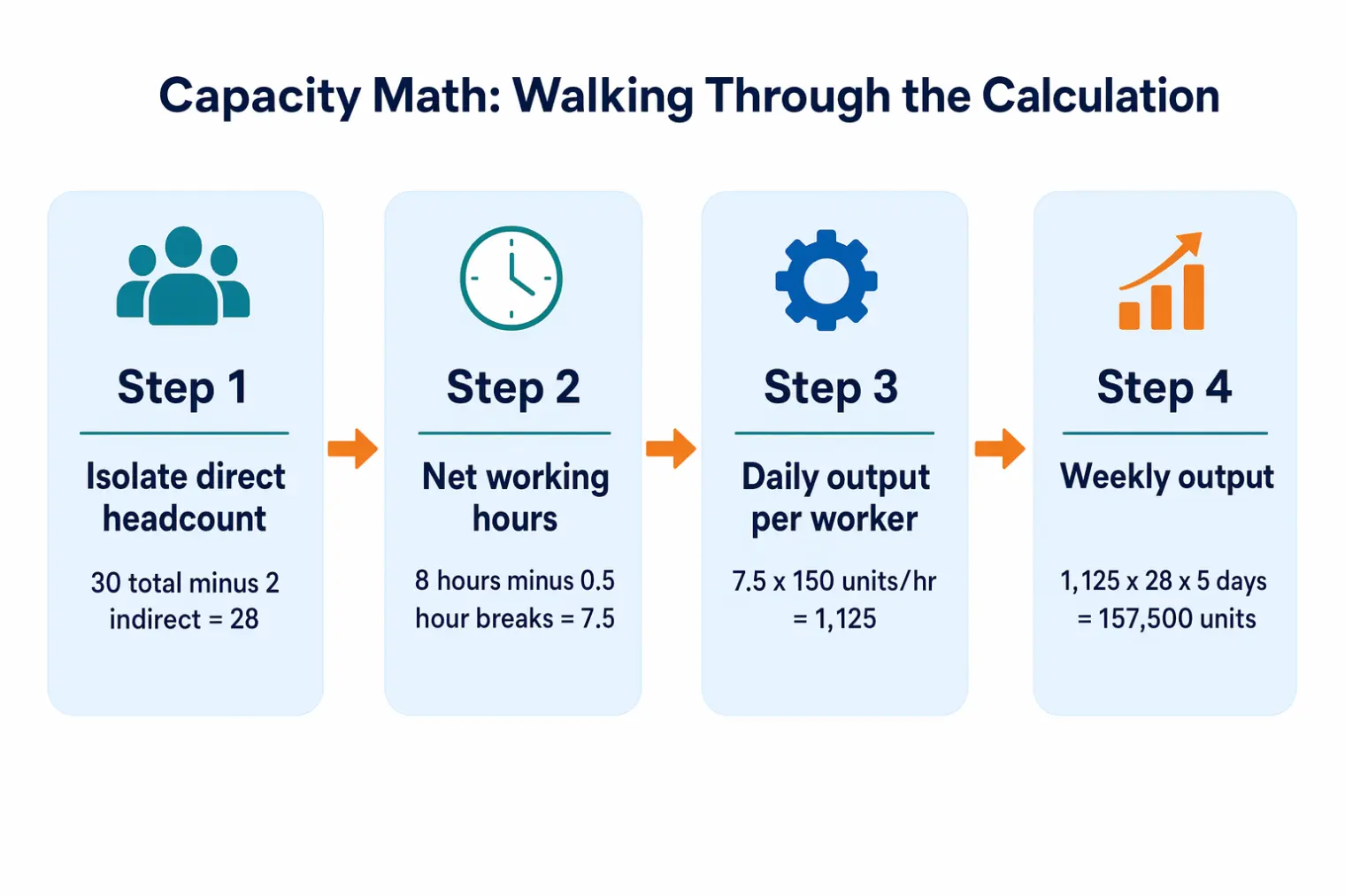
- Isolate direct headcount: 30 total − 2 indirect = 28 direct workers.
- Net working hours per day: 8 hours − 0.5 hours of breaks = 7.5 hours.
- Daily output per worker: 7.5 hours × 150 units/hour = 1,125 units.
- Weekly output: 1,125 × 28 workers × 5 days = 157,500 units.
The math itself isn't hard. What trips candidates up is doing it live, narrating each assumption clearly, and staying calm when the interviewer changes a variable mid-answer ("now assume one associate calls in sick"). Interviewers are watching your process under mild pressure, not grading you like a math exam — but freezing up reads as a red flag for a role that's supposed to make exactly this kind of calculation daily.
Practice this format specifically. Generic behavioral rehearsal won't prepare you for it, and it's one of the areas where structured, repeated practice — including with an AI interview assistant that can throw follow-up variables at you the way a real interviewer would — closes the gap fastest.
STAR Stories for Process Improvement
When asked about process improvement (Lean, Six Sigma, or just "how did you make things better"), the strongest operations manager answers follow a specific shape:
- Baseline: What was the metric before you touched it? ("Order-to-ship cycle time averaged 3.2 days.")
- Root cause: What did you actually find? ("62% of delay was concentrated in a single approval step that had no SLA.")
- Intervention: What did you change, specifically? ("Introduced a same-day approval SLA and moved approval authority to the shift lead for orders under $500.")
- Result, quantified: ("Cycle time dropped to 1.8 days within six weeks; no increase in approval errors.")
This is the same STAR framework used everywhere, but operations interviewers listen specifically for the root-cause step. Candidates who skip straight from "cycle time was slow" to "I fixed it" without naming what they diagnosed sound like they got lucky, not that they understood the system.
How to Practice Without Guessing
The honest challenge with operations manager interview prep is that you can't fully rehearse it alone — a case-math question needs someone to change a variable on you mid-answer, and a leadership story needs someone to push back with "what if that hadn't worked?" the way a real interviewer would.
Real-time AI interview tools like AceRound are useful here for a specific reason: during a live interview, if you're asked a capacity-math variant you haven't drilled, or a follow-up you didn't anticipate on a leadership story, quiet on-screen prompts can help you structure the answer in the moment — without turning the conversation into something scripted. It's not a substitute for knowing your own numbers cold. It's a safety net for the moment your prep doesn't cover everything the interviewer throws at you.
FAQ
What is the hardest operations manager interview question? Most candidates struggle most with the quantitative case-math questions — capacity, headcount, or throughput arithmetic done out loud, under time pressure, with no calculator. Behavioral questions about leadership feel more familiar because candidates can prepare a story in advance; the math format catches people who haven't rehearsed thinking on their feet.
What would you do if you noticed that someone on your team was under-performing? Interviewers want a specific process, not a vague promise to "have a conversation." Name the diagnostic step (is it a skill gap, a motivation issue, or a resourcing problem), the timeline for a documented check-in, and how you'd measure improvement — then give a real example if you have one.
Do you think there's a difference between management and leadership? Yes, and naming the distinction well is the point of the question. Management is about process, resourcing, and hitting operational targets; leadership is about influence, direction, and getting people to commit beyond what's required. Strong answers show you do both, with an example of each.
What aspect of this job do you expect to be most challenging within the first four weeks? The strongest answers name something specific and true — usually building credibility with a team you didn't hire, or learning an unfamiliar system or process fast enough to make sound decisions — rather than a generic "the learning curve."
If we hire you, what's the first thing you would do in your position as an operations manager? Interviewers are testing whether you'll walk in and start changing things before you understand them. A strong answer describes a listening and diagnostic phase — reviewing current KPIs, talking to the team and cross-functional partners — before naming any specific first project.
Have you ever had a team struggle to meet their business goals? What did you do? This is a variation on the failure-recovery story. Interviewers want the diagnosis (why were targets missed), the intervention you made, and a measurable outcome — not just that the team eventually hit its number.
Author · Alex Chen. Career consultant and former tech recruiter. Spent 5 years on the hiring side before switching to help candidates instead. Writes about real interview dynamics, not textbook advice.
Related Articles
Datadog Interview Process (2026): What's Allowed With AI, Round by Round
Datadog publishes its AI rules for candidates. Here's what they allow, what they ban, the reported loop, and how to prep for the project deep dive.
Figma Software Engineer Interview Process (2026): What's Reported
Figma publishes no interview rubric. Here's the loop candidates report, the product-flavored coding and design rounds, and what's known about an AI round.
Oracle and PayPal Fresher Interview Process in India: What Candidates Reported, Year by Year
Oracle India's test moved from aptitude plus core CS to HackerRank with a REST API task. PayPal's cut-offs and platform also differ. Posts compared.