Executive Assistant Interview AI: Judgment Calls and Tool-Vetting Questions
This executive assistant interview AI guide covers tool vetting, confidential data, and multi-executive judgment calls with practical scenarios.
TL;DR: Executive assistant interview AI prep should go beyond "how do you prioritize" and "tell me about a conflict." Practice a multi-executive judgment-call scenario and an AI-fluency question about vetting tools that may handle confidential material. Use AI to rehearse both beforehand, then rely on your own judgment in the interview.
You've rehearsed the classics. "Tell me about a time you managed a difficult calendar." "How do you handle confidential information?" You have a tight STAR answer for both. Then the hiring manager leans back and asks: "Two of our executives both insist their meeting is the priority for the same 2 p.m. slot. Walk me through what you actually do — not what you'd tell them, what you'd do."
Or a newer question worth preparing for in 2026: "What's your process for vetting a new AI tool before you put a board document through it?"
Neither question shows up on the generic "20 executive assistant interview questions" lists that dominate search results. Both are worth practicing for senior EA and chief-of-staff-adjacent roles because they expose judgment under discretion better than a generic prioritization question does.
What Executive Assistant Interviews Are Actually Testing
Strip away the specific wording and every serious executive assistant interview is probing three things:
- Do you have a repeatable process for competing priorities, not just a story about one time it worked out.
- Can you be trusted with information an executive can't fully verify you'll protect — this is the real subtext behind "confidentiality" questions.
- Do you evaluate new tools (including AI) with the same discretion you'd apply to a person you're handing sensitive material to.
The role is unusual among admin-adjacent positions because the entire value proposition is trust that can't be directly observed in a 45-minute interview — which is exactly why interviewers keep inventing scenario questions instead of trusting a rehearsed answer.
Executive Assistant Behavioral Interview Questions You Should Expect
These show up, in some phrasing, in almost every serious loop — the baseline you need covered before the harder questions below:
- "Tell me about a time you had to manage a demanding executive's schedule." — wants a process, not a war story.
- "How do you make judgment calls with confidential board or HR documents?" — wants a classification system, not a promise.
- "Describe a time priorities shifted last-minute. What did you do?" — wants to see you re-triage calmly, not just "work harder."
- "What's your approach to learning a new tool or system quickly?" — the old version of the tech-fluency question, still asked alongside the newer AI-specific one below.
Build one clear, specific example per question, ideally from your last two roles, and you'll cover most of what a first-round screen actually asks.
The Multiple-Executive Scheduling Conflict Almost Nobody Preps For
Use this scenario to test whether your process holds up: two C-suite executives you support both need the same 2 p.m. slot, both consider their meeting non-negotiable, and neither is available to just "ask."
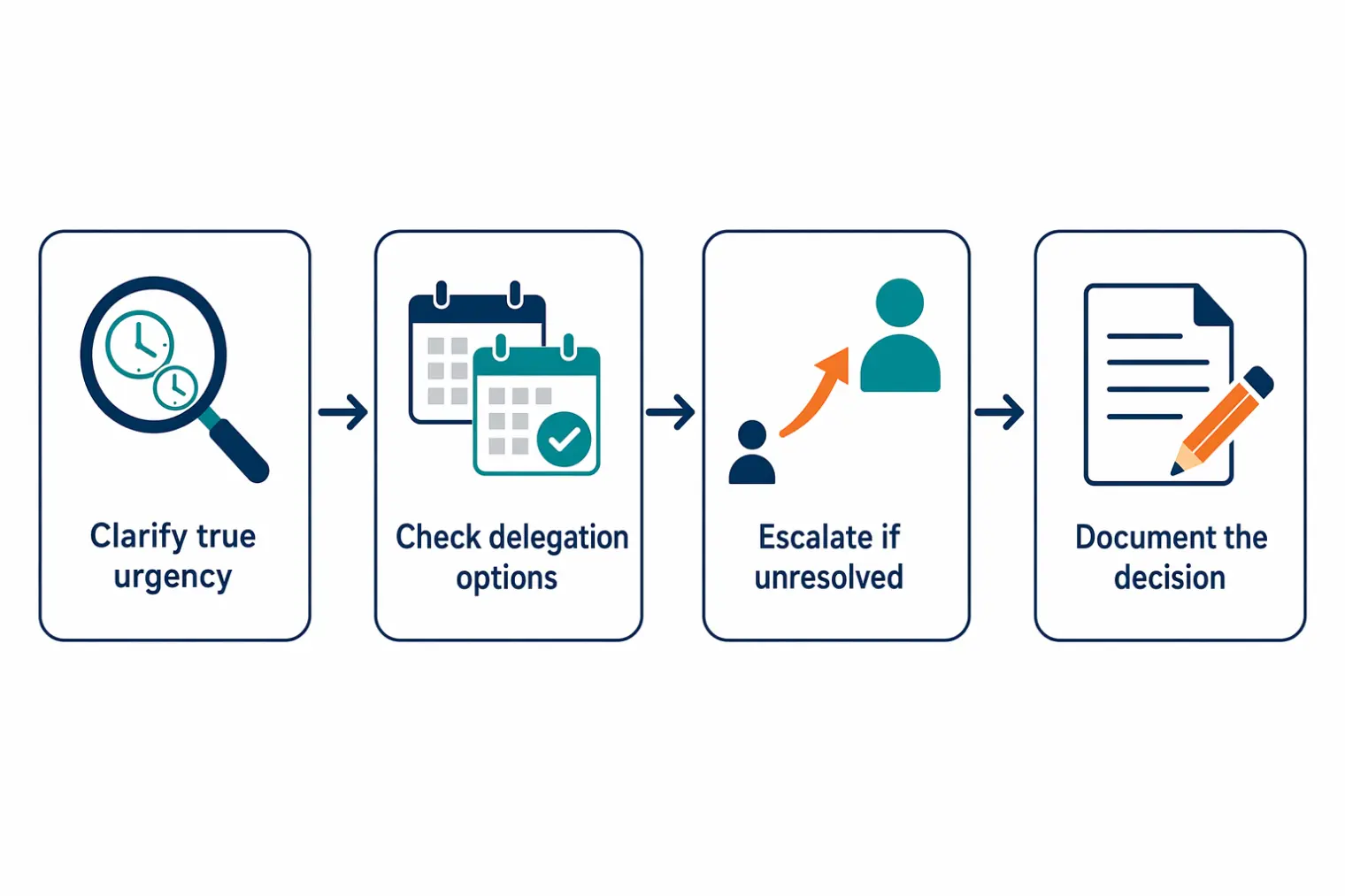
A strong answer names the actual method:
- Clarify real urgency versus stated urgency — ask each principal's chief of staff or EA (or the principal directly, briefly) what's actually at stake if the meeting slips 30 minutes.
- Check for a delegation option — can a deputy attend one meeting on the executive's behalf without it reading as a snub?
- Escalate rather than silently choose — if truly tied, you flag it up rather than quietly picking a "winner," which is where EAs get burned.
- Document the decision and the reasoning — so it's defensible afterward, not just remembered.
What interviewers are actually screening for here isn't diplomacy — it's whether you have a process you'd run the same way under pressure at 4:55 p.m. on a Friday, not just good instincts in a calm interview room.
AI Tools in an Executive Assistant Interview: How Do You Vet Them?
This is the question competitor interview guides consistently miss. The Bureau of Labor Statistics says AI systems and digital tools let staff prepare more of their own documents, one reason it projects little change or decline for most secretary and administrative-assistant categories. That makes this a useful question to rehearse: "What AI tools do you currently use for scheduling, transcription, or drafting, and how do you decide what's safe to run confidential material through?"
It's really the confidentiality question wearing new clothes. A strong answer covers:
- What you'd never put into a consumer AI tool without an enterprise data agreement (unreleased financials, HR cases, board materials).
- How you check a new tool's data-retention and training policy before adopting it, even for something as small as meeting notes. A checklist based on the NIST AI Risk Management Framework is stronger than "I read the privacy page."
- A specific example, if you have one, of choosing not to use an AI tool for a task because the confidentiality risk wasn't worth the time saved.
If you've only prepared the old "I'm proficient in Microsoft Office and Google Workspace" version of this question, the AI-specific follow-up can catch you off guard — which is exactly why it's worth rehearsing on purpose.
How to Use AI for Executive Assistant Interview Prep — Honestly
Here's the tension worth naming directly: this is a role built entirely on discretion, so using a hidden AI to feed you live answers during the actual interview undercuts the thing you're being hired for. That's a different call than using AI to prepare.
Preparing with AI beforehand is unambiguous — drill the judgment-call scenario above until your triage process is automatic, rehearse the AI-vetting question until it's not the first time you've said it out loud, and stress-test your confidentiality STAR story against follow-up questions you haven't thought of yet. A structured AI interview coach is genuinely useful here because it can throw the follow-up variable at you — "now assume the executive is unreachable" — the way a real interviewer would, instead of you rehearsing the same clean version of the story every time.
Where it gets murkier is live, undisclosed use during the interview itself. Real-time tools like AceRound can provide on-screen prompts mid-interview. For an executive assistant interview specifically, we'd be honest with you: lean on AI hardest in the rehearsal phase, and go in trusting your own judgment once you're in the room — because judgment, not a scripted answer, is the actual job.
FAQ
What is the hardest executive assistant interview question? For most candidates it isn't the classic prioritization or confidentiality question — it's a judgment-call scenario involving two or more executives who both think they're your top priority, or a new question about how you vet the AI tools you use. Both test discretion under pressure rather than a rehearsed script.
How do you answer "how do you handle confidential information" in an executive assistant interview? Name a concrete system, not a promise. Describe how you classify sensitive material, who you loop in versus never loop in, and one real (anonymized) example where you protected information under pressure. Vague reassurance ("I'm very trustworthy") is the answer interviewers hear the most and trust the least.
Are executive assistants being asked about AI tools in interviews now? They can be. Beyond the old "are you good with Outlook and Excel" question, a hiring manager may ask how you evaluate AI scheduling, transcription, or writing tools before giving them calendar or document data. Evaluating those tools is a confidentiality decision an EA may need to make independently.
Is it okay to use AI to prepare for an executive assistant interview? Yes, for rehearsal — practicing judgment-call scenarios, tightening a STAR story, or drilling the AI-fluency question before you walk in. It gets murkier if you'd lean on a hidden AI feeding you live answers during the interview itself, given that the entire job is built on being trusted without a script. Prep with AI; don't outsource the judgment the role exists to test.
How do you handle competing demands from multiple executives in an interview answer? Give the actual triage method you use — how you'd clarify true urgency versus stated urgency, when you escalate instead of silently choosing a winner, and a real example where two executives needed the same hour. Interviewers are listening for a repeatable process, not diplomacy alone.
What's a good STAR example for an executive assistant interview? Pick a moment where discretion or competing priorities were the actual test, not just busy-ness — e.g., managing an executive's calendar during a confidential reorg, or catching a scheduling conflict between two board members before it became visible. Name the situation, your specific action, and a measurable or verifiable result.
Author · Alex Chen. Career consultant and former tech recruiter. Spent 5 years on the hiring side before switching to help candidates instead. Writes about real interview dynamics, not textbook advice.
Related Articles

Deloitte USI, EY GDS, KPMG GDC, and PwC AC: India Hiring Process Explained
Deloitte USI, EY GDS, KPMG GDC, and PwC AC run four separate hiring processes — HireVue, group exercises, and Eduthrill included — and none of them match a TCS-style aptitude test.
Virtual Onsite Interview Loop: How to Survive 4-6 Back-to-Back Rounds
What a virtual onsite interview loop is, why round 4 is where candidates fall apart, and how to prepare for 4-6 back-to-back video rounds in one day.
Interviewing While Employed: How to Actually Prepare With Zero Time
Job searching while employed means near-zero prep time, not just staying discreet. Here's a 20-minute prep script, plus what the counteroffer statistics actually show.