How to Answer What Do You Know About Us
What to research before an interview, a 3-part answer formula, and how AI turns your notes into talking points that impress.

TL;DR: "What do you know about our company?" isn't small talk — it's a research-and-preparation filter, and it's a different question from "why do you want to work here." The strongest answers combine 2-3 specific, recent facts with one line connecting them to the role, then close with a smart question back. Most candidates lose points here not because they didn't try, but because they stopped at the company's own About page.
Someone posted this on Quora: "How do you respond when someone asks 'what do you know about our company' if they haven't provided much information?" It's a fair question, because most candidates treat this one as a warm-up before the "real" questions start. It isn't. Interviewers use it as an early filter — it's one of the fastest ways to tell who spent twenty minutes preparing and who spent two.
Here's the research framework that actually holds up, the answer structure that works, and where it goes wrong.
Why This Question Isn't Small Talk (and Isn't "Why Do You Want to Work Here")
These two questions get conflated constantly, but they're testing different things. "What do you know about our company" evaluates your research and preparation — can you demonstrate real knowledge of the business. "Why do you want to work here" evaluates your motivation and fit — why this appeals to you personally, what you'd bring.
Some interview guides blur this line mid-article, pivoting straight from "here are some facts about the company" into "and here's why that matters to you personally." That's a trap. If you answer both questions at once, you end up giving a shallow version of each. The cleanest approach: answer this question with facts and a role connection, then bridge briefly into motivation only if asked directly — a strong why do you want to work for this company answer is its own separate topic.
There's also a real skepticism worth acknowledging. On forums like Blind, some candidates dismiss this as a "BS question" that gets a "BS answer." They're not wrong that it can feel performative — but performative or not, it's scored, and under-preparing for it is an unforced error.
How to Research a Company Before an Interview: The 5-Source Checklist
This is the core of company research before an interview — you don't need all five sources for every interview, so pick the two or three most relevant to the role and company.
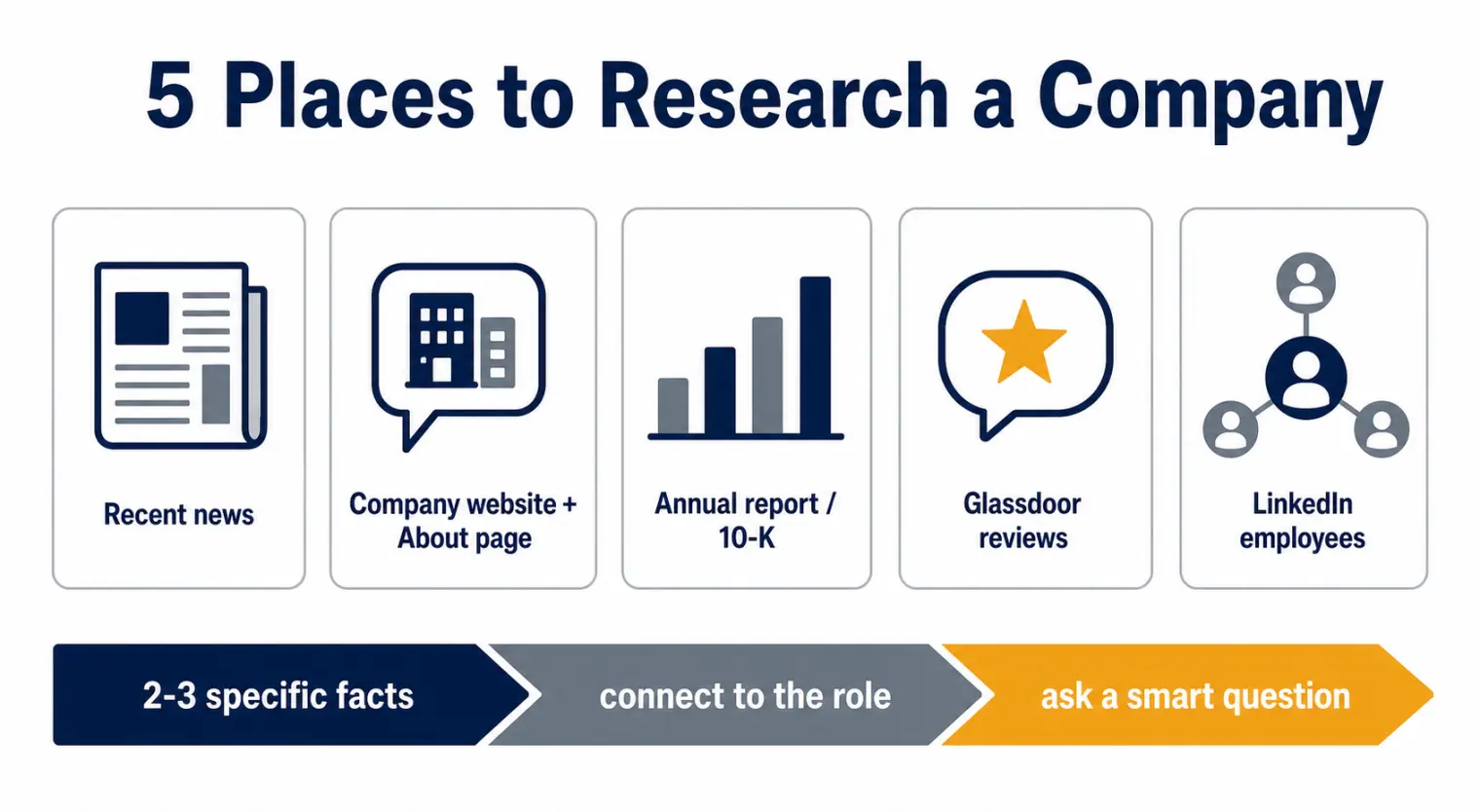
- Company basics — the About/Mission page, product or service lineup, size, and geography. This is the baseline everyone checks, so don't stop here.
- Recent developments — a quick news search of the company name plus their industry term, their LinkedIn company page, and their own blog. A product launch, a leadership change, or a funding round from the last few months is far more memorable than a mission statement.
- Financials, for public companies — the annual report or most recent 10-K, or an investor-relations summary. Almost no candidates go here, which is exactly why it's a strong differentiator.
- Culture and reality check — Glassdoor reviews and LinkedIn profiles of people in the team or role you're targeting. This tells you what the company is actually like to work at, not just what its marketing says.
- Market position — who their competitors are and where they sit in the industry. Useful mainly for senior or strategy-adjacent roles.
If the company has almost no web presence (small business, early-stage startup, local employer): check local business journals, chamber-of-commerce listings, trade publications, and the founder's LinkedIn. Then say so directly — "I found less online than I expected, so I also checked X and Y" reads as resourcefulness, not as an admission of failure.
The 3-Part Answer Formula
Keep the whole answer to 60-90 seconds:
- Two or three specific, recent facts — not generic About-page language. "You expanded into the Brazilian market last quarter" beats "you're a global company" every time.
- One sentence connecting a fact to the role or team — "that expansion is probably why this team is hiring for someone with Portuguese-language support experience" shows you're thinking about fit, not just reciting research.
- A smart follow-up question — turns a one-way recital into a conversation. "How is the team handling onboarding for that expansion?" signals genuine engagement.
This structure beats a longer, more thorough research dump almost every time, because it demonstrates judgment about what's relevant — not just that you can use a search engine.
The Mistakes That Sink This Answer
- Reciting the About page almost verbatim. The interviewer wrote that page. Hearing it repeated back signals you stopped at the first source.
- Stating outdated or inaccurate facts. A leadership change or a discontinued product you didn't catch is worse than saying less — it signals you researched carelessly, not thoroughly.
- Admitting "I don't really know much." Even a thin answer beats no answer; see the small-company workaround above.
- Over-indexing on what's in it for you. Talking only about salary, growth, or prestige answers a different question than the one being asked.
- Getting inappropriately personal. Citing a specific negative Glassdoor review or executive gossip by name reads as unprofessional, not as thorough research.
How AI Helps Turn Research Into Talking Points
The research above is available to anyone — the real gap is synthesis and rehearsal, and that's where most guides leave you on your own.
Synthesizing scattered research. You end up with notes spread across a news search, the company site, Glassdoor, and LinkedIn. Feeding those raw notes into an AI tool and asking it to identify the 2-3 most interview-relevant facts, and draft a role-connection sentence, turns 20 minutes of scattered browsing into a tight talking-point outline.
Rehearsing the follow-up. This is the part competitors leave you alone with. AceRound AI can take what you say you researched and generate plausible interviewer follow-ups — "you mentioned their expansion into fintech, how would you contribute to that?" — so you're not improvising the connection between your research and the role for the first time in the actual interview.
Practicing the timing. Sixty to ninety seconds is a narrow window. Rehearsing out loud with a timer, rather than just reading your notes silently, is what makes the difference between a fluent answer and one that runs long or trails off.
Frequently Asked Questions
What if the interviewer asks what I know about the company and I haven't found much information?
Say what you found and how you found it, rather than pretending you know more than you do. For a small or low-web-presence company, mention the specific sources you checked — local business coverage, the founder's LinkedIn, a trade publication — and frame the gap as something you'd want to learn more about directly from the team. Interviewers read this as resourcefulness, not as a weak answer, as long as you don't just say "I couldn't find much."
What are the best answers to what do you know about our company?
The strongest answers combine two to three specific, recent facts (not generic About-page language) with one sentence connecting a fact to the team or role you're interviewing for, and close by turning it into a two-way conversation with a smart follow-up question. Keep the whole answer to 60-90 seconds — a research dump with no connection to the role scores worse than a shorter, more targeted answer.
What should I research about a company before an interview?
Five sources cover most of what you need: the company's own site and recent news for current direction, the annual report or 10-K if it's public (signals real business-acumen), Glassdoor for culture and interview-process reality, and LinkedIn for who's on the team you'd join. You don't need all five for every interview — pick the two or three most relevant to the role level you're interviewing for.
Is what do you know about our company the same as why do you want to work here?
No — they test different things. "What do you know about us" evaluates your research and preparation: can you demonstrate real knowledge of the business. "Why do you want to work here" evaluates your motivation and fit: why this appeals to you personally. The best answers to the first question end with a brief bridge into the second, rather than answering both questions in one breath.
What's the biggest mistake candidates make with this question?
Reciting the company's own About-page language back at them almost verbatim. Interviewers wrote that page — hearing it repeated signals you stopped at the first source instead of actually researching. The second most common mistake is answering with only what's in it for you (salary, growth, prestige) instead of demonstrating knowledge of the business itself.
Related reading: for the motivation side of this pair of questions, see why do you want to work here; for the broader research and prep workflow, see AI job interview preparation.
For deeper reading on this question, see Career Sidekick's answer framework and Indeed's guide to researching a company before an interview.
Author · Alex Chen. Career consultant and former tech recruiter. Spent 5 years on the hiring side before switching to help candidates instead. Writes about real interview dynamics, not textbook advice.
Related Articles
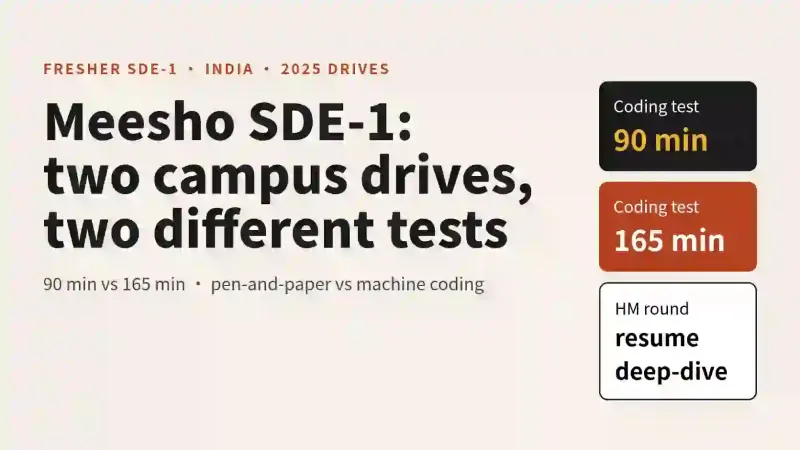
Meesho SDE-1 Interview Process for Freshers: Three 2025 Accounts Compared
Meesho SDE-1 campus accounts from 2025 disagree on test length, round order and design format. Here is what each reported and how to prep for any of them.
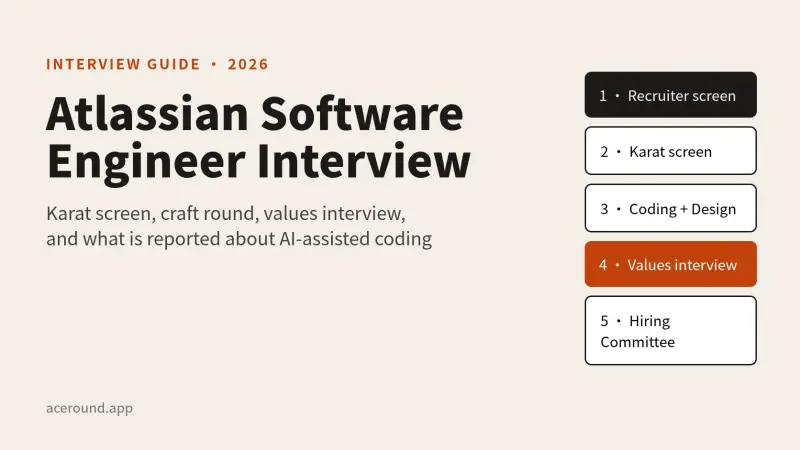
Atlassian Software Engineer Interview: Karat Screen, Craft Round and the Values Interview
How Atlassian's engineering loop works, from the Karat screen to the values round, what is official and what candidates report, including the AI-assisted rounds.
LinkedIn's AI-Enabled Coding Interview: What Candidates Report and How to Prepare
LinkedIn reportedly swaps one coding round for a CoderPad session with an AI panel. Here is the reported format, what gets scored, and what is unconfirmed.