Meesho SDE-1 Interview Process for Freshers: Three 2025 Accounts Compared
Meesho SDE-1 campus accounts from 2025 disagree on test length, round order and design format. Here is what each reported and how to prep for any of them.
For anyone with a Meesho SDE-1 campus or open-campus drive coming up. If you have several drives landing in the same fortnight, multiple placement drives is about how to split your time.
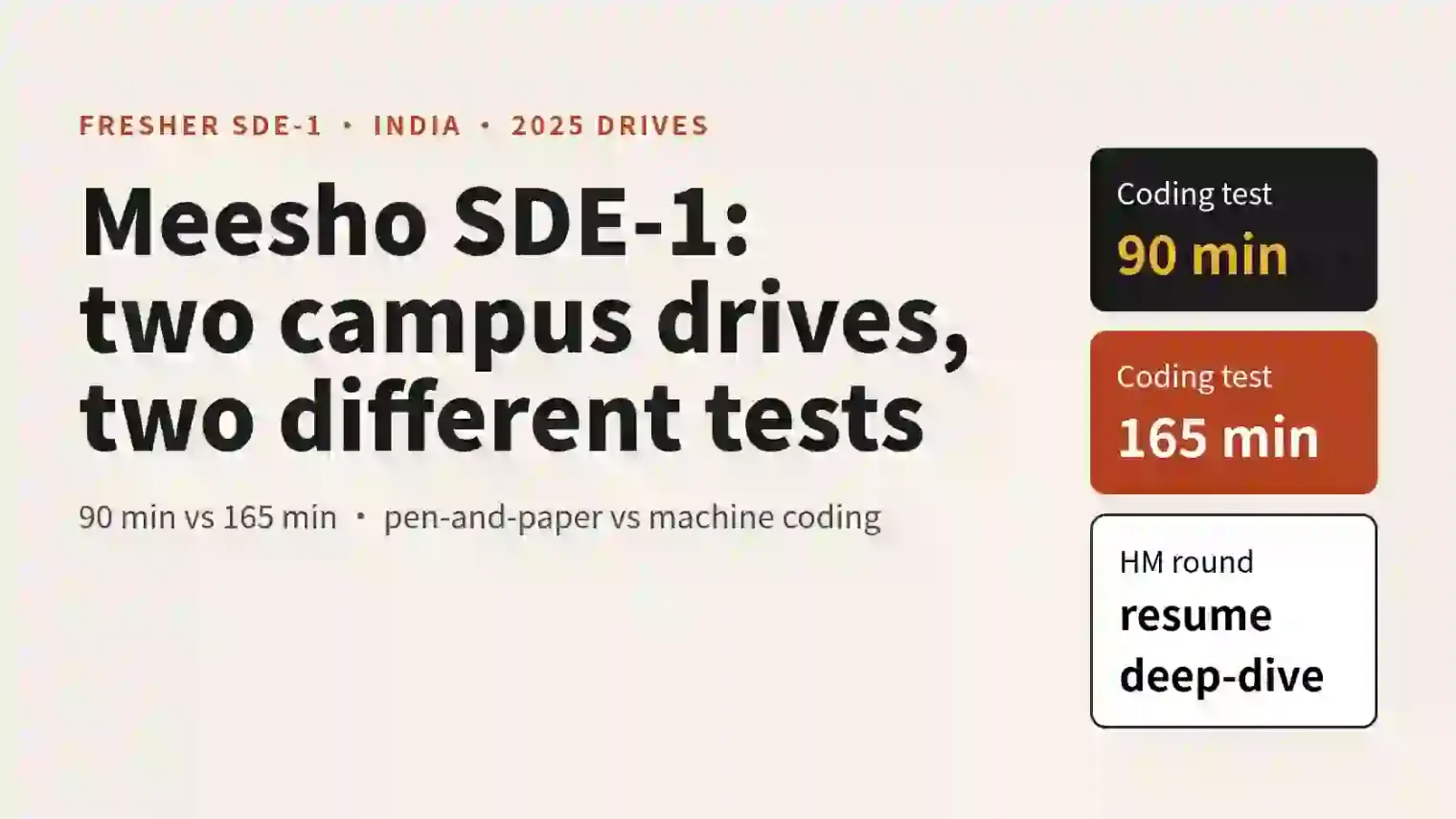
TL;DR: I read three first-hand Meesho SDE-1 accounts on GeeksforGeeks, two from the 2025 drives, one older and undated. They agree on the broad shape: a coding test, a technical interview, something design-flavoured, then a hiring manager or HR conversation. They disagree on nearly everything below that: test length (90 versus 165 minutes), what the second round is (pen and paper versus a live technical interview) and whether there's a design round at all.
I tried to build a cluster post with other consumer-tech startups here and dropped it. The Zepto and Myntra material I could open was either a coaching institute's marketing page, a single internship account, or a page I couldn't load, so I'm not putting them in. Meesho is the one where I could read the candidate posts in full.
The three accounts
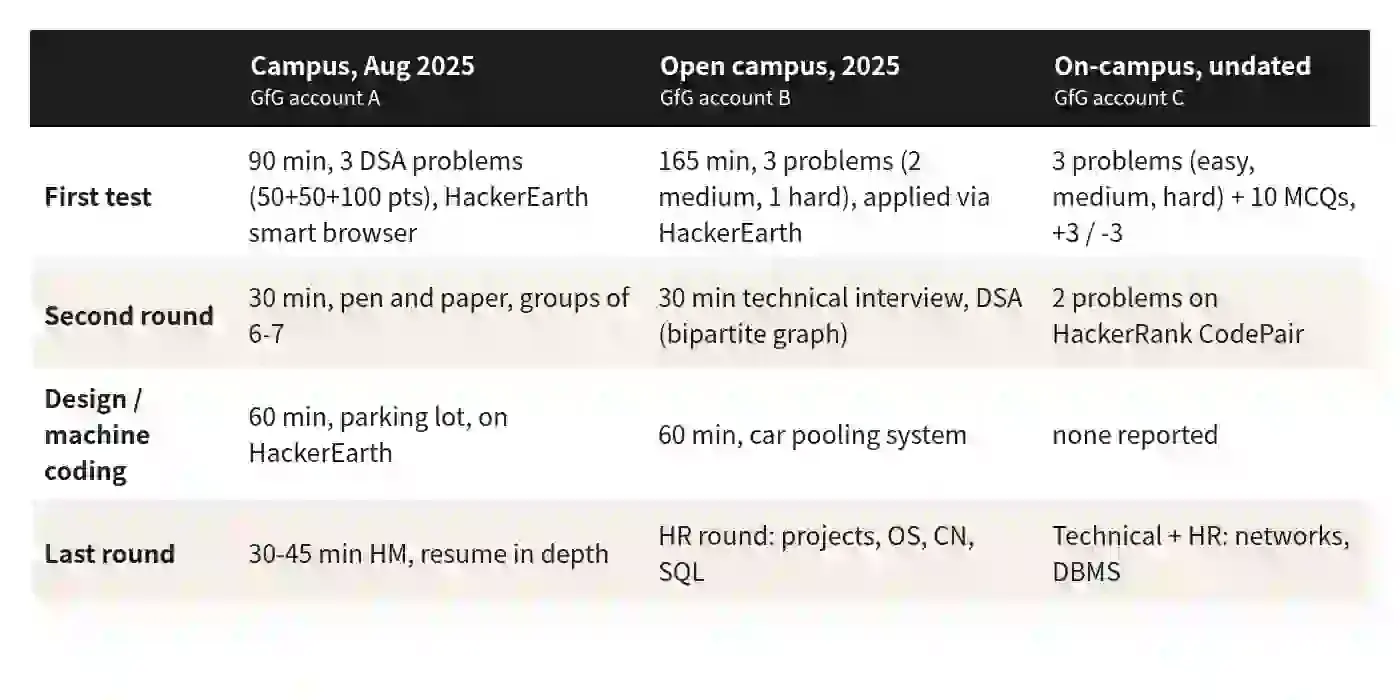
Account A — campus drive, August 2025. The author says there was no initial screening or CPI cutoff, and everyone who applied could sit the first round. Four stages followed:
- A 90-minute test with three DSA problems worth 50, 50 and 100 points, on the HackerEarth smart browser. Candidates reportedly got different questions, and the author says they were hard enough that a strong Codeforces profile still wasn't a guarantee. About 50 people cleared it.
- A 30-minute pen-and-paper round: one medium-to-hard problem, write the code (all or part, depending on the interviewer), then explain it. Candidates were put in groups of 6-7 who got the same question, and one or two per group moved on. Around 15-20 were shortlisted.
- A 60-minute round the author describes as a design round that turned out to be an easy DSA plus OOP problem on HackerEarth. They were asked to code a parking lot. Nine people went through.
- A 30-45 minute hiring manager round that went deep on the resume. The author's advice is to avoid vague impact claims you can't explain. Four people were finalised, and the author wasn't one of them.
The author also says everything after the first test happened offline, on the same day.
Account B — open campus recruitment, 2025. The route here was an application on HackerEarth, a resume shortlist about a week later, then a 165-minute online test with three problems (two medium, one hard). After that:
- a 30-minute technical interview a week after the test, with a bipartite graph question,
- a 60-minute machine coding round the same day, building a car pooling system, where the interviewer cared about class and module structure,
- an HR round the next day that mixed projects and internships with operating systems, networks and SQL.
The author was rejected after the last round.
Account C — on-campus, undated. The page was last updated in July 2025 but gives no drive date, so I'd weigh it below the other two. It describes a test with three problems (easy, medium, hard) and ten computer-fundamentals MCQs marked +3 and -3. Then came a technical round of two problems on HackerRank CodePair, including an extension of number of islands, and a final technical-plus-HR round on networks and DBMS. No design round is reported. Only the author was selected from that drive.
Where they conflict
- Test length: 90 minutes in A, 165 in B. A says 3 DSA problems; C adds 10 MCQs with negative marking, and I can't tell from the pages whether A's drive had them too.
- Round two: a pen-and-paper explanation round in A, a live DSA interview in B, a CodePair interview in C.
- Design round: A calls it design but describes an easy coding problem. B is a proper machine coding build. C has none.
- Online or offline: A says offline on the day. B doesn't say. I wouldn't generalise either way.
My read, which is a read and not a fact: Meesho changes the format between campuses and between the campus and open-campus routes, so the useful prep is the skills all three share, not a memorised round list.
What the three have in common
- DSA under a clock. Every account starts with a timed test, and A's scoring (50, 50, 100) suggests partial credit exists, so an incomplete hard problem can still earn points.
- Explaining your code. A's pen-and-paper round and B's technical round both want you to talk through the approach, not just reach a green tick.
- Object-oriented structure. Parking lot, car pooling: both design-type problems are about classes and responsibilities. A says the interviewer wasn't looking for named design patterns.
- A resume you can defend. The last round in A and B is largely about your own projects and internships.
How to prep
Timed practice. Pick three problems, one easy, one medium, one hard, and give yourself 90 minutes. Then try 165 with the same set plus a longer hard problem. The aim is a habit for the first 10 minutes: read all three, take the one you can finish, bank those points.
Machine coding. Practise one 60-minute build from a blank file: parking lot, car pool matching, a simple booking system. Start with entities and their methods, make it run on a sample input, then handle the awkward inputs. A reports a hidden test where the input being less or more than expected mattered, and the interviewer let a mostly-correct solution through.
Whiteboard-style explanation. Do one problem on paper and read it aloud to a friend. If you stall on a loop condition when nobody's checking, that's the bit to fix.
For the timed coding test itself, OA Copilot is built for online assessments on HackerRank, CodeSignal, Codility and similar platforms. Account A describes a HackerEarth smart browser, and the terms on your invite decide what's allowed during your test, so read them before you rely on any tool.
For the live rounds, a mock interview where you narrate a design problem out loud is closer to Meesho's technical and machine-coding rounds than another batch of solved-silently problems. If you want the same kind of read on other product companies, the product-based OA guide and the Razorpay, PhonePe, Swiggy and CRED breakdown cover their formats.
Pay
I'm not giving a Meesho fresher CTC. One post has a one-line number with no breakdown behind it, and I couldn't find the figure on a Meesho page. Get the offer in writing and read the CTC structure guide before you compare it with another offer.
FAQ
What is the Meesho interview process for SDE-1 freshers?
The 2025 accounts describe an online coding test, then technical interviews, a design or machine-coding round, and a final hiring manager or HR round. The count, order and test length differ between accounts, so your own invite is the real schedule.
How long is the Meesho online coding test?
An August 2025 campus account says 90 minutes with three DSA problems scored 50, 50 and 100. An open-campus account says 165 minutes with three problems, two medium and one hard. They're different drives.
Does Meesho have a machine coding or LLD round?
Two of three accounts do: a 60-minute parking lot problem and a 60-minute car pooling system. The older on-campus account reports none.
Which platform does Meesho use for its coding test?
HackerEarth shows up in the accounts, for the test and for applications. One older account mentions a HackerRank CodePair interview.
What is the Meesho SDE-1 salary for freshers?
I'm not quoting a number. Ask for the written breakdown of fixed pay, variable pay and any stock.
Author · Alex Chen. Career consultant and former tech recruiter. Spent 5 years on the hiring side before switching to help candidates instead. Writes about real interview dynamics, not textbook advice.
Related Articles
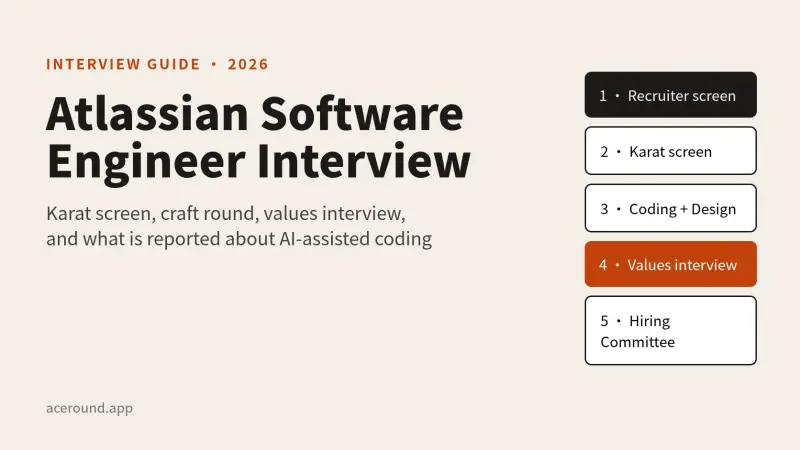
Atlassian Software Engineer Interview: Karat Screen, Craft Round and the Values Interview
How Atlassian's engineering loop works, from the Karat screen to the values round, what is official and what candidates report, including the AI-assisted rounds.
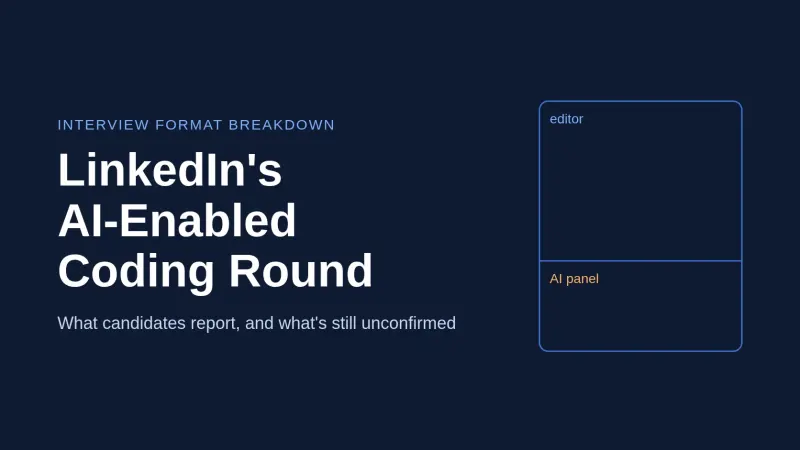
LinkedIn's AI-Enabled Coding Interview: What Candidates Report and How to Prepare
LinkedIn reportedly swaps one coding round for a CoderPad session with an AI panel. Here is the reported format, what gets scored, and what is unconfirmed.
Samsung R&D and Qualcomm India Interviews: What Past Candidates Reported
What 2019-2024 candidate accounts say about Samsung R&D Bangalore and Qualcomm India fresher interviews: test formats, rounds, and where they disagree.