Truck Driver Interview Questions: What to Say When an AI Screens You First
Truck driver interview questions and answers, the MVR accountability script that actually gets you hired, and what to expect when the first call is an AI voice agent.

TL;DR: Truck driver interview questions split into three buckets — experience/equipment, regulatory and safety knowledge, and accountability — but the real filter is the third one: how you talk about anything on your MVR. In 2026, your first screening call might not even be a person; AI voice agents now run the initial phone screen for a growing number of carriers before a recruiter sees your name.
You call back about a job posting, and the voice on the other end asks for your CDL class, your endorsements, and whether you've had any moving violations in the last three years — and it isn't a person. It's an AI screening agent, and it's verifying your basics before deciding whether to hand you off to a human recruiter at all. That's the reality for a growing slice of truck driver hiring in 2026, and it changes what "preparing for the interview" actually means: you're now preparing for a screening layer most driver-interview guides don't mention, on top of the in-person conversation that still decides whether you get the job.
What a Truck Driver Interview Actually Tests
Carriers are filling roles against a real shortage — the American Trucking Associations puts the current driver shortfall at roughly 82,000, with the industry needing to add around 1.2 million new drivers over the next decade to cover growth and retirements. That shortage doesn't make the interview easier; it makes carriers more careful about who they put behind the wheel, because a bad hire is expensive — replacing a single driver at a large carrier typically costs $5,000 to $12,000 once you count turnover, training, and lost freight.
So the interview is checking three things: can you actually do the job (equipment, cargo types, route experience), do you know the rules (FMCSA hours-of-service limits — the 11-hour driving limit, 14-hour on-duty window, and 30-minute break rule come up constantly), and can this carrier trust you with a truck and a schedule — which is where your MVR and how you talk about it matters more than almost anything else.
Common Truck Driver Interview Questions
Experience and equipment
- Tell me about your professional driving experience — what types of vehicles and cargo have you hauled?
- What endorsements do you hold (HazMat, Tanker, Doubles/Triples, Passenger)?
- Have you run OTR, regional, or local routes? Which do you prefer and why?
- What ELD or telematics systems have you used (Motive, Omnitracs, PeopleNet)?
Regulatory and safety knowledge
- Walk me through your pre-trip inspection routine.
- What's your understanding of the hours-of-service rules — the 11-hour, 14-hour, and 30-minute break requirements?
- How do you handle fatigue on a long haul?
- How do you feel about real-time monitoring — dash cams and telematics that track your location and driving activity?
Behavioral and accountability
- Have you ever been late for a delivery? How did you handle it?
- Tell me about a time you faced a difficult situation on the road — bad weather, a mechanical issue, a routing problem.
- Tell me about the incident or violation on your MVR.
- How do you deal with dispatch when a plan changes mid-route?
The Question That Actually Decides Whether You Get Hired
Most "truck driver interview questions" lists bury this as one bullet in a tips section. It deserves its own section, because multiple carriers and recruiters independently point to it as the single biggest disqualifier risk: how you narrate anything on your Motor Vehicle Record.
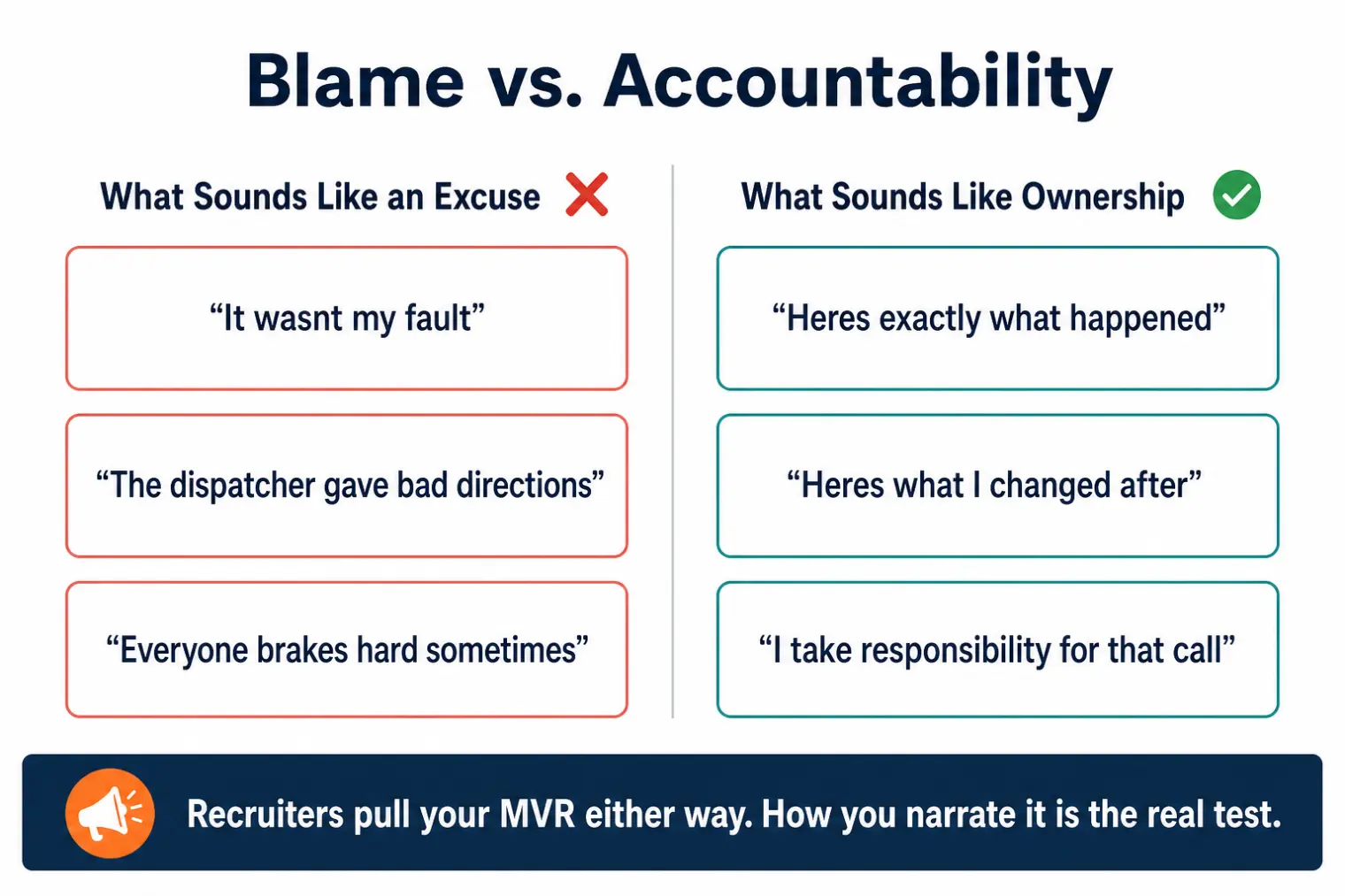
Here's the thing candidates miss — the recruiter is going to pull your MVR no matter what you say in the interview. The question isn't a trap to see if you'll admit something; it's a test of whether you can own a mistake without shifting blame. That distinction matters because "I'd never speed to make a delivery" is the expected answer, but a recruiter is really listening for how you'd handle the moment you're already behind schedule and dispatch is pushing — the honest answer is always to communicate with dispatch and hold the line on safety, not to promise perfection you can't back up.
The structure that works is fact, ownership, change:
- Weak: "The weather was bad and everyone was sliding around that day, it wasn't really my fault."
- Strong: "I was cited for a following-distance violation in wet weather in 2024. I was at the posted limit but hadn't adjusted my following distance for the conditions. Since then I run at least 8 seconds of following distance any time the road is wet, and it hasn't happened again."
The second version states the fact, takes ownership of the part that was actually a judgment call, and names a concrete change. That's what a recruiter can trust; "it wasn't my fault" is what they can't.
Your First "Interview" Might Be an AI Voice Agent
This is the part most truck driver interview guides haven't caught up to yet. Because drivers are hard to reach by phone during runs and turnover is so high, a growing number of carriers and staffing platforms — Classet's voice-AI screening tool is one documented example — now use an AI agent to run the entire first-round phone screen. It verifies your CDL class and endorsements, checks your MVR and DOT medical card status, and asks a handful of the standard experience questions, all before a human recruiter ever looks at your file.
Be clear-eyed about what this means for you: it's not a harder interview, it's an earlier gate. The AI screen is checking facts, not judging your delivery the way a person might. What still matters is answering clearly and completely the first time — an AI agent generally can't read tone or follow up on nuance the way a recruiter can, so vague or incomplete answers are more likely to end the call than get a second chance. If you clear that gate, the accountability conversation above still happens with a human, later in the process.
OTR vs. Regional vs. Local: Tailor Your Answer to the Route Type
The same "why do you want this route" question gets a different right answer depending on the role. OTR interviews weight your comfort with time away from home and flexibility on load types heavily — recruiters are screening for realistic expectations, not just willingness. Regional roles care more about your fit with a specific lane or region and how you handle a rotating but predictable schedule. Local and last-mile roles ask more about delivery windows, customer-facing interactions, and how you handle a tight urban route. Generic "I'll drive anything, anywhere" answers read as unprepared for all three — naming the specific route type and what you actually know about it (typical trip length, home time, load types) reads as someone who did their homework.
How AceRound Helps During a Live Screening Call
For the phone-screen stage — whether that's a human recruiter or an AI voice agent — AceRound listens in real time and surfaces structured suggestions as questions come up, so you're not scrambling to organize your MVR explanation or your hours-of-service answer on the spot. It works the same way for a video pre-screen with a safety manager before an in-person round.
Be honest about the limits, though: AceRound can't and shouldn't claim to help during an in-cab road test, a hands-on pre-trip inspection evaluation, or any part of the process where an evaluator is watching you actually drive or inspect a truck. That's real skill, not something a copilot can feed you in the moment. The honest scope is real value all the same — most driver candidates get zero structured practice before either screening call, and walking in with your accountability story and regulatory basics already rehearsed changes how the whole conversation goes.
For more on preparing for an AI-run screening call specifically, see our guide on AI phone screen interview tips, and for a broader look at structuring accountability and situational answers, see our behavioral interview questions guide.
Questions to Ask Your Recruiter Back
Driver forums consistently show candidates asking peers what to ask back during the interview — it signals you're evaluating the carrier as much as they're evaluating you:
- What does a typical week or trip look like for this specific route?
- How is home time actually scheduled, versus what's advertised?
- What telematics or in-cab monitoring system do you use, and what does it track?
- What's your average driver tenure on this route, and why do drivers leave?
Asking these isn't a formality — carriers with high turnover often have vague answers to the tenure question, which tells you something the job posting won't.
FAQ
What is the hardest question in a truck driver interview?
It is not a knowledge question, it is the one about your driving record: "Tell me about the accident/violation on your MVR." Recruiters run a Motor Vehicle Record check no matter what you say, so the question is really testing how you narrate what happened, not whether something happened. Candidates who explain the situation factually and name what changed afterward pass this filter; candidates who blame the dispatcher, the weather, or "everyone drives like that" usually do not.
What should I say about a late delivery or a violation on my record?
State the fact, own your part of it, and name one concrete thing you changed afterward. For example: "I was cited for a following-distance violation in wet weather in 2024. I was following the posted limit but not adjusting for conditions. Since then I run at least 8 seconds of following distance any time the road is wet, and it has not happened again." That structure — fact, ownership, change — reads as accountability. Blaming dispatch, weather, or other drivers reads as a risk the interviewer cannot verify won't repeat.
Will an AI actually interview me for a trucking job?
Increasingly, yes, for the first call. Several carriers and staffing platforms now use AI voice agents to run the initial phone screen — verifying your CDL class, endorsements, MVR status, and DOT medical card, and asking a few of the standard experience questions — before a human recruiter ever sees your file. It is not the final interview, but it is often the gate you have to get through to reach one.
What questions are asked in a truck driver interview?
Expect three buckets: experience and equipment (what you've hauled, what trucks and trailers you've run, your route type), regulatory and safety knowledge (hours-of-service rules, pre-trip inspection routine, how you handle fatigue), and behavioral/accountability questions (a time something went wrong and what you did about it). OTR, regional, and local roles weight these differently — OTR interviews lean harder into time-away-from-home and route flexibility, local roles ask more about delivery windows and customer interaction.
Can AI help me prepare for a truck driver interview?
Yes, for the phone-screen and video pre-screen stages — rehearsing how you'll structure your experience, practicing the accountability script for anything on your MVR, and reviewing hours-of-service basics so you don't blank on a regulatory question. It can't and shouldn't claim to help during an in-cab road test or a hands-on pre-trip inspection evaluation, where actual driving skill is what's being judged.
Author · Alex Chen. Career consultant and former tech recruiter. Spent 5 years on the hiring side before switching to help candidates instead. Writes about real interview dynamics, not textbook advice.
Related Articles
OpenAI's AI Interview Policy: Banned, Required, or Team-Dependent
OpenAI sells AI coding agents, then bans most candidates from using one. Here's the round-by-round policy, including the new agentic round that flips it.
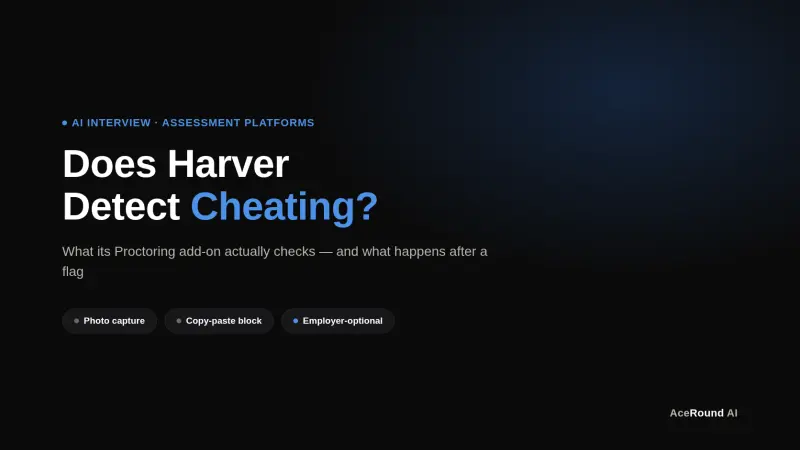
Does Harver Detect Cheating? What Its Proctoring Actually Checks
Does Harver detect cheating on its pre-employment assessments? A candidate look at Harver's Proctoring add-on, what gets logged after a flag, and what happens next.

Micro1's Zara AI Interview: What It Actually Tests (And Why Timing Gets Flagged)
Micro1's AI interviewer Zara has run 300,000+ interviews for remote roles. Here's why it flags response latency as a cheating signal, and what that means for AI prep.