Micro1's Zara AI Interview: What It Actually Tests (And Why Timing Gets Flagged)
Micro1's AI interviewer Zara has run 300,000+ interviews for remote roles. Here's why it flags response latency as a cheating signal, and what that means for AI prep.
TL;DR: If you've done an AI-led first-round interview recently, what actually gets scored may not be what you said — it's when you started saying it. Zara, micro1's AI voice interviewer, asks the questions and scores your spoken answers with no human on the call. The part that trips people up is that its anti-cheat layer watches response latency — the pause between a question ending and you starting to talk — as a proxy for "reading off a second screen." Your transcript and score still go to a human recruiter, who makes the actual call.
If you've applied for a remote engineering or AI-training contract role in the last year, there's a decent chance your first interview wasn't with a person. It was with Zara.
What Micro1 and Zara Actually Are
Micro1 is a staffing company that places remote contractors — mostly software engineers and AI trainers — with US clients. It replaced the human first-round screen with Zara: no recruiter on the line, just an automated system that turns your speech to text, generates the next question, and reads it back to you, on a loop, without ever needing a human calendar to schedule the call. According to micro1's own published research, Zara has now conducted over 300,000 interviews — a volume that means if you apply to a remote contract role in this space, there's a real chance your first-round interviewer is Zara rather than a person.
The interview itself feels like a normal phone screen, structured around three categories: a resume walk-through, a technical question scoped to whatever stack you listed on your application, and a situational question about handling an ambiguous request — the kind of thing that comes up constantly in contract work where you're dropped into someone else's codebase or workflow. You answer out loud, same as any phone screen. The difference is everything happening underneath while you talk.
How Zara Scores You — And Why Response Timing Matters
Alongside Zara, micro1 runs a companion evaluation layer (reported in some coverage under the name "Ava") that produces what candidates see referred to as an Integrity Score. It's built from a few signals:
- Gaze and eye movement — whether you're looking at the camera or repeatedly glancing off to the side
- Tab or window focus — whether you leave the interview window during the call
- Response latency — the gap between Zara finishing a question and you starting your answer
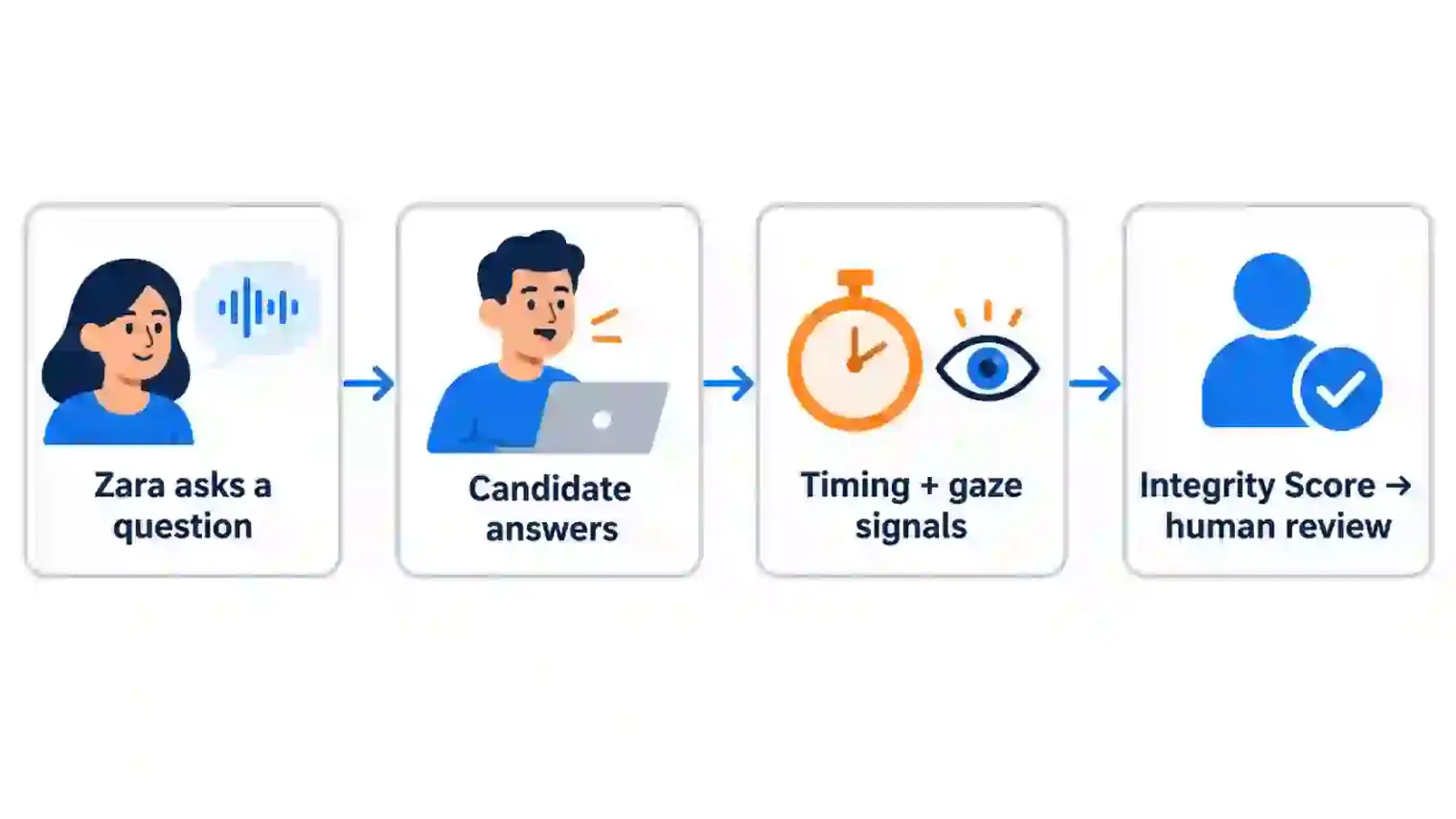
The latency signal is the one people don't expect. A three-to-five-second pause before every answer isn't inherently suspicious on its own — people think before they talk. But it's also the exact rhythm produced by reading a response that an AI tool generated on a second monitor: question ends, brief silent read, then unnaturally smooth delivery. Zara's scoring is built around that specific pattern, not around banning silence.
What a Flag Actually Does (And Doesn't Do)
Zara doesn't auto-reject you. The interview produces a recording, a transcript, and a scored writeup that goes to a human recruiter or the hiring client's team, who decides what to do with it. A single hesitant answer isn't going to end your candidacy — a consistent pattern across most or all of your answers, especially combined with delivery that reads as scripted, is what gets a file flagged for closer human review rather than passed through automatically. Normal interview jitters and an actual scripted-reading pattern look different at that scale, which is the whole point of scoring the pattern instead of any single pause.
Which of These Signals Are Universal, and Which Are Zara-Specific
Latency and gaze tracking aren't unique to micro1. The same underlying idea — a model watching how you answer, not just what you say — shows up across the current wave of AI-led first-round interviews: Ribbon AI, Apriora, Paradox's Olivia, and Sapia.ai are all built on some version of it, even though each vendor tunes its own thresholds and weighting differently. If you're prepping for any AI-interviewer round, not just Zara's, the transferable lesson is the same: the risk isn't getting caught reading — it's that reading produces a rhythm (silence, then unnaturally smooth delivery) that's mechanically different from thinking out loud, and that rhythm is exactly what these systems are tuned to notice.
What's specific to Zara is the format it's applied to: high-volume screening for remote contract roles, rather than a single company's own hiring pipeline built around one job description.
Practically, that means the fix isn't finding a tool that reads faster — it's rehearsing out loud, under time pressure, without a script, until answering that way is the default instead of the exception. That's a practice problem, not a knowledge problem: the content of a strong answer isn't the hard part, saying it without a silent read-through first is.
If your process also involves a screen-recorded round instead of a voice-only one, our breakdown of does HireVue record your screen covers how that specific mechanic differs from Zara's audio-timing approach. And if you want a structured way to drill the out-loud, no-script rehearsal itself, that's what AceRound AI's mock interviews are built for.
FAQ
Is micro1 legit?
Yes — it's a real, VC-backed staffing company that places remote contractors with US clients, not a scam. Its growth has reportedly gone from single-digit millions in annual revenue to a $300M+ run rate within about two years, almost entirely on the back of Zara replacing human first-round interviewers.
Does every micro1 client use the same Integrity Score threshold?
No. Micro1 doesn't publish one fixed passing threshold — each client company configures its own screening, so the same interview behavior can read differently depending on who's hiring. What stays consistent across clients is the underlying signal set (latency, gaze, tab focus), not the cutoff applied to it.
How is a Zara interview different from a human phone screen?
The question categories are similar — background, technical, situational — but a human recruiter can't precisely time your pauses or track your gaze across an hour of calls the way an automated system can. That's the actual shift: not different questions, but a different kind of attention on how you answer them.
Is Zara the only AI interviewer candidates are running into now?
No — it's one of a growing category of AI-led first-round interviews, alongside tools like Ribbon AI, Apriora, Paradox's Olivia, and Sapia.ai. Each has its own scoring mechanics, but the shared idea is the same: a model runs the screen instead of a recruiter, at a volume no human calendar could match. Zara's specific niche is high-volume contract staffing rather than a single company's own hiring pipeline.
Author · Alex Chen. Career consultant and former tech recruiter. Spent 5 years on the hiring side before switching to help candidates instead. Writes about real interview dynamics, not textbook advice.
Related Articles
Does CoCubes Detect Cheating During the Online Assessment?
CoCubes (an Aon platform) proctors off-campus drives with real AI monitoring — what it actually watches, what candidates report, and where prep helps.
Anthropic's AI Interview Policy Explained: Where Claude Is Banned, Where It's Required
Anthropic makes Claude, then bans it from most of its own interview. Here's the stage-by-stage AI policy, and why the take-home test keeps changing.
Wonderlic Test in 2026: Is It Proctored, and Where Does AI Help Fit?
The Wonderlic comes in two formats: a proctored test and an unproctored take-home QuickTest. Here's what separates them and where outside help is possible.