Behavioral Interview Questions: 30 Most Common and How to Actually Answer Them
Master behavioral interview questions with a story bank approach and AI practice. Covers the 30 most common questions, STAR method answers, and why most candidates freeze under pressure.

TL;DR: Behavioral interview questions ask you to describe past experiences to predict future performance. Most candidates fail not because they don't know the STAR method, but because they haven't practiced enough to recall stories under pressure. Build a bank of 8–10 reusable career stories first, then map them to the 30 most common behavioral questions — and practice out loud, not in your head.
Job seekers spend hours studying lists of behavioral interview questions. Then they walk into the interview room, hear "tell me about a time you dealt with a difficult colleague," and their mind goes blank.
That's not a knowledge problem. That's a rehearsal problem — and it's different.
In a study published in the Journal of Business Research, past-behavioral interview questions were shown to significantly outperform hypothetical situational questions in predicting actual job performance. Interviewers aren't using them because HR made up a format. They work. The structure forces you to draw on real memories, and real memories reveal how you actually operate under stress, not how you'd like to.
This guide is not a list to memorize. It's a system to build.
Why Behavioral Interview Questions Exist (and What They're Actually Measuring)
The U.S. Office of Personnel Management defines structured behavioral interviews as the gold standard for predicting job performance. They've been the federal hiring standard for decades — not because of bureaucratic inertia, but because research consistently validates them.
What interviewers are measuring with behavioral questions isn't the story itself. It's three things:
1. Self-awareness. Can you accurately assess your own behavior, including in situations where you didn't succeed? Candidates who claim nothing ever went wrong set off alarm bells.
2. Judgment. Given that scenario, did you make decisions a smart, senior person would endorse? Or did you optimize for the wrong thing?
3. Communication. Can you convey a complex situation concisely, get to the point, and let the outcome land? This directly predicts how you'll operate in meetings, with stakeholders, under pressure.
The STAR format — Situation, Task, Action, Result — is a delivery framework, not a content generator. It tells you how to structure an answer. It doesn't help you find the story or stay calm when you're nervous.
The Real Reason Candidates Fail Behavioral Interviews
The most common description of a behavioral interview failure on r/jobs and r/cscareerquestions isn't "I didn't know what STAR was." It's some version of:
"My mind went completely blank. I knew the examples I'd prepared but I couldn't access them in the moment. I ended up rambling."
This is well-documented in performance psychology: under mild-to-moderate stress, working memory access degrades. The examples you planned to use become harder to retrieve precisely when retrieval pressure increases.
Studying a list of 50 behavioral questions and mentally associating each with an answer doesn't solve this. What solves it is encoding your stories so deeply through repetition that retrieval becomes automatic, not deliberate.
This is why interviewers who conduct hundreds of interviews can spot a "first-timer" immediately — not because the stories are bad, but because there's visible effort in recall. The candidate is translating notes into words in real time, rather than recounting something they've told before.
The fix isn't more questions. It's a different practice method.
Build Your Story Bank Before Memorizing Any Questions
MIT's Career Advising office recommends building a story bank as the foundational step — before matching examples to specific questions. Here's why this works: one good story can answer twelve different questions depending on which angle you emphasize.
Step 1: Identify 8–10 career moments worth mining.
Pick moments from your career (or academic/personal life if you're early in your career) that had stakes, required a real decision, and ended with a measurable or observable outcome — good or bad. Include at least:
- One moment where you led something or took initiative
- One moment where you disagreed with someone and it went somewhere
- One moment where something went wrong and you had to recover
- One moment where you had to collaborate under tension
- One moment where you delivered something you're proud of
- One moment where you failed or underdelivered (yes, this one is required)
Step 2: Write each story as a full narrative first.
Don't immediately STAR-format it. Write it as you'd tell a friend. Include the context, what was at stake, what you were feeling, what you decided, what happened. This version is for your benefit only.
Step 3: Extract a compressed STAR version (90–120 seconds when spoken).
Now reduce it. Situation in one sentence. Task/challenge in one sentence. Actions in 3–4 sentences (this is where most of your time goes). Result with a concrete outcome.
Step 4: Practice spoken aloud, not in your head.
This is where most candidates stop short. Mental rehearsal is not the same as spoken rehearsal. Your brain encodes spoken performance differently. Record yourself on your phone. Listen back. You'll immediately hear the filler words, the hesitations, the places where you lose the thread.
An AI interview practice tool like AceRound can give you real-time feedback on STAR completeness, pacing, and whether your answer drifts from the question — the kind of feedback you can't get from reviewing notes or asking a friend to listen politely.
The 30 Most Common Behavioral Interview Questions
Organized by competency. For each, the core of what the interviewer is evaluating is noted in italics.
Teamwork & Collaboration
- Tell me about a time you worked effectively in a team. (Can you contribute without needing to lead?)
- Describe a situation where you had to work with someone whose style was very different from yours. (Adaptability to people differences)
- Tell me about a time you helped a team member who was struggling. (Empathy and team investment)
- Describe a time you had to rely on others to complete a project. (Trust and delegation)
- Tell me about a time a team project failed. What was your role? (Accountability, not blame deflection)
Leadership & Initiative
- Tell me about a time you took initiative without being asked. (Ownership mentality)
- Describe a situation where you had to lead a project with no formal authority. (Influence skills)
- Tell me about a time you motivated a team during a difficult period. (Energy management and communication)
- Describe a time you had to make a decision with limited information. (Comfort with ambiguity)
- Tell me about a time you identified a problem before it became a crisis. (Proactivity and systems thinking)
Conflict & Difficult Situations
- Tell me about a time you disagreed with your manager. How did you handle it? (Can you push back without burning bridges?)
- Describe a situation where you had to deal with a difficult colleague or client. (De-escalation, professionalism)
- Tell me about a time you had to deliver bad news. (Courage and communication clarity)
- Describe a time when you had competing priorities and had to decide what to deprioritize. (Judgment under resource constraints)
- Tell me about a time you had to change someone's mind. (Persuasion and evidence use)
Adaptability & Problem Solving
- Describe a time when you had to adapt to a significant change at work. (Resilience)
- Tell me about a time you faced an unexpected obstacle on a project. (Problem-solving under pressure)
- Describe a situation where you had to learn something new quickly. (Learning velocity)
- Tell me about a time you made a mistake. What did you do? (Accountability and recovery)
- Describe a time you had to work under a tight deadline. (Execution under pressure)
Communication & Stakeholder Management
- Tell me about a time you had to explain something complex to a non-technical audience. (Communication calibration)
- Describe a situation where you had to manage up — communicate upward effectively. (Organizational intelligence)
- Tell me about a time you received critical feedback and how you responded. (Growth mindset)
- Describe a situation where you had to build trust with a new stakeholder. (Relationship-building)
- Tell me about a time you had to present to senior leadership. (Presence under scrutiny)
Results & Impact
- Tell me about your most significant professional achievement. (Self-assessment, impact framing)
- Describe a time you went above and beyond what was expected. (Standards and drive)
- Tell me about a time you improved a process. (Continuous improvement instinct)
- Describe a time you had to deliver results with fewer resources than you needed. (Resourcefulness)
- Tell me about a time a project you were responsible for didn't go as planned. (Ownership and learning extraction)
How to Structure Answers That Sound Human, Not Rehearsed
The failure mode of STAR isn't that people don't use it. It's that they use it too mechanically.
Compare these two openers:
Mechanical: "Situation: I was working at a mid-sized tech company in 2022. Task: I was asked to reduce customer churn in the onboarding funnel..."
Human: "We were losing about 30% of users in the first week of onboarding — which is brutal when your cost per acquisition is $80. I was the only PM on the team and our lead designer had just gone on parental leave..."
Both use the same underlying structure. One sounds like a form being read aloud. The other sounds like someone recounting a real experience.
The key shifts:
- Open with the stakes or the problem, not the organizational context
- Use "I" not "We" for your specific actions (even in team projects, interviewers are asking about you)
- Put numbers in the result even if they're approximate ("roughly 40% improvement", "from 6 days to 2 days")
- End with what you learned, not just what happened — this is the part that distinguishes senior candidates
For asynchronous video interviews (HireVue, Spark Hire), your behavioral answers need to be even more compact: aim for 60–90 seconds per answer, not 2–3 minutes. The camera compresses perceived time.
How STAR Adapts Across Interview Cultures
If you're applying to companies with offices in Japan, Korea, or other collectivist cultures — or if you're a non-English speaker preparing for Western-style behavioral interviews — the cultural calibration of your STAR answers matters more than most guides acknowledge.
In Japan and Korea: Framing your individual role too strongly reads as arrogance. "Our team achieved..." is more appropriate than "I achieved..." even when you were the primary driver. Japanese interviewers specifically listen for wa (harmony) signals — evidence that you can work within group norms. Conflict resolution stories are particularly sensitive: framing a disagreement as a learning moment for both parties is safer than framing it as "I was right, they came around."
In Brazil and Latin America: Behavioral interviews are more conversational. Answers can be longer and more narrative. Personal context (your background, what motivated you) is welcomed, not penalized as off-topic. If you're a Brazilian candidate preparing for an international company interview, the challenge is usually the opposite: condensing answers to the directness expected in US or Northern European interview styles.
For non-native English speakers across all regions: The STAR structure is actually an advantage. It gives you a mental scaffold during high-pressure moments when language retrieval is harder. Practice the transition phrases: "The situation was...", "What I specifically did was...", "The result was that..." — having these anchors keeps you from losing the thread mid-answer.
AceRound AI supports real-time answer coaching during live interviews, which helps non-native speakers stay on track without losing confidence mid-sentence.
FAQ
How many behavioral interview questions should I prepare for? You don't prepare for specific questions — you prepare a story bank of 8–10 career moments, then practice mapping them to question categories. If you have good stories for teamwork, leadership, conflict, failure, and results, you can handle ~90% of behavioral questions interviewers ask.
What's the hardest behavioral interview question? Based on real Reddit feedback, "tell me about your greatest failure" consistently causes the most difficulty. Not because candidates lack a failure story, but because they either dodge (and sound dishonest) or over-confess (and sound like a liability). The right frame: choose a real failure, own your role in it, show the recovery, extract a concrete lesson you applied afterward.
Is it bad that I can't think of examples during the interview? Very common, and it's a rehearsal gap, not a memory problem. Under interview stress, working memory access narrows. The solution is spoken rehearsal — not review, but speaking your stories aloud repeatedly until recall becomes automatic. Recording and replaying yourself is the most effective low-tech version of this.
Can I reuse the same story for multiple behavioral questions? Yes, absolutely — with a different emphasis. A story about navigating a team conflict can also be your "adapting to change" story, your "influencing without authority" story, or your "delivering difficult feedback" story, depending on which aspect you foreground. Good stories are multi-use tools.
Should I prepare behavioral examples for fresh graduate interviews with no work experience? Use academic projects, internships, volunteer work, or significant personal projects. Interviewers hiring juniors fully expect this and mentally adjust their evaluation lens. The quality of the story structure and self-awareness matters more than the scale of the situation.
How does AI help with behavioral interview practice? AI tools like AceRound give you instant feedback on whether your answer was complete (did you include all four STAR components?), whether you over-talked (most good answers are 90–120 seconds spoken, not 5 minutes), and whether you answered the actual question asked versus a version of it you found easier. The most useful feature is being able to practice 20 repetitions in the same time it takes to schedule one mock interview with a friend.
Author · Alex Chen. Career consultant and former tech recruiter. Spent 5 years on the hiring side before switching to help candidates instead. Writes about real interview dynamics, not textbook advice.
Related Articles
Interviewing While Employed: How to Actually Prepare With Zero Time
Job searching while employed means near-zero prep time, not just staying discreet. Here's a 20-minute prep script, plus what the counteroffer statistics actually show.
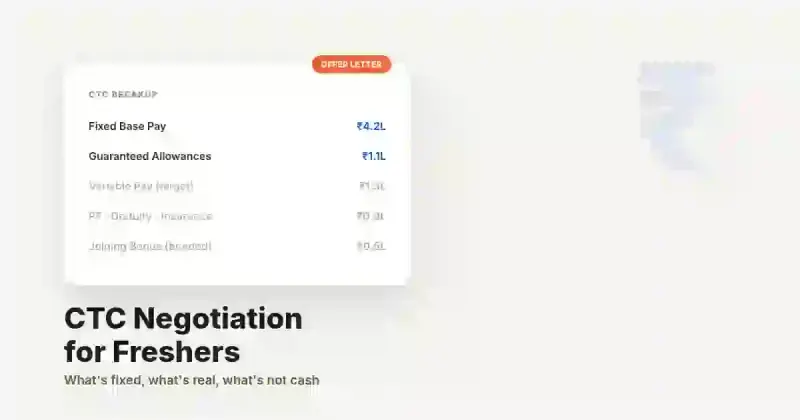
CTC Negotiation for Freshers in India: What's Actually Negotiable
Most fresher CTC negotiation advice ignores that TCS, Infosys, and Wipro set fixed pay bands. Here's what's really negotiable, and where lowball offers hide.
Service-Based or Product-Based? Deciding When You Have Both Live at Once
TCS offer in hand, product company interview next week — here's the actual decision framework, not another generic service vs product comparison table.