OpenAI's AI Interview Policy: Banned, Required, or Team-Dependent
OpenAI sells AI coding agents, then bans most candidates from using one. Here's the round-by-round policy, including the new agentic round that flips it.
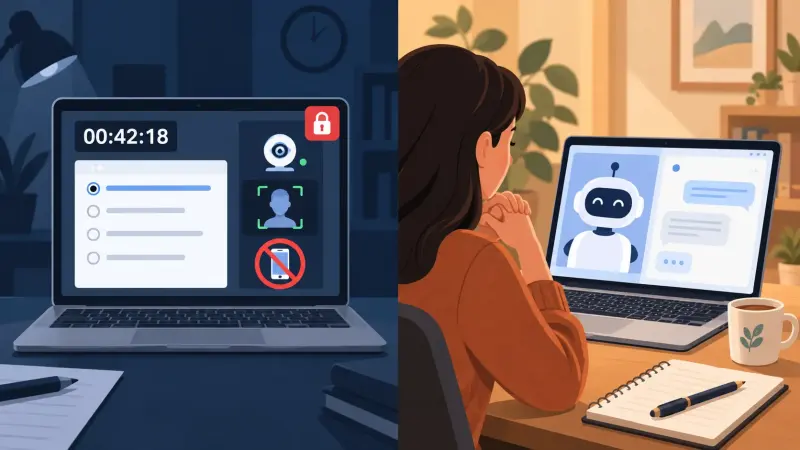
TL;DR: OpenAI doesn't have one interview AI policy — it has several, and which one applies to you depends on the round and sometimes the team. Application materials and interview prep: use AI freely, it's expected. Live coding screens on Research and Infrastructure tracks: AI is off, full stop. Take-homes and Applied AI rounds: ask your recruiter, because it's genuinely inconsistent. And in a newer pilot round, OpenAI flips the rule entirely — you're handed a codebase too large to finish by hand and expected to drive an AI agent through it live, where not using AI well is the failure mode. Confirm the rule for your specific loop before you walk in; guessing wrong in either direction works against you.
OpenAI's own interview guide states it plainly: "Expectations for AI and other tools vary by interview: some formats intentionally allow them, while others are designed to assess your independent problem-solving without AI tools." That's an unusually candid admission from a company whose product is the thing candidates are being told not to use — and it's worth taking at face value, because the split isn't cosmetic. It runs by track, by round, and in at least one new case, by design intent that inverts the usual rule entirely.
The Loop, Round by Round
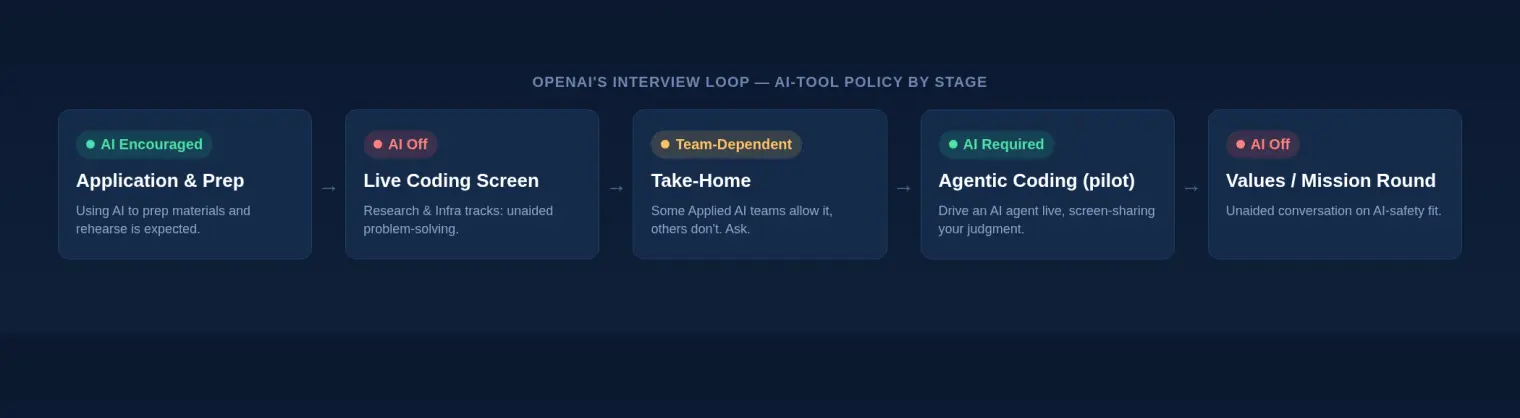
A typical engineering loop at OpenAI runs, in order: a recruiter screen, one or two technical phone screens split between live coding and system design, sometimes a paid take-home, and a virtual onsite spanning four to six hours across four or five sessions — coding, system design, a roughly 45-minute presentation where you defend something you've actually built, and one or two rounds evaluating fit with OpenAI's mission and AI-safety stance.
The AI-tool rule doesn't hold steady across that loop:
- Application materials and interview prep — AI-encouraged. Refining your resume with an assistant or rehearsing answers isn't something to hide.
- Live coding screens — generally AI-off for Research and Infrastructure tracks, where the point is unaided problem-solving. Infrastructure specifically runs coding AI-prohibited but design-discussion rounds AI-permitted, which is its own small split.
- Take-home / work trial — team-dependent. Reported to run around 48 hours, graded like production code rather than a LeetCode set; data science roles reportedly get a separate 48-hour A/B-test take-home submitted as a slide deck. Whether AI is allowed on either isn't stated company-wide.
- Applied AI rounds — mixed by team. Some teams allow AI tools openly; others require unaided performance on at least the foundational portion.
- Values / mission-alignment round — no coding, evaluated on how you think and communicate about OpenAI's mission and AI-safety posture, generally without outside AI.
If you take one thing from this: the rounds you can prepare for in advance (materials, prep) are the ones where AI help is normal, and the rounds that happen live and unscripted are mostly the ones where it's off — with one deliberate exception.
The Agentic Round Flips the Rule on Purpose
The most distinctive piece of OpenAI's loop, reported as a newer pilot round that not every candidate receives, does the opposite of every other AI-off round on this list. You're handed an existing codebase with a set of tasks sized deliberately too large to finish unaided in the time given, and you're expected to drive an AI coding agent through it live — screen-sharing your prompts, your review of what the agent produces, and your calls on when to accept, redirect, or throw out its output.
This isn't a loophole in the no-AI policy; it's a separate, intentional signal. Candidates who've described it report that dumping the entire problem into the model and letting it run unsupervised is treated as a warning sign, not a shortcut — what's actually being scored is judgment: whether you catch the agent's mistakes, whether you can redirect it toward a better approach, whether you verify what it hands back instead of taking it on faith. It's a strange thing for an interview to reward, but it's a real skill, and one you either have from working this way daily or you don't.
Why "Ask Your Recruiter" Is the Actual Answer
OpenAI's guide doesn't dodge the inconsistency — it tells you to resolve it directly: "if you're unsure, ask your recruiter before the interview." That's not boilerplate. Given that the same broad role can land you in an AI-off algorithmic screen, a team-dependent take-home, or an AI-required agentic round depending on which team and track you're interviewing for, the generic advice you'll find elsewhere ("OpenAI bans AI" or "OpenAI expects AI") is wrong often enough to be actively unhelpful. The one universal move that actually works: confirm per round, not per company.
How to Actually Prepare for This
Once you know which rounds are which, the prep splits cleanly: the AI-off rounds — live coding, values — are where you're rehearsing unaided under a clock, since that's exactly the condition they're graded under; if you land the agentic pilot, the thing worth practicing is the opposite skill, supervising and correcting a coding agent fast enough to keep up with a real interviewer watching. AceRound covers both ends of that split — mock interview mode for rehearsing live rounds under real follow-up questions, OA Copilot for timed platforms if your loop includes a separate take-home. Our Anthropic AI interview policy breakdown covers how a comparable AI-lab peer handles the same tension differently, if OpenAI isn't your only offer in play.
Author · Alex Chen. Career consultant and former tech recruiter. Spent 5 years on the hiring side before switching to help candidates instead. Writes about real interview dynamics, not textbook advice.
Related Articles
Does Harver Detect Cheating? What Its Proctoring Actually Checks
Does Harver detect cheating on its pre-employment assessments? A candidate look at Harver's Proctoring add-on, what gets logged after a flag, and what happens next.
Micro1's Zara AI Interview: What It Actually Tests (And Why Timing Gets Flagged)
Micro1's AI interviewer Zara has run 300,000+ interviews for remote roles. Here's why it flags response latency as a cheating signal, and what that means for AI prep.
Does CoCubes Detect Cheating During the Online Assessment?
CoCubes (an Aon platform) proctors off-campus drives with real AI monitoring — what it actually watches, what candidates report, and where prep helps.