Staff Engineer Interview AI: Prep for the Scope & Influence Bar
Staff engineer interviews test scope and influence, not just system design. Here's the real interview loop, how to build STAR stories that pass the bar, and how AI practice helps.
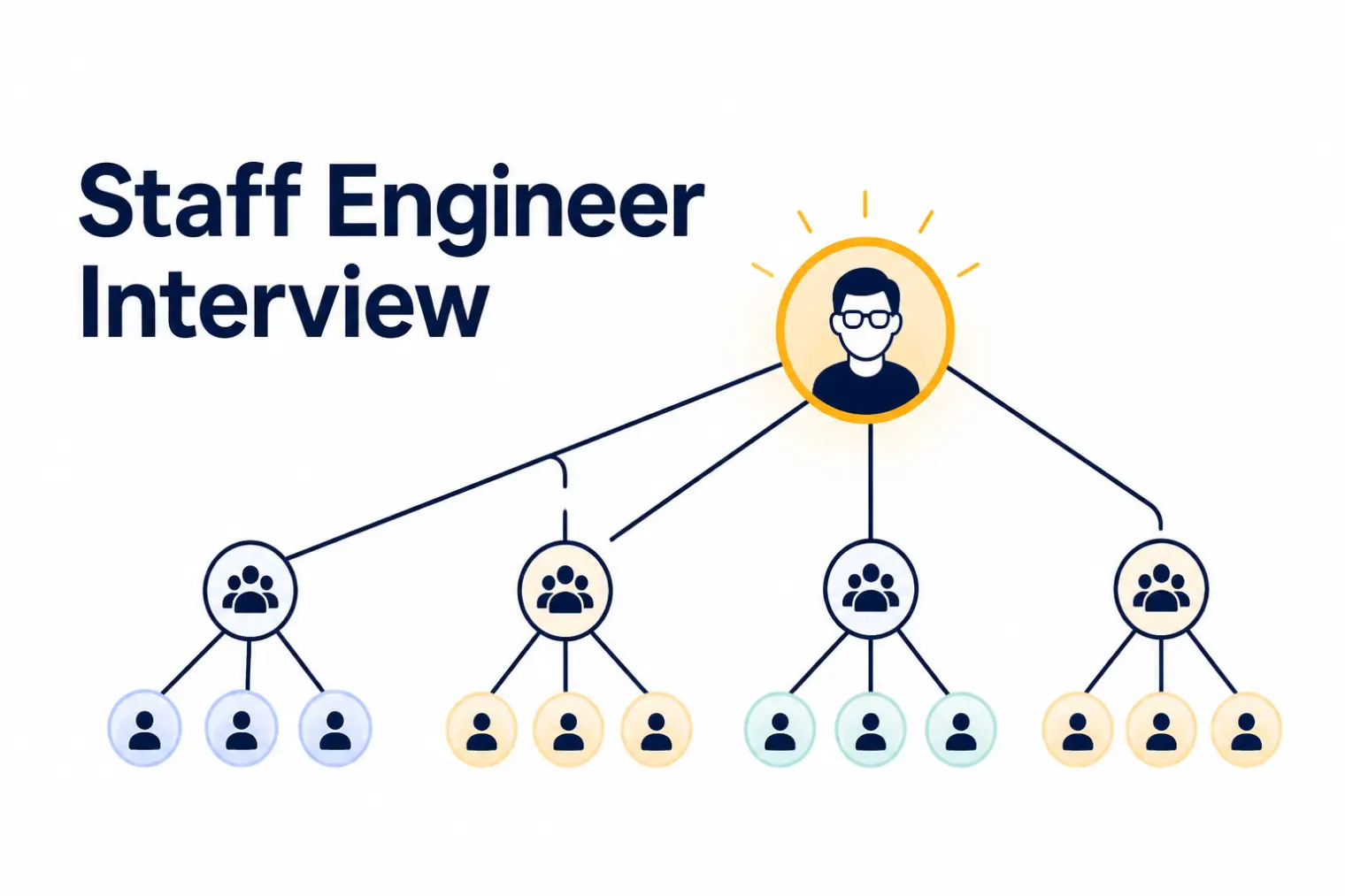
TL;DR: Staff engineer interviews are decided on scope and influence, not raw technical skill — the coding round is a gate almost everyone clears, and the system design and behavioral rounds are where candidates actually get filtered. The bar interviewers are checking for: can you set technical direction across teams you don't manage, and can you tell a true story about doing it. AI mock-interview practice helps most on the behavioral follow-up questions that separate a Senior-sounding answer from a Staff-sounding one.
A senior engineer with eight strong years at one company walked into her Staff loop with a portfolio of shipped features, a strong system design round behind her, and a set of STAR stories she'd used successfully at every promotion review to date. She didn't get the offer. The feedback, paraphrased: "Every story you told was about a project you owned. We needed to hear about a decision you made that other teams had to live with."
That's the entire Staff engineer interview in one sentence. It's not a harder version of the Senior loop — it's testing a different thing.
What Actually Separates Staff from Senior
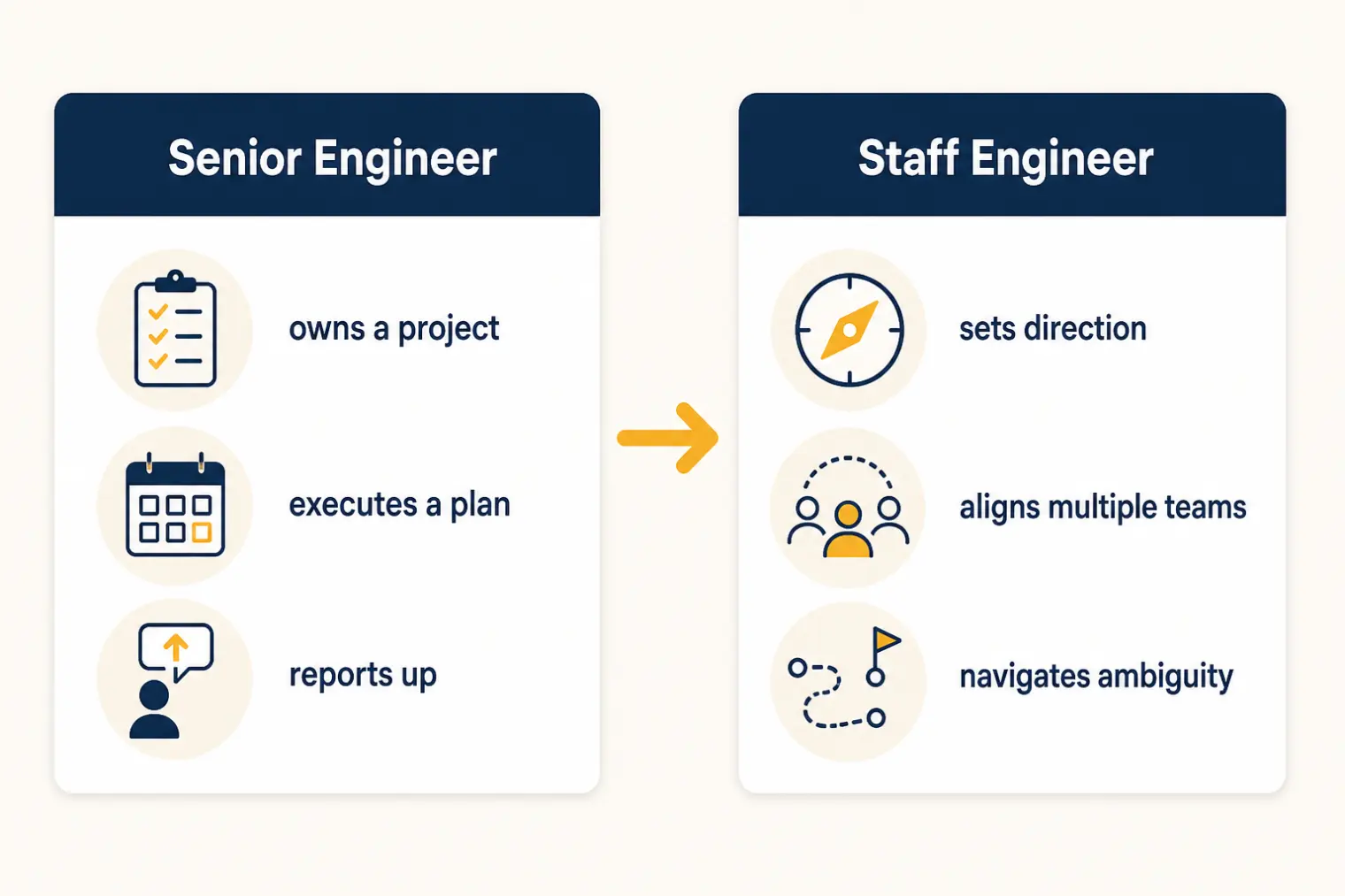
The most-cited framework for this comes from Will Larson's Staff Engineer: Leadership Beyond the Management Track, and most large tech companies' internal leveling guides map onto some version of it. Four signals, evaluated mostly through behavioral questions:
- Direction setting — can you define where a technical area should go, not just execute a plan someone else wrote?
- Driving alignment — can you get multiple teams with competing priorities to agree on an approach, without having authority over any of them?
- Navigating ambiguity — when there's no clear owner and no clear answer, do you make a call and take responsibility for it?
- Conflict resolution — when a technical disagreement escalates, can you resolve it on the merits rather than by seniority or volume?
Notice what's absent from that list: raw coding speed, depth of framework trivia, or how many services you've built. Those matter at every level. They stop being the differentiator at Staff.
The Staff Engineer Interview Loop: What's Actually Tested
A typical Staff loop runs three to five rounds. The mix varies by company, but the shape is consistent:
- A coding round — usually one, sometimes skipped for internal promotions. It confirms you haven't lost your edge; it rarely decides the outcome.
- One or two system design rounds — but at Staff scale: cross-team dependencies, migration strategy, org-wide platform decisions, not "design Twitter."
- One or two behavioral rounds, explicitly structured around scope and influence rather than generic "tell me about a challenge" prompts.
- Sometimes a presentation round — walking a panel through a real technical decision you made, defending it live under questions.
The candidates who stumble usually over-invest in round 1 and under-invest in rounds 3–4, because coding prep has decades of established materials and scope-and-influence prep mostly doesn't.
Behavioral Round: Building Stories That Clear the Scope Bar
The single most common mistake at this level is bringing Senior-scoped stories to a Staff-scoped bar. A story about optimizing your own team's deploy pipeline, however well-executed, answers "can you own a project" — not "can you set direction other teams follow."
What a Staff-level story actually needs:
- A decision that other teams had to live with, not just one your own team benefited from.
- Genuine disagreement somewhere in the story — a stakeholder who pushed back, a plan that had real trade-offs you had to defend, not a decision everyone immediately agreed with.
- A moment where you didn't have the authority to just mandate the outcome, and had to build agreement instead.
- An honest account of what you'd do differently. Staff-level interviewers specifically probe for self-awareness; a story with no acknowledged misstep reads as either lucky or dishonest.
A useful diagnostic: if your story could be told by a Senior engineer without any changes, it's not a Staff story yet. Rework it around the decision, not the delivery.
Technical Round: System Design at Staff Scale
Staff-level system design questions look similar to Senior ones on the surface but probe differently. Where a Senior round asks "design a URL shortener," a Staff round is more likely to be "here are three teams independently building overlapping caching layers — what do you do?"
The interviewer is testing whether you can reason about:
- Migration and rollout strategy across systems you don't fully control, not just the target architecture.
- Organizational cost, not only technical cost — what does this design ask of teams who have to adopt it?
- Trade-offs under real political constraint — "the platform team already committed to a different approach; how do you handle that?"
If you're also brushing up on the pure system-design mechanics that come up in these rounds, the cloud architect interview guide covers the multi-cloud, cost-and-scale reasoning that overlaps heavily with Staff-level infrastructure questions.
How Level Names Map Across Companies and Regions
One thing almost no English-language guide addresses: "Staff engineer" isn't a universal title, and candidates researching this outside the US often can't tell what to search for.
- United States: Staff (L6 at Google, E6 at Meta) sits above Senior and below Principal at most companies; titles and level numbers vary company to company.
- Greater China: Alibaba, Tencent, and Baidu use numbered technical ladders — roughly T8/T9 at Alibaba or equivalent P8/P9 designations (高级专家/资深专家) map to the Staff-to-Principal band; ByteDance and Didi use their own numbered scales. If you're mapping a US-style resume to a China-market application, Staff generally lines up with the 高级专家 tier, not a direct title translation.
- Japan: Japanese engineering orgs more often skip a distinct "Staff" title entirely and move from シニアエンジニア (Senior) directly to プリンシパルエンジニア (Principal) or an architect-track title — search and prep around "プリンシパルエンジニア" rather than a literal translation of "Staff."
- Korea: 스태프 엔지니어 is a fairly recently imported term at Korean offices of global companies; 수석 엔지니어 (senior/principal engineer) is the more established local title and the one most Korean job postings actually use.
Knowing this matters for two reasons: it changes what to search for in local job postings, and it changes how to translate your own scope story if you're interviewing across regions — the interviewer's mental model of "what a Staff-equivalent engineer does" shifts with the local ladder, even when the technical bar doesn't.
How AI Practice Helps Close the Gap
Reading about the scope-and-influence bar gives you the vocabulary. It doesn't tell you whether your actual stories clear it — that only shows up when someone pushes back on them.
That's the part a static guide (including this one) structurally can't do, and it's where AI mock-interview practice earns its place: an AI interviewer that asks the follow-up a real panel would ask — "Why didn't you just escalate to your manager?" or "What if the other team had simply refused?" — forces you to find out in advance whether your story actually holds up under the kind of pressure a Staff loop applies. AceRound AI runs this as a live mock session, probing both the system-design reasoning and the scope-and-influence stories in the same format the real loop uses.
The honest limit: no AI session replicates the actual political texture of a real cross-team conflict, or the specific panel of engineers deciding your case. What it replicates well is the discipline of having your story survive a skeptical follow-up question — which is exactly the skill most candidates haven't practiced, because most interview prep stops at "here's a list of questions" rather than "here's someone who will argue with your answer." For the technical-round overlap, the engineering manager interview guide covers the people-leadership questions that sometimes appear in Staff loops at companies without a hard IC/manager split, and the software engineer behavioral interview guide is a useful baseline if you're building your STAR structure from scratch before scaling it up to Staff scope.
FAQ
What is the difference between a Staff and Senior engineer interview?
A Senior engineer interview mostly tests whether you can own a project end to end. A Staff interview tests whether you can set technical direction for other teams, work through ambiguity nobody has resolved for you, and get people who don't report to you to follow your call. The technical bar overlaps; the behavioral bar is the real filter.
How important is coding in a Staff engineer interview?
It's a gate, not the differentiator. Most loops still include a coding round, but it's there to confirm you haven't lost your edge, not to rank candidates. Almost everyone who reaches a Staff loop passes the coding bar; almost nobody clears the loop on system design and behavioral alone. Weight your prep accordingly.
What does "scope" mean in a Staff engineer interview?
Scope is the size and boundary of what you're expected to influence without needing anyone else's permission to act. A Senior engineer's scope is usually a project or a team's roadmap. A Staff engineer's scope is typically a problem area spanning multiple teams, where you're expected to set direction even though you don't manage anyone in it.
Is a Staff engineer the same as a Principal engineer?
Not always, and the naming is genuinely inconsistent across companies. At some companies Staff and Principal are the same level with different titles by region; at others Principal is one rung above Staff. Check the specific company's leveling guide (many publish one) rather than assuming the title maps the way it does elsewhere.
Can AI actually help prepare for a Staff engineer interview?
It helps most on the part static guides can't reach: the back-and-forth. A real Staff loop interviewer pushes on your story ("why didn't you just escalate to your manager instead?") the way a reading list never will. AI mock interviews that ask follow-up questions and inject new constraints mid-answer build the same muscle a live loop actually tests — they don't replace practicing with real humans, but they make that practice sharper.
Author · Alex Chen. Career consultant and former tech recruiter. Spent 5 years on the hiring side before switching to help candidates instead. Writes about real interview dynamics, not textbook advice.
Related Articles
The SQL Technical Screen: What Interviewers Actually Watch You Do Live
The SQL technical screen is a live, shared-editor round, not a take-home. Here's the format, what interviewers watch for beyond correct output, and how to prep.

The Palantir Forward Deployed Engineer Interview: What Decomposition Tests
Palantir's FDE interview has a round most candidates never expect: decomposition. Here's what it actually tests, and why AI tools are banned in the room.

The Byteboard Interview at Google, Waymo & Dropbox: What CoreEval Tests
Byteboard swaps algorithm trivia for a two-part take-home assessment. Here's what CoreEval measures, who uses it, and where AI tools actually fit.