The Palantir Forward Deployed Engineer Interview: What Decomposition Tests
Palantir's FDE interview has a round most candidates never expect: decomposition. Here's what it actually tests, and why AI tools are banned in the room.

TL;DR: Palantir's Forward Deployed Engineer interview runs three to four weeks across a recruiter call, a technical screen, an onsite with rounds drawn from a pool (decomposition, learning, coding, re-engineering, system design), and a hiring-manager final. The signature round is decomposition — a case interview where you scope an ambiguous, real-world operational problem out loud, with no code involved. It has the lowest pass rate and the highest weight of any stage. Palantir also explicitly bans AI assistance at every stage of the loop, which matters if you've been prepping with a copilot tool: the honest answer is that your prep should lean on AI, and your live performance can't.
Most candidates walk into a Palantir loop expecting a harder version of a normal big-tech interview — tougher algorithm questions, a stricter bar on system design. That's not quite what's waiting for them. The coding rounds are, by most accounts, easier than a typical FAANG interview. What trips people up is a round most FDE candidates have never heard of until they're already sitting in it: decomposition.
The FDE Loop, Stage by Stage
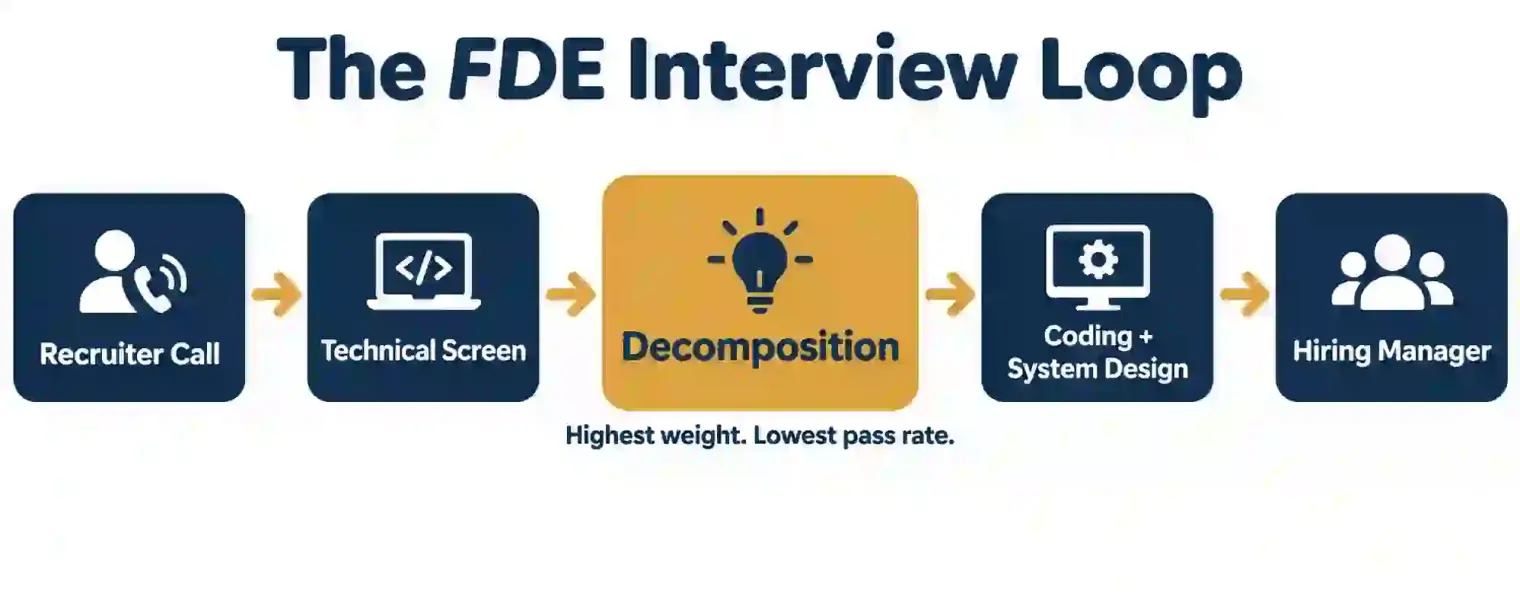
The full process typically runs three to four weeks:
- Recruiter call (~30 min) — background, motivation, basic culture fit
- Technical screen — live coding via CodePair/Karat, or an async assessment covering coding, SQL, and a small API task
- Onsite — three 60-minute rounds, drawn from a pool that includes decomposition, learning, coding, re-engineering, and system design
- Hiring-manager final — typically re-probes whichever onsite round was weakest
Behavioral questions aren't a separate round here — they're woven into almost every stage, which is consistent with what the job actually requires: technical judgment applied in front of a client, not in isolation.
Decomposition: The Round That Actually Decides This
Here's a version of what candidates report getting: you're handed something like 8,000 rows of London taxi trip data, and the person across from you — playing the customer — says they need "something deployable in a week." No further spec. No code editor. Your job for the next 45 to 60 minutes is to figure out, out loud, what "something" should even be.
This is scoping under ambiguity, not algorithm design. A strong answer sounds less like "I'd build a microservice architecture with X and Y" and more like a sequence of decisions a client could actually approve: what's the smallest useful thing you'd ship first, what would you deliberately punt on, what would you ask the customer before committing to an approach, and how would you know in three days whether you're on the right track. Interviewers are listening for whether you can turn "vague and urgent" into a plan someone would trust, not for a textbook-correct architecture.
It's reportedly the stage with both the highest weight and the lowest pass rate in the whole loop — around 40% by some candidate accounts — and that combination is the entire point of this article. Grinding LeetCode doesn't move the needle here. Neither does memorizing system-design frameworks. The only real preparation is rehearsing the specific muscle of narrating a scoping decision, live, to someone who's going to push back on it.
The Learning Round and Re-Engineering: Testing Onboarding Speed, Not Memorization
A separate round — sometimes called the "learning" round — hands you unfamiliar code (candidates have reported things like Python's concurrent module) and asks you to read, extend, or debug it under time pressure. There's a re-engineering round in the same spirit. Neither is about knowing the library in advance; they're both proxies for the actual job, where an FDE gets dropped into a customer's existing, unfamiliar codebase and is expected to be useful within days, not weeks.
By 2026, the technical scenarios in coding and system-design rounds have also shifted noticeably toward agent-shaped problems — designing an agent that takes real actions in a customer's systems, with guardrails, a human-in-the-loop step, and an audit trail — rather than classic graph or dynamic-programming prompts. If your system-design prep is still purely "design Twitter," it's worth reading a broader system design interview guide that covers reasoning about tradeoffs generally, then adapting that reasoning to an agentic, customer-embedded context specifically.
Why This Model Is Suddenly Everywhere
Palantir didn't invent embedding engineers at customer sites, but it's become the reference case, and 2026 is the year everyone else started copying it. OpenAI formalized its own version in May 2026 through its acquisition of the consulting firm Tomoro, folding roughly 150 engineers into what it's internally calling "DeployCo." Anthropic, AWS (reportedly backing FDE-style teams with over $1B), and Databricks have all stood up similar orgs, alongside a wave of Series-A AI startups.
The reason shows up in research MIT's NANDA initiative published this year: roughly 95% of enterprise AI pilots show no measurable P&L impact. Companies increasingly conclude the bottleneck isn't model quality — it's deployment, integration, and the last mile of getting a system to actually work inside one specific customer's messy reality. That's exactly the skill Palantir's decomposition round is built to test, which is why other companies are now hiring for the same trait even when the interview process still looks different from Palantir's.
The Part Nobody Selling You Interview Prep Wants to Say Out Loud
Palantir explicitly prohibits AI assistance at every stage of this loop. That's a real, stated exception in an industry where plenty of companies now tacitly tolerate — or in some technical screens, actively expect — candidates to use AI tools live. If you've built a prep routine around a copilot that whispers answers into a call, that specific tool has no legitimate place in this particular interview room.
We'd rather say that plainly than pretend otherwise, because it's the honest answer and because it's also not the whole story. The place AI genuinely helps is before the interview, not during it — running the decomposition scenario as a rehearsal, out loud, against a tool that pushes back the way a real interviewer would, until narrating a scoping decision under pressure stops feeling unfamiliar. That's a fundamentally different use case than live assistance, and it's the one a mock interview is actually built for: practicing the skill in private so the live version, where nothing but your own judgment is allowed, goes better.
FAQ
How hard is the Palantir FDE interview?
Candidates commonly rate it around 3.5 out of 5 for difficulty, and it's a different kind of hard than a typical big-tech loop. The coding questions themselves sit at easy-to-medium LeetCode difficulty, so raw algorithm grinding isn't where people get stuck. The decomposition round is what actually filters people out — it has the lowest reported pass rate of any stage precisely because there's no algorithm to study for it, only judgment under ambiguity.
What is the decomposition round at Palantir?
It's a 45-60 minute case interview where the person across from you plays a customer with a real but vague operational problem — something like 8,000 rows of unstructured data and a request to "build something deployable in a week." You're not asked to write code. You're asked to scope the problem, decide what to build first, and sequence a plan a client would actually accept, out loud, in real time.
Can you use AI tools during the Palantir FDE interview?
No. Palantir is explicit that AI assistance isn't permitted at any stage of the loop, which is a notable exception in an industry where several other companies now tolerate or even expect candidates to use AI tools live. Practically, that means any interview-copilot product is off the table the moment you're in the room — the only place AI has a legitimate role is in how you prepare beforehand, not how you perform during.
What does a Palantir Forward Deployed Engineer actually do?
An FDE is embedded directly at a customer's site — a government agency, a hospital system, a manufacturer — building and adapting software against that specific customer's data and workflows, rather than shipping a general-purpose product from Palantir's own offices. Palantir's internal framing contrasts this with a more traditional "Dev" engineering role: FDEs are judged on how fast they can turn an ambiguous operational problem into something a customer can use, not on elegant general-purpose architecture.
How much does a Palantir Forward Deployed Engineer make?
Reported total compensation ranges widely by level and source, roughly $185K to $630K+, with the top of that range reflecting senior levels and strong equity outcomes rather than typical new-hire offers. Worth noting: as the forward-deployed model spreads to frontier AI labs building their own FDE-style teams, several of those orgs are reportedly paying at a meaningful premium over Palantir's classic band for equivalent seniority, mostly through equity.
Is the Palantir interview process the same as a normal software engineering interview?
No — three of the four onsite rounds are drawn from a pool that includes decomposition, a code-reading "learning" round, and a re-engineering round, in addition to more familiar coding and system design rounds. The mix you get can vary, but decomposition is the one every FDE candidate should assume is coming, since it's the round that most directly tests what the job actually is.
Author · Alex Chen. Career consultant and former tech recruiter. Spent 5 years on the hiring side before switching to help candidates instead. Writes about real interview dynamics, not textbook advice.
Related Articles
The SQL Technical Screen: What Interviewers Actually Watch You Do Live
The SQL technical screen is a live, shared-editor round, not a take-home. Here's the format, what interviewers watch for beyond correct output, and how to prep.

The Byteboard Interview at Google, Waymo & Dropbox: What CoreEval Tests
Byteboard swaps algorithm trivia for a two-part take-home assessment. Here's what CoreEval measures, who uses it, and where AI tools actually fit.

System Design Interview Questions: The 2026 Prep Guide
System design interview questions for 2026: the 5-step framework, how Amazon, Google, and Meta's rounds differ, and why GenAI questions are now common.