Tell Me About a Time You Had to Learn Something Quickly: A Real Answer
"Tell me about a time you had to learn something quickly" tests learning agility, not memory. STAR structure, real examples, what to say when you blank.
TL;DR: "Tell me about a time you had to learn something quickly" is a learning-agility question, not a memory test — interviewers care about how you learned, not just that you eventually succeeded. Use STAR, name your actual learning method, and have a real, recent example ready that isn't just "I'm a fast learner."
Six weeks into a new job, your manager hands you a codebase you've never seen, in a language you last touched in a bootcamp, with a client demo in four days. Or: your company acquires a smaller shop, and suddenly you're the one who has to understand their entire billing system by Friday. Everyone has a version of this story — it's a close cousin of "describe a time you had to make a difficult decision", another moment interviewers use to see how you think under real constraints. The problem is that most candidates, asked to tell it in an interview, compress the whole thing into "I'm a fast learner" and move on — which is exactly the answer that makes interviewers stop listening.
Why Interviewers Ask This
This question isn't really about whether you can learn things — nobody in the room doubts that. It's a proxy for learning agility, a specific and well-studied trait that predicts how you'll handle the next unfamiliar problem your role throws at you, which is a far better signal than whether you can recite a past success.
Talent-assessment firm Korn Ferry breaks learning agility into five dimensions in its widely-cited research, summarized in Forbes: mental agility (comfort with complexity), people agility (learning through others), change agility (curiosity under pressure), results agility (delivering in first-time situations), and self-awareness (knowing your own gaps). A good answer to this question should touch at least two or three of those — not just "I read the documentation and figured it out."
That's also why interviewers ask you to walk through a specific past example rather than just asking "are you a fast learner?" directly. It's worth separating two things here. Decades of meta-analytic research on hiring — most notably the widely-cited work by Schmidt, Oh, and Shaffer — puts the structured employment interview among the strongest available predictors of job performance, well ahead of an unstructured chat; that evidence is about structured interviewing as a whole, not about any particular style of question. The rest is the interviewer's own practical reasoning, not a finding of that research: a concrete "here's what I actually did" account is harder to fake, and tells them more, than a self-assessment like "I pick things up quickly."
The Gap Almost Every Prep Article Misses
Most interview-prep guides tell you to "pick an example where you learned something new," then jump straight to a script. What they skip is the part that actually separates a forgettable answer from a memorable one: naming your specific learning method, not just the fact that you eventually got there.
"I learned it by reading the docs" tells an interviewer almost nothing — everyone reads docs. Compare that to: "I built a throwaway script that hit every endpoint in the API so I could see real response shapes instead of guessing from documentation, then paired with the one engineer who'd touched that service before to sanity-check my assumptions." The second version demonstrates mental agility (building your own test harness) and people agility (knowing when to ask, and who to ask) — the interviewer walks away with actual evidence, not an assertion.
Building the Answer With STAR
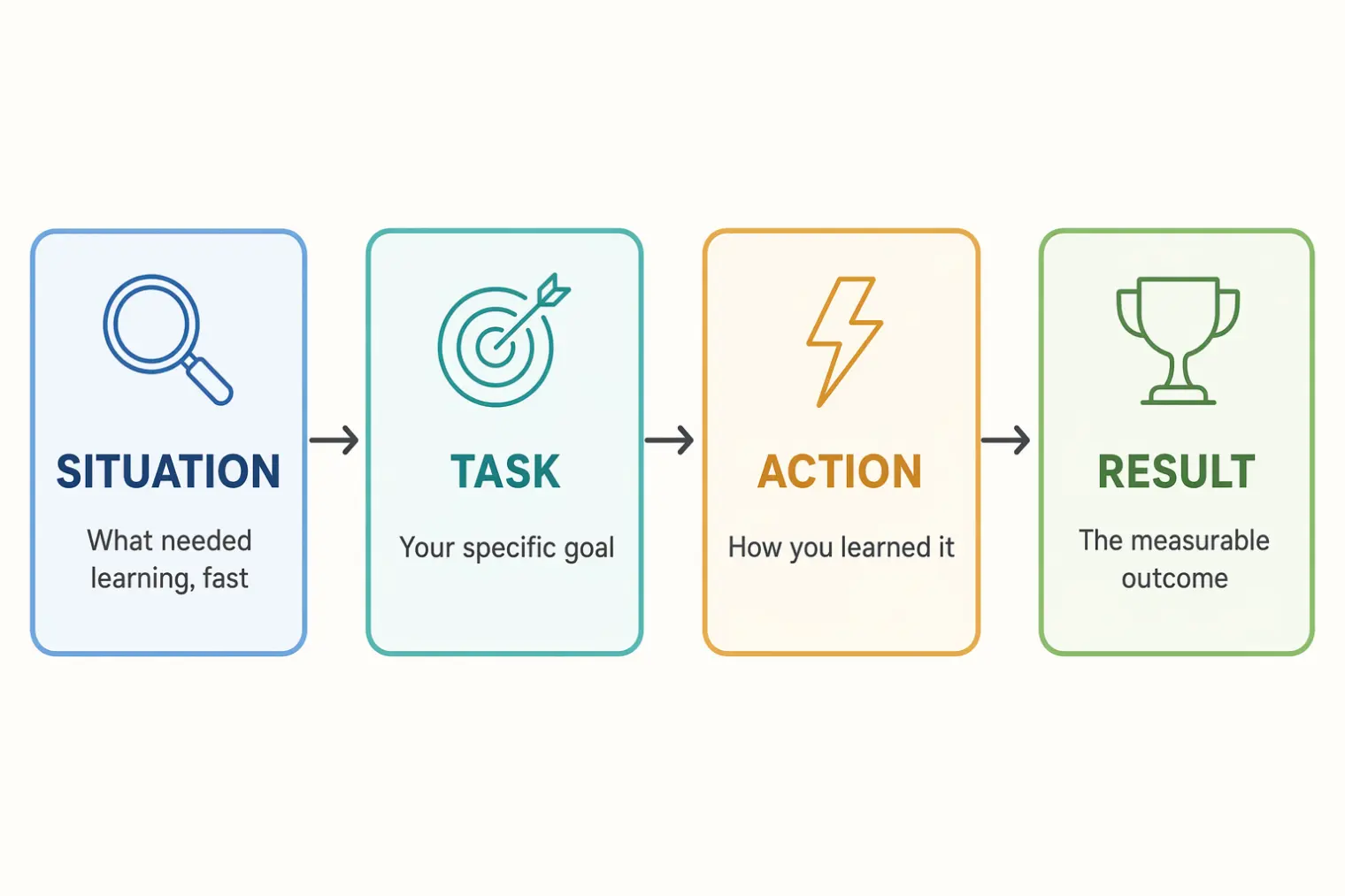
The STAR method keeps this story from turning into a vague montage of "and then I studied a lot":
- Situation — what you were suddenly expected to know, and why the timeline was real (a launch date, a client call, a teammate leaving).
- Task — the specific thing you had to be able to do by when, not just "learn X" in the abstract.
- Action — your actual learning method: what you built, who you asked, what you tested against, what you deliberately skipped to save time. This is the step that carries the whole answer.
- Result — a measurable outcome (shipped on time, passed the demo, reduced a support queue) plus a verification step showing you confirmed you'd actually learned it correctly, not just assumed so.
Two Sample Answers That Show, Don't Assert
Engineer: "Three weeks into my current job, the team member who owned our payments integration left, and I inherited a Stripe webhook handler I'd never touched, with a compliance deadline nine days out. Instead of reading the whole codebase top to bottom, I wrote a small test harness that fired sample webhook payloads through the handler so I could watch exactly what each code path did, then scheduled two 20-minute pairing sessions with our backend lead to walk through the parts that weren't obvious from the code alone. We hit the deadline, and afterward I documented the handler so the next person wouldn't have to reverse-engineer it the way I did — QA caught zero regressions in that module over the following quarter, which told me I'd actually understood it, not just patched around it."
Non-tech (operations): "When my company switched fulfillment vendors with two weeks' notice, I had to learn an entirely new inventory system well enough to train four warehouse staff on it. I spent the first day just breaking things in a sandbox account — creating test orders, forcing errors, seeing what the system did — instead of only reading the vendor's manual. Then I built a one-page cheat sheet from what I'd actually hit, not from the manual's structure, and ran a 30-minute walkthrough with the team before go-live. We had zero fulfillment errors in week one, and two staff later told me the cheat sheet was more useful than the vendor's own training deck."
When You Genuinely Can't Think of a Good Example
This happens more often than prep guides admit — especially in a live loop where your strongest "learned something fast" story already got used on an earlier question, and you're left mentally scrambling for a second one. If that's you right now, broaden your definition before you panic: a new tool, an unfamiliar codebase, a role you were thrown into with no formal onboarding, or a hobby you picked up under a real deadline (planning a wedding, learning a language before a trip) all qualify, as long as you can name the actual method, not just the topic.
If you're preparing with a real-time interview copilot like AceRound, this is exactly the moment it's built for: when you're blanking on which story fits, a live prompt that surfaces the STAR shape and nudges you toward naming your actual learning method — rather than defaulting to "I read up on it" — can be enough to pull the right memory forward instead of improvising a thin answer under pressure.
Handling the Follow-Up Questions
Interviewers rarely stop at the story. The two follow-ups worth preparing for:
- "How did you know you'd actually learned it correctly?" — Have a real verification step ready: a code review that came back clean, a test suite that passed, a colleague who checked your work, a metric that held steady after you shipped.
- "What would you do differently if you had to learn something similar again?" — This is a self-awareness check (Korn Ferry's fifth dimension). A specific, honest answer — "I'd loop in the domain expert on day one instead of day four" — reads far better than "I wouldn't change anything."
Both follow-ups are checking the same thing: whether you actually verified your understanding, or just muddled through and got lucky.
Frequently Asked Questions
How do you answer "tell me about a time you had to learn something new quickly"? Pick one specific, recent example where you had a real deadline — not a vague "I'm a fast learner" claim. Structure it with STAR: what needed learning and why the clock was ticking (Situation/Task), the actual method you used to learn it, not just that you "read up on it" (Action), and a measurable outcome plus what you'd do differently next time (Result).
What do interviewers listen for in this question? They're scoring learning agility — a specific, research-backed trait (Korn Ferry's model breaks it into five dimensions: mental, people, change, and results agility, plus self-awareness) that predicts how you'll handle the next unfamiliar problem, not just whether you can recite a past success. The "how" of your learning method matters more than the fact that you eventually succeeded.
What if I genuinely can't think of a good example? This happens to almost everyone mid-interview, especially if your best story got used on an earlier question. Broaden your definition: a new tool, an unfamiliar codebase, a role you were thrown into without training, or even a hobby you picked up under real time pressure all count, as long as you can name the specific method you used to learn.
Is "I'm a fast learner" an acceptable interview answer? No — it's the single most common reason this answer falls flat. Interviewers hear that phrase dozens of times a week with no evidence behind it. Replace the claim with a specific story that demonstrates the trait instead of asserting it.
What follow-up questions come after this one? Expect "how did you know you'd actually learned it correctly?" and "what would you do differently if you had to learn something similar again?" Both are checking whether you verified your own understanding rather than just muddling through — have a concrete verification step ready (a code review, a test you ran, feedback from a colleague).
Author · Alex Chen. Career consultant and former tech recruiter. Spent 5 years on the hiring side before switching to help candidates instead. Writes about real interview dynamics, not textbook advice.
Related Articles
Interviewing While Employed: How to Actually Prepare With Zero Time
Job searching while employed means near-zero prep time, not just staying discreet. Here's a 20-minute prep script, plus what the counteroffer statistics actually show.
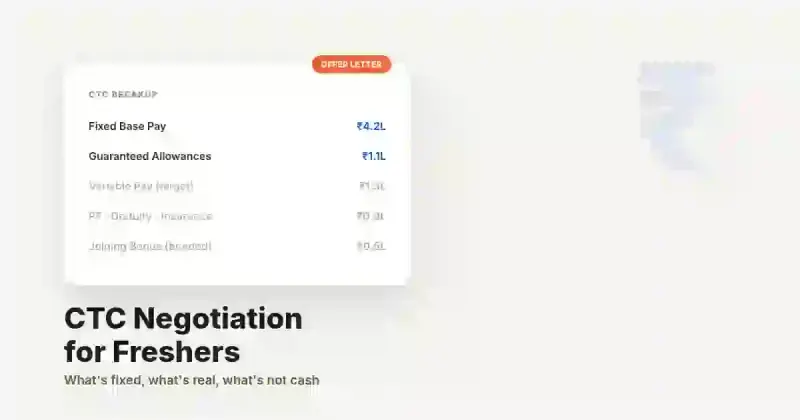
CTC Negotiation for Freshers in India: What's Actually Negotiable
Most fresher CTC negotiation advice ignores that TCS, Infosys, and Wipro set fixed pay bands. Here's what's really negotiable, and where lowball offers hide.
Service-Based or Product-Based? Deciding When You Have Both Live at Once
TCS offer in hand, product company interview next week — here's the actual decision framework, not another generic service vs product comparison table.