What Is Your Ideal Work Environment? A Real Answer Framework
What is your ideal work environment? Learn to research a company's real culture, avoid scripted-sounding answers, and structure one that's honest and specific.

Quick answer: There's no single correct answer to "what is your ideal work environment" — there's only an honest one. Name one or two specific factors that genuinely affect how well you work (pace, collaboration style, how ambiguous the priorities are), back it with a real example, then connect it to something you've actually found out about this company. Skip the perks, skip "I can work anywhere," and don't guess at a culture you haven't researched.
You're thirty minutes into a promising interview when the hiring manager leans back and asks, "So, what's your ideal work environment?" It sounds like small talk. It isn't. It's one of the highest-signal questions in the interview, because your answer tells them whether you actually know how you work — and whether that matches how this team works.
Most candidates either freeze into a vague non-answer ("I can adapt to anything!") or reach for a scripted-sounding list of buzzwords that could apply to any job posting. Neither works. Here's how to build an answer that's specific, honest, and actually backed by research instead of guesswork.
Why Interviewers Ask This Cultural Fit Interview Question
This isn't a filler question. It's a cultural fit interview question dressed up as small talk, and interviewers ask it for a concrete reason: mismatch between what you need to do good work and what the team actually offers is one of the biggest predictors of an employee leaving within the first year.
The data backs this up. SHRM's 2026 Global Workplace Culture Report found that employees who rate their culture as poor are nearly four times more likely to be actively job hunting than those who rate it highly, and 74% report feeling demotivated by a bad cultural fit. Gallup's ongoing workplace research puts it even more starkly: engagement and work-life balance issues account for roughly 69% of the reasons employees leave a job. Hiring managers know these numbers, even if they've never read the report. Asking about your ideal work environment is their cheap, five-minute way to screen for a mismatch before it costs them a bad hire.
That means your job isn't to guess the "right" answer. It's to demonstrate that you know yourself well enough to answer accurately.
What "Describe Your Ideal Work Environment" Answers Are Actually Testing
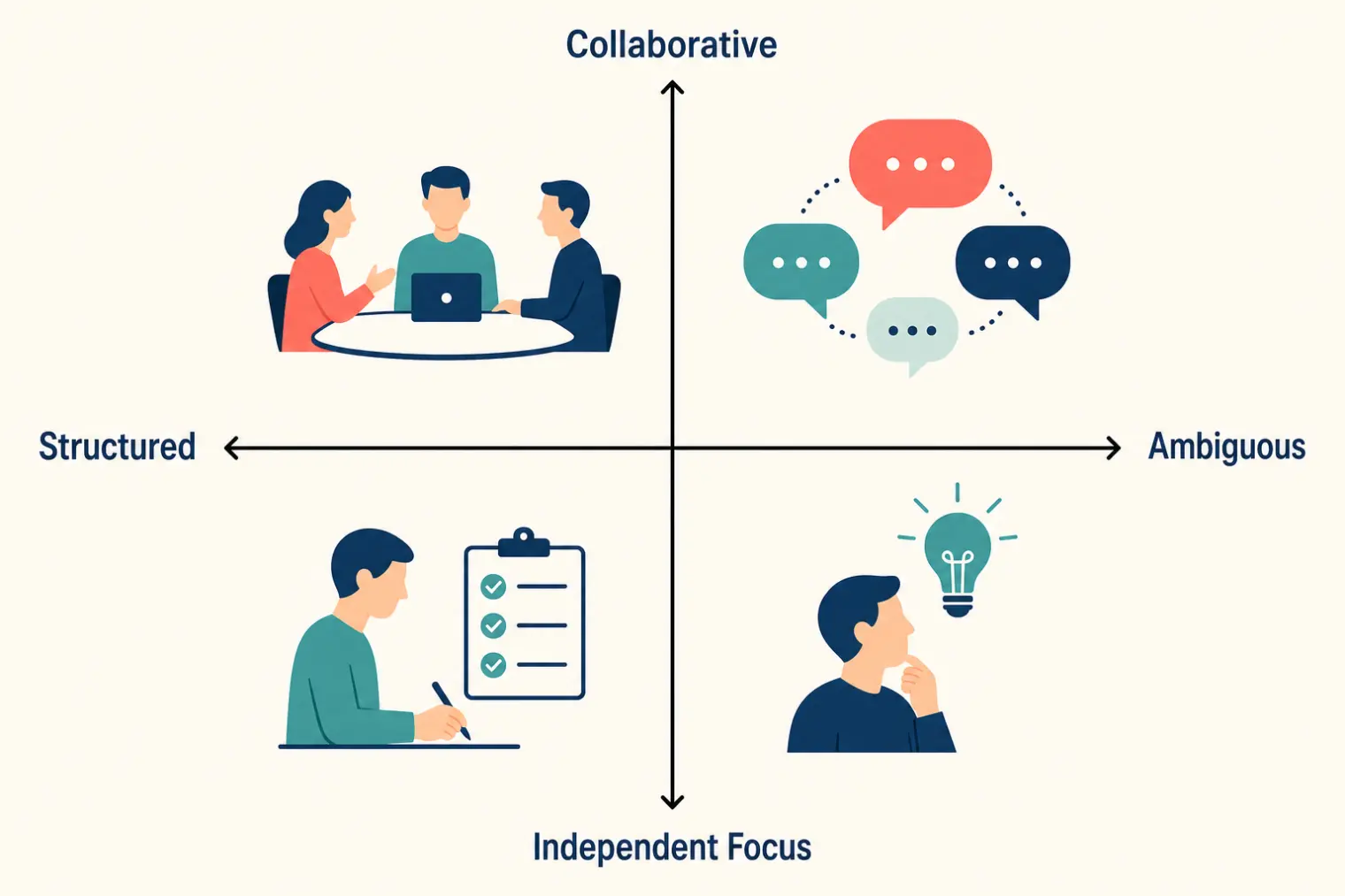
Strip away the phrasing and the question is really asking about four underlying factors. Before you write an answer, figure out where you actually sit on each:
- Collaboration vs. independent focus — do you do your best work in constant back-and-forth with a team, or do you need blocks of uninterrupted time to think?
- Structure vs. ambiguity — do clear processes and defined priorities help you move faster, or do they feel like overhead compared to figuring things out as you go?
- Pace — do you thrive when priorities shift daily, or do you do better work when scope is stable for weeks at a time?
- Feedback style — do you want frequent, informal check-ins, or scheduled, structured reviews?
Pick one or two of these — not all four — and build your answer around the ones that genuinely change how well you perform. An answer that tries to cover everything sounds like a personality test summary, not a real preference.
How to Research a Company's Real Work Environment Before an Interview
Every generic interview guide tells you to "check Glassdoor and the company's mission statement." That's a start, but it's thin — mission statements are aspirational marketing copy, and Glassdoor reviews skew toward people with strong (often negative) opinions. Here's a sharper method for how to research a company's work environment before an interview, using signals that are harder to fake:
- Read the job posting like evidence, not fluff. A posting heavy on words like "fast-paced," "wear many hats," and "figure it out" is telling you the environment is ambiguous and self-directed. One with "established processes," "cross-functional stakeholders," and "reporting structure" is telling you it's more structured and coordination-heavy.
- Look at the interview loop itself. A single 45-minute call with the hiring manager signals fast, autonomous decision-making. A five-round panel with multiple stakeholders signals a consensus-driven, more structured culture. The process is a preview of how the company operates.
- Check who's posting on LinkedIn from the team. Individual contributors sharing technical deep-dives suggest an engineering-driven, autonomous culture. Managers sharing culture and event content suggest people-and-process investment. Neither is better — but it tells you what the company optimizes for.
- Ask a direct question back. "How does the team typically handle shifting priorities mid-sprint?" gets you a real answer instead of a culture-deck slogan, and it signals you're thinking about fit seriously.
Use whatever you find to make your answer specific to this role, not a generic script you'd give anywhere.
A Simple Framework for Your Answer
Once you know your own factors and you've done five minutes of research, structure the answer in three parts:
- Name your one or two factors, specifically. "I do my best work when priorities are clear for a couple of weeks at a time, and I can go heads-down without needing to context-switch every hour."
- Back it with a brief, real example. "In my last role, I had the most productive quarter when we locked scope at the start of each sprint — output nearly doubled compared to the weeks priorities shifted daily."
- Connect it to something you've learned about this company. "From the job description and how the interview loop is structured, it sounds like this team runs on defined sprint cycles, which is exactly the setup where I do my best work."
That third step is what separates a credible answer from a rehearsed one — it proves you actually looked, instead of reciting a preference that would fit any job posting.
Ideal Work Environment Interview Question Examples, by Setting
Different roles call for different honest answers. Here are examples across common settings — adapt the specifics, don't recite them verbatim (more on why that backfires below).
In-office, team-based role: "I do my best work in a collaborative environment where I can talk through problems with teammates in real time rather than over async threads. In my current role, pairing with a colleague on a tricky integration cut our debugging time roughly in half compared to solving it solo. I saw from the interview process that your team does daily standups and pair programming, which lines up with how I work best."
Remote work environment interview answer: "I need to be deliberate about staying visible without a physical office — that means writing clear async updates instead of assuming people will ask if they're confused, and defending a few hours of uninterrupted focus time each day. At my last remote job, I set a standing habit of a written end-of-day summary, and my manager told me it was the reason he never had to wonder what I was working on."
Hybrid role: "I like splitting my week deliberately — deep individual work on my at-home days, and saving anything that needs real-time back-and-forth, like planning or design reviews, for the days I'm in the office. That split kept me from wasting in-person time on things I could've done alone, and from trying to do collaborative work over a laptop screen."
Early-stage startup, high ambiguity: "I do well when priorities are loosely defined and I get to figure out the right approach myself, as long as I have a clear outcome to aim for. I'd rather be told 'reduce onboarding drop-off' and given room to figure out how than be handed a fixed spec — that's part of why I'm interested in an earlier-stage company like this one."
Large, structured organization: "I work well within clear processes and defined ownership, because it means less time spent figuring out who owns a decision and more time actually executing. I noticed your job posting mentions a defined cross-functional review process, which is the kind of structure that's let me move fastest in past roles."
What If You Don't Know the Company's Culture Yet?
Sometimes you're asked this question in a first-round screen, before you've had a chance to research much, or the job posting itself is vague. Don't fabricate a culture you haven't verified — that's the fastest way to give an answer that falls apart under a follow-up question.
Instead, say what you've inferred so far and be upfront about the gap: "From the posting, it sounds like this role involves a lot of cross-team coordination, which tells me the environment is probably fairly structured — is that accurate?" Turning the question back with a specific, informed guess does two things: it shows you're already thinking seriously about fit, and it gets you a real answer you can use for the rest of the interview.
Mistakes That Make Your Answer Sound Memorized
Job seekers comparing notes in interview forums consistently flag the same failure mode: an answer that's clearly recited rather than reasoned through. If a description sounds like it was memorized off a career-advice article, an experienced interviewer notices immediately — and it works against you, not for you.
Avoid these:
- Naming perks instead of an environment. Free snacks, a ping-pong table, and unlimited PTO are benefits, not an environment. Interviewers are trained to hear the difference, and this answer reads as shallow.
- Claiming you can work "anywhere, honestly." This sounds agreeable, but it actually signals a lack of self-awareness — everyone has real preferences, and pretending not to makes you harder to place well.
- Listing every factor at once. Trying to cover collaboration, structure, pace, and feedback style in one answer sounds like you're reading off a personality-test summary instead of describing yourself.
- Reciting company buzzwords back at them. Repeating "fast-paced, collaborative, mission-driven" — the exact phrases from their careers page — reads as flattery, not fit. Use your own words backed by your own example.
Practice It Out Loud Before the Real Interview
The gap between a good answer on paper and a good answer under pressure is usually delivery, not content. Most people who read a framework like this can write a strong answer in ten minutes — and then freeze or ramble when an interviewer follows up with "can you give me a specific example of when that wasn't the case?"
That's worth rehearsing out loud, ideally with realistic follow-up pressure rather than just reading your notes back to yourself. Tools built for structured practice — including AceRound AI's mock interview mode — can push back with the kind of follow-up an interviewer would actually ask, which is a different skill than having a good answer memorized. If you want the same STAR-style structure applied to a related question, our guide on the STAR method for interviews is a useful companion, and for live-interview support once you're past the practice stage, see our real-time AI interview helper guide.
FAQ
What is a good answer to "What is your ideal work environment?"
A good answer names one or two specific factors that actually affect your performance — collaboration versus independent focus time, structured versus ambiguous priorities, fast pace versus deep work — backed by a real example from a past role, then ties those factors to something you've found out about this specific company. Avoid vague answers like "I can work anywhere" and avoid naming perks instead of an actual environment.
Is it OK to say I like working alone in an interview?
Yes, if you frame it accurately. Saying "I do my best individual-contributor work heads-down, but I want regular check-ins so I'm not siloed" is honest and specific. What hurts you is saying "I like working alone" with no nuance, for a highly collaborative team-based role — that reads as a fit mismatch, not an honesty problem.
What if I don't know the company's culture yet?
Say so, and show your research method instead of guessing. You can say what you've inferred from the job posting's language, the team structure described in the role, or the interview process itself, then ask a direct follow-up question back to confirm it. That's more credible than fabricating a culture you haven't verified.
How do I answer honestly without lying to get the job?
Separate "ideal" from "acceptable." You don't have to claim the role is your perfect environment — you can say which parts of your ideal environment this role clearly offers, and which parts you're comfortable flexing on. Interviewers are checking for self-awareness and fit, not a performance of total enthusiasm.
How should I answer this for a remote or hybrid job?
Be specific about what remote or hybrid work requires from you, not just that you prefer it. Mention how you stay visible without a physical office, how you protect deep-focus time, and — for hybrid — what kind of work you'd save for in-person days versus solo days. Vague "I love remote work" answers don't address what the interviewer is actually worried about: whether you'll go quiet and disengage.
Why do interviewers ask what your ideal work environment is?
They're checking three things at once: whether you're self-aware about how you actually work best, whether your expectations roughly match what the team offers, and whether you're likely to stay if hired. Research from SHRM and Gallup both link poor culture fit directly to higher turnover, so this question is a low-cost way for interviewers to screen for a mismatch before it becomes an expensive hire.
Author · Alex Chen. Career consultant and former tech recruiter. Spent 5 years on the hiring side before switching to help candidates instead. Writes about real interview dynamics, not textbook advice.
Related Articles

Does Cursor Allow AI in Interviews? Anysphere's Two-Sided Policy
Cursor's maker bans AI in round one to test raw skill, then hands you an 8-hour paid project where using AI well is the entire grade. Here's how the two rounds actually differ.

The Internal Transfer Interview: What Actually Changes at Google and Amazon
Fewer rounds doesn't mean lower stakes. How Google and Amazon's internal transfer mechanics — tenure rules, manager notification, bar raisers — actually differ from an external hire.

Databricks Interview: The Concurrency Round Nobody Warns You About
Databricks runs a full hour on multithreading alone, and reportedly grades system design in a Google Doc, not a whiteboard tool. Here's what candidates say.