Tell Me About a Time You Had to Make a Difficult Decision: A Real Answer, Not a Script
'Tell me about a time you had to make a difficult decision': it works only if you could defend the other choice. STAR structure and pushback tips inside.

TL;DR: A decision only counts as "difficult" for this question if you could plausibly defend the opposite choice — real competing stakes, not just a hard task with a good ending. Structure your answer with STAR, name the trade-off you accepted, and prepare for the interviewer to push back on your reasoning live.
You've got your "tell me about yourself" answer memorized. You've got a failure story ready. Then the interviewer leans back and asks, "Tell me about a time you had to make a difficult decision" — and your mind runs through three options in half a second, discards all of them as "not difficult enough," and lands on nothing.
That hesitation usually isn't a prep problem. It's that most of us don't have a clean mental filing system for what actually counts as "difficult" — so we either freeze, or we reach for a story that's really just a hard task, not a genuine dilemma.
Why Interviewers Ask This
This question isn't really testing whether you can make decisions — everyone in the room already assumes you can. It's testing how you think when the answer isn't obvious: what information you gather, what trade-offs you're willing to name out loud, and whether you can own the downside of a choice instead of pretending there wasn't one.
There's a reason interviewers lean on this exact format instead of just asking "are you a good decision-maker?" A meta-analysis of 85 years of hiring-research data by Schmidt and Hunter (1998) found that structured behavioral interviews — questions with a specific past-tense scenario like this one — predict job performance meaningfully better than unstructured "how would you handle X" chats; the updated review by Schmidt and Oh reports the widely-cited validity coefficients of roughly .51 for structured versus .38 for unstructured interviews. A separate meta-analysis focused on employment interviews (McDaniel et al., 1994) reached the same structured-beats-unstructured conclusion. Asking for a real, specific decision you already made is simply a better predictor than asking you to speculate.
The Real Test for "Difficult"
Here's the gap almost every prep article misses: they tell you to "pick a significant decision," without giving you a way to check whether your example actually qualifies.
Try this diagnostic before you commit to a story: could you argue convincingly for the option you didn't pick? If a smart, reasonable person on your team could have made the opposite call and defended it just as well, you've got a real difficult decision. If the "hard" part was really just effort, risk tolerance, or a technically demanding task with an outcome nobody seriously doubted, it's not the same thing — and experienced interviewers can usually tell the difference within the first thirty seconds.
Some patterns that reliably pass this test:
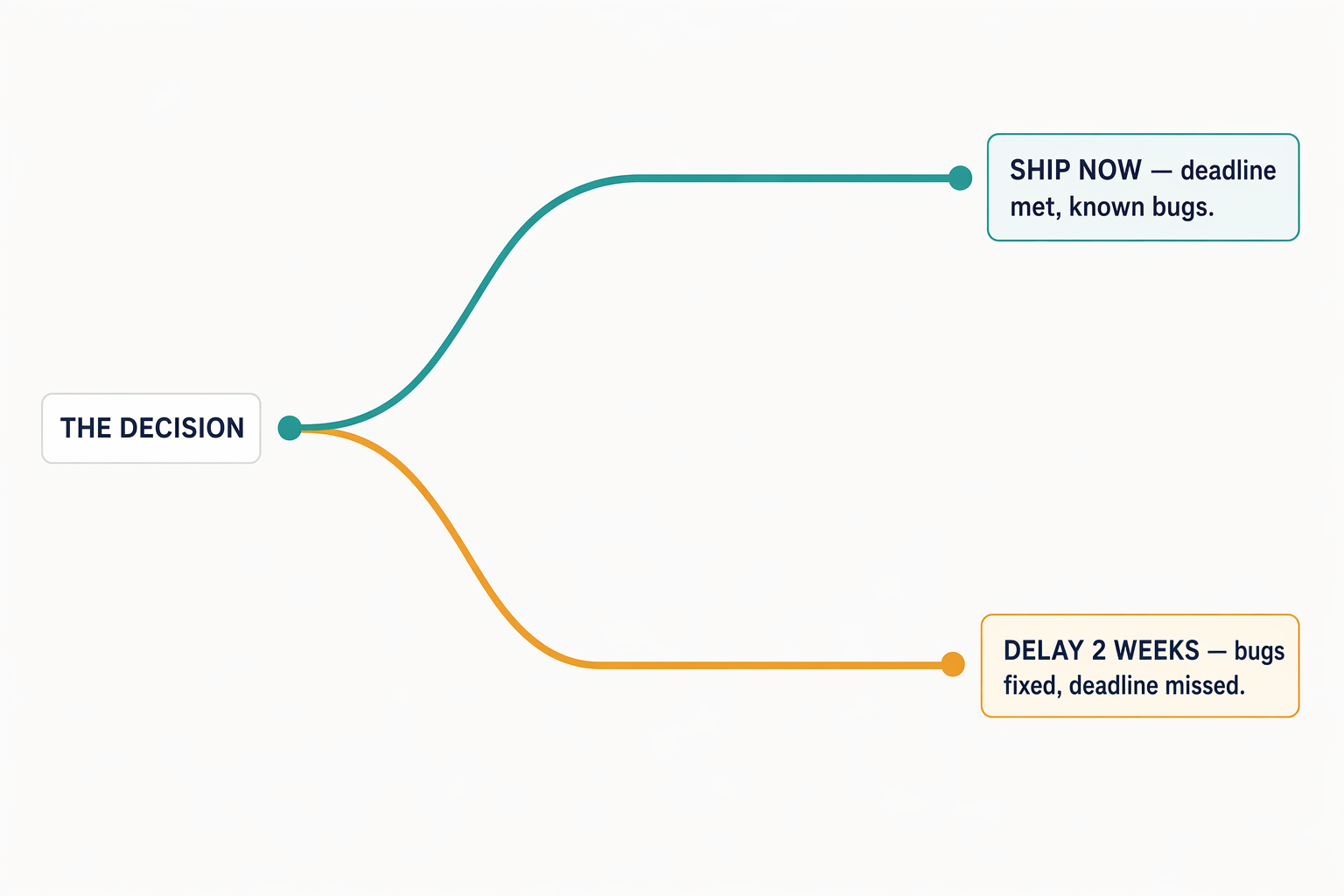
- Speed vs. quality — shipping now with known limitations vs. delaying for a fix, when both have a real cost.
- Loyalty vs. process — advocating for a struggling teammate vs. following a performance policy that affects the whole team.
- Short-term result vs. long-term trust — hitting this quarter's number in a way that could cost a client relationship later.
- Following instructions vs. raising a concern — going along with a manager's call vs. escalating a disagreement you believed was a real risk.
Notice none of these have an obviously "correct" side. That's the point.
Building the Answer With STAR
Once you've got a story that passes the diagnostic, the STAR method keeps it from turning into a rambling narrative:
- Situation — enough context to understand the stakes, in one or two sentences. Don't over-explain the org chart.
- Task — what decision was actually yours to make, and by when.
- Action — what you weighed, who you consulted, and why you chose what you chose — this is the part interviewers actually care about, not just the final call.
- Result — what happened, quantified if you can (time, cost, retention, a metric that moved), plus what you learned or would reconsider.
The Action step is where most answers go thin. Don't just say "I considered the pros and cons" — name the actual trade-off. "I chose to delay the launch two weeks, which meant missing a marketing deadline we'd already announced, because shipping known billing bugs risked real customer trust" tells the interviewer far more than "I weighed the risks and decided to delay."
Handling Live Pushback
Here's what separates a good answer from a great one, and what almost no prep guide covers: what happens when the interviewer doesn't just nod and move on, but pushes back.
Common follow-ups to expect:
- "What if you'd chosen the other option?"
- "How do you know that was the right call?"
- "Did anyone disagree with you at the time?"
The instinct is to defend your choice as obviously correct. Resist it. The stronger move is to name what you'd have gained from the other path, then explain — briefly, without hedging into indecisiveness — why you still weighed it as the better call given what you knew at the time. Something like: "If I'd shipped on schedule, we'd have hit the announced date and avoided an awkward customer email — that's real. But we'd have shipped a billing bug to paying customers, and I judged that trust cost as bigger than the schedule cost." That's a senior answer. "I was confident it was right" is not.
If someone genuinely disagreed with you, say so. Interviewers already assume decisions worth telling a story about had real disagreement attached — pretending everyone agreed with you instantly usually reads as less credible, not more.
When You Freeze and Can't Pick a Story
The scenario that opened this article — running through options and rejecting all of them mid-interview — happens to almost everyone at some point, especially in a live loop where you've already used your best story on a different question. The freeze itself isn't the problem; not having a fallback structure is.
If you're preparing with a real-time interview copilot like AceRound, one practical use is exactly this moment: when you blank on which story fits, a live prompt that surfaces the STAR shape and a couple of matching example categories (speed-vs-quality, loyalty-vs-process, and so on) can be enough to unstick you and pull the right memory forward — rather than you improvising a story that doesn't actually pass the difficulty test under pressure.
Two Sample Answers That Pass the Test
Tech lead: "As a tech lead, I had to decide whether to launch a new feature on schedule with two known edge-case bugs, or delay two weeks past a date we'd already told customers. Shipping meant hitting the date but risking a bad first impression for anyone who hit those bugs; delaying meant fixing them properly but breaking a public commitment. I chose to delay, sent a direct email explaining why, and used the extra time to also fix a third bug QA found. We shipped clean, and the account team told me two enterprise prospects specifically mentioned the transparent email as a reason they trusted us. If I'd shipped on time, we'd have hit our date, but I judged the trust cost of a buggy public launch as higher."
Operations lead (non-tech): "I managed a team of eight, and one of my strongest performers was consistently missing a process step that mattered for compliance, not just style. Enforcing the exact policy meant a formal write-up that could affect her bonus eligibility; going easier meant protecting someone the team relied on but creating an inconsistency I'd have to explain if anyone else was written up for the same thing. I chose to follow the policy, but paired it with a private conversation acknowledging her overall contribution and a plan to fix the gap. She was frustrated initially, but six months later she was the one flagging the same issue in a teammate's work — which told me the consistency mattered more than I'd worried it would going in."
Both of these pass the diagnostic: in each, a reasonable manager could have made the opposite call. That's what makes them worth telling.
Frequently Asked Questions
What's the most difficult decision you've ever had to make? The strongest answers pick a moment with two genuinely defensible options — where a reasonable person could have argued for either side — rather than a hard task with an obviously correct outcome. If you can't imagine defending the opposite choice, the story isn't difficult enough for this question.
What's the hardest decision you've ever made at work? Frame it around real competing stakes: something or someone had a cost either way (a deadline, a relationship, budget, or a person's role), not just a technically demanding task. Use STAR to structure it, and be ready to explain what you'd reconsider if the interviewer pushes back.
What type of decisions are the most difficult for you to make? This variant asks for a pattern, not a single story. A credible answer names a specific category (e.g., decisions that trade short-term results for long-term trust, or ones with incomplete information under time pressure) and backs it with one example — not a vague "I don't like conflict."
Can you describe a time you had to make a difficult decision as a manager or supervisor? Manager-track questions want to see how you weighed the impact on people, not just the outcome. Name who was affected, what trade-off you accepted, and how you communicated the decision afterward — interviewers are listening for accountability, not just a good result.
Tell me about a tough choice you've had to make in the last year This is a recency-check phrasing of the same question. Have a second, more recent example ready in case the interviewer specifically rules out your go-to story from several years ago — it also signals you're still facing real decisions in your current role.
Author · Alex Chen. Career consultant and former tech recruiter. Spent 5 years on the hiring side before switching to help candidates instead. Writes about real interview dynamics, not textbook advice.
Related Articles

How Do You Handle Ambiguity? The Interview Answer That Actually Works
Answer 'how do you handle ambiguity' with a Clarify-Frame-Decide-Communicate framework, plus sample answers for tech, consulting, and startup roles.
Tell Me About a Time You Had to Learn Something Quickly: A Real Answer
"Tell me about a time you had to learn something quickly" tests learning agility, not memory. STAR structure, real examples, what to say when you blank.
What Would You Do in Your First 90 Days? A Better Way to Answer
"What would you do in your first 90 days?" The generic 30-60-90 day plan template no longer works — here's how to build a live, JD-specific answer instead.