Two Sigma Software Engineer Interview: The Hidden Test Case Problem
Two Sigma's HackerRank OA fails candidates who pass every sample case they can see. Here's how the hidden-test-case gate actually works, round by round.
TL;DR: Two Sigma's software engineering interview runs four to six stages, but the real filter is the second one: a 60-to-90-minute HackerRank OA with two to three hard-difficulty problems (graphs, DP, sliding window). The trap most candidates don't see coming is that passing every sample case shown to you isn't enough — your solution has to clear nearly all of the hidden test cases behind it, and the platform won't tell you which ones failed or why. Brute-force logic that looks correct on the visible samples is the single most common way strong candidates get filtered here. What follows the OA — pair-coding rounds, a behavioral round — is comparatively standard; the assessment is where the process actually gets decided.
You open the Two Sigma HackerRank link expecting a normal coding test, solve both problems, watch every sample case go green, submit — and still don't advance. That's not a fluke. It's the specific, well-documented mechanic of this OA: a small set of visible sample cases sits in front of a much larger set you never see, and your score is graded almost entirely against the hidden set. Most prep guides treat the OA as a footnote before "the real interview." At Two Sigma, it's closer to the opposite — the OA is where the process is actually decided, and the later rounds are comparatively conventional.
What's Actually Watching: The Hidden Test Case Gate
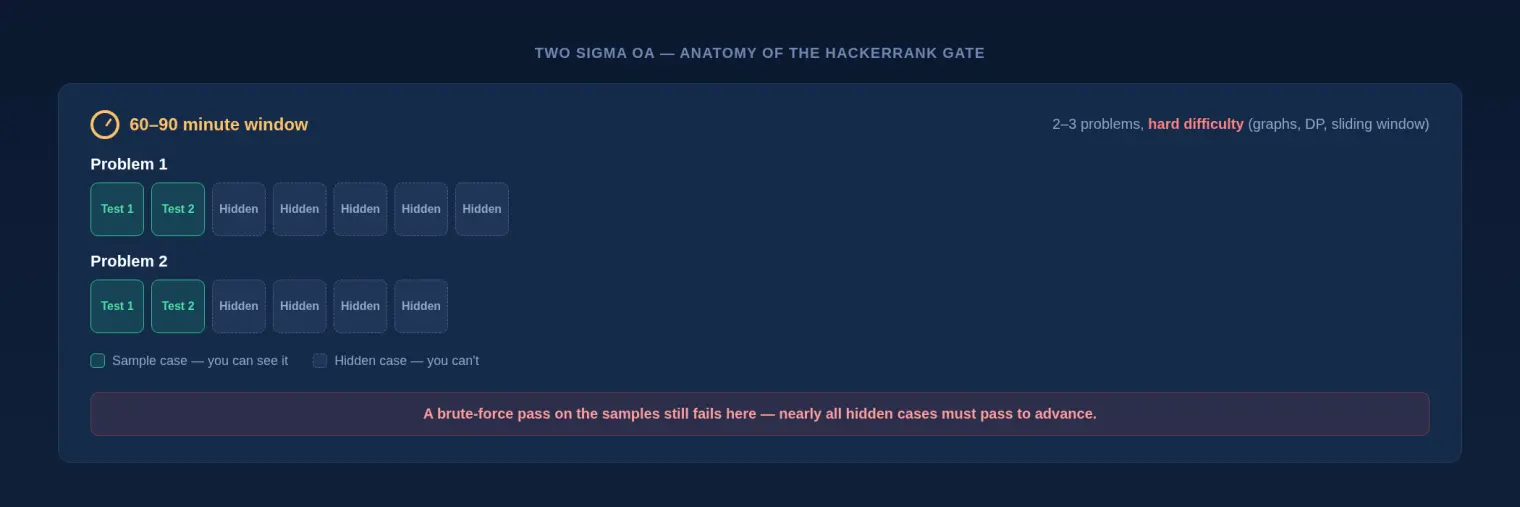
The format itself is simple to describe: a timed HackerRank assessment, typically 60 to 90 minutes, with two to three problems pulled from genuinely hard difficulty — graph traversal (BFS, DFS, Dijkstra), dynamic programming, and sliding-window patterns show up most often in candidate reports. Each problem gives you a handful of sample cases to check your logic against.
The part that catches people is what's behind those samples. Candidate accounts consistently describe needing to pass nearly all of the hidden cases — not just compile cleanly and clear the visible ones — to have the submission count as a real pass. A solution built around the happy path, or one that's technically correct but not fully optimized for the input sizes the hidden cases throw at it, tends to pass every sample you can see and still fail the gate. The assessment doesn't tell you which hidden case broke or by how much, so there's no partial-credit signal to debug against after the fact — you either cleared enough of them or you didn't.
Why This Trips Up Strong Candidates Specifically
This is the detail worth sitting with if you're used to OAs that reward getting a working solution submitted: Two Sigma's hidden-case structure specifically punishes solutions that are correct-but-unoptimized, not just solutions that are wrong. A candidate who writes a working O(n²) approach when the hidden cases are sized to require something closer to O(n log n) will watch their samples pass and their hidden score fail — which reads, from the inside, like an unexplained rejection rather than a specific, fixable gap in complexity analysis.
Here's a concrete, made-up-but-representative version of how that plays out. Say the problem is "shortest path in a weighted graph" and the two samples you can see both use graphs under 20 nodes — small enough that a naive O(V²) Dijkstra without a priority queue finishes in milliseconds and returns the correct answer both times. The constraints line, easy to skim past, says 1 ≤ V ≤ 10^5. The hidden cases are built at that upper bound, where an O(V²) solution takes minutes instead of milliseconds and simply times out — same code, same correct logic, zero credit. The fix isn't a smarter algorithm idea, it's reading the constraints line as a spec, not a footnote, before you write a single line.
The practical takeaway: treat every sample case as a correctness check, not a completion check. Before you submit, ask specifically what input size and edge cases the problem's constraints imply, and whether your solution's time complexity actually holds at that scale — not just whether it returns the right answer on the three cases in front of you.
What Comes After the OA
Once you clear the assessment, candidate reports describe a more conventional structure: one or more pair-coding or technical interview rounds, and a behavioral round evaluating fit. These stages don't carry the same hidden-grading structure as the OA — they're closer to a standard technical conversation, where an interviewer can ask follow-ups and see your reasoning directly rather than grading a black-box submission. That's a meaningfully different skill from OA prep: the OA rewards getting hidden-case-proof code out under a clock with no one watching your process, while the pair-coding rounds reward being able to narrate your thinking to a person in real time.
Two Sigma's own careers page confirms the general technical-plus-behavioral shape of the process without publishing question content, which lines up with third-party candidate reports rather than contradicting them.
Where Practice Actually Helps
The honest limitation first: a 60-to-90-minute timed OA with a hard submission deadline isn't a format built around live outside help during the window in the way a longer take-home might be — the point of the timer is measuring what you can produce solo under pressure, in one sitting. What actually moves your result is deliberate practice beforehand on exactly this failure mode: solving hard-difficulty graph and DP problems, then specifically stress-testing your own solution against large or adversarial inputs before you'd ever consider it "done," the way the hidden cases will — for the OA itself and for the same HackerRank-style hidden-case format at other quant and tech employers, that's the gap AceRound's OA Copilot is built to help you close. If your next step is a live pair-coding round, that's a different skill — narrating your reasoning to a person in real time rather than shipping silent code — and our mock interview mode is built for that stage specifically.
For the format specifics on the platform itself, our HackerRank AI-assisted interview guide covers how the platform's scoring and proctoring work independent of which company is using it.
FAQ
How hard is the Two Sigma software engineer interview?
Harder than a typical FAANG loop at the online-assessment stage specifically. The HackerRank OA runs at genuinely hard difficulty — two to three problems covering graphs, dynamic programming, and sliding-window patterns in a 60-to-90-minute window — and candidates report that a solution passing every sample case you can see can still fail because it doesn't clear the hidden cases behind it. The later pair-coding and behavioral rounds are more standard, but the OA is the stage that filters the hardest.
What is the Two Sigma HackerRank OA like?
A timed, 60-to-90-minute online assessment with two to three hard-difficulty algorithmic problems — commonly graph traversal (BFS/DFS/Dijkstra), dynamic programming, or sliding-window problems. Each problem ships with a small number of visible sample cases and a larger set of hidden ones you can't see, and your score depends on how many of the hidden cases your solution actually passes, not just whether it compiles and runs on the samples.
Does Two Sigma require passing all test cases on the OA to advance?
Candidate reports consistently describe needing to pass all or nearly all hidden test cases to move forward, not just the visible samples. A brute-force solution that clears the samples you can see but times out or fails edge cases on the hidden set is a common way strong candidates get filtered out without realizing why, since the platform doesn't show you which hidden cases failed or how close you were.
How many rounds does Two Sigma have for software engineers?
Reported as four to six stages: a recruiter/background screen, the timed HackerRank online assessment, one or more pair-coding or technical interview rounds, and a behavioral round. The virtual onsite typically bundles three or more hour-long technical sessions once you clear the OA, so the assessment functions as the real gate before the process gets more conversational.
What programming language should I use for the Two Sigma interview?
Two Sigma's HackerRank OA supports the standard set of mainstream languages (Python, Java, C++, and others), and there's no public evidence any one language is scored more favorably. The practical answer is whichever language you can write hidden-test-passing, edge-case-handled code in fastest under a real clock — this is not the round to learn a new language in.
Does Two Sigma use a coding OA for all roles?
The HackerRank-style timed assessment is reported most consistently for core software engineering roles. Two Sigma also hires quantitative research and data roles with different assessment formats, so if your recruiter describes something other than a timed HackerRank test, confirm the specific format for your track rather than assuming this guide's OA details apply directly.
Author · Alex Chen. Career consultant and former tech recruiter. Spent 5 years on the hiring side before switching to help candidates instead. Writes about real interview dynamics, not textbook advice.
Related Articles

Deloitte USI, EY GDS, KPMG GDC, and PwC AC: India Hiring Process Explained
Deloitte USI, EY GDS, KPMG GDC, and PwC AC run four separate hiring processes — HireVue, group exercises, and Eduthrill included — and none of them match a TCS-style aptitude test.
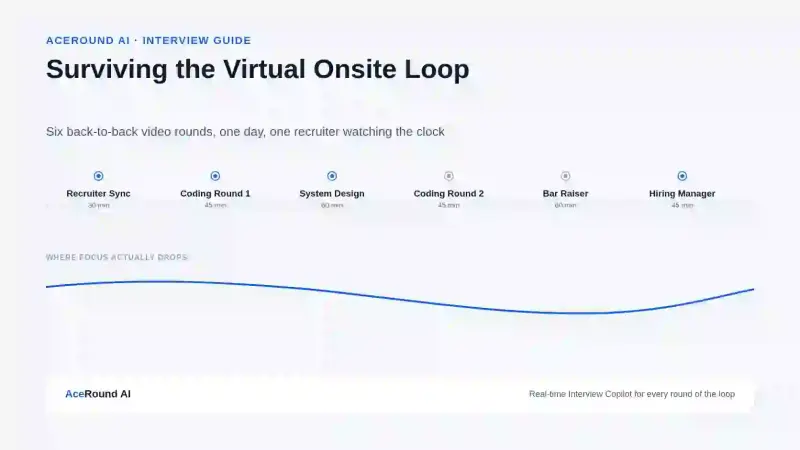
Virtual Onsite Interview Loop: How to Survive 4-6 Back-to-Back Rounds
What a virtual onsite interview loop is, why round 4 is where candidates fall apart, and how to prepare for 4-6 back-to-back video rounds in one day.
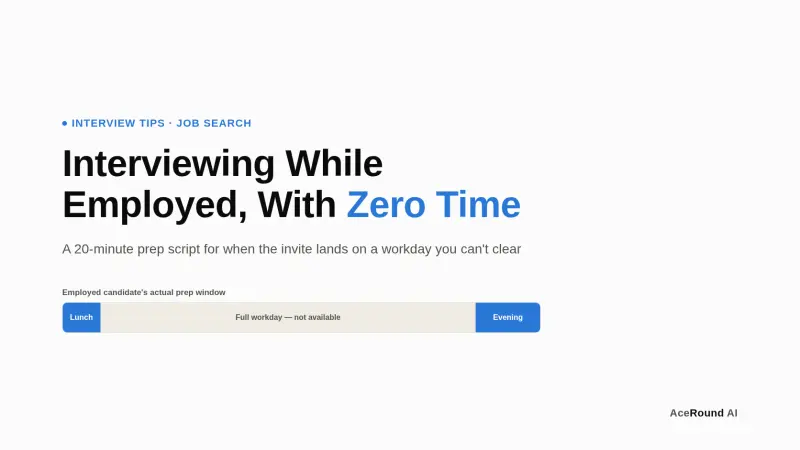
Interviewing While Employed: How to Actually Prepare With Zero Time
Job searching while employed means near-zero prep time, not just staying discreet. Here's a 20-minute prep script, plus what the counteroffer statistics actually show.