How Do You Keep Your Skills Sharp When AI Does the Work?
Interviewers now test whether AI has quietly eroded your skills. Here's a provable answer framework, not a vague 'lifelong learner' line.
TL;DR: "How do you keep your skills sharp when AI does the work?" is a 2026 interview question testing whether you can still perform without the tool, not whether you use it. The strongest answer names one concrete verification habit — a solo-first-draft rule, an explain-it-out-loud test, or a periodic AI-off rep — backed by a specific recent example, not a "I'm always learning" line that could apply to anyone.
A Meta engineer posted on TeamBlind in mid-2026 describing what happened after two years of leaning on AI to write code: "I rarely write any code myself. Just use LLMs to generate code and fix any gaps... no motivation and no need right now but worried it might bite me in a few years." A Google engineer replied in the same thread: "Your brain is getting soft cause it's too easy." An engineering manager on the same platform put the hiring-side version of it more bluntly: "the skill level of the average applicant is in the sewer now" — attributing it directly to candidates who leaned on AI through their formative years and never built the underlying reflexes.
That's the fear behind this question, and it's not paranoia. A Carnegie Mellon and Microsoft Research study found that higher AI reliance correlates with measurably lower self-reported critical thinking. An MIT Media Lab study on essay writing with ChatGPT found AI-assisted writers showed lower brain engagement, weaker recall of their own output, and depressed engagement that lasted months. Interviewers have read the same headlines you have. This question is them checking whether you're the candidate the research is warning about.
What this question is actually testing
Not whether you use AI — by 2026 almost every candidate does, and refusing to would itself be a red flag. It's testing something narrower: if the tool disappeared tomorrow, would your output quality drop a little, or would you be starting from zero?
That's a different question from "how do you use AI in your work," which is about workflow and judgment calls on when to reach for the tool. This one is about whether the underlying competence is still there underneath the workflow. You can give a great answer to the first and still fail this one, because plenty of confident AI-fluency answers have no verification step in them at all.
The trap answers
Three answers sound fine out loud and fall apart under any follow-up:
- "I'm a lifelong learner" — true of everyone who's ever updated a LinkedIn headline. No evidence attached, so it evaporates the moment someone asks "can you give me an example from the last month?"
- "I barely use AI, I still do everything myself" — in 2026, this reads as either untrue or as a productivity problem, not a virtue. Interviewers aren't nostalgic for pre-AI workflows; they're worried about people who've stopped checking.
- A values statement with no mechanism — "I believe it's important to stay sharp" describes an intention, not a habit. Interviewers hear this constantly and it's the easiest tell that someone hasn't actually thought about the question before walking in.
A framework that survives follow-up questions
The fix is the same in every version of this answer: name one specific, repeatable habit that would still be true of you next month, then give one real instance of it.
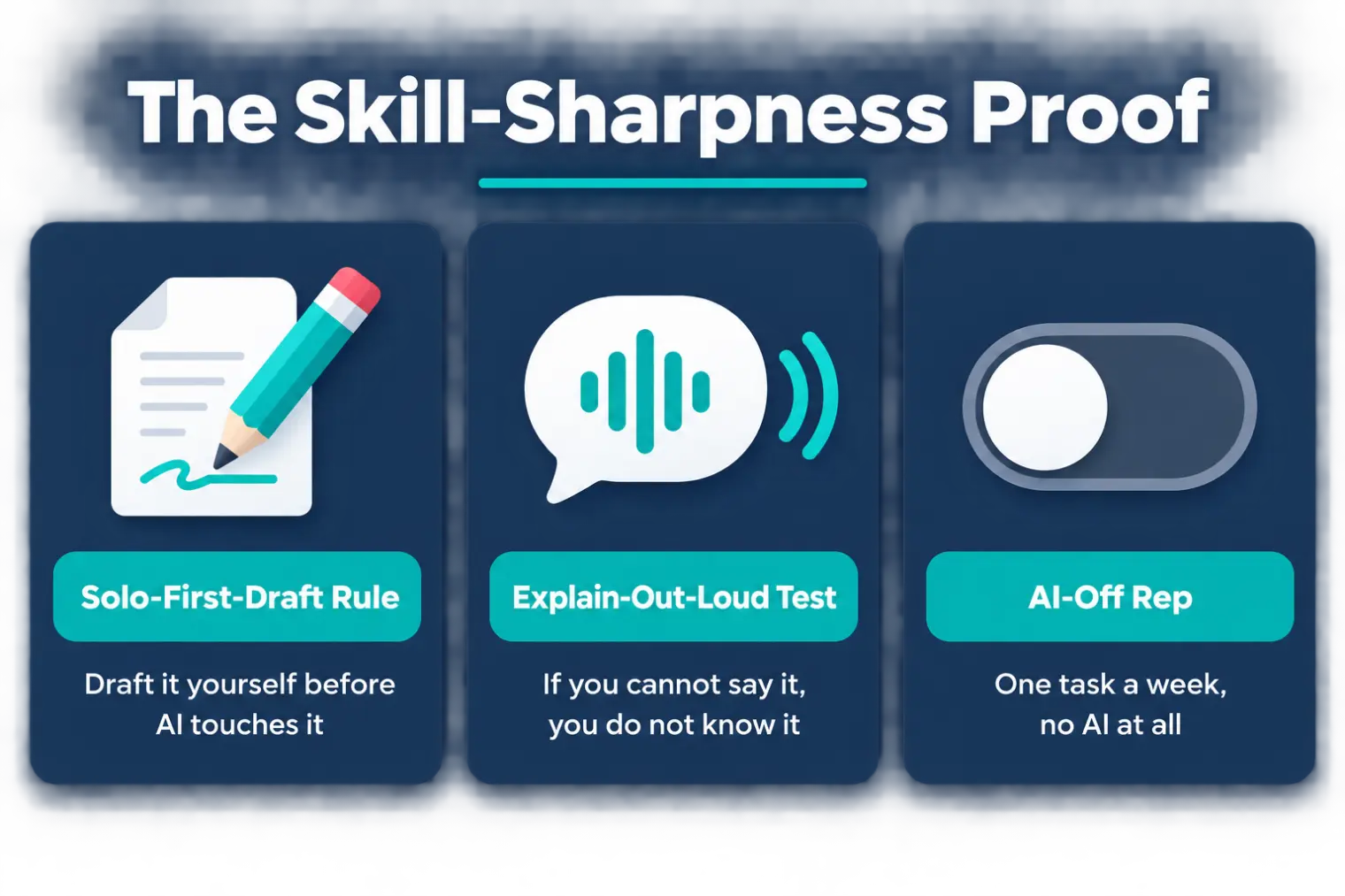
1. The solo-first-draft rule
Pick one recurring task and commit to producing a rough first pass yourself before AI touches it — not because AI can't help, but because the struggle is where the skill lives. "For any estimate I'm putting my name on, I sketch the number myself first, then check it against what the model says. If the two are close, I've confirmed my judgment is still calibrated. If they're far apart, I've caught something worth digging into before either of us finds out I was wrong."
2. The explain-it-out-loud test
Before you ship AI-assisted work, explain it to yourself (or a colleague) without the output in front of you. If you can't, you don't understand it well enough to put your name on it yet. "I had AI draft a technical explanation for a non-technical stakeholder. Before sending it, I made myself walk through it out loud with the doc closed. One part didn't hold up — which meant I didn't actually understand it — so I rewrote that section myself before it went out."
3. The AI-off rep
Once a week or month, do one instance of your core task with the tool switched off entirely, purely as a diagnostic. It's not about being efficient that day — it's about finding out, on a low-stakes task, whether the muscle is still there before you need it on a high-stakes one. "Once a month I take one bug and debug it without any AI assistance, start to finish. It's slower. It's also the fastest way I know to notice if I've started depending on the tool for reasoning I used to be able to do myself."
Pick one, not all three — a single specific habit told well beats three generic ones listed quickly.
Sample answer, put together
"I use AI heavily for drafting and first passes — it's genuinely faster. But I have one rule: anything I'm putting my name on, I do a rough version myself first, before I look at what the tool produced. Last month I was estimating a project timeline. I sketched my own number, then ran it past the model. They were off by almost a week, and digging into why surfaced a dependency I'd missed — the model didn't catch it either, because it didn't have context I had. That gap is exactly what the rule is designed to catch. If I'd only ever seen the model's number, I'd never have known to double-check it."
Notice what's doing the work: a named habit, a specific recent instance, a concrete outcome, and an honest acknowledgment that the tool has real value. That combination is what separates this from the generic "I'm always learning" answer.
Follow-ups to expect
Interviewers who ask this well don't stop at the first answer. Be ready for:
- "When's the last time that habit actually caught something?" — if your answer is "I can't think of a specific time," the habit isn't real yet. Build one before the interview, not during it.
- "What would you do if you didn't have AI access for a week?" — this is testing whether your competence is tool-dependent or genuinely yours. Answer with what you'd still be able to produce, not with how you'd cope without it.
- "How do you know when your judgment and the model's disagree?" — this is really asking whether you're paying attention at all, or just accepting outputs. Having a real story about disagreeing with an AI recommendation is the strongest thing you can bring here.
Where a live interview copilot actually fits
There's an honest tension worth naming: this article argues that leaning on AI without a verification habit erodes skill, and AceRound is a live AI copilot that gives you suggestions during the interview itself. The two aren't in conflict if you're clear on what each one is for. A copilot like AceRound is there to steady your delivery and surface a starting point in the one hour where nerves cost you the most — it's not a substitute for the skill-sharpness habits above, and it was never meant to replace the work you put in before you walked into the room. Treat what it surfaces the same way you'd treat any AI output: a draft to check against what you actually know, not the final answer. If you haven't done the underlying work this article describes, no live suggestion in the room will cover for it under a real follow-up question — and that's also true of how you'd prepare for an AI interview more broadly.
FAQ
Isn't this the same as "how do you use AI in your work?" No, and answering it that way is the most common way people fumble this question. "How do you use AI" is about your workflow and tool fluency. This question is about whether the underlying skill is still there when the tool isn't. You can ace the first question and still fail this one if your answer has no verification step in it.
What if I honestly can't remember the last time I did something without AI? That's worth noticing before the interview, not during it. It usually means you've let the tool make every call by default instead of choosing when to use it. Pick one recurring task, do it solo once this week, and you'll have a real answer instead of a rehearsed one.
Is it a bad sign if I say I use AI for almost everything? Not by itself — most interviewers now assume heavy AI use. What reads badly is heavy use with no verification habit attached. Pair the honest "I use it constantly" with the specific check you run before you trust the output, and the volume stops being a liability.
What's a good example task for the "AI-off" habit if I'm not a software engineer? Pick whatever task in your role has the most "I could explain this to someone in one sentence" value: a marketer drafting a positioning line unassisted before checking it against an AI pass, an analyst building one model from scratch monthly instead of only auditing AI-built ones, a support lead handling one hard ticket without a suggested-reply tool. The pattern matters more than the specific task.
How do I prove I still have the skill without sounding defensive? Lead with the ritual, not with a denial. "I still do X manually because Y" sounds confident. "I promise I haven't gotten worse" sounds like you're arguing with an accusation nobody made. State your practice, then let the follow-up questions confirm it.
Author · Alex Chen. Career consultant and former tech recruiter. Spent 5 years on the hiring side before switching to help candidates instead. Writes about real interview dynamics, not textbook advice.
Related Articles
OpenAI's AI Interview Policy: Banned, Required, or Team-Dependent
OpenAI sells AI coding agents, then bans most candidates from using one. Here's the round-by-round policy, including the new agentic round that flips it.
Does Harver Detect Cheating? What Its Proctoring Actually Checks
Does Harver detect cheating on its pre-employment assessments? A candidate look at Harver's Proctoring add-on, what gets logged after a flag, and what happens next.
Micro1's Zara AI Interview: What It Actually Tests (And Why Timing Gets Flagged)
Micro1's AI interviewer Zara has run 300,000+ interviews for remote roles. Here's why it flags response latency as a cheating signal, and what that means for AI prep.