Interviewing While Employed: How to Actually Prepare With Zero Time
Job searching while employed means near-zero prep time, not just staying discreet. Here's a 20-minute prep script, plus what the counteroffer statistics actually show.
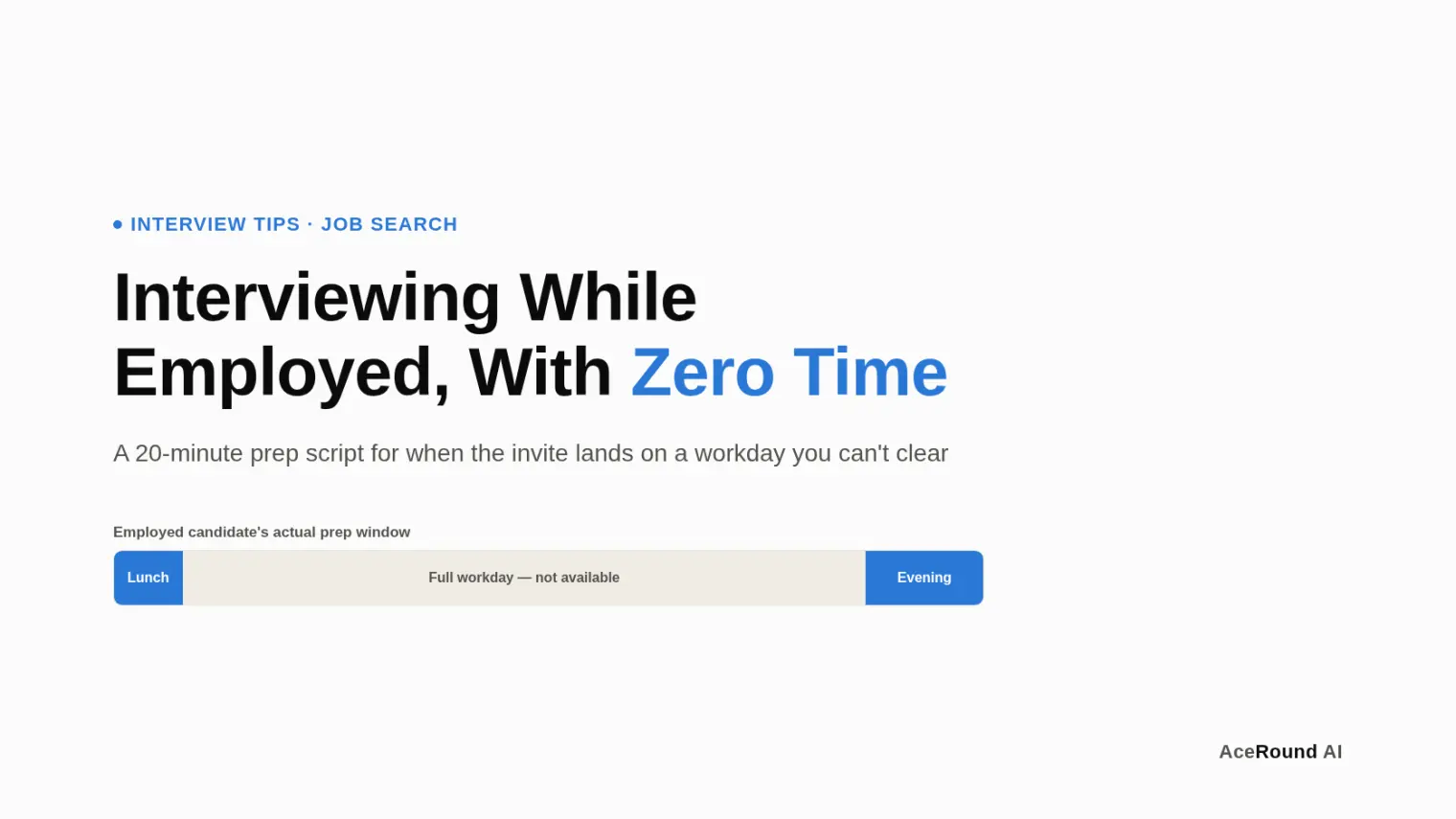
TL;DR: Staying discreet during a job search is a solved problem — the checklist hasn't changed in a decade. What's actually hard is that you'll get a real interview slot with almost no runway to prep for it. Robert Half's late-2025 survey put 38% of U.S. employees planning a search, and Huntr's Q1 2026 data shows employed candidates converting to interviews at 4.19% — barely behind the 4.39% rate for people laid off in the last three months. If you get the call, you're not the exception, and neither is the time crunch.
You've got a 2pm call on your calendar labeled "team sync" that's actually a screening interview, and you found out yesterday afternoon. You can't clear three hours to research the company and rehearse the way you would between jobs — you have a 1pm meeting that'll run long and a Slack channel that doesn't stop. Most advice about job searching while employed stops at "keep it discreet." It skips the part that actually determines how you do: you're interviewing on the prep time of someone with a full-time job, because you have one.
The Discretion Part Is Already Solved
Ask a Manager's Alison Green has run the same core guidance for over a decade, refreshed again in February 2026, because the failure modes haven't changed: turn off LinkedIn activity broadcasts before editing your profile, don't job-search from a company device or network, take calls where coworkers can't overhear, skip posting your resume on public boards your own employer might search, and put interviews at the start or end of the day instead of midday — a pattern of unexplained absences is the actual tell, not any one slip. None of this is new, and it isn't where people actually get tripped up.
Where People Actually Get Tripped Up: Zero Runway
An unemployed candidate who gets an invite can spend the next three days on research and rehearsal. An employed candidate gets the same invite and has to fit that prep into whatever's left after a full workday — and per Huntr's numbers above, you're about as likely to land the interview either way. The gap isn't in getting the call. It's in what you can do with the hours before it.
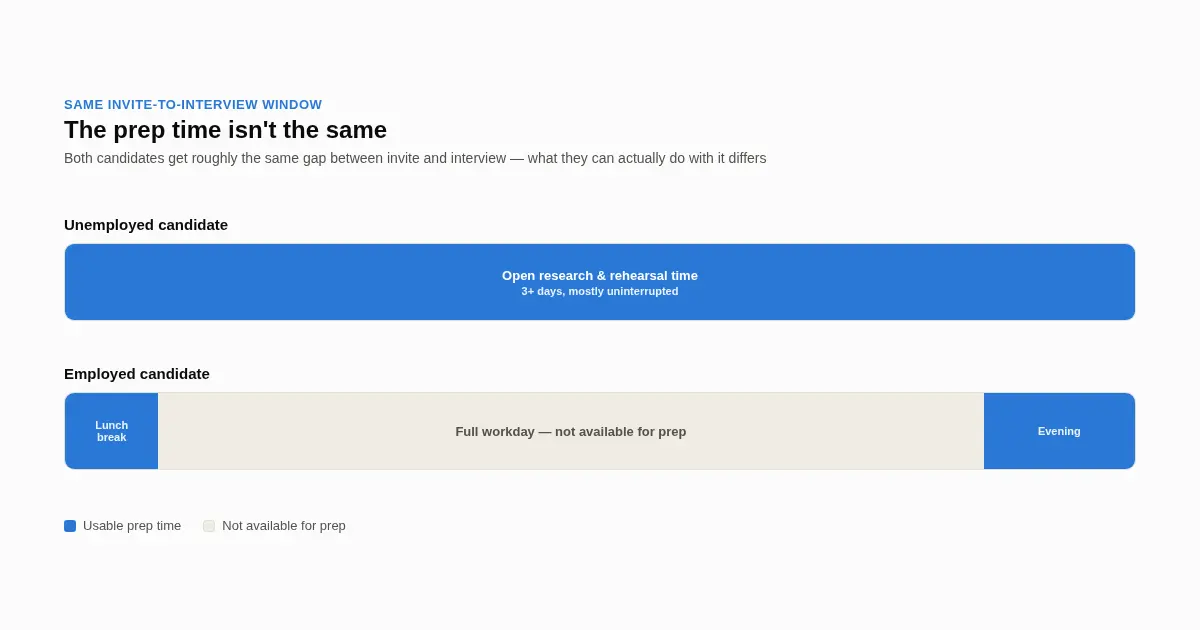
If your entire prep window is one lunch break, this is the split that holds up:
- 5 minutes — confirm the format and who you're meeting, from the calendar invite and a quick LinkedIn glance
- 5 minutes — skim the company's most recent news or product launch, not their whole site
- 10+ minutes — say your two or three strongest stories out loud, not silently in your head
That last one is the part people skip, and it's the one that matters most. Reading a story silently doesn't expose where you'd actually stumble on a follow-up question; saying it out loud does. If you only rehearse one thing, rehearse the follow-up, not the story itself. Interviewers rarely stop at your first answer — they push on it — and the questions that come back tend to repeat across companies:
- "What would you have done differently?" — pick one real thing, not a fake flaw dressed up as a strength
- "Walk me through why you made that call specifically." — have the one-sentence reason ready, not the whole timeline
- "How did the team react?" — this is the one people go silent on, because most story prep stops at the decision, not the aftermath
A story you can only tell once, start to finish, isn't rehearsed. A story you can enter and exit from any of its follow-up questions is.
The Counteroffer Question, Answered Honestly
If your search gets far enough that your employer finds out — by accident, or because you use the offer as leverage — you'll likely get a counteroffer. The number everyone quotes here (something like "80% of people who take a counteroffer leave within a year anyway") turns out not to hold up. A recruiter named Ken Davies spent years trying to trace that figure to an actual study and came up empty — no dataset, no named source, just the same claim recirculating as 48%, 66%, 80%, 89%, and 93% depending on who's repeating it that week. The one number that does trace back to something real is CEB (now Gartner) research cited in a 2016 Harvard Business Review piece: roughly 50% within 12 months — about half the folklore version, and still not gospel.
The more useful question isn't which percentage to believe. It's why you started looking. iHire's 2025 Talent Retention Report found the top reasons people leave are a toxic environment (26.8%), poor leadership (24.2%), and a bad manager (22.8%) — and a raise doesn't touch any of those. If your reason was compensation specifically, and the counter genuinely brings you to market rate with nothing else broken, that's a real, defensible case for staying. If your reason was your manager, your workload, or how you're treated, the money changes nothing about who you report to on Monday.
FAQ
How do I job search without my current employer finding out?
Turn off LinkedIn activity broadcasts before touching your profile, don't search from a company device or network, and put interviews at the edges of the day rather than midday — a sudden cluster of unexplained absences is what actually gets noticed, not any single tell on its own.
Can I get fired for interviewing for another job while employed?
Most U.S. states are at-will, so technically yes, though it's rare in practice. The far more common cost is a manager who quietly pulls you off good projects once a search leaks — which is the real reason to stay discreet, not the unlikely termination scenario.
Should I take a counteroffer from my current employer?
Depends entirely on why you started looking. If it was purely underpayment and the counter genuinely matches market rate, that's a real, defensible reason to stay. If the reason was your manager, your workload, or how you're treated, a raise doesn't touch any of that — and that's the split worth checking honestly before you answer.
What exactly do I say when I tell my manager I'm resigning?
Keep it short and forward-looking: state the decision as final, give your last day based on standard notice, and offer to help with the handoff — don't open it as a negotiation or explain the whole backstory. "I've accepted another offer and my last day will be [date]; I want to make the transition as smooth as possible" does the job in one sentence.
How do I explain a sudden PTO day to coworkers without raising questions?
You don't owe an explanation beyond "personal day" or "appointment" — the mistake is over-explaining, which is what actually invites follow-up questions. One clean phrase said once and not repeated draws less attention than a vague excuse you have to keep track of.
Is it risky to use PTO for interview days?
Less risky than a string of vague sick days or "doctor's appointments," which pattern-match to a job search faster than people expect. A single PTO day barely registers; what draws attention is a sudden cluster of midday absences, so spread interview days out if you can.
If you want to rehearse the out-loud part before the real thing, AceRound AI runs short, timed mock sessions built to fit into a lunch break rather than an open afternoon.
Author · Alex Chen. Career consultant and former tech recruiter. Spent 5 years on the hiring side before switching to help candidates instead. Writes about real interview dynamics, not textbook advice.
Related Articles
CTC Negotiation for Freshers in India: What's Actually Negotiable
Most fresher CTC negotiation advice ignores that TCS, Infosys, and Wipro set fixed pay bands. Here's what's really negotiable, and where lowball offers hide.
Service-Based or Product-Based? Deciding When You Have Both Live at Once
TCS offer in hand, product company interview next week — here's the actual decision framework, not another generic service vs product comparison table.

Attending Job Interviews While Serving Notice Period in India
The real logistics of interviewing for your next job while still clocking in at your current one — notice period math, buyouts, and where prep time goes.