Surviving Multiple Placement Drives in the Same Week: A Fresher's Guide
Three companies, one week, overlapping OAs and interview slots. Here's how to prioritize drives, protect your offer, and actually prep for all of them.

TL;DR: During peak placement season, it's normal for two or more company drives — each with its own OA and interview rounds — to land in the same week. Most prep advice is written per-company and assumes you're only juggling one process at a time. The real skill this season tests is triage: knowing which drives to actually prep hard for, which offer rules your college enforces (one-job policies, Dream/Day 1 distinctions), and how to keep enough energy for drive four when drive one was Monday morning.
Most placement prep content is organized by company — how to crack the TCS NQT, what Infosys actually asks, how Capgemini's assessment works. That's useful once you know which drive you're prepping for next. It says nothing about the week where three of those drives land back to back, which is exactly what Phase 2 (October–December, the mass IT-services hiring window) tends to produce at colleges running a full recruiter calendar.
What a Heavy Week Actually Looks Like
There's no official industry number for "how many drives per week is normal" — it isn't published anywhere, and treat any specific count you see online as one student's experience, not a rule. What is documented in real placement-policy documents is that colleges often cap how many company slots you can sit for on a single day when the calendar overlaps — a rule that exists precisely because multiple drives landing on the same day is a known, recurring problem, not a rare edge case.
The practical version: during peak weeks, expect an OA on one day, an interview round for a different company on another, and a third company's slot announced with only a few days' notice. Plan your week assuming congestion, not assuming a clean one-company-at-a-time schedule — because the schedule that assumes otherwise is the one that leaves you cramming for Wednesday's interview at 1am after Tuesday's OA ran long.
The Rule Nobody Explains Until You're Already Placed: One Offer, One Job
This is the single most consequential thing to understand before placement season starts, not after: most colleges run some version of a "one student, one job" policy. Once you accept an offer — even from a mass-recruiter Day 1 drive — you're typically barred from sitting for further mass-recruiter drives. What most colleges preserve is an exception for a genuine Dream or Super Dream company attempt, where "dream" is defined by your specific college's placement policy, not by student consensus. Some define it as a fixed CTC bar (a package clearing roughly ₹10 LPA shows up as a common threshold, though this varies a lot by institute); others define it as beating your current accepted offer by a set margin.
This matters because it changes the actual decision you're making at a Day 1 drive: it's not just "do I want this offer," it's "am I willing to trade away my shot at every other mass-recruiter drive this season for it." Read your own college's placement policy document for the actual definition you're bound by — not a senior's summary of it, and not this article.
Can You Reject an Accepted Offer and Sit Elsewhere?
Legally, the offer letter is a contract between you and the company — but in practice, placement cells sit in the middle of this and actively police it, because reneging without going through them risks the college getting blacklisted by that employer for future batches. That's the real stake, and it's why "just don't show up" is bad advice: it can cost the students after you their shot at that company entirely. If you're genuinely considering walking away from an accepted offer for a better one, the placement office is the first call, not the company's HR.
Triage: Which Drives Actually Deserve Your Prep Time
When three drives are stacked in one week, treating them all as equally worth full prep is how you end up mediocre at all three instead of strong at the one that matters most. A workable way to split effort:
- Drives you're only sitting for because everyone is (low personal priority, high volume, likely to overlap heavily with drives you actually want): light prep — enough to not embarrass yourself, not enough to eat into prep time for something you care about more.
- Your realistic best offer this week: full prep — company-specific OA format, technical fundamentals it actually tests, and the interview-round structure.
- A genuine stretch/Dream attempt: worth disproportionate prep time even if it's a long shot, because it's the one category your one-job policy likely still lets you attempt after you're placed — so it's not a use-it-or-lose-it slot the way a mass-recruiter drive is.
When Two Slots Actually Collide
Scheduling collisions — two OAs at the same time, or an interview slot that overlaps a different company's test window — do happen, especially in weeks with three or more drives. There's no guaranteed fix: some placement cells can negotiate a reschedule with one company if you flag the conflict the moment slots are announced, but neither company is obligated to accommodate it. The only actionable habit here is speed: check your slot times as soon as they're published, not the night before, so a real conflict reaches your placement officer while there's still time to do something about it.
A Week-by-Week Way to Structure a Heavy Stretch
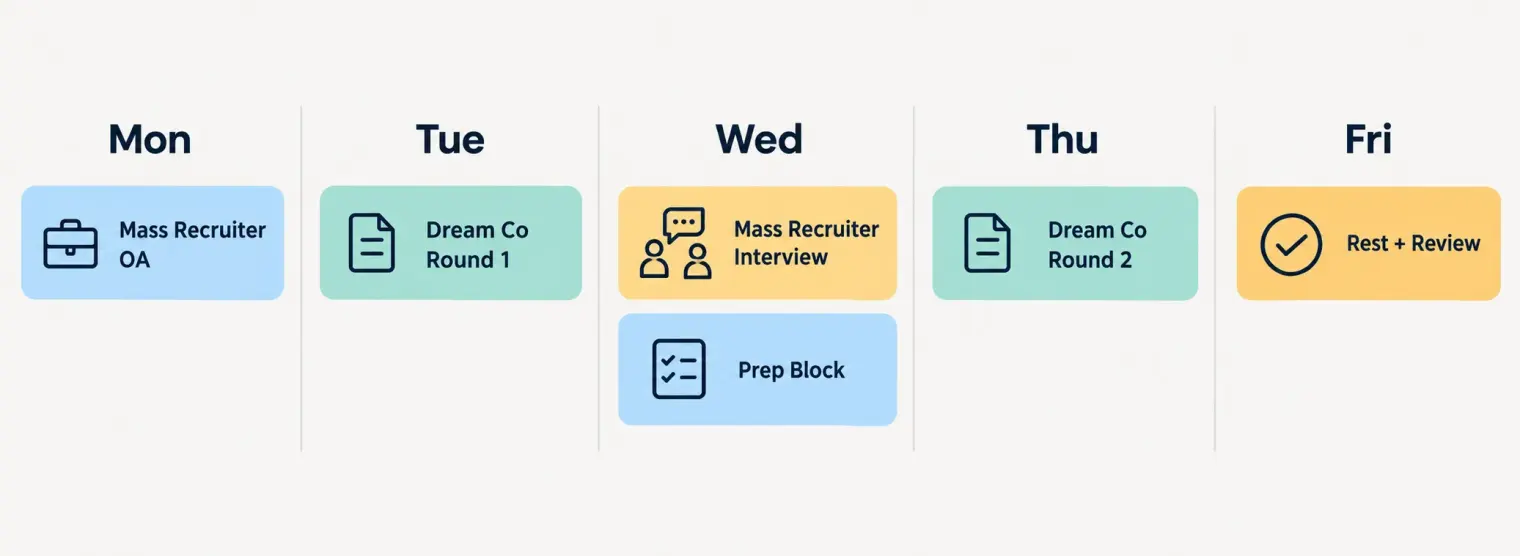
Before the season gets heavy: build a base layer of prep that transfers across companies — DSA fundamentals, aptitude speed, one language you're genuinely fluent in — so no single week starts from zero.
The week a heavy stretch actually lands: front-load light prep for your lower-priority drives earlier in the week so your best energy on interview days goes to the company you actually want. Block real recovery time after a demanding OA or interview day rather than moving straight into the next drive's prep — a tired attempt at your best-fit company is a worse trade than a slightly under-prepped attempt at a company you were never going to prioritize anyway.
After each drive: a five-minute note on what the test actually asked, win or lose. Formats repeat across batches at the same company — that note is worth more to you next season, or to a junior, than it feels like in the moment.
Where AI Practice Fits Into a Congested Week
The honest constraint first: nothing replaces having done the reading for a specific company's format, and none of the proctored OAs are something you use a tool during. What preparation software is actually useful for in a week like this is compressing prep time, not replacing it — timed practice against a specific OA format so you're not relearning the interface under pressure, and a quick mock interview run-through for whichever drive's interview round is next, rather than one long generic prep session that doesn't map to any of the three companies you're actually facing this week.
That's also the practical reason a single day's access rarely covers a week like this: if Monday is an OA and Thursday is an interview for a different company, you need prep tools available across the whole stretch, not just for one sitting. AceRound AI runs multi-day access options specifically for this — the Coding Test Copilot for OA-format practice and the mock interview mode for the rounds that follow — so the tool is there for drive three on Thursday the same way it was for drive one on Monday, instead of expiring the moment your first OA ends. If you're deciding between service-based companies specifically, our comparison of Capgemini, Accenture, HCLTech, Tech Mahindra, and LTIMindtree's processes is a useful next read for prioritizing which of those to prep hardest for.
FAQ
Can I sit for multiple companies during the same campus placement season?
In most colleges, yes — until you're placed. Once you accept an offer from a Day 1 or mass-recruiter drive, many colleges apply a one-offer or one-job policy that blocks further mass-recruiter drives, though most keep an exception for a genuine Dream or Super Dream company attempt. The exact rule is set by your college's placement cell.
Can I reject a placement offer I already accepted and sit for another company?
Technically the offer letter is between you and the company, but most placement cells require you to route this through them first, and reneging without that step risks your college being blacklisted by that employer for future batches.
What counts as a "dream company" versus a "Day 1" offer?
There's no universal number — it's set per college, sometimes as a fixed CTC bar (commonly discussed around ₹10 LPA, though this varies a lot by institute), sometimes as beating your existing accepted offer by a set margin. Read your own college's placement policy document for the actual definition.
How many company drives happen in a single week during peak placement season?
There's no single official number, but it's common during peak Phase 2 weeks (October–December) for two or more drives to land in the same week. Plan for that congestion rather than assuming drives will be spaced out.
What happens if two company OAs are scheduled at the same time?
This does happen. Some placement cells can negotiate a reschedule if you flag the conflict early, but neither company is obligated to accommodate it — check your slot times the moment they're announced.
Author · Alex Chen. Career consultant and former tech recruiter. Spent 5 years on the hiring side before switching to help candidates instead. Writes about real interview dynamics, not textbook advice.
Related Articles
Interviewing While Employed: How to Actually Prepare With Zero Time
Job searching while employed means near-zero prep time, not just staying discreet. Here's a 20-minute prep script, plus what the counteroffer statistics actually show.
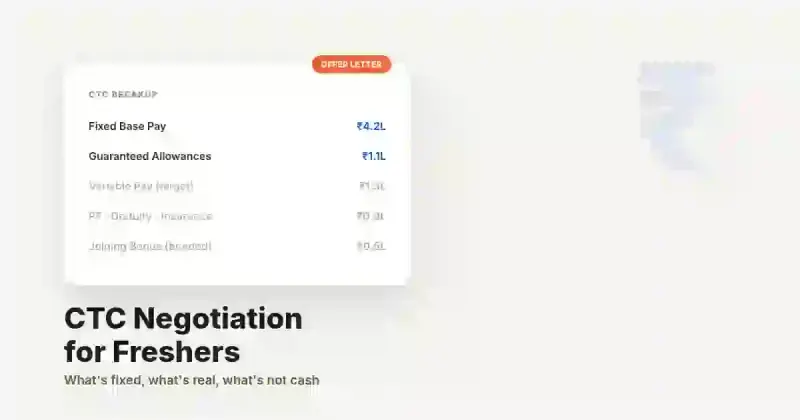
CTC Negotiation for Freshers in India: What's Actually Negotiable
Most fresher CTC negotiation advice ignores that TCS, Infosys, and Wipro set fixed pay bands. Here's what's really negotiable, and where lowball offers hide.
Service-Based or Product-Based? Deciding When You Have Both Live at Once
TCS offer in hand, product company interview next week — here's the actual decision framework, not another generic service vs product comparison table.