Attending Job Interviews While Serving Notice Period in India
The real logistics of interviewing for your next job while still clocking in at your current one — notice period math, buyouts, and where prep time goes.

TL;DR: Most interview-prep content assumes you have unstructured free time — you're a student, or between jobs. If you're a working professional in India interviewing while still employed, the real constraints are different: WFH days get claimed for video rounds, lunch breaks become screening calls, and a single PTO day gets stacked with two or three interviews at once. Layered on top of the usual interview pressure is a second, quieter one — not getting caught mid-search — plus notice-period math (90 days is standard at large IT-services firms, shorter at product companies and startups) and a CTC negotiation you're often navigating solo. None of that is a performance problem you can fix by studying harder. It's a logistics problem, and it's worth planning for as one.
Most placement and interview-prep content is written for someone with time to spend — a student between semesters, or a candidate who's already left their last role. If you're one of the many Indian professionals interviewing for a new job while still fully employed at your current one, that content quietly assumes away your actual constraint: you have maybe 20 to 40 minutes of real prep time before most rounds, not a free evening, and you're doing all of it without your current employer noticing.
The Notice Period Math Nobody Explains Up Front
Notice periods in India are entirely contractual — there's no statutory law fixing the duration, just whatever your offer letter says, operating under the general framework of the Indian Contract Act. In practice, the length tracks company type and seniority fairly consistently: large IT-services employers (TCS, Infosys, Wipro, HCLTech, Tech Mahindra) commonly require 90 days for experienced hires, product companies and MNCs (Google India, Microsoft India, Amazon India among them) typically run shorter at 30 to 60 days, and startups or smaller firms often sit at 30 days. It also scales with your own seniority — early-career roles tend toward 30 days, 2-to-7-year experience bands toward 60 to 90, and management-level roles are almost always at the top end.
If you want to leave before serving the full period, a buyout is the usual mechanism: most employers calculate it as your monthly CTC divided by either 26 working days or 30 calendar days, multiplied by however many days you're short-serving. There's no legal cap on this — it's whatever your contract says — and large IT-services firms are generally described as stricter about actually enforcing the full 90 days, particularly if you're staffed on an active client project, compared to startups and product companies, which tend to be more willing to let you buy your way out. A related and less-discussed practice is garden leave — legal in India and common at senior or IT roles — where you're relieved of duties but stay on payroll and contractually barred from joining a competitor or taking other paid work during that stretch. It's worth reading your own offer letter for this clause specifically, since it changes how soon you can actually start somewhere new even after your last working day.
How People Actually Find Time to Interview
There's a consistent pattern in how working professionals in India describe managing this, and it doesn't usually involve dramatic subterfuge. WFH days get quietly claimed for full video rounds. Lunch breaks become 20-to-30-minute screening calls. And rather than repeatedly taking half-days, the more common move is stacking one PTO or personal day with two or three interview rounds back to back, since a single day off draws far less attention than a pattern of Tuesday-afternoon disappearances. None of this requires actively lying about your whereabouts — it requires knowing your own calendar well enough to protect a block of it before your manager or a client fills that slot with something else.
The Part Nobody Warns You About: The Risk Isn't Just Getting Caught
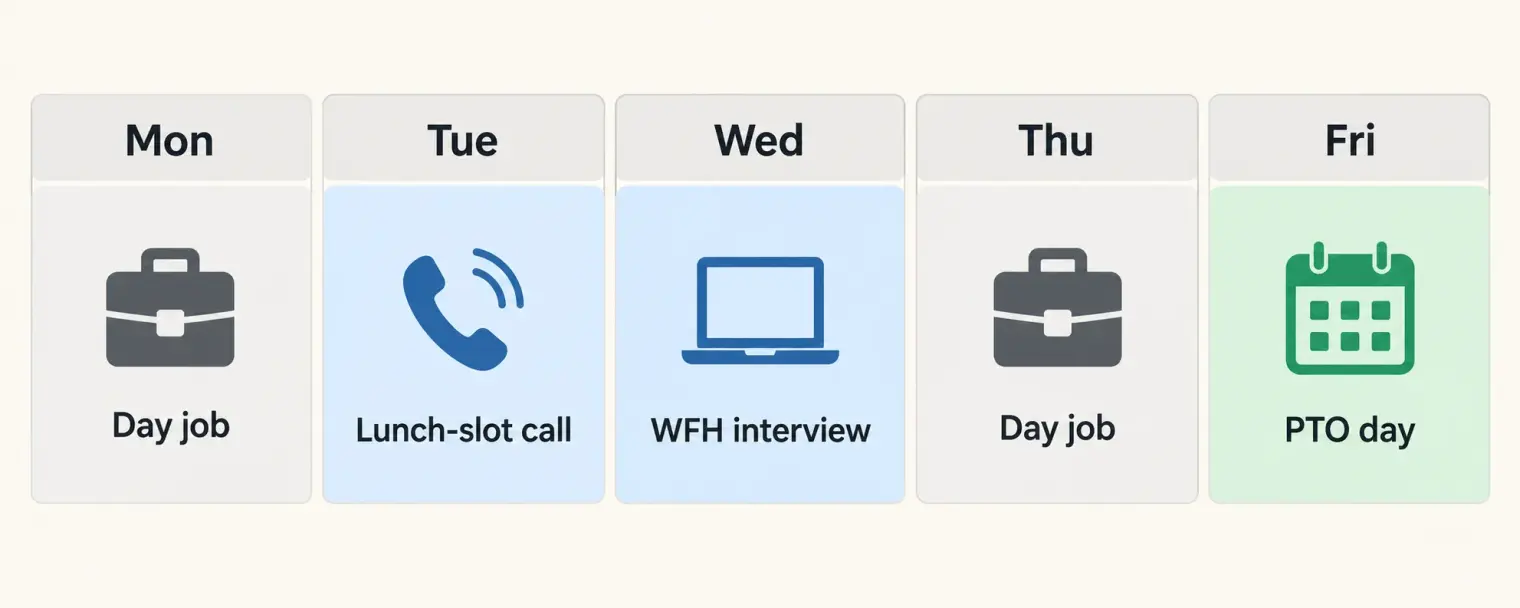
Campus placement content is about performing well in a scheduled, sanctioned event everyone around you knows is happening. This is closer to operating inside someone else's calendar without disrupting it — and the friction points are different from anything a fresher guide prepares you for. A Teams or Slack notification can interrupt a call at any second. Your video background has to not obviously be a stairwell, a parked car, or a meeting room you've booked under a vague name. And there's a real asymmetry some candidates flag: an interview panel keeping their own cameras off while expecting yours on, which reads very differently when you're already managing the stress of being somewhere you're not supposed to be doing this.
The honest reframe here: the anxiety isn't really "will I pass this round" the way it is for a fresher. It's "will I get caught mid-question," stacked directly on top of the actual interview pressure — with a fraction of the prep time a student would have, and zero ability to visibly rehearse an answer out loud at your desk beforehand.
CTC Negotiation Without Oversharing
The advice to never disclose your current CTC is common, and mostly right — but plenty of Indian recruiters still ask directly, and it's worth having a plan for the question rather than being caught off guard by it. The more reliable approach isn't refusing outright; it's leading with the range you're targeting for the new role before the recruiter has a chance to anchor the conversation around your current number. It won't work every time — some processes are structured to require a current-CTC figure before moving forward — but going in with your number ready changes who's setting the terms of that first conversation.
Will LinkedIn Actually Tell Your Employer?
LinkedIn's "Open to Work" feature has a private mode specifically meant to hide the signal from recruiters at your current company. LinkedIn's own help documentation, though, is explicit that this can't be guaranteed — it's a best-effort filter, not a hard technical wall. The safer assumption is that any visible activity on the platform — a profile view, a new connection with a recruiter, updated headline language — is something a colleague could plausibly notice, and worth planning your visibility settings around rather than treating as fully invisible.
Where Real-Time Help Actually Changes the Calculus
The constraint that makes this genuinely different from student interview prep isn't knowledge — you likely know your own work better than any fresher knows a textbook. It's compressed time and zero room to visibly rehearse. You can't run a mock interview out loud at your desk between meetings, and you don't have a free evening to do a proper run-through before a call that got scheduled with two hours' notice. AceRound AI is built as a real-time interview copilot for exactly that kind of live video call, with a mock interview mode you can run through in the small windows you actually have — a lunch break, a commute, the ten minutes before a call starts — instead of needing a block of free time you don't have as a working professional. If a coding round is also part of your process, our guide on product-based company OA formats covers what to expect there, and attending video interviews remotely has more on the logistics side of the call itself.
FAQ
What happens if I don't serve my full notice period?
You typically owe a buyout — most Indian employers calculate this as (monthly CTC divided by 26 or 30 days) multiplied by the number of days short-served, though the exact formula and whether buyout is even allowed is entirely contractual, set by your offer letter, not by any labor statute. Large IT-services firms are generally described as stricter about actually making you serve the full 90 days, especially if you're on an active project, than startups or product companies, which tend to be more flexible about letting you buy out the remainder.
Can I negotiate CTC without revealing my current salary?
You can try, and plenty of career advice tells you to — but in practice many Indian recruiters still ask directly, and some processes are structured around it. The more reliable move is to anchor the conversation on the range you're targeting for the new role rather than volunteering your current number first, and to have that range ready before the recruiter screen, not during it. It won't always work, but it changes who's setting the anchor.
How do people actually find time to interview while working full-time?
The realistic pattern from working professionals: WFH days get used for full video rounds, lunch breaks get used for shorter screening calls, and a single PTO or personal day gets stacked with two or three rounds back to back rather than taking separate half-days repeatedly. None of this requires lying about where you are — it requires knowing your own calendar well enough to protect blocks of it before slots get scheduled around you.
Will my current employer find out I'm job hunting through LinkedIn?
LinkedIn's "Open to Work" setting has a private mode that's supposed to hide it from recruiters at your current company specifically, but LinkedIn's own help documentation is explicit that this can't be guaranteed — it's a best-effort filter, not a hard wall. Treat any activity on the platform, from profile views to connection requests, as something a colleague could plausibly notice, and plan your visibility settings accordingly rather than assuming full invisibility.
Should I request PTO for interviews or just avoid mentioning where I'll be?
There's no universal right answer, but the lower-risk pattern described in professional advice is to take real time off rather than inventing excuses you'll have to keep consistent later — a generic personal day covers you without requiring specifics. The bigger practical risk isn't the excuse itself, it's a scheduling collision: a client call or team meeting landing on top of an interview slot you didn't fully protect.
Do interview processes differ between product companies and IT services firms for experienced hires?
Directionally, yes, though there's no clean published comparison specific to lateral hiring to cite a hard number from. Product and MNC companies more consistently weight system-design and deep technical rounds for experienced candidates; service-based firms tend to weight client-communication and project-delivery questions more heavily alongside the technical round. Round count for a mid-level hire commonly lands around three to five either way — treat the format difference as the more reliable planning signal than the count.
Author · Alex Chen. Career consultant and former tech recruiter. Spent 5 years on the hiring side before switching to help candidates instead. Writes about real interview dynamics, not textbook advice.
Related Articles
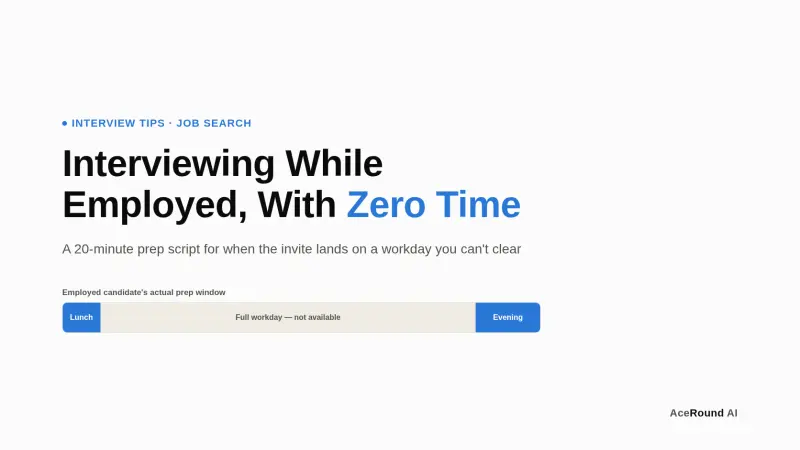
Interviewing While Employed: How to Actually Prepare With Zero Time
Job searching while employed means near-zero prep time, not just staying discreet. Here's a 20-minute prep script, plus what the counteroffer statistics actually show.
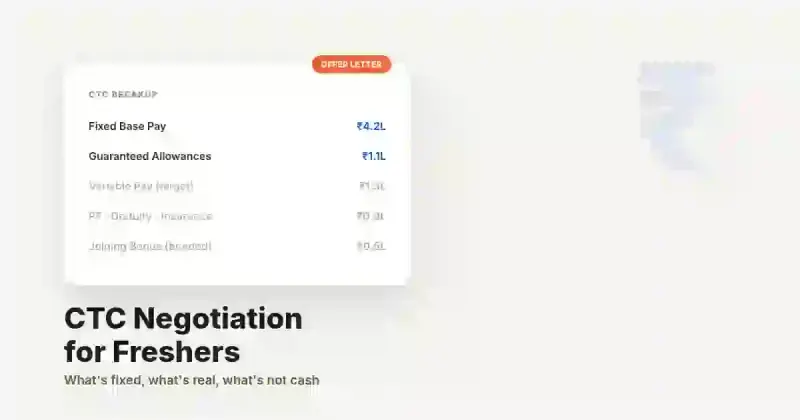
CTC Negotiation for Freshers in India: What's Actually Negotiable
Most fresher CTC negotiation advice ignores that TCS, Infosys, and Wipro set fixed pay bands. Here's what's really negotiable, and where lowball offers hide.
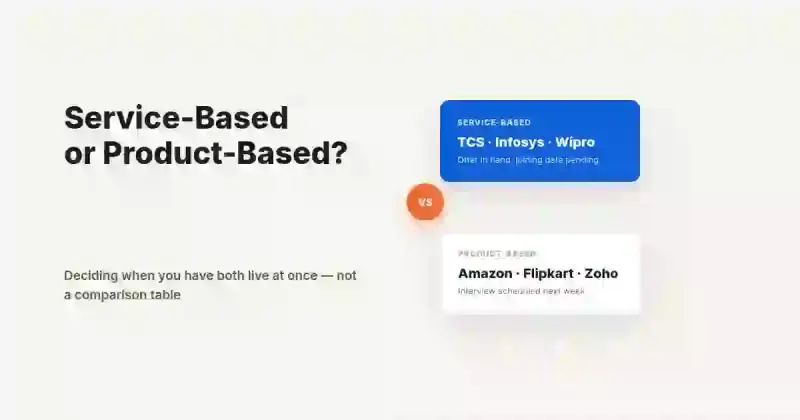
Service-Based or Product-Based? Deciding When You Have Both Live at Once
TCS offer in hand, product company interview next week — here's the actual decision framework, not another generic service vs product comparison table.