Sapia.ai Interview: Is It Safe, and How to Pass It
Sapia's chat interview has no camera or microphone: you type 5-7 answers and an AI scores them. What it records, what gets flagged, and how to pass.
TL;DR: Sapia.ai is a text-only chat interview, not a video call. There is no camera, microphone, or audio/video recording, and only your written answers and optional multiple-choice responses are scored. That makes it safe in the privacy sense most candidates mean, and Sapia backs it with ISO 27001 and ISO/IEC 42001 certification plus a SOC 2 Type II attestation.
Passing it is about substance, not polish. You get five to seven behavioural prompts, 50-150 words is the recommended range, and the interview is untimed. The score covers role-specific competencies, communication, and experience. Lead with what you did, use one real example with a result, and write it in your own words: Sapia's detector is trained on chatbot output, and its own guidance says fluency earns nothing extra.
If you have a Sapia.ai chat interview coming up, two questions tend to come first: is this thing safe, and how do you pass it. Both have specific answers. Sapia is a text-only interview platform used by large employers, there is no camera or microphone involved, and your score is built from the words you type.
The format is simple. You open a link, answer five to seven behavioural questions in a chat window, and submit. Sapia's candidate guide suggests 50-150 words per answer and allows up to 500, there is no timer, and Sapia suggests setting aside 20-30 minutes. You can do it on a phone, save your progress, and come back later.
What follows is what the platform records, how the scoring and AI-content detector work, and the specific moves that separate an answer that scores well from one that reads like a template.
How the Sapia.ai Chat Interview Works
Unlike most AI-interviewer platforms candidates run into - Apriora's live video interviewer Alex, Mercor's screening calls, Ribbon's voice interviews - Sapia's core Chat Interview product has no audio or video component at all. It is asynchronous and text-only. Sapia's product page describes five structured questions with optional multiple-choice items; its candidate guide says five to seven questions.
There is no follow-up question reacting to what you just said, no interviewer nodding along, and nothing to read off a human face. What you write is, in a very literal sense, the entire interview.
Sapia says candidates can answer in the language they are most comfortable in, which matters if the role is bilingual or you are applying outside your first language. The assessment is still scored against the same role criteria for every applicant.
What Sapia.ai Interview Questions Ask, and What Gets Scored
The prompts are standard behavioural territory: a time you handled a difficult customer, a time you disagreed with a decision, a time you had to learn something quickly, a mistake you made and what changed. Nothing exotic. What is different is how the answers get read.
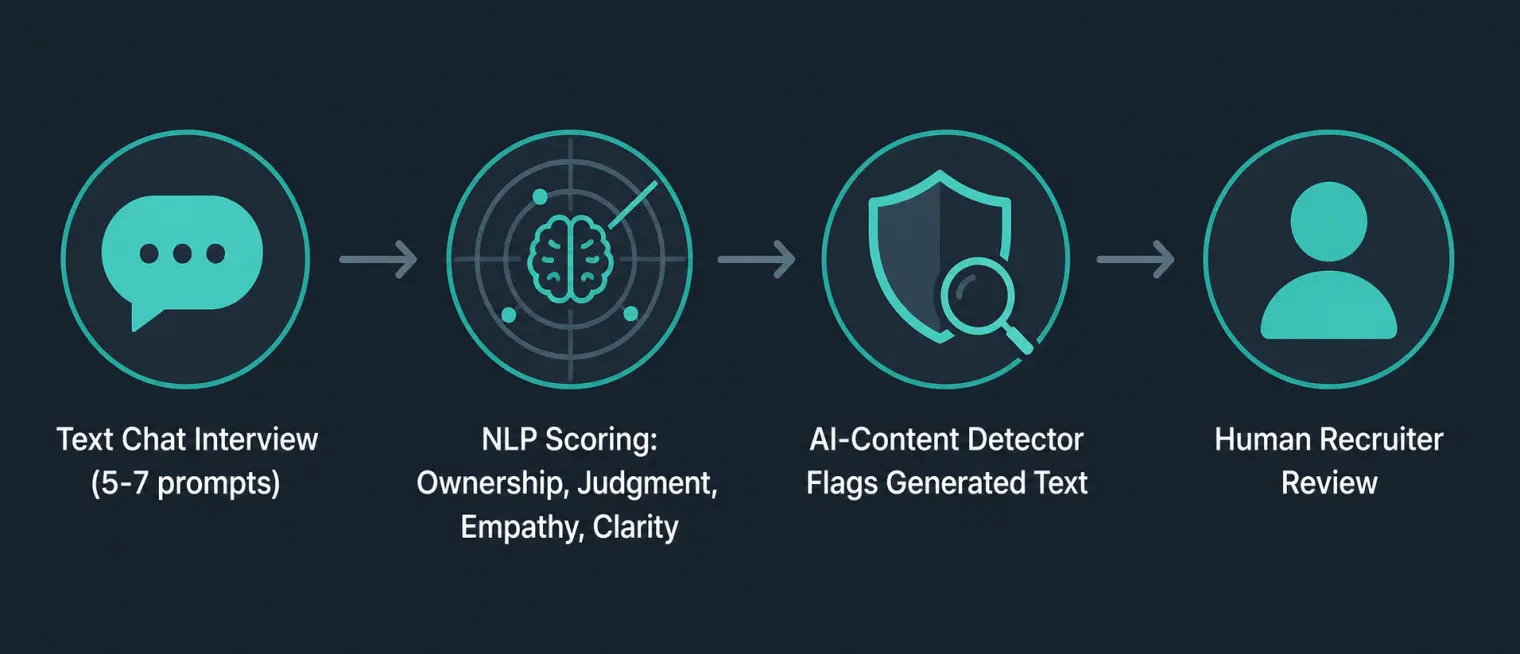
Sapia's product page says each response is scored against a competency model built for that role, covering three things: competencies and soft skills, communication, and experience weighted for the job. Each question is mapped to a competency, and each competency has scoring criteria. In plainer terms, the model is reading whether your answer shows you actually did something rather than watched it happen, whether you understood the human impact, whether you took ownership of the outcome, and whether you can explain it clearly.
That is why generic, textbook-sounding answers tend to score worse. There is less specific evidence to detect. A sentence such as "communication is key" carries no information about what you did; a sentence about the exact words you used with an upset customer does.
Given the word budget, the practical move is to skip the setup most STAR-method answers spend a sentence or two on and get straight to the specific action and outcome. You do not have room for throat-clearing.
Is Sapia.ai Safe? What It Records and Who Sees It
Yes, in the sense most candidates mean. Sapia is a legitimate hiring platform: it says it has been running since 2018 and has interviewed more than 10 million candidates, and its customers include household-name retailers and airlines. The more useful question is what the platform actually collects and who can see it.
Sapia's candidate guide is unusually direct on the recording question: there is no video recording, no camera, and no microphone. Its November 2026 detector announcement adds that there is no eye-tracking and no lockdown browser either. You are assessed on your written answers, and Sapia says its AI does not use sensitive characteristics such as gender, age, or race. It calls the format blind screening: the assessment is based on your words, not your identity.
| What Sapia records | What it does not |
|---|---|
| Your typed answers to the interview questions | Camera or video |
| Your name, email, phone, and location | Microphone or audio recording |
| Optional multiple-choice responses | Eye-tracking or facial analysis |
| Scores against the role's competency criteria | Screen recording or a lockdown browser |
The free My Insights personality profile is generated from your answers, but Sapia says it is for your eyes only and is not shared with the prospective employer. What the employer receives is the assessment: scores, the evidence behind them, and the answers that produced them.
On security, Sapia holds ISO 27001 for information security management and SOC 2 Type II attestation, and in October 2025 it added ISO/IEC 42001, the standard for AI management systems. It states that it complies with GDPR and the UK Data Protection Act 2018, and that its models run on AWS Bedrock with zero data sharing or retention by LLM providers. It also publishes a breach-response commitment on the candidate page.
Two limits are worth knowing. Where EU or UK data protection law applies, Sapia acts as a data processor for the employer, which means the employer's policy governs the application data once it leaves the interview; Sapia's privacy policy explains how to request access, export, or deletion. And "safe" does not mean "consequence-free": your answers are still scored, and the employer still makes the hiring decision. Sapia says it recommends and people decide, and that nobody is rejected automatically by the AI.
What Happens If the AI Detector Flags Your Answer
Sapia has built and repeatedly upgraded an AI-generated-content detector, and the current version is a meaningful step up. In November 2026 Sapia released version 3, which it says catches nearly 97% of AI-written answers from current LLMs, up from 92% for the previous version. It was trained on outputs from OpenAI, Google, Anthropic, xAI, DeepSeek, Moonshot AI, and Alibaba, paired with genuine candidate answers written before ChatGPT existed.
Three details matter more than the headline percentage:
A flag is a nudge, not a rejection. Sapia's stated rule is that three or more flagged answers in one interview trigger a real-time prompt to answer in your own words. Nobody is rejected automatically, and Sapia says AI never makes the final hiring decision.
False positives are rare but real. Sapia estimates that a genuine answer is wrongly flagged around 2% of the time, which it calculates as roughly a 1 in 13,000 chance of an honest candidate being nudged in a five-question interview. Candidates on Reddit have reported being flagged despite writing their own answers, so the estimate is not zero in practice.
Plagiarism is checked separately. Sapia's candidate guide says the interview checks for copied answers from internet sources as well as content generators. An answer lifted from a blog or a template site can be caught even if no chatbot was involved.
If you do get a nudge, the fix is not to argue in the chat box. Rewrite the answer with a detail only you could supply: the name of the system you used, the number of people affected, the exact thing you said, what happened the next week. Specificity is both the thing the detector responds to and the thing the competency scoring rewards.
The practical takeaway is not that any AI tool near this interview is forbidden. It is that pasting a fully generated answer is a poor bet here for a structural reason: the detector exists for this exact format, and Sapia says fluency earns no extra points, so the polish a chatbot adds buys you nothing in the scoring.
The Sapia HEXACO Personality Test: What Your Free Report Means
After you finish the chat interview, Sapia gives you a free My Insights personality snapshot based on the HEXACO model - Honesty-Humility, Emotionality, eXtraversion, Agreeableness, Conscientiousness, and Openness. It is generated through linguistic analysis of your answers, not a separate quiz, and Sapia says there is no right or wrong score on any dimension.
Two things follow from that. First, the report is private: Sapia says it is not shared with the employer, so it cannot help or hurt your application. Second, it is a rough instrument. Some candidates report the summary feeling oddly disconnected from what they actually wrote, which is a fair reaction to inferring personality from a handful of short answers. Treat it as a curiosity you get for your time, not a verdict, and do not spend energy trying to reverse-engineer which HEXACO trait each answer is signalling.
Who Actually Uses Sapia.ai, and What That Means for You
Sapia's public case studies and solution pages centre on retail, contact centres, healthcare, airlines, rail, and graduate recruitment. Confirmed users include Woolworths, Kmart, Big W, David Jones, Holland & Barrett, Starbucks, and Qantas. This is high-volume, frontline hiring, not corporate office screening, and it explains the format: at that scale, a scheduled human phone screen for every applicant simply does not work.
One recurring complaint on Reddit is candidates being frustrated that an AI reviews their answers before any person does. That is a legitimate design choice to sit with, but it is not unique to Sapia - it is the same tradeoff behind HireVue's one-way video screens and every other AI-first-round tool. If it bothers you, it is a fair question to raise with the recruiter, but it will not change how the current round works.
How to Pass a Sapia.ai Chat Interview
The score is not a mystery, and it is not a test of writing style. It is a test of whether your answers contain enough specific evidence of the competencies the role needs. These are the moves that make the difference.
1. Spend your words on the action and the result
Sapia recommends 50-150 words (its tips page suggests 50-100), and a common first draft spends half of that on background. A workable split looks like this:
| Part of the answer | Words | What belongs there |
|---|---|---|
| Situation | 15-25 | One line: where, when, what was at stake |
| Action | 50-70 | What you did, in the first person, step by step |
| Result | 25-35 | What changed, with a number if you have one |
| Reflection | 10-20 | What you would repeat or do differently |
That lands around 100-150 words. The box accepts up to 500, but a longer answer is not a better answer: the scoring is looking for evidence, not volume.
2. Lead with what you did, not the backstory
You do not have room to build up to it. "I checked the card transaction, confirmed the date, and offered a replacement on the spot" beats three sentences about how the customer walked in and what the weather was like. The assessor needs to see your action early, because that is the evidence being scored.
3. Use one example, and put a number in it
One fully developed example beats three half-told ones. Numbers are the cheapest specificity available: how many customers, how many hours, what percentage, how much money, how many people on the team. If you do not have a workplace example, Sapia's guide explicitly allows examples from school, family, friendships, or hobbies.
4. Say "I", not "we"
The competency model is scoring your behaviour, not your team's. "We decided to change the process" tells the assessor nothing about what you contributed. "I mapped the last month of complaints and proposed a two-step return process, which the manager adopted" does.
5. Write it yourself, in your own words
This is the one part of the interview where the detector and the scoring point in the same direction. Sapia's detector is trained on chatbot output, and Sapia says fluency earns no extra points, so a pasted answer carries risk without carrying a reward. The same applies to copying an answer from a blog or a friend: plagiarism is checked separately.
6. Review before you submit, and use the save-and-return option
The interview is untimed, so there is no cost to rereading each answer. Fix typos and grammar, check that you actually answered the question rather than a nearby one, and use the edit pencil to revise earlier answers. If you need to stop, Sapia emails you a link that restores your saved answers.
What a strong answer looks like
Here is a weak answer to "tell me about a time you handled a difficult customer", followed by one that would score better on the same question.
"Customer service is very important to me. I always try to go above and beyond for every customer and make sure they leave happy. In my previous role I dealt with many difficult situations and learned that communication is key. I believe teamwork and a positive attitude are essential."
That answer is grammatically fine and says nothing. There is no situation, no action, no result, and no evidence of judgment.
"A customer came back with a kettle that had stopped working eight days after purchase, and she had lost the receipt. I found the card transaction on the till, confirmed the date, and offered a straight replacement rather than a repair. While I processed it, I asked how she had been cleaning it and found she had been descaling it with vinegar, which had corroded the element. I swapped the unit, wrote the correct cleaning method on the box, and flagged the product note to my manager. She came back the next month and bought the same model for her daughter."
The second answer works because it shows a specific action, a diagnosis, ownership of the fix, and an outcome you can picture. It is also the kind of detail that is hard to produce from a generic chatbot prompt, which is the point.
7. Do not overthink the personality report
The HEXACO snapshot is a byproduct, not a gate, and it is not shared with the employer. Spend your preparation on the behavioural answers, which are what the employer actually sees.
Where AceRound Fits
Sapia's round is typed before you submit, so the leverage is in rehearsal, not in something running live in the chat window. AceRound's mock interview lets you rehearse behavioural prompts like these, see which of your stories compress into 150 words, and get feedback before you are staring at Sapia's word counter for real. New accounts get 30 minutes free.
If a live video or phone round follows the chat interview, the real-time interview assistant covers that format. For the wider category, our guides to Apriora, Mercor, and how to pass an AI interview go deeper.
FAQ
What is Sapia.ai and how does its chat interview work? Sapia.ai is an asynchronous, text-only interview platform used by large employers for high-volume hiring. You answer five to seven behavioural prompts by typing 50-150 words per response, untimed, with no camera or microphone involved. The box accepts up to 500 words per answer, so the range is a recommendation rather than a hard ceiling.
Is Sapia.ai safe to use? Sapia is a legitimate hiring platform: it has been running since 2018, says it has interviewed more than 10 million candidates, and holds ISO 27001, SOC 2 Type II and ISO/IEC 42001. The chat interview uses no camera, microphone, video recording, eye-tracking or lockdown browser; only your typed answers and the details you enter are collected. Your My Insights personality profile is for you and is not shared with the employer. Where EU or UK law applies, Sapia acts as a data processor for the employer, which controls the application and sets the retention policy.
Does Sapia.ai actually detect ChatGPT-written answers? Sapia says version 3 of its AI-content detector, released in November 2026, catches nearly 97% of AI-written answers from current LLMs, up from 92%. It is trained on outputs from OpenAI, Google, Anthropic, xAI, DeepSeek, Moonshot AI and Alibaba, paired with genuine answers written before ChatGPT. Sapia also says fewer than 1% of interviews on its platform are flagged as written entirely by AI. These are Sapia's own reported figures, not an independent audit.
What happens if I get flagged for using AI on my answers? Sapia's stated rule is that three or more flagged answers in one interview trigger a real-time nudge to answer in your own words. Nobody is rejected automatically, and Sapia says AI never makes the final hiring decision. A genuine answer is wrongly flagged around 2% of the time by Sapia's own estimate. If you get a nudge you believe is wrong, rewrite the answer with more specific, personal detail rather than assuming the interview is over.
How do you pass a Sapia.ai interview? Answer the question with one real example, lead with what you did rather than the background, and spend most of the 50-150 words on the action and the result. Write in the first person, include a number where you can, and use your own words: Sapia checks for plagiarism as well as AI-generated text, and says polished fluency earns no extra points. The interview is untimed, so review each answer before you submit it.
Which companies use Sapia.ai for hiring? Sapia is built for high-volume, frontline, and hourly hiring. Confirmed users include Woolworths, Kmart, Big W, David Jones, Holland & Barrett, Starbucks, and Qantas, spanning retail, healthcare, airline, and graduate recruitment.
Are the HEXACO personality insights based on my actual chat answers? Yes. Sapia generates the free My Insights profile through linguistic analysis of your interview answers, mapped to the six HEXACO dimensions. Sapia says there is no right or wrong score and that the profile is for your eyes only, not shared with the employer. Some candidates report the summary feeling disconnected from what they wrote, so treat it as a rough signal rather than a precise read.
Will a human ever review my application, or is it AI all the way through? For most Sapia deployments, the chat interview is a first-stage filter, not the final decision. Sapia says it recommends and people decide, and that AI never makes the final hiring decision. Candidates who score well typically move on to a human-reviewed stage; the frustration candidates voice online is usually about not being told this upfront, not about never reaching a person at all.
Author · Alex Chen. Career consultant and former tech recruiter. Spent 5 years on the hiring side before switching to help candidates instead. Writes about real interview dynamics, not textbook advice.
Related Articles
Xinterview AI (X Interview): What the Recorded Interview Is and How to Prepare
Xinterview AI sends candidates a link to record answers on their own time. What the timers, retakes and AI scoring actually do, plus how to prepare.
Big Interview Alternative: What $39 Buys, and Where It Stops
Big Interview charges $39 for 30 days, $99 for three months and $299 for life. What those plans include, what they leave out, and the one-time alternative.
Tesla AI Interview (Ribbon) 2026: Questions and How to Pass
Tesla's first round is a recorded Ribbon AI screen: 4–7 questions built from the job posting, 10–25 minutes, no interviewer on the line, and it moves on the moment you stop talking. What each stage asks and how the tape gets scored.