Hexaware, Mphasis and Zensar Fresher Interview Process in India: What Prep Guides and a Candidate Post Report
Hexaware's test differs between a 2023 candidate post and a 2026 guide. Mphasis uses AMCAT plus Versant, Zensar a 50-question test plus GD. Compared.
For anyone whose placement cell has just announced one of the mass-recruiting IT-services drives. If it clashes with a TCS or Infosys test, multiple placement drives covers how to split your time.
TL;DR: I read three FACE Prep guides from May 2026 (Hexaware, Mphasis, Zensar) and one candidate post on GeeksforGeeks about a Hexaware campus drive in September 2023. None of them is an official company page, and the Hexaware sources disagree with each other. The shared pattern is aptitude first, MCQ-style technical questions, then a short conversational technical interview and an HR round, with a spoken-English check bolted on in a different form at each company (read-aloud test, automated Versant call, group discussion).
I also looked for Coforge. All I found were scattered Glassdoor entries from different campuses, and they didn't agree on enough to write up, so it isn't in this guide.
Hexaware: two sources, two shapes
The May 2026 guide (Graduate Engineer Trainee)
FACE Prep describes four sequential stages:
- Aptitude test: about 60 questions in 60 minutes (quant, verbal and logical reasoning, roughly 20 each), no negative marking.
- Technical MCQ: data structures, sorting complexity, DBMS (normalisation, joins, keys), operating systems, OOP, and output-based C/C++ or Java questions.
- Coding round: a browser IDE, 2 to 3 problems in 45 to 60 minutes, rated LeetCode easy to medium. The problem types it lists are array manipulation, string processing, basic sorting and searching, and simple recursion.
- HR interview: background and projects, why Hexaware, handling a disagreement, availability and relocation.
Eligibility in the same guide: B.E./B.Tech, 60% aggregate or 6.0 CGPA, no active backlogs. It says the exact cut-off, branch list and gap-year policy are in your drive notice.
The September 2023 candidate post
The writer's campus visit looked different:
- Online assessment: 75 minutes, 70 MCQs, no negative marking. 45 minutes and 45 questions of aptitude (English, analytical reasoning, quantitative), then 30 minutes and 30 questions of domain test (pseudocode and computer fundamentals).
- Communication test: on Mettl. A few sentences to read aloud and record, plus grammar and fill-in-the-blanks. The post says it was an elimination round.
- Technical interview (30-45 minutes): projects, two small programs (bubble sort and Armstrong number), education and goals, college events.
- HR round: introduction, current project and role, favourite subject, data structures learnt, flexibility on location, expectations, and "are you aware of the 2-year signed bond?"
There is no separate coding round in that account.
Where they disagree
The 2026 guide has a coding round and no communication test. The 2023 post has a communication test and no coding round. The aptitude test is 60 minutes in one and 45 in the other. Two different years, possibly two different tracks or campuses, and a guide versus a first-hand account. I can't tell which of those explains it. Prepare for both: easy coding in a browser IDE, and speaking clearly into a microphone.
The one line I'd take seriously from the post is the bond question. If your offer letter carries a service agreement, read it before the HR round rather than after.
Mphasis: AMCAT, one combined interview, Versant
FACE Prep's May 2026 guide describes three rounds.
Round 1, AMCAT: four sections, each timed on its own, with no carry-over of unused time. The guide gives quantitative aptitude as 16 questions in 16 minutes, verbal ability as 18 in 16 minutes, and logical reasoning as 14 in 14 minutes. Programming concepts is listed without numbers. It is multiple choice (read a snippet and predict the output, pick a data structure, trace an algorithm), not live coding.
Round 2, technical and HR in one session: typically one interviewer, 20 to 30 minutes of technical (C/C++, OOP, Java basics, arrays, linked lists, trees, process management and deadlocks, OSI model) and 10 to 15 minutes of HR. The guide says resume projects take up a larger share than students expect, including why you chose one framework or database over another.
Round 3, Versant: an automated spoken-English call with no human evaluator, scored on pronunciation, fluency, sentence mastery and vocabulary. The guide calls it pass-fail with a drive-specific threshold.
Two caveats from the same page. A separate coding round (two programs in C or C++) existed in the original process for some roles and isn't consistent across drives. And off-campus candidates are pulled from the AMCAT database above a score threshold, with AMCAT scores described as valid for about two years. If you've already taken AMCAT for another company, see the AMCAT and eLitmus guide.
Eligibility in the guide: 60% or 6.3 CGPA across 10th, 12th and graduation, no active backlogs at joining, and willingness to relocate to any Mphasis location.
Zensar: a short test and a group discussion
The 2026 FACE Prep guide describes four rounds.
- Online test: 50 questions in 50 minutes, 30 aptitude and reasoning plus 20 technical MCQs, rated moderate. The guide cites HitBullseye, a community resource, for the breakdown and warns that Zensar can change it without notice. The technical MCQs cover C/C++ output, data structures, SQL and normalisation, OS scheduling and paging, and OSI/TCP-IP basics.
- Group discussion (10-15 minutes): topics from technology trends, current affairs, or open debate. The guide says it evaluates clarity and collaborative thinking, not subject expertise.
- Technical interview (30-45 minutes): conversational. Language fundamentals in whichever of C, C++, Java or Python is on your resume, pseudocode for arrays, lists, trees and sorting, SQL and normalisation, scheduling algorithms, TCP versus UDP, and a two-to-three minute walkthrough of your final-year project.
- HR (15-20 minutes): self-introduction, why Zensar, strengths and a weakness, five years, and situational questions.
The guide also says off-campus drives sometimes go straight from the test to the technical interview, and that a 60% bar applies separately in Class X, XII and B.Tech.
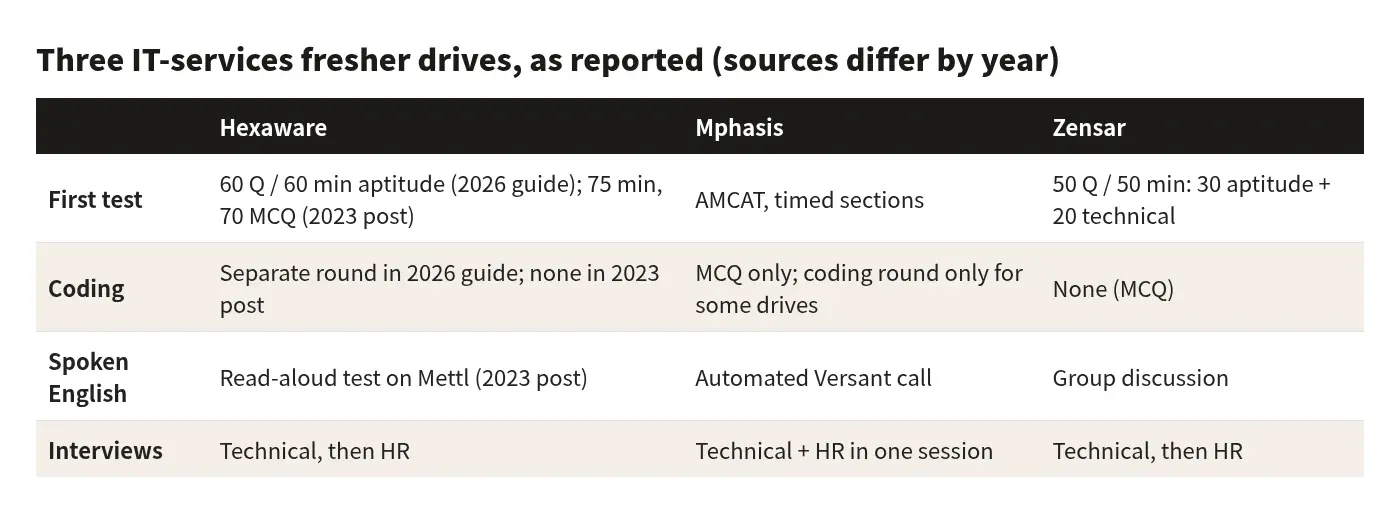
Side by side
What the three have in common
- The first test is a speed test. Every source stresses timing: one minute per question at Hexaware, separate section clocks at Mphasis, 30 aptitude questions in 30 minutes at Zensar.
- Technical means concepts, not competitive programming. Output prediction, normalisation, scheduling, OSI layers. Zensar's guide says outright that the bar is above TCS Ninja but below algorithm-heavy firms. That's the guide's opinion, not a measurement.
- Projects carry the interview. Mphasis and Zensar both say interviewers dig into whatever you list.
- Spoken English is tested separately. Read-aloud on Mettl, an automated Versant call, or a group discussion. It's the round people skip preparing for.
- Location flexibility gets asked. Hexaware HR asked it in the 2023 post, and Mphasis lists willingness to relocate in its criteria.
How to prep
Aptitude under a clock. Do 60 questions in 60 minutes with no negative marking, then 30 in 30. If your campus uses AMCAT, practise with separate section timers so you can't borrow time.
Technical MCQs. Twenty C/C++ output questions, twenty SQL outputs, and one page each on process scheduling, paging, normalisation to 3NF and the OSI layers. Explain why Quick Sort degrades on sorted input; the Hexaware guide uses exactly that example.
Two tiny programs. Bubble sort and Armstrong number were asked in the 2023 Hexaware interview. Write them in your declared language without looking anything up.
Say it out loud. Record yourself reading a paragraph, then answer "tell me about yourself" in under 90 seconds. That covers a Mettl read-aloud, a Versant call and the HR round with the same practice.
Group discussion. Take one topic, give yourself 10 minutes, and make three short points rather than one long one.
For live rounds that go over video, a mock interview where you explain your project to a tough listener is closer to what these accounts describe than rereading notes. For the timed test stage, OA Copilot (online assessments on platforms like HackerRank and CodeSignal) is built for online assessments, but AMCAT and Mettl sessions can be proctored, so read the rules in your own invite before deciding what to use. Other mass-recruiter write-ups in the same format: TCS, Infosys and Wipro and Capgemini, Accenture and HCLTech.
Pay
None of the four sources gives a verified salary and I'm not quoting a number from elsewhere. When an offer arrives, ask HR to break it into fixed pay, variable and any joining bonus or bond terms, then use the CTC structure guide.
FAQ
How many rounds does Hexaware have for freshers?
It depends on the source. The May 2026 guide has four stages (aptitude, technical MCQ, coding, HR). The 2023 candidate post has an online test, a communication test, a technical interview and an HR round.
What is the Mphasis test for freshers?
An AMCAT test with aptitude, verbal, logical reasoning and programming-concepts sections, each timed separately, according to FACE Prep's 2026 guide. Programming concepts is multiple choice there, though a coding round existed for some drives.
What is Versant in the Mphasis process?
An automated spoken-English call scored on pronunciation, fluency, sentence mastery and vocabulary, treated as pass-fail with a threshold that varies by drive.
Does Zensar have a group discussion for freshers?
The 2026 guide lists one as the second of four rounds, and says some off-campus drives skip it.
Do these companies ask coding questions in the test?
Mixed. The 2026 Hexaware guide has a coding round of 2 to 3 easy-to-medium problems. The 2023 Hexaware post had MCQs only, with two small programs in the interview. Mphasis and Zensar are described as MCQ-based.
Author · Alex Chen. Career consultant and former tech recruiter. Spent 5 years on the hiring side before switching to help candidates instead. Writes about real interview dynamics, not textbook advice.
Related Articles
GitLab's AI Interview Policy: What's Allowed at Each Stage
GitLab publishes its AI rules for candidates: welcome in assessments and take-homes, not as a script in live interviews. Here's the stage-by-stage breakdown.
KPIT, Tata Elxsi and LTTS Fresher Interview Process: Engineering R&D Hiring Tests by Year
KPIT, Tata Elxsi and L&T Technology Services campus rounds as candidates describe them: Superset, AON, HirePro and CoCubes tests, C/C++ coding limits, and where posts disagree.
Interview Cheat Tools in 2026: What They Actually Do, and What Catches Them
Most 'interview cheat tool' searches are looking for one of two very different products. What live answer-feeding tools do, what proctoring sees in 2026, and how to pick without gambling your offer.