AMCAT or eLitmus Cleared? Here's What the Cognizant, Accenture, Capgemini, or HCL Interview Actually Looks Like
AMCAT and eLitmus only get you the call. Here's what the interview at Cognizant, Accenture, Capgemini, and HCL actually tests, off-campus.

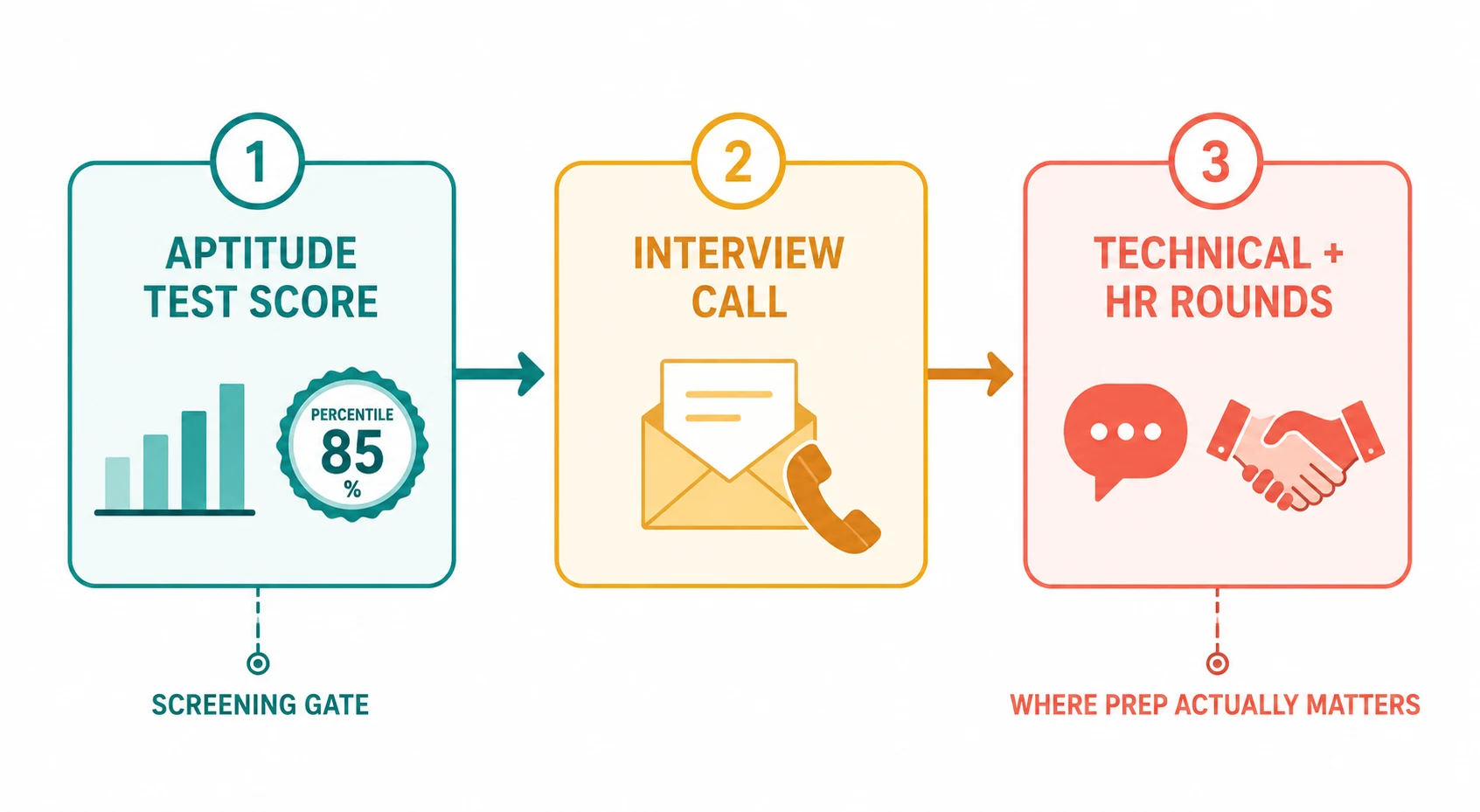
TL;DR: AMCAT and eLitmus are screening layers, not the interview itself — clearing your section cutoffs gets you a call, and the actual technical and HR rounds at Cognizant, Accenture, Capgemini, and HCL still play out separately, with each company running its own distinct format. Most prep content stops at "how to clear the cutoff." This covers what happens after that, company by company, plus how off-campus hiring changes the process compared to a campus drive.
You clear your AMCAT sections, or you cross the eLitmus percentile bar everyone talks about, and then — an interview call. Almost every guide about these tests stops exactly there, at the score. What happens in the actual interview afterward, and how it differs by company, is the part that decides whether the score turns into an offer.
AMCAT and eLitmus Are the Gate, Not the Interview
AMCAT (owned by SHL) is a computer-adaptive test covering English, quantitative, and logical reasoning as compulsory sections, plus a personality inventory and an optional domain module like computer programming. It's scored 0–900 per section, stays valid for one year, and you can retake it roughly every 45 days — up to about three attempts a year, choosing which score to share. Aspiring Minds' own materials describe thousands of employers, including HCL, Cognizant, Accenture, Wipro, Mphasis, Genpact, and L&T, sourcing candidates from the AMCAT database.
eLitmus runs the pH ("Potential Hiring") test differently: 60 questions across quant, verbal, and reasoning, with negative marking, scored by percentile per section rather than a single number. A commonly cited threshold — roughly the 80th percentile across all sections — unlocks eligibility for interview calls with eLitmus's partner companies, a list that has included Accenture, Capgemini, IBM, Dell, and GE. The score is valid for two years, double AMCAT's window, and candidates generally rate it as the harder of the two tests, with clearer scores tied to better-paying offers.
Either way, the mechanism is the same: your score is a filter that produces a call. The interview that follows is run entirely by the hiring company, on its own format.
What the Interview Actually Looks Like, Company by Company
Cognizant (GenC / GenC Next). Four rounds: a communication assessment, an aptitude-and-technical MCQ round (quant, logical reasoning, data interpretation, plus programming/DBMS/OS/networking/OOP basics), a technical interview built around your project and CS fundamentals with occasional light coding, and HR. No negative marking. GenC lands around ₹4 LPA; GenC Next, which adds a real coding round and expects stronger DSA, runs closer to ₹6.5 LPA.
Accenture. The 2026 fresher pipeline leans more technical than it used to: a cognitive-and-technical assessment with per-section cutoffs, a coding assessment (typically two problems, any language), a communication assessment that also probes deeper technical MCQs for cloud/networking/cybersecurity-heavy tracks, then a technical interview and an HR interview. Two entry bands — ASE around ₹4.5–6.5 LPA and Advanced ASE around ₹6.5–9 LPA — both generally requiring 60% aggregate academics and no active backlogs.
Capgemini. The standout is a pseudocode round: roughly 25 questions in 25 minutes where you read C-style pseudocode and predict the output, spot the bug, or find the error — no code writing involved. It sits alongside quant, logical reasoning, technical MCQs, and a written English section across four to five total rounds, and this online-test stage applies to freshers only, not lateral hires.
HCL Technologies. Three stages: an online written test (about 60 questions in 60 minutes, roughly a 70% section cutoff), a technical interview (30–45 minutes covering DSA, OS, DBMS fundamentals plus live coding), and an HR round (20–30 minutes on communication and motivation fit). Note that HCL TechBee, a separate 12-month program for post-12th candidates, runs on its own track and isn't the standard graduate-fresher process described here.
Tech Mahindra. The Entry Level Qualification (ELQ) test is proctored, with independently-scored elimination sections — the biggest gate in the process — followed in some 2026 off-campus drives by a story-writing round, then a technical interview (15–45 minutes) and HR. On-campus compresses all of this into one or two days; off-campus spreads the same rounds over several weeks.
The pattern that repeats across all five: the technical round leans on CS fundamentals plus a project walkthrough, and the HR round weights communication and cultural fit as heavily as technical competence — "tell me about yourself," strengths and weaknesses, why this company, and (a genuinely service-industry-specific question) your willingness around shift timing, relocation, and notice period.
Off-Campus Drive: What Actually Changes
On-campus, your college does the pre-screening work for you — it invites the company, sets the eligibility bar, and you're only competing against your own batch, usually across a single campus visit. Off-campus, you source the opening yourself: AMCAT and eLitmus databases, LinkedIn, company career pages, or drive-alert channels on WhatsApp and Telegram, and you're competing against graduates from any college in the country. There's no campus pre-filter, which is exactly why a strong AMCAT or eLitmus score functions as your substitute for it. Off-campus hiring sometimes converges with walk-in drives — single-day events where you show up with a resume and get assessed the same day, common in Tech Mahindra and HCL's bulk hiring pushes — though these typically have far fewer openings than a mass campus drive, and off-campus offers for the same role tend to land somewhat lower than their on-campus equivalents.
Where Preparation Actually Pays Off
Nearly every AMCAT and eLitmus guide — including the platforms' own material — stops at syllabus, cutoffs, and practice questions for the aptitude test itself. Almost none of them walk you through what the technical interview and HR round actually sound like once you're past the score, which is exactly the stage where a cleared cutoff either turns into an offer or doesn't.
If your target is TCS, Infosys, or Wipro specifically, our TCS, Infosys, and Wipro interview prep guide covers those formats in depth. For the companies here — Cognizant, Accenture, Capgemini, HCL, Tech Mahindra — the useful prep isn't more aptitude drilling, since you've already cleared that gate. It's rehearsing the project walkthrough, the CS-fundamentals follow-ups, and the HR questions about shift flexibility and relocation until they come out naturally under a live panel. AceRound AI runs mock interviews built around exactly this kind of technical-plus-HR format, so the questions above stop being a surprise by the time you're actually on the call.
FAQ
Is the AMCAT exam useful for getting a job?
It's useful as a screening gate, not as a job offer by itself. Aspiring Minds reports that thousands of employers, including large service-based firms like HCL, Cognizant, Accenture, and Genpact, source candidates through AMCAT scores, but clearing your section cutoffs earns you an interview call — you still go through that company's own technical and HR rounds afterward. The score opens the door; it doesn't walk you through it.
How many times can I attempt AMCAT in a year?
You can retake AMCAT after a roughly 45-day gap between attempts, which in practice allows about three attempts a year, and you choose which score to share with employers. Your score stays valid for one year from the test date, so a strong score from an earlier attempt is still usable if it's within that window.
What is a good eLitmus pH score, and what does it unlock?
The pH test scores you by percentile in each section — quant, verbal, reasoning — rather than a single composite number, and a commonly cited benchmark is roughly the 80th percentile across all three sections to become eligible for interview calls from eLitmus's partner companies, which have included names like Accenture, Capgemini, IBM, Dell, and GE. Your pH score stays valid for two years, longer than AMCAT's one-year window.
What's the difference between on-campus and off-campus placement?
On-campus, your college invites the company, sets the eligibility bar, and you compete only against your own batch, with the whole process usually compressed into one campus visit. Off-campus, you source the opening yourself — through AMCAT/eLitmus databases, LinkedIn, company career pages, or drive-alert groups — and compete against graduates from any college nationally, often substituting your test score for the campus pre-screening step that on-campus candidates get for free.
Is Cognizant GenC or GenC Next better for freshers?
They're different tracks, not a strict better-or-worse. GenC is the standard entry track around 4 LPA with four rounds — communication assessment, aptitude and technical MCQs, a technical interview, and HR. GenC Next sits higher, around 6.5 LPA, adds an actual coding round on top of the same structure, and expects a stronger DSA baseline. Which one fits depends on how confident you are going into a live coding round versus an MCQ-based technical screen.
What is the Capgemini pseudocode test?
It's a distinctive round in Capgemini's fresher process — around 25 questions in 25 minutes where you read C-style pseudocode and predict its output, spot the bug, or identify the error, without writing any code yourself. It sits alongside separate quant, logical reasoning, technical MCQ, and written English sections, and it only applies to freshers, not experienced hires.
Author · Alex Chen. Career consultant and former tech recruiter. Spent 5 years on the hiring side before switching to help candidates instead. Writes about real interview dynamics, not textbook advice.
Related Articles

The Amazon Bar Raiser Interview: What They Actually Do (2026 Guide)
Amazon's Bar Raiser interview explained: what the role actually is, how the veto really works, how Amazon selects Bar Raisers, and how to prepare for one.
Predictive Index Test: How to Actually Prepare for the PI Cognitive and Behavioral Assessment
The Predictive Index test is really two assessments. Here's what the 12-minute Cognitive test and the untimed Behavioral checklist actually measure, score, and allow.
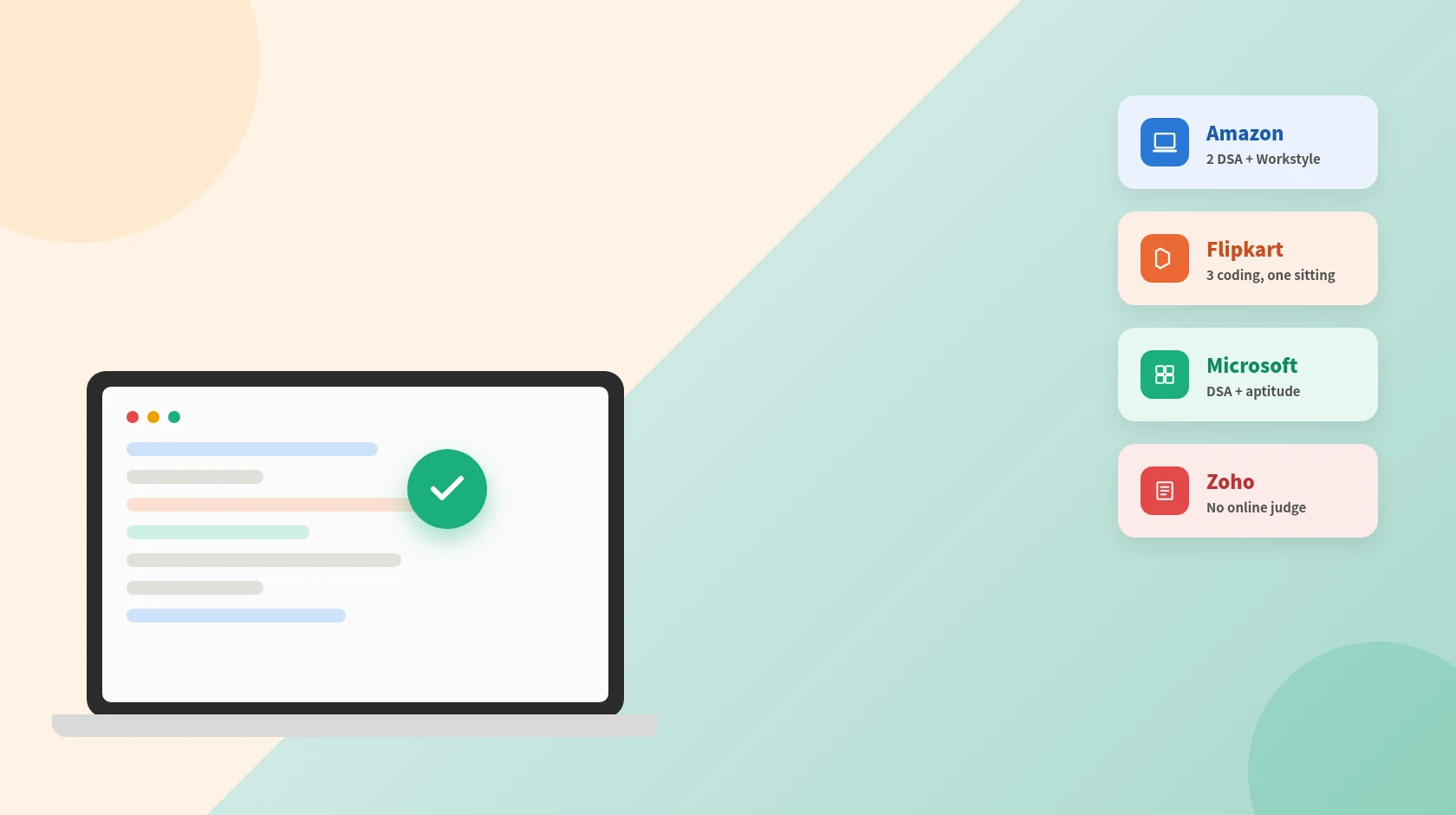
Off-Campus OA Prep for Product-Based Companies: Amazon, Flipkart, Microsoft, and Zoho Compared
Amazon, Flipkart, Microsoft, and Zoho run off-campus OA very differently. Here's what each one actually tests, and how to prepare for the one you'll face.