AI Interview Coach: How Structured Practice Builds Real Interview Skills
An AI interview coach isn't a cheat tool — it's a training partner. Here's how to use deliberate practice with AI to build genuine interview competence.
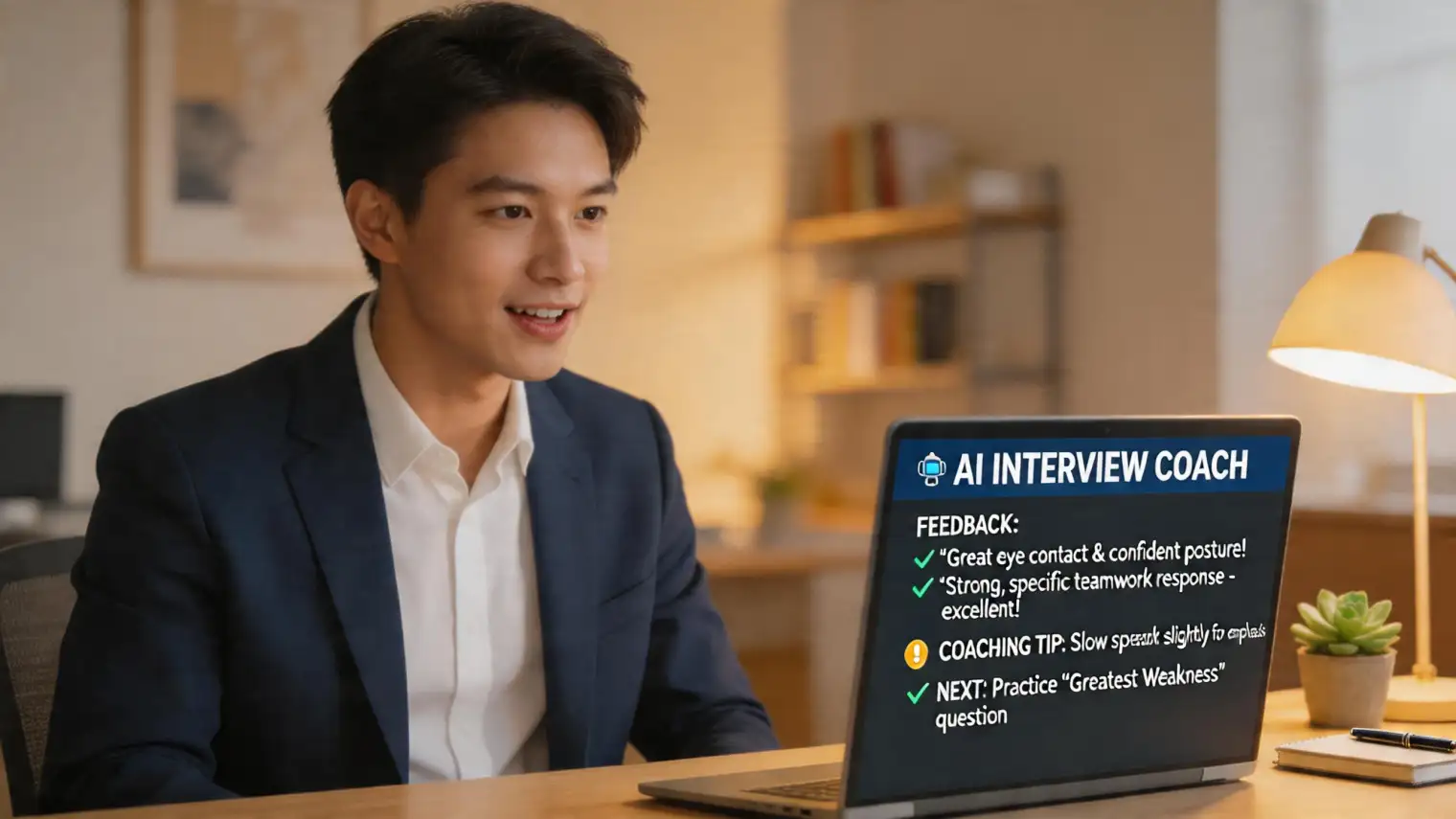
TL;DR: The best use of an AI interview coach isn't getting answers handed to you — it's using AI mock interview practice to build the kind of fluency that holds up under pressure. Structured repetition with immediate feedback outperforms any amount of passive prep.
Most people prepare for job interviews the wrong way.
They read lists of common questions, write out bullet-pointed answers, maybe do one practice run with a friend. Then they walk into the interview, get a question that's 20% different from what they practiced, and the whole thing unravels because they were rehearsing a script rather than building a skill.
A 2025 study tracking 80 participants through AI-assisted mock interview sessions found that 60% reported reduced anxiety not from knowing the "right" answers, but from practicing in a judgment-free environment enough times that the format stopped feeling threatening. The skill wasn't answering questions — it was tolerating the discomfort of being on the spot until it became routine.
That's what a good AI interview coach actually delivers.
The Coaching Model vs. the Cheat Tool Model
Before getting into the how, this distinction matters.
The loudest voices in the AI interview space are promoting real-time assistance tools — software that listens to your interview audio and feeds you answers as the interviewer speaks. Some of them use the word "undetectable" prominently in their marketing. That's a different product category with different risks and ethics. (If you want to think through those tradeoffs, this piece on AI interview ethics is worth reading first.)
An AI interview coach is something else: a tool you use before the interview to get measurably better at answering questions on your own. The goal is to become the candidate who doesn't need a crutch in the room.
Research from Clemson University on practice and feedback in interview performance found that external feedback — feedback from an outside source rather than self-assessment alone — produced significantly higher performance ratings than practice alone. AI coaching gives you that external feedback loop at any hour, at any volume, without the social stakes of practicing with a real person.
Reddit captures the sentiment well:
"AI practice interviews helped me overcome anxiety. Low stakes, immediate feedback, unlimited retries. But I'd never want an actual hiring decision made by AI."
Users instinctively draw the line. Practice AI: yes. Hiring AI: no. That's a coherent position, and it's exactly how the coaching model is supposed to work.
Why Deliberate Practice Works for Interviews
"Practice makes perfect" isn't quite right. Unfocused repetition doesn't build much. What research consistently shows is that deliberate practice — targeted, effortful repetition with immediate feedback and progressive difficulty — produces compounding improvement.
A meta-analysis published in the Proceedings of the Royal Society found that deliberate practice explains up to 61% of reliable performance variance across skill domains. Interviews are a learnable skill, not a fixed personality trait.
What makes practice deliberate for interviews:
- Targeted repetition: Practice the specific question types you're weakest at, not just your favorites
- Immediate feedback: Know within seconds whether your STAR structure was complete, whether your answer was too vague, whether you buried the most important point at the end
- Progressive difficulty: Start with easy behavioral questions, add follow-ups, then add curveball questions as your baseline improves
- Spaced sessions: Multiple short sessions over days outperforms one marathon session before the interview
An AI mock interview practice tool can run you through all four of these simultaneously. The AI doesn't get bored on your fifteenth attempt at "tell me about a conflict you resolved." A human coach does.
How to Structure Your AI Coaching Sessions
Unstructured AI practice — just opening the tool and "doing some interviews" — doesn't work much better than cramming. Here's a framework that does:
Week 1–2: Diagnosis and Foundation
Before you can improve, you need to know what's actually broken.
Run 3–4 mock interviews with an AI interview coach without any specific prep. Treat it like a baseline test. Use the feedback to identify your actual problem areas:
- Are your stories structurally weak (missing Situation or Result)?
- Are you speaking too vaguely ("I helped improve the process")?
- Are you rambling past the 2-minute mark?
- Is your "tell me about yourself" a rehearsed monologue or a conversation opener?
Most people discover their real problem isn't lack of experience — it's lack of specificity. Numbers, timelines, team sizes. The concrete details that make a story credible.
For a deep dive into structuring interview stories, the STAR method guide covers the framework from scratch.
Week 3–4: Targeted Drilling
Once you know your weaknesses, drill them specifically.
If your Situation setup is always too vague: practice only the first 30 seconds of each answer repeatedly. If your Results section lacks impact: practice only closing statements with quantifiable outcomes.
AI coaching tools are good at this granular feedback because they evaluate each component of your answer independently. You'll know "your Action section was strong, but you didn't close with a Result" after every attempt, not just at the end of the session.
This is where AI outperforms human mock interview partners. A friend will say "that sounded good." An AI interview training tool will say "your answer was 3:20 long, your Result section was one sentence, and you used 'basically' 7 times."
Ready to start structured practice? Try AceRound AI's interview coaching →
Week 5–6: Full Rounds with Pressure
Shift to full mock interview sessions: 45–60 minutes of consecutive questions, simulating a real interview structure.
Introduce pressure variables:
- Set a timer for each answer (2 minutes max)
- Include questions from your specific target industry/role
- Add follow-up questions after each answer — the real interview challenge isn't the first question, it's the probing follow-up
By week 6, most candidates who've completed this progression report that the interview format itself no longer triggers significant anxiety. The cognitive load has been processed enough times that it's become manageable.
The Day Before: What AI Coaching Can't Replace
Structured AI practice delivers the foundation. But the 24 hours before the interview have their own logic.
Do NOT do another mock interview the day before. Your brain needs consolidation time, not more input. Sleep is more valuable than an extra session.
Do:
- Review your 3–5 strongest stories — not to memorize, but to remind yourself what you have
- Research the company's last quarter: one specific, recent development you can reference naturally
- Check your tech setup if it's a video interview (the real-time AI interview helper guide has a solid pre-interview checklist)
- Write down your first-sentence opener for "tell me about yourself" — not the whole answer, just the hook
The goal isn't more prep. It's arriving calibrated — confident in your material, familiar with the format, ready to adapt rather than recite.
Measuring Progress: What to Track
Most candidates don't track their interview practice, which means they have no way to know if they're improving. AI coaching tools that give you session scores make this easy, but even without automated tracking, measure these:
| Metric | How to track |
|---|---|
| STAR completion rate | After each mock session, count how many answers had a clear Result |
| Answer length | Are you consistently under 2.5 minutes per answer? |
| Filler word frequency | "Um", "like", "basically" per minute |
| Follow-up resilience | What % of follow-up questions get a complete answer vs. "I'm not sure" |
| Pre-interview anxiety level | Self-rated 1–10 before each mock session |
The anxiety metric is underrated. If you're doing deliberate practice correctly, it should drop measurably over 4–6 weeks — not because the interview stops mattering, but because the format stops feeling foreign.
FAQ
Does AI interview coaching actually work for senior-level roles? Yes, arguably more so. Senior candidates often have more experience than they know how to articulate efficiently. An AI coach's structured feedback on clarity and conciseness is more valuable at director or VP level than at entry level, where the problem is usually lack of examples, not overabundance.
How is an AI interview coach different from just practicing with ChatGPT? ChatGPT can simulate interview questions, but it doesn't give structured feedback on your answers or track improvement over time. A purpose-built AI interview coaching tool scores your responses on STAR completeness, specificity, clarity, and pacing — then lets you compare across sessions. It's the difference between free weights and a guided training program.
I practiced with AI for weeks and still bombed the real interview. Why? Usually one of three reasons: (1) You practiced correctly but hit a company with an unusual interview style or format — this isn't a failure of your prep, and you still have better baseline skills for the next round; (2) You practiced the answers but not the conversation — AI coaching should include follow-up question scenarios, not just opening answers; (3) Anxiety from the stakes overrode the training — this is real, and deliberate exposure practice helps more than another round of drilling answers.
How many sessions do I need before an interview? Minimum viable: 3–5 targeted sessions. If you have 3 weeks, aim for 12–15 sessions across focused drilling and full mock rounds. More than that without increasing difficulty just becomes routine, which doesn't build new skill.
Can AI coaching help with non-English interviews? Yes — tools like AceRound AI support multiple languages, which matters for candidates preparing for interviews in a second language. The structure and feedback loop works regardless of language. For Japanese or Korean candidates preparing for English-language interviews specifically, the combination of language support and behavioral coaching is particularly useful.
What's the single most impactful thing to improve first? Answer specificity. Most interview feedback from hiring managers cites "answers were too vague" more than any other issue. Before working on pacing, structure, or body language — get specific. Numbers, project names, team sizes, timelines. Every story needs at least one concrete anchor. See the best AI interview tools overview for tools that specifically flag vagueness in answers.
Author · Alex Chen. Career consultant and former tech recruiter. Spent 5 years on the hiring side before switching to help candidates instead. Writes about real interview dynamics, not textbook advice.
Related Articles
GitLab's AI Interview Policy: What's Allowed at Each Stage
GitLab publishes its AI rules for candidates: welcome in assessments and take-homes, not as a script in live interviews. Here's the stage-by-stage breakdown.
KPIT, Tata Elxsi and LTTS Fresher Interview Process: Engineering R&D Hiring Tests by Year
KPIT, Tata Elxsi and L&T Technology Services campus rounds as candidates describe them: Superset, AON, HirePro and CoCubes tests, C/C++ coding limits, and where posts disagree.
Interview Cheat Tools in 2026: What They Actually Do, and What Catches Them
Most 'interview cheat tool' searches are looking for one of two very different products. What live answer-feeding tools do, what proctoring sees in 2026, and how to pick without gambling your offer.