DoorDash's AI-Assisted Engineering Interview: 60 Minutes, Your IDE, AI Required
DoorDash replaced its coding rounds with a 60-minute AI-assisted working session. Here is what the official post confirms, how it's scored, and how to prepare.
TL;DR: DoorDash's careers blog (March 19, 2026) says it is replacing traditional coding rounds with a 60-minute, AI-assisted engineering working session. You bring your own IDE, you're asked to use AI tools, and the score is about workflow and judgment, not whether you finish. The failure mode DoorDash itself describes is arriving unprepared, or treating AI use as cheating.
Most "does company X allow AI in interviews" pages end up quoting a Reddit thread. This one doesn't need to. DoorDash wrote the policy down, in a post from two of its own people, and it's unusually specific. So this page sticks to what that post says, marks what comes from elsewhere, and turns it into a prep plan.
What DoorDash Actually Published
The post is titled "Why DoorDash is rebuilding its engineering interviews around AI," dated March 19, 2026, by Ivan Rudovol and Alex Danilychev on the DoorDash careers blog. The core argument is that when a standard interview prompt can be solved by a model in seconds, the old format either turns into proctoring or into "a shared pretense that engineers don't use AI tools at work." DoorDash says it isn't interested in winning a detection arms race. It changed the interview instead.
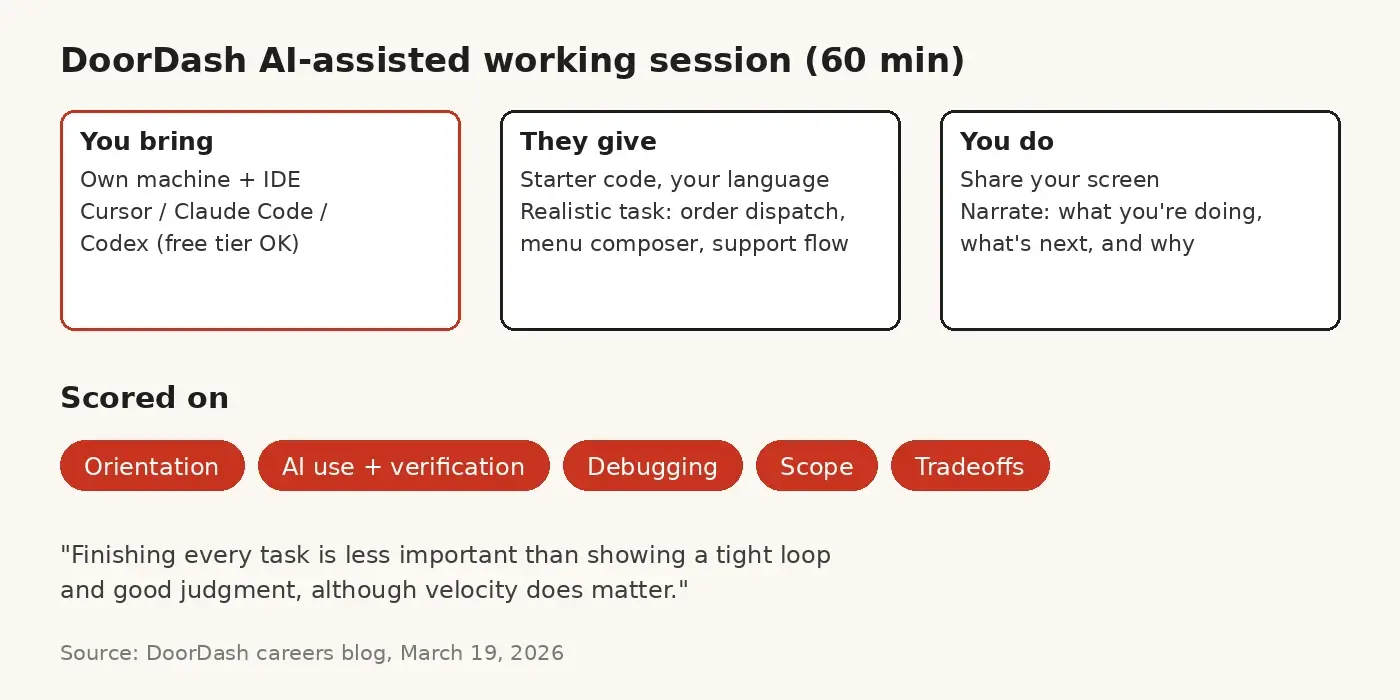
What the format looks like, per the post:
- 60 minutes, replacing traditional coding rounds.
- Your own machine and IDE. No locked-down browser editor.
- AI tools are expected. The post asks you to use an editor-integrated assistant because they want to "see the full loop": editing, running code, debugging, iterating.
- Everything is on the table: chat, inline suggestions, planning, agent or autopilot modes, running commands through the tool. Free tiers of Cursor, Claude Code and Codex are called sufficient.
- A realistic task with starter code in your preferred language. The post's examples are extending an order dispatch system, building a smart menu composer, and automating a support-request resolution system.
- Screen share and narration. You say what you're doing, what you'll try next, and why.
How It's Scored
DoorDash names five signals: how you get oriented, how you use AI and verify outputs, how you debug, how you manage scope, and how you communicate tradeoffs. And one sentence worth reading twice: finishing every task is "less important than showing a tight loop and good judgment, although velocity does matter."
The post also lists the skills behind those signals. Two are easy to underrate:
- Validating with rigor. Make a minimal repro, read the logs, write a targeted check that proves the fix works, "rather than blindly trusting an AI output."
- Making pragmatic tradeoffs with DoorDash's actual stakeholders in mind: merchants, Dashers and consumers. A tradeoff you can explain in those terms scores better than a generic "it scales better."
Three Things the Pilot Taught Them (and You)
The most useful part of the post is the section where DoorDash admits what it got wrong. Each lesson is a hint about what candidates struggle with:
- Scope matters more than cleverness. An early question had three services (order, fulfillment, a message bus) in a large codebase. Many candidates burned 15 to 20 minutes just exploring. DoorDash moved to smaller, focused projects. Takeaway for you: expect to ramp into unfamiliar code fast, and budget your first minutes for orientation, not typing.
- Candidates arrived unprepared. Without guidance, many showed up with little experience using AI tools, no configured IDE, or "believing that the use of AI to its fullest potential was somehow 'cheating'" (the post adds that yes, you are allowed to one-shot problems). Takeaway: test your setup before the call.
- Interviewers are graded on this too. The format can't be scored with an output-checking rubric, so DoorDash says it trains interviewers to assess workflow, debugging and judgment.
They now send a candidate guide up front. If your recruiter hasn't, ask for it.
What Isn't Confirmed
Be careful with anything beyond the post. I could not confirm from DoorDash itself how evenly this format has rolled out across teams and seniority levels. Candidate-side question banks I checked showed very few recorded AI-assisted sessions, which suggests either a recent rollout or uneven adoption. Specific question text you'll see on prep sites is second-hand. And the post covers the coding replacement only; it says nothing about how AI is treated in the behavioral or system design conversations. Don't assume the permission carries over.
How to Prepare
Treat this less like LeetCode and more like a pairing session you happen to be recorded in.
- Set up and rehearse your environment. Pick one tool (Cursor, Claude Code or Codex), make sure it's logged in and working with your language, and do two or three full timed sessions on a small project you didn't write.
- Practice the first ten minutes. Open an unfamiliar repo, read the entry points and tests, and say your mental model out loud before touching anything.
- Write the plan before prompting. "Here's what success looks like" is the line DoorDash itself uses: you can't expect an agent to succeed if you haven't defined success.
- Verify every non-trivial change. Run it, reproduce the bug first, add one targeted test. Say out loud what you're checking and why.
- Cut scope on purpose. If time is tight, tell the interviewer what you're dropping and what you'd do next. That is a scored signal, not a failure.
- Narrate tradeoffs in product terms. What does this choice do to a merchant's order, or a Dasher's route?
For the narration habit specifically, a mock interview where you talk through your reasoning as you work is the cheapest way to find out how you sound. And a note on tools: in this particular round, AI use is invited, so the tool that matters is the coding assistant you've practiced with. Interview Copilot is built for the rounds where you need a prompt to recover a thought mid-answer, such as the behavioral and system design conversations, and you should check each round's rules with your recruiter before using anything. Companies differ; our pieces on OpenAI and Snowflake show the other end of the spectrum.
FAQ
Does DoorDash allow AI in coding interviews?
Yes, and it asks for it. DoorDash's March 2026 careers post says the AI-assisted working session replaces traditional coding rounds and that candidates should use integrated AI tools.
Which AI tools can I use in the DoorDash interview?
Your own IDE and assistant. The post says free tiers of Cursor, Claude Code and Codex are sufficient, and that chat, inline suggestions, planning, agent modes and command running are all allowed.
How is DoorDash's AI-assisted session scored?
On orientation, AI use and verification, debugging, scope management and communication of tradeoffs. Finishing every task is explicitly less important than a tight loop and good judgment.
Does every DoorDash engineering candidate get this format?
Not confirmed. The post presents it as the replacement for traditional coding rounds, but rollout across teams and levels isn't documented. Ask your recruiter what your loop includes.
Author · Alex Chen. Career consultant and former tech recruiter. Spent 5 years on the hiring side before switching to help candidates instead. Writes about real interview dynamics, not textbook advice.
Related Articles
Shopify Interview Process 2026: Life Story, Pair Programming and the AI Memo
Shopify's official hiring steps, what the Life Story round scores, and what Tobi Lütke's reflexive-AI memo does and doesn't tell you about using AI in the interview.
Nagarro, Persistent, Publicis Sapient, Thoughtworks: How Each Interviews Freshers in India
Nagarro's Mettl tests, Persistent's AMCAT-style objective round, Publicis Sapient's values round, Thoughtworks' pairing session: what candidates report for each, and where the reports disagree.
Ramp's AI-Assisted Coding Interview: What Candidates Are Reporting
Candidates report Ramp added a round where using Cursor, Copilot, or Claude Code is expected, not banned. Here's what's confirmed, what's reported, and how to prepare.