Which Companies Allow AI in Coding Interviews? 2026 Policies Compared
Canva, DoorDash and Meta expect AI in some coding rounds. Snowflake and Palantir ban it. Here's every company's stance, what's official and what's only reported.
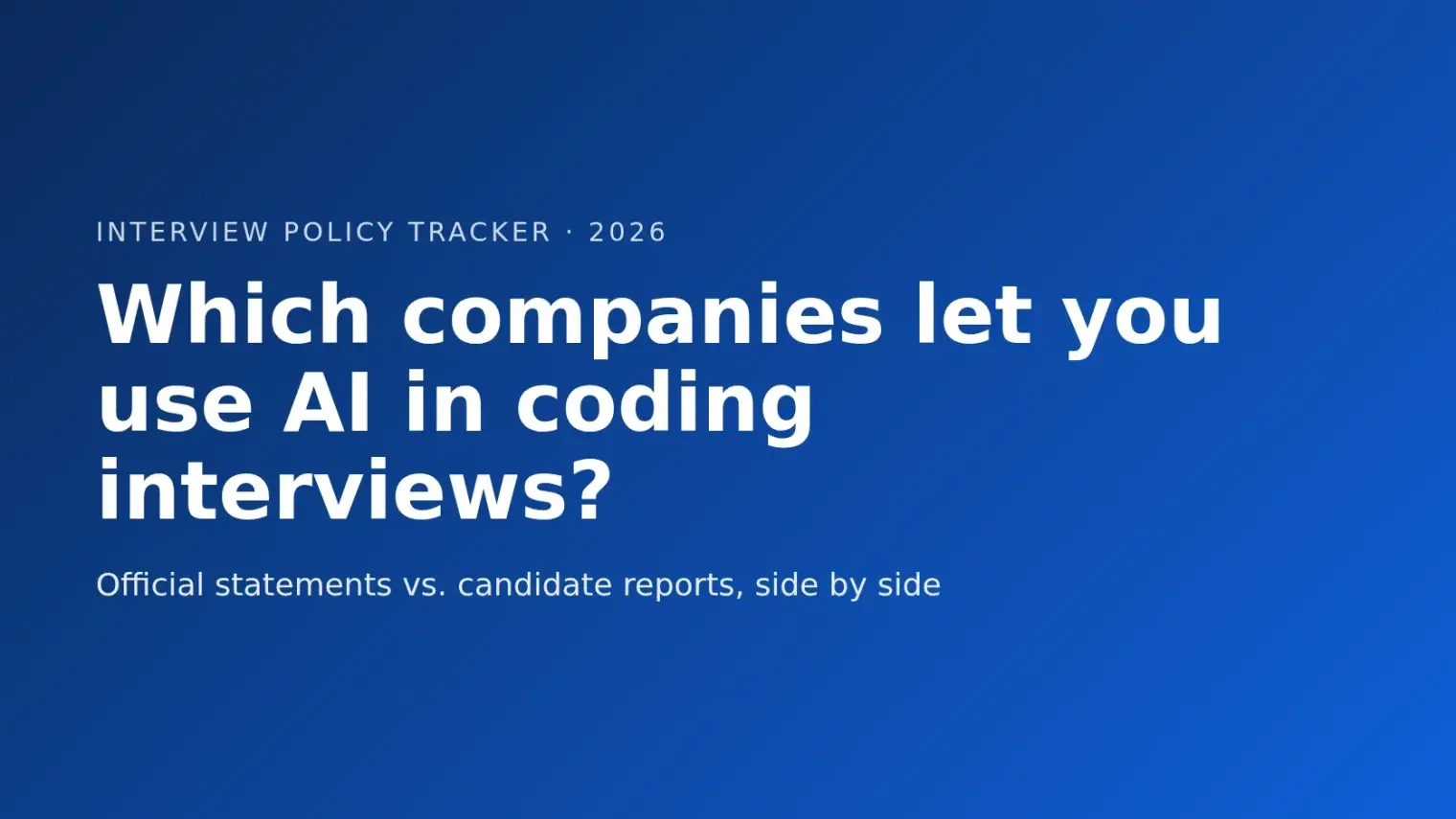
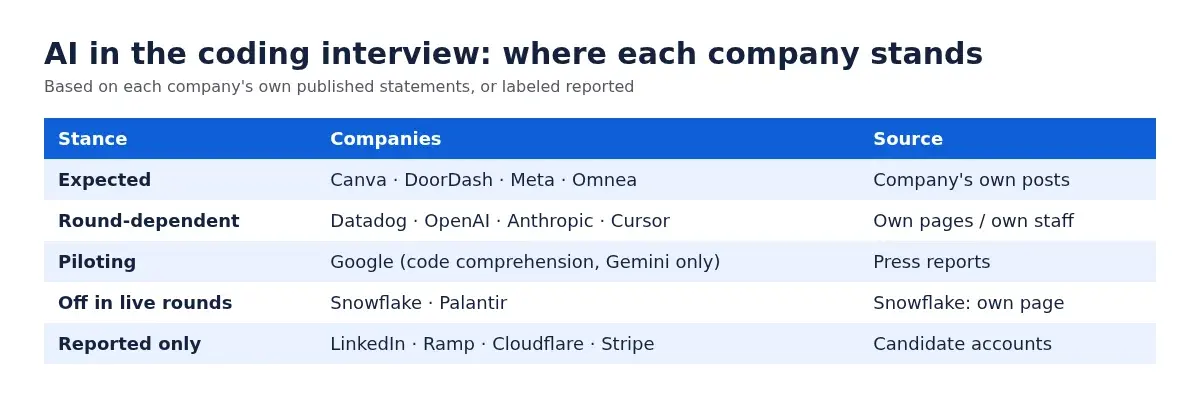
TL;DR: There's no industry-wide rule. A small group of companies now expect AI use in at least one coding round (Canva, DoorDash, Meta, Omnea). Others split it by round (Datadog, OpenAI, Anthropic, Cursor), and some keep live coding AI-free (Snowflake, Palantir). Only some of this is published by the companies themselves. The rest is candidate reporting, and this guide labels which is which.
Source note: "official" below means a company's own careers page, engineering blog or named staff. "Reported" means candidate accounts or press coverage. I link to the full write-up for each company where I have one.
Searching "can you use AI in a coding interview" gets you forum threads that contradict each other, because the honest answer is that it depends on the company, the round and sometimes the team. This page puts the pieces in one place so you can see the pattern before you walk into a loop.
Companies that expect AI in a coding round
Canva. Its engineering blog says it expects backend, machine learning and frontend candidates to use tools like Copilot, Cursor and Claude, and tells them in advance. The AI-Assisted Coding round replaced its Computer Science Fundamentals screen. Details: Canva's AI-assisted coding interview.
DoorDash. Its careers blog (March 19, 2026) describes a 60-minute AI-assisted working session replacing traditional coding rounds. You bring your own IDE, and scoring is about workflow and judgment, not finishing. Details: DoorDash's AI-assisted engineering interview.
Meta. Its loop includes a 60-minute AI-enabled coding round with an assistant built into CoderPad, and Meta lists the models available. Outside AI tools aren't part of it. Details are in our Meta interview preparation guide.
Omnea. A smaller company, but one of the clearest statements I found. In a May 26, 2026 engineering post, it says it opened its pair-programming interview to AI tools, from none at all to full coding agents, and that strong candidates have done well both ways. It says it looks for people who "don't outsource their thinking entirely" and treat AI as an accelerator rather than a crutch. It also says a distinct planning phase and a good verification loop (tests) are good signs, and that the pace suddenly accelerating once AI starts writing code is the moment interviewers notice most.
Companies that split the rule by round
Datadog. It has one of the most specific official policies: fine for your resume and research, allowed on a take-home if you can defend the conclusions live, expected only in AI-assisted coding interviews you're told about in advance, off everywhere else, and misuse "may lead to disqualification." Details: Datadog's AI guidelines, round by round.
OpenAI. Several policies, not one. AI is expected for application materials and prep. Live coding screens on some tracks are AI-free. Take-homes are inconsistent. A newer pilot round has you drive an AI agent through a large codebase. Details: OpenAI's AI interview policy.
Anthropic. Claude is expected on materials and prep, conditional on the take-home, and banned in the live technical screen and values interview unless told otherwise. Details: Anthropic's AI interview policy.
Cursor (Anysphere). A time-boxed first screen with AI limited to autocomplete, then a paid 8-hour project where AI is expected and judged on how well you direct and verify it. Details: Cursor's AI interview policy.
Piloting
Google. The reported plan is a "code comprehension" round for junior and mid-level software engineers, where Gemini is the only AI tool and interviewers score prompting, output validation and debugging. Details: Google's AI interview policy. This one comes from press coverage, so confirm with your recruiter.
Companies that keep live coding AI-free
Snowflake. Its own careers blog published an "AI Cheat Sheet": welcome for resume polish, mock practice and company research, not welcome in application answers, take-homes or live coding, and it runs one coding interview in person to keep that boundary. Details: Snowflake's AI interview policy.
Palantir. Reportedly bans AI assistance at every stage, and its signature decomposition round involves no code at all. Details: Palantir's Forward Deployed Engineer interview.
Reported, not confirmed
These companies haven't published a policy that I could find, so the details come from candidates. Treat them as likely, not certain.
- LinkedIn: one AI-enabled round on CoderPad with a chat panel, replacing one of two standard coding rounds. Read more.
- Ramp: a round where you're expected to work alongside an AI assistant. Read more.
- Cloudflare: a 45-minute AI-assisted coding round where Google and AI were allowed. Read more.
- Stripe: the Bug Squash debugging round reportedly allows web search but not AI coding assistants. Read more.
- Shopify: its CEO memo makes AI a job expectation, but its hiring pages don't say what's allowed inside an interview. Read more.
What the pattern says
Three things repeat across the companies that wrote their policy down.
- The rule follows the round, not the company. Cursor, Datadog, Anthropic and OpenAI all give different answers for different stages. Asking "does Company X allow AI?" without naming the round gets you a useless answer.
- Where AI is expected, judgment is what's scored. Canva, DoorDash and Omnea all describe planning first, verifying output and explaining decisions. None of them describe rewarding speed or prompt tricks.
- Where it's banned, the ban is explicit. Snowflake and Datadog state it. Silence usually means you should ask, not assume.
How to prepare for both kinds of round
- Ask in writing. Email your recruiter before each stage: "Is AI tool use allowed or expected in this round, and if so which tools?" Keep the reply.
- Split your practice. One session with your usual AI tool on an open-ended problem, one without any. Time yourself in both.
- Review output like a diff. Check for missed edge cases, invented APIs and quiet assumptions before you run anything.
- Practice explaining. In AI-allowed rounds, the discussion is where over-reliance shows. Rehearse defending each choice against "why this and not that?"
A mock interview session is a reasonable place to rehearse the explaining part out loud. If you want live help in the rounds where tools are allowed, check each company's rules first, and use AceRound only where the policy permits it.
FAQ
Which companies allow AI in coding interviews?
Canva, DoorDash and Omnea say so in their own posts, for specific rounds. Meta runs an AI-enabled round with a built-in assistant. Datadog allows it only in AI-assisted rounds it announces in advance. Google is reported to be piloting a Gemini-only round.
Which companies ban it?
Snowflake's careers blog says AI isn't welcome in take-homes or live coding. Palantir reportedly bans it at every stage. Stripe's debugging round reportedly allows web search but not AI assistants, unconfirmed.
How do I find out a specific company's rule?
Check its careers site and engineering blog, then ask your recruiter in writing before each round. Treat forum posts as reported, not confirmed.
Is it cheating if the company allows it?
No. The risk is the opposite: using AI in a banned round, or where nothing was stated.
How do I prepare for a round where AI is expected?
Practice with your actual tool on open-ended problems, plan before prompting, review every output, and rehearse explaining your decisions aloud.
Author · Alex Chen. Career consultant and former tech recruiter. Spent 5 years on the hiring side before switching to help candidates instead. Writes about real interview dynamics, not textbook advice.
Related Articles
Interview Cheat Tools in 2026: What They Actually Do, and What Catches Them
Most 'interview cheat tool' searches are looking for one of two very different products. What live answer-feeding tools do, what proctoring sees in 2026, and how to pick without gambling your offer.
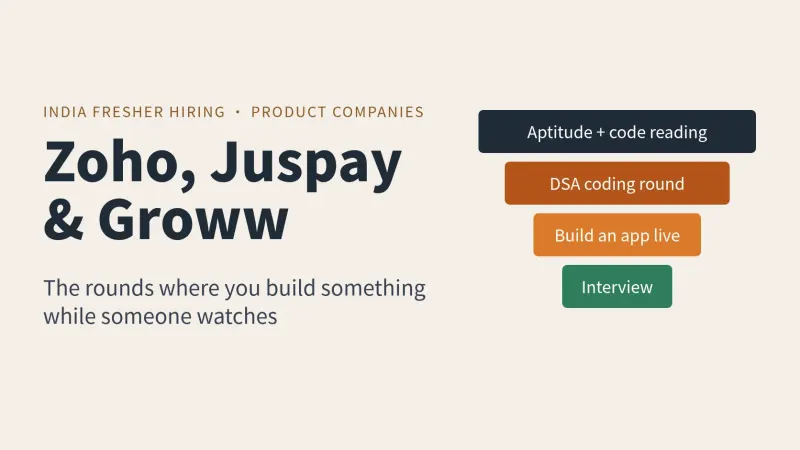
Zoho, Juspay and Groww Fresher Interview Process in India: Build-It-Live Rounds, Not Just an OA
Zoho cuts 1,500 to 3,000 applicants with aptitude and coding, then a live build round. Juspay runs hackathon rounds. What candidate posts report.
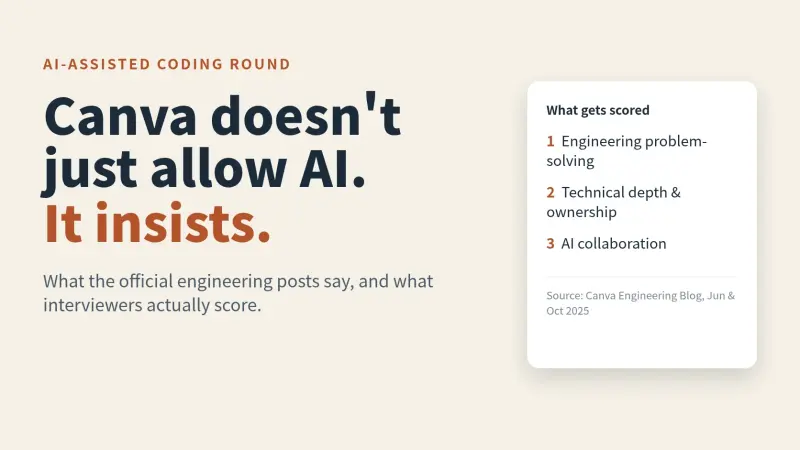
Canva's AI-Assisted Coding Interview: What They Expect and Score
Canva tells engineering candidates to use AI in the technical interview. Here's what its own posts say about the format, what interviewers score and how to prep.