Amazon's PR/FAQ Interview Exercise: How to Actually Write One
Amazon PM and TPM candidates get a 48-hour PR/FAQ take-home most guides gloss over. Here's the real structure, scoring criteria, and a worked example.

TL;DR: Amazon's PR/FAQ interview exercise asks PM, PM-T, and TPM candidates (typically L6+) to write a 2-3 page mock press release and FAQ for a product that doesn't exist yet, usually as a 48-hour take-home before the onsite loop. It's based on Amazon's real internal "Working Backwards" process, but most guides either explain the internal practitioner version with no interview framing, or treat it as a generic "writing sample" without showing the actual PR/FAQ structure. Below is the real shape of the document, what each section is scored on, and where a live mock round earns its keep.
Search "Amazon PM interview" and you'll find plenty of advice about Leadership Principles and STAR stories. Search "Amazon PR/FAQ" and you land somewhere else entirely — Working Backwards' own site, written for product managers already inside a company, with zero interview framing. Almost nobody bridges the two: what this document actually looks like when you're the one being scored on it, cold, with a 48-hour clock running.
Where the PR/FAQ Actually Shows Up in the Loop
It shows up in three different forms, and which one you get changes how you should prepare.
The written take-home is the most common version, typically triggered at L6 and above for PM, PM-T, and Sr. PM-T roles. A recruiter sends a prompt roughly 48 hours before your onsite, and you submit a 2-3 page writing sample — often explicitly framed as a PR/FAQ, sometimes as a "most innovative project" narrative that follows the same structure. Interviewers read it in advance and spend part of the loop probing it directly.
The conceptual discussion appears in PM-T and Sr. PM-T loops specifically, where one ~60-minute round splits roughly in half: Leadership-Principles behavioral questions, then a "technical product life cycle" discussion where you reason through how you'd write or critique a PR/FAQ for a hypothetical feature, without producing a full document on the spot.
The live, compressed version is rarer but reported in some TPM and product-sense rounds — sketch a headline plus two or three customer FAQs live, as a fast proxy for the real exercise.
What the Document Actually Looks Like
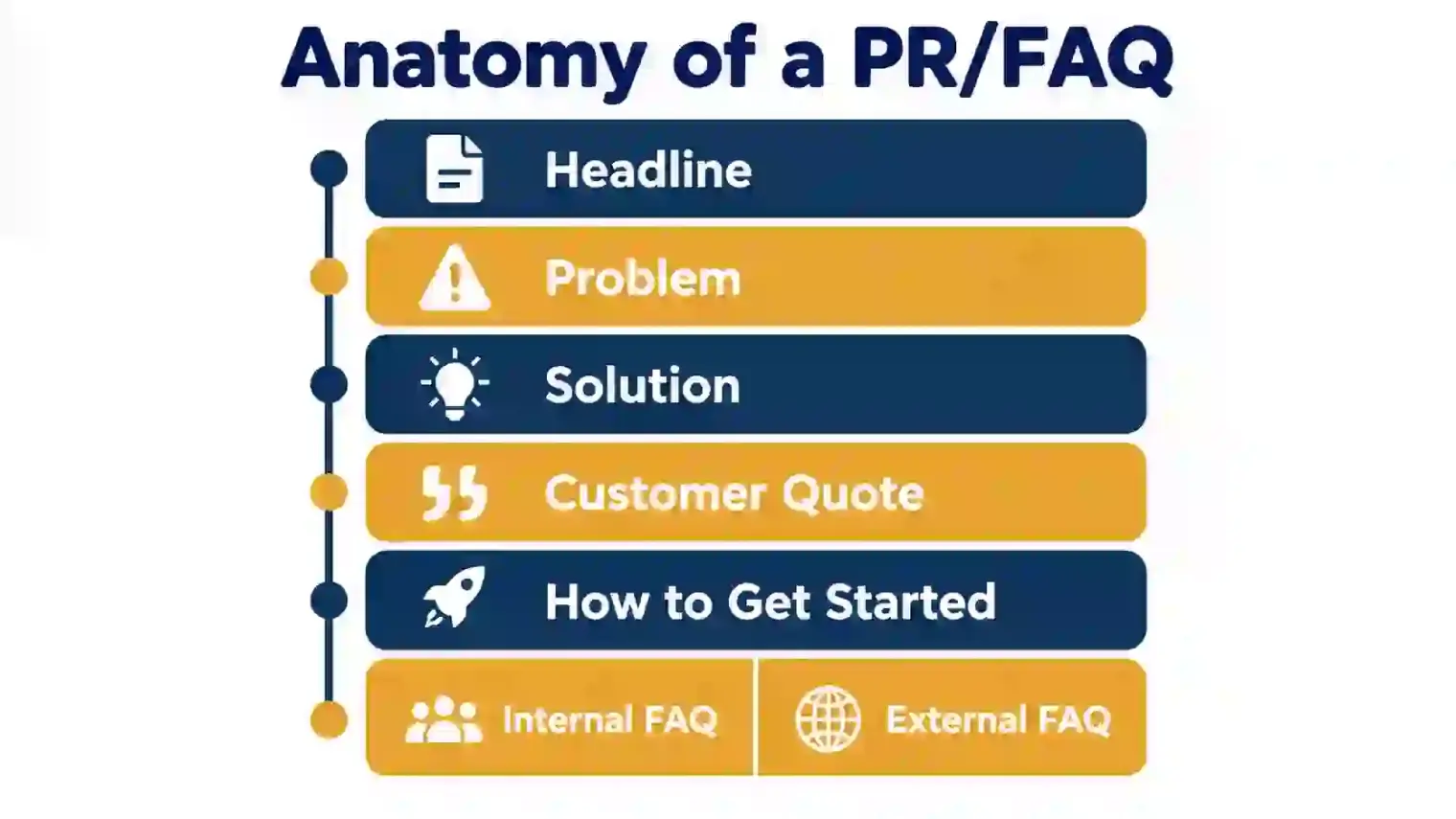
Amazon's own internal PR/FAQs run up to roughly six pages with an extensive FAQ section. The interview version is a compressed proof of the same skill, but it keeps the same shape:
- Headline — one sentence, written as if a journalist wrote it, naming the product and its main benefit
- Subheading — who it's for and what it does, in one line
- Problem — the customer pain point, described specifically enough that a stranger would recognize it, written before any mention of your solution
- Solution — how the product solves that exact problem, in plain language, no jargon
- Customer quote — a fictional but realistic quote from someone who'd actually use this
- How to get started — the concrete first step a customer takes
- Internal FAQ — the hard questions from finance, legal, ops, and engineering: cost, feasibility, risk, dependencies
- External FAQ — the questions an actual customer would ask: pricing, how it works, what happens if it fails
The order matters more than it looks like it should. Amazon's own guidance is blunt about the most common failure mode: candidates who start from "here's a cool feature to build" instead of "here's who's struggling and why" get marked down immediately, regardless of how polished the writing is. The problem paragraph has to stand on its own before the solution shows up at all.
What's Actually Being Scored
Interviewers aren't grading whether your product idea is good business strategy. They're scoring three things: whether you genuinely started from a customer problem rather than backfilling one to justify a feature, whether you can write in Amazon's terse, narrative-memo style instead of a bullet-point pitch deck, and — this is the part candidates underestimate — whether your internal FAQ anticipates the skeptical follow-up questions yourself, rather than getting blindsided by them live.
That last point is the real tell. A candidate who lists three obvious internal-FAQ questions and answers them thinly reads very differently from one who names the actual hard tradeoff — "this assumes we can get X team's buy-in, and if we can't, here's the fallback" — before anyone in the room has to drag it out of them.
The 2026 Wrinkle: AI-Fluency Prompts
Amazon has pushed AI fluency harder inside PM interviews through 2026, and that's starting to show up in PR/FAQ prompts specifically — candidates report being asked to write the exercise for an AI-powered feature rather than a conventional one. The document structure doesn't change, but the problem paragraph gets harder to write well: "customers want an AI assistant" isn't a real customer problem, and interviewers can tell the difference between a candidate who's thought through what the AI actually needs to do differently from a human-run process and one who's just attached "AI" to a generic pitch.
How to Actually Prepare
Write the problem paragraph five separate times before you touch the solution. If you can't state the customer's pain in one sharp paragraph without mentioning your product, the rest of the document is built on sand — this is the single most common place real candidates lose points.
Draft the internal FAQ like you're your own harshest reviewer. List the three questions that would actually kill this project internally — budget, a dependency on another team, a technical risk — and answer them honestly instead of picking safe, easy questions to make yourself look prepared.
Rehearse defending it out loud, not just writing it well. The take-home only gets you in the door; the harder part is fielding follow-up questions live when an interviewer pokes at the weakest assumption in your internal FAQ. A mock interview built around Amazon's actual follow-up style is a reasonable way to feel that pressure before it's live and the stakes are real.
If the round you're prepping for turns out to be more behavioral than product-writing, our Amazon Leadership Principles guide covers the STAR-format side of the loop, and our Bar Raiser guide explains the cross-team interviewer who sits in on most Amazon loops regardless of role.
FAQ
What is a PR/FAQ in an Amazon interview?
It's a mock press release and FAQ document, written as if the product has already launched, based on Amazon's internal "Working Backwards" process. In interviews it usually shows up as a 48-hour take-home writing sample for PM, PM-T, and TPM candidates at L6 and above — you write a short document arguing for a product, and the panel reads it before your onsite and probes it live during the loop.
How do you write a PR/FAQ for an Amazon interview?
Start from a real customer problem, not a feature idea — Amazon's own guidance is explicit that a PR/FAQ that opens with what you're building instead of who's struggling and why gets marked down immediately. Structure it as a headline, a problem paragraph, a solution paragraph, a customer quote, a "how to get started" section, and then two FAQ sections: an internal one covering the hard operational and business questions, and an external one covering what a customer would actually ask.
How long should an Amazon PR/FAQ interview writing sample be?
Most candidates are asked for 2 to 3 pages, which is shorter than Amazon's own internal PR/FAQs — those commonly run up to about 6 pages with a fuller FAQ section. The interview version is a compressed proof of the same skill: can you write Amazon's terse, narrative-memo style and reason backward from a customer problem, not a full go-to-market plan.
What's the difference between the internal and external FAQ sections?
The external FAQ answers questions a real customer would ask about the product itself — pricing, how it works, what problem it solves for them. The internal FAQ is where Amazon actually tests judgment: it's supposed to anticipate the hard, skeptical questions from finance, legal, ops, and engineering stakeholders — cost, feasibility, risk, what could go wrong — before anyone in the room has to ask them out loud.
Does Amazon still use the PR/FAQ process in 2026?
Yes, and reporting through 2026 shows the mechanism itself is largely unchanged — the same 48-hour take-home window, the same L6+ trigger, the same 2-3 page expectation. The one notable shift is Amazon's broader 2026 push on AI fluency inside PM interviews, which means candidates should be ready for prompts that ask them to apply the PR/FAQ format to an AI-powered feature specifically, not just a conventional one.
Is the PR/FAQ the same thing as Amazon's Leadership Principles interview?
No, they test different things and often show up in different rounds. Leadership Principles rounds use STAR-format behavioral questions about your past experience; the PR/FAQ is a forward-looking product-writing exercise about something that doesn't exist yet. Some PM-T loops blend both into a single round — roughly half behavioral, half product-writing discussion — but they're distinct skills worth prepping separately.
Author · Alex Chen. Career consultant and former tech recruiter. Spent 5 years on the hiring side before switching to help candidates instead. Writes about real interview dynamics, not textbook advice.
Related Articles
Interviewing While Employed: How to Actually Prepare With Zero Time
Job searching while employed means near-zero prep time, not just staying discreet. Here's a 20-minute prep script, plus what the counteroffer statistics actually show.
CTC Negotiation for Freshers in India: What's Actually Negotiable
Most fresher CTC negotiation advice ignores that TCS, Infosys, and Wipro set fixed pay bands. Here's what's really negotiable, and where lowball offers hide.
Service-Based or Product-Based? Deciding When You Have Both Live at Once
TCS offer in hand, product company interview next week — here's the actual decision framework, not another generic service vs product comparison table.