The Amazon Bar Raiser Interview: What They Actually Do (2026 Guide)
Amazon's Bar Raiser interview explained: what the role actually is, how the veto really works, how Amazon selects Bar Raisers, and how to prepare for one.

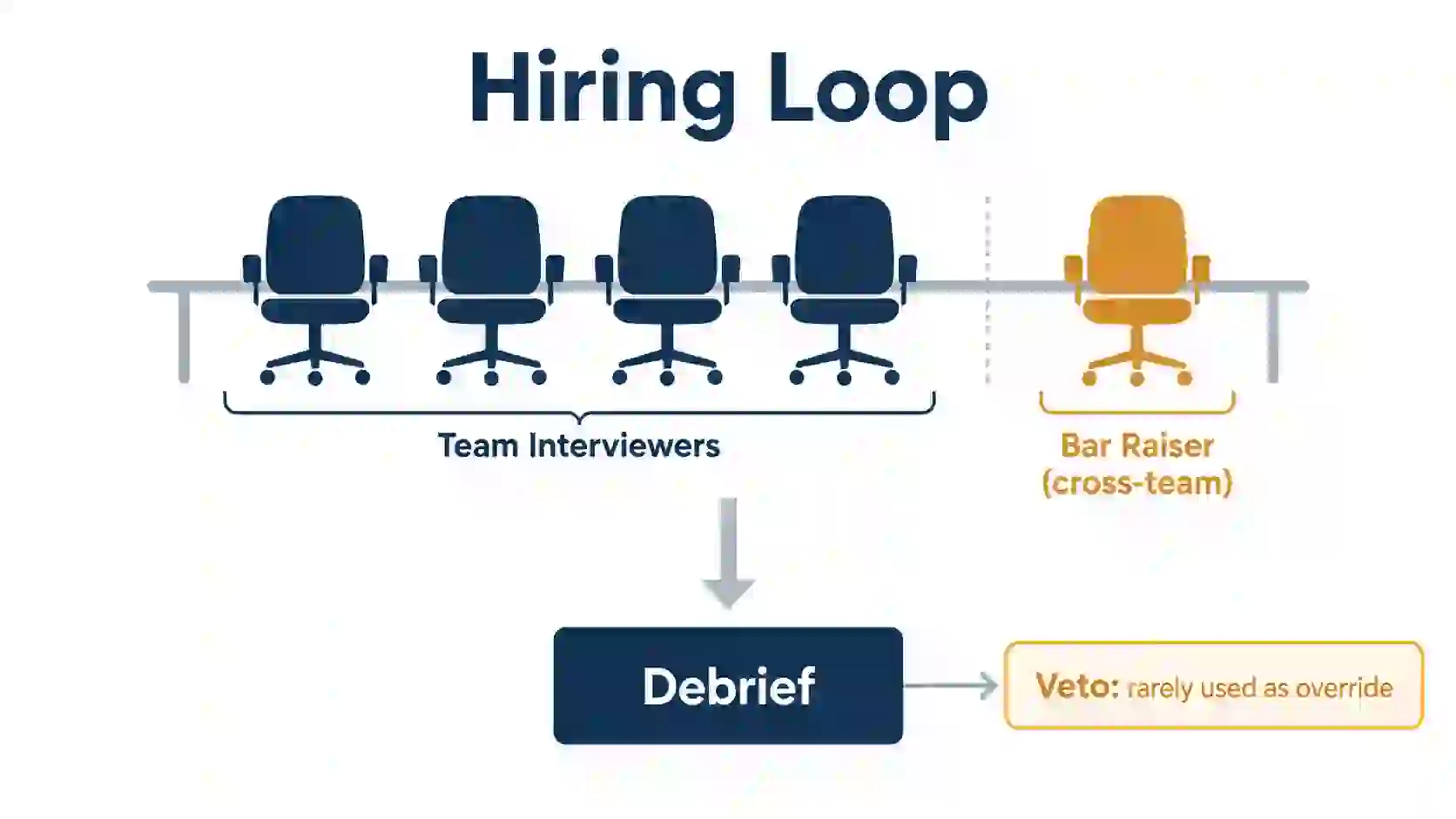
TL;DR: A Bar Raiser is a specially trained, cross-team interviewer who sits in every Amazon interview loop and can veto a hire even if the hiring manager wants to move forward — though in practice, that veto is rarely used as a blunt override; most Bar Raisers steer the debrief toward the right decision instead. They're chosen for interviewing skill, not seniority, trained through a mentorship process Amazon documents in detail, and their questions are standard Leadership Principles material asked with unusually persistent follow-up. In 2026's leaner hiring environment, that "raise the bar, don't just fill the seat" mandate matters more than ever.
Somewhere in every Amazon interview loop is a person whose name doesn't show up on the org chart of the team you're interviewing for. Candidates notice this after the fact — "wait, who was that fifth interviewer, and why did their questions feel completely unrelated to the role?" — and by then it's too late to have prepared for it. That person was very likely the Bar Raiser, and understanding what they're actually doing changes how you should walk into that specific 45-60 minutes.
What a Bar Raiser Actually Is
Amazon's own careers publication puts it plainly: Bar Raisers are trained, objective interviewers whose job is to make sure a new hire will be better than at least half of the people already doing that job — someone who raises the average, not just fills a seat. They're deliberately pulled from outside the hiring team, often from a completely different org, because someone with zero stake in whether this req closes this quarter is much harder to pressure into a rushed yes.
That single design choice — no incentive to fill the role fast — is why the round feels different from every other interview in your loop. A hiring manager wants a decision. A Bar Raiser wants the right decision, on a timeline that doesn't matter to them personally.
The Veto, Explained Honestly
This is the fact candidates fixate on, and it's real: a Bar Raiser can block a hire even when the hiring manager and every other interviewer wants to move forward. It's documented by Colin Bryar and Bill Carr — former Amazon senior executives who helped build the program — in their book Working Backwards, and Amazon's own hiring content references the role's authority to hold the line on quality.
What most explainers skip is how that authority is actually exercised. A flat override in the debrief room is the rare case, not the routine one. Experienced Bar Raisers more often use the debrief to walk the panel through the evidence — "here's what I heard that concerns me, does anyone else have data on that?" — and let the group arrive at the conclusion themselves. One widely cited account from a longtime Bar Raiser describes running well over 700 interviews without ever needing to issue a hard veto. The power exists as a backstop against groupthink and hiring-manager urgency bias, not as a weapon a Bar Raiser reaches for by default.
Who Actually Becomes a Bar Raiser (And Why It Matters for Your Interview)
This is the part almost no candidate-facing guide covers, and it changes how you should think about the round. Amazon doesn't hand out the Bar Raiser certification by seniority — it's earned through a demonstrated track record of strong interviewing judgment, and candidates for the role can come from any level, IC or executive. A new Bar Raiser trains under an experienced mentor, shadows real loops before running their own, leads debriefs under supervision, and is periodically evaluated by a central Bar Raiser group to keep their calibration consistent with the broader program over time.
The practical implication: you're not talking to someone who got assigned this round because they had a free slot on their calendar. You're talking to someone Amazon has specifically vetted for the ability to tell a well-rehearsed answer from a genuinely strong one — which is exactly why generic, memorized STAR answers tend to fall apart faster in this round than in others.
Why the Questions Feel Different Even Though They're Not
A Bar Raiser draws from the same 16 Leadership Principles every other Amazon interviewer uses — there's no secret question bank reserved for this round. What's different is scope and persistence. Because their job is calibration across the entire panel, not just their own slot, Bar Raisers are more likely to:
- Range across your whole career rather than staying anchored to the specific team's domain
- Keep pulling on a single story with follow-up questions until they hit real detail, instead of moving on after a solid first answer
- Chair the debrief afterward and probe other interviewers' evidence — a standard LP interviewer's job usually ends when their 45 minutes does
That last point is worth sitting with: a Bar Raiser's actual function extends beyond your time in the room. They're the one person in the loop whose job includes checking whether the rest of the panel's positive signals actually hold up under scrutiny.
The "Intentionally Harder" Myth
A persistent piece of interview folklore says Bar Raiser rounds are designed to be tougher, closer to a gotcha test than a normal interview. There's no internal Amazon policy or public documentation supporting that framing — it's reputation built from candidates who had a rough round and assumed the difficulty was structural rather than just a more experienced interviewer digging harder than they were used to. Treat this one as debunked: what's real is the persistence of follow-up, not a deliberately harder question set.
2026 Context: Why This Round Matters More Right Now
Amazon has trimmed corporate headcount significantly over the past year while still committing to thousands of early-career and engineering hires. In an environment with more qualified applicants per opening than there used to be, the Bar Raiser's original mandate — hire people who raise the average, don't just fill the seat — has more teeth than it did in a faster-growth hiring market. If you're interviewing at Amazon in this cycle, assume the bar this round is calibrating against is a genuinely competitive one, not a formality.
How to Actually Prepare
Know all 16 principles, not just the ones that map to your target team. A Bar Raiser's questions aren't scoped to the role — Ownership and Customer Obsession come up in a Bar Raiser round for a backend engineer just as often as Delivering Results does.
Expect the follow-up, not just the story. Prepare 6-8 STAR stories in enough depth that you can go three or four "what happened next" questions deep on each one without running out of real detail to give. A story that only survives the first telling is the one that falls apart under a Bar Raiser's persistence.
Don't perform consistency — have it. Since the Bar Raiser is specifically checking whether your answers hold up against the rest of the panel's read on you, the honest version of your experience is a safer bet than the most impressive-sounding one. Trained interviewers are better than most candidates expect at spotting a story that's been polished past the point of being true.
Practice saying it out loud, not just writing it down. A written STAR answer and a spoken one under real conversational pressure are different skills, and the gap shows up fastest in a round built around follow-up questions. This is where a live mock interview earns its place — running your stories against a version of the follow-up pressure a Bar Raiser actually applies, before you're doing it live with someone whose whole job is finding the gap in your answer. If your Amazon loop runs over video — increasingly common, including through Amazon Chime — AceRound AI can also surface relevant Leadership Principles talking points in the moment, which matters more in a round designed to probe follow-up depth than in a straightforward technical screen.
If Amazon's broader Leadership Principles framework is still new to you, our complete LP interview playbook covers all 16 principles in depth — the Bar Raiser round tests that same material, just with a more experienced interviewer asking the follow-up questions.
FAQ
What is a Bar Raiser at Amazon?
A Bar Raiser is an Amazon interviewer, usually from a completely different team than the one hiring, who's been specifically trained and certified to run one round of every Amazon interview loop. Their job isn't to fill the open role — it's to protect the hiring bar across the whole company, which is why Amazon deliberately picks someone with no stake in whether this specific req gets filled quickly.
Can a Bar Raiser veto a hire even if everyone else says yes?
Yes, that authority is real and well-documented by former Amazon executives who built the program. In practice, though, an explicit override is rare — most experienced Bar Raisers describe using the debrief discussion to walk the panel through evidence and let the team reach the right call themselves, rather than issuing a flat no. The veto exists as a backstop against groupthink and hiring-manager urgency, not as a tool that gets used every loop.
Is the Bar Raiser interview harder than other Amazon rounds?
There's no internal Amazon documentation suggesting Bar Raiser rounds are designed to be harder or more "gotcha" than any other interview in the loop — that reputation is candidate folklore, not policy. What's true is that Bar Raisers are trained to dig for specificity and follow-up detail more persistently than a less-experienced interviewer might, which can feel harder even when the questions themselves are standard Leadership Principles territory.
How do I know if my interviewer is a Bar Raiser?
You usually can't tell from the invite or the interviewer's title — Bar Raisers aren't a job title, they're a certification layered on top of someone's regular role, and they can be an IC or an executive. The best signal during the interview itself is scope: a Bar Raiser's questions tend to range across your whole career rather than staying narrowly focused on the specific team's tech stack, because their job is calibration, not team fit.
How does Amazon pick Bar Raisers?
Amazon selects Bar Raisers based on a track record of strong interviewing judgment, not seniority alone — candidates for the role can come from any level. New Bar Raisers train under a mentor Bar Raiser, shadow real loops, and lead debriefs under supervision before being certified to run interviews independently, and a central Bar Raiser group periodically reviews their calibration over time.
What questions does an Amazon Bar Raiser ask?
Standard STAR-format Leadership Principles questions — the same 16 principles every Amazon interviewer draws from, not a secret separate list. The difference is in follow-up: a Bar Raiser is more likely to keep probing a single story for inconsistencies, ask what you'd do differently, and cross-check what you say against how your answers compare to the rest of the panel's notes during the debrief.
Author · Alex Chen. Career consultant and former tech recruiter. Spent 5 years on the hiring side before switching to help candidates instead. Writes about real interview dynamics, not textbook advice.
Related Articles

Predictive Index Test: How to Actually Prepare for the PI Cognitive and Behavioral Assessment
The Predictive Index test is really two assessments. Here's what the 12-minute Cognitive test and the untimed Behavioral checklist actually measure, score, and allow.
Off-Campus OA Prep for Product-Based Companies: Amazon, Flipkart, Microsoft, and Zoho Compared
Amazon, Flipkart, Microsoft, and Zoho run off-campus OA very differently. Here's what each one actually tests, and how to prepare for the one you'll face.

Microsoft Growth Mindset Interview Questions: A Real Prep Guide
Microsoft names growth mindset as a hiring criterion on its careers site. Here's how it shows up across the loop, real candidate questions, and how to answer them.