Airline Pilot Interview Questions & AI Prep
Airline pilot interview questions cover four distinct stages, from TMAAT panels to a sim ride. Here's what AI prep can help with, and what it honestly can't.
TL;DR — Airline pilot interview questions come in four distinct stages: an HR screen, a pilot-panel TMAAT behavioral round, a technical interview, and a simulator evaluation. The first three reward real preparation, including AI-assisted practice. The fourth is a hands-on flying test, and pretending otherwise does candidates a disservice.
You've cleared the FAA's ATP hour requirements, submitted your application, and gotten the callback. Now the actual interview is four separate events, not one conversation, and each one tests something different. Knowing which stage rewards rehearsal and which one doesn't is the difference between prepping efficiently and wasting three weeks polishing answers for a round that isn't the one that will trip you up.
The real structure: four stages, not one interview
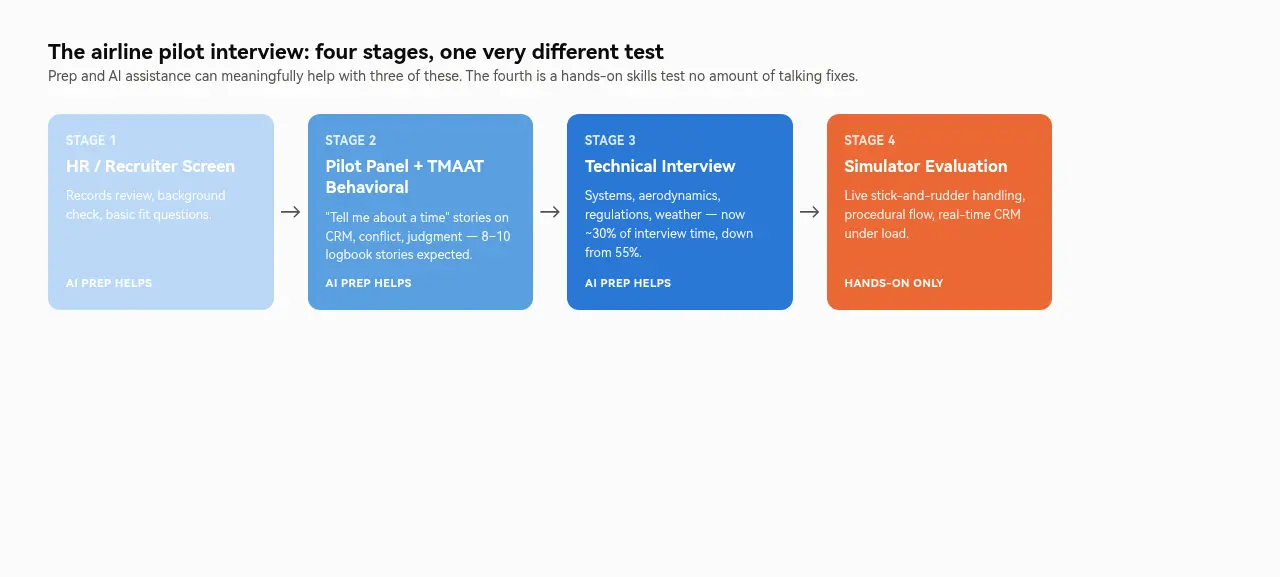
Most major-carrier hiring follows the same shape, confirmed across multiple 2026 airline-hiring breakdowns:
- Recruiter or HR screen — records review, background check, basic fit and availability questions.
- Pilot-to-pilot panel + structured behavioral (TMAAT) interview — real captains and check airmen asking for specific stories from your logbook.
- Technical interview — systems knowledge, aerodynamics, regulations, weather. Notably, this portion has shrunk to roughly 30% of interview time in 2026, down from about 55% through 2023, as airlines lean harder into scenario-based and behavioral assessment.
- Simulator evaluation — live handling, procedural knowledge, CRM, and the ability to learn a new profile in real time.
Individual carriers layer on their own steps. Delta's process runs an Aon online assessment, then an HQ panel interview, then an MMPI-2 personality inventory, then a virtual interview with a company psychologist. United's pipeline goes through initial screening and records review, a Denver Flight Training Center panel plus a Technical Readiness Review, a Leadership Inventory and "Becoming United" assessment, and finally an Acceptance Board of Review — with roughly 5–8% of applicants making it through to an offer.
What a TMAAT question is actually testing
TMAAT — "Tell Me About A Time" — is the format that defines the pilot-panel stage. These aren't hypotheticals; interviewers want a specific incident, what you did, and what you'd do differently. Real examples candidates report facing:
- "Tell me about a time when you have flown with a difficult captain."
- "Have you ever broke an SOP/FAR to help the company?" — a genuinely uncomfortable question, since the "right" answer usually isn't the one that sounds most impressive.
- "Made a decision without all the information" — reported as an actual United Airlines panel prompt.
- "Why do you want to fly for [this airline]?" — the question candidates most often answer too generically, without specific fleet, route, or culture details.
The common prep advice is to walk in with 8 to 10 logbook stories mapped to categories — conflict, judgment, emergency response, leadership — so you're pulling from memory rather than improvising under pressure, the same STAR-method structure used across behavioral interviews in any field. That prep is exactly where structured rehearsal and an AI interview copilot are genuinely useful: drilling story structure, checking you're not repeating the same anecdote for three different prompts, and making sure a story that sounds fine in your head actually lands out loud.
Where AI prep genuinely helps
Be honest about what rehearsal actually fixes. For the HR screen, the TMAAT panel, and the technical interview:
- Story-bank drilling — running your 8–10 TMAAT stories against a wider set of prompts than you'd think to generate alone
- Technical recall — systems, regs, and weather questions are memorizable, and structured Q&A practice closes real gaps
- Airline-specific research — the "why this airline" question rewards knowing fleet type, route network, and recent news, which is straightforward prep work
- Live-call support — if you're doing a virtual technical or HR round over video, a real-time assistant like AceRound AI can surface a structured prompt if a technical question catches you off guard, the same way it does for any other video interview
None of that is controversial. It's the same category of value that behavioral interview prep has always provided — just faster and more targeted with AI in the loop.
The simulator ride: the one stage prep can't touch
Here's the split most pilot-interview content quietly avoids, because it undercuts the pitch of every prep product, including ours: the simulator evaluation is a physical skills test. It's watching whether you can actually fly the profile — handling, procedural flow, checklist discipline, and CRM under real cognitive load — and whether you can pick up an unfamiliar aircraft type quickly. Nerves that cause you to freeze on a procedure or fumble a callout are a real part of what's being evaluated, and that's a fair thing to be nervous about.
No amount of talking, mock interviewing, or AI-assisted rehearsal changes your stick-and-rudder proficiency or your familiarity with checklist flow under pressure. If the sim ride is your actual weak point, the honest fix is more time in an actual simulator or the cockpit, not more interview prep. Any tool that implies otherwise is selling you something it can't deliver.
A note if you're not interviewing with a US carrier
The TMAAT-style structured panel, the ATP-CTP requirement, and the regional-to-legacy career ladder (via programs like Propel or Aviate) are largely American hiring conventions, built around FAA rules: an ATP certificate requires 1,500 total flight hours (with sub-minimums for cross-country, night, PIC, and instrument time), though the Restricted ATP path lowers that to 1,000 hours for a bachelor's-degree graduate or 1,250 for an associate's. European, Asian, and Middle Eastern carriers generally run different competency-based frameworks and psychometric batteries, with no direct R-ATP equivalent. If you're applying outside the US, use this as a guide to the American system specifically, not a universal template — the mechanics of your local hiring process will differ.
FAQ
Airline hiring pipelines are opaque even to people already in the field. A few of the questions candidates ask most:
What is a TMAAT question and how many stories do I need ready? A "Tell Me About A Time" behavioral prompt drawing on your real flying history. Most prep guidance points to 8–10 mapped stories covering conflict, judgment, leadership, and emergency response.
How many stages does an airline pilot interview have? Typically four — HR/recruiter screen, pilot-panel TMAAT behavioral, technical interview, and simulator evaluation — with some carriers adding their own layers, like Delta's personality inventory and psychologist round.
What happens in the sim evaluation, and can you fail it on nerves alone? The sim tests handling, procedural knowledge, and CRM under real-time pressure, including how you respond when something goes wrong. Freezing or missing a procedural step under nerves is a legitimate risk factor in that stage, which is why it's treated separately from the interview rounds that reward talking.
Can AI interview prep tools help with a pilot interview? For the HR screen, the TMAAT panel, and the technical interview, yes — story-bank drilling, technical recall, and live-call support all transfer. For the simulator ride, no — that stage tests flying proficiency, not a rehearsed answer.
Is the format the same at every airline, everywhere in the world? The four-stage shape and TMAAT format are common at major US carriers, but the ATP-CTP requirement and regional-to-legacy ladder are American conventions specifically — non-US carriers tend to run different competency frameworks.
Why do median pilot salaries and openings matter for interview prep? They don't change how to answer a TMAAT question, but they're useful context for why competition is fierce: the U.S. Bureau of Labor Statistics reports a median wage of $226,600 for airline and commercial pilots with roughly 18,200 annual openings projected through 2034 — enough demand that airlines can afford a four-stage filter.
Author · Alex Chen. Career consultant and former tech recruiter. Spent 5 years on the hiring side before switching to help candidates instead. Writes about real interview dynamics, not textbook advice.
Related Articles

The SQL Technical Screen: What Interviewers Actually Watch You Do Live
The SQL technical screen is a live, shared-editor round, not a take-home. Here's the format, what interviewers watch for beyond correct output, and how to prep.

The Palantir Forward Deployed Engineer Interview: What Decomposition Tests
Palantir's FDE interview has a round most candidates never expect: decomposition. Here's what it actually tests, and why AI tools are banned in the room.

The Byteboard Interview at Google, Waymo & Dropbox: What CoreEval Tests
Byteboard swaps algorithm trivia for a two-part take-home assessment. Here's what CoreEval measures, who uses it, and where AI tools actually fit.