Principal Engineer Interview Questions: What the Loop Actually Tests
Principal engineer interview questions go beyond system design — real interview loops test org-scale tradeoffs, influence without authority, and why you're Principal and not Staff.

TL;DR: Principal engineer interview questions don't test harder algorithms — they test whether you can set direction at organizational scale, defend a tradeoff that other teams have to live with, and explain why you're the right level for the call, not just a capable one. The loop usually mirrors a Staff loop in structure (coding gate, system design, behavioral) but every round is scored against org-wide, not team-wide, scope.
A candidate with seventeen years of experience walked out of a Principal loop with feedback he didn't expect: "amazing" on behavioral and system design, dinged on the coding round for being "too careful with requirements." He'd spent the whole session double-checking edge cases the way you would on a production system nobody could roll back. The interviewer wanted speed; the candidate gave rigor. Neither was wrong — they were calibrated to different levels.
That gap is the entire Principal engineer interview in one story. It's not a harder version of the Staff loop. It's testing whether your instincts are already tuned to a scope most candidates haven't operated at yet.
What a Principal Loop Is Actually Scoring
Generic interview-prep listicles treat Principal engineer questions like a longer list of the same Staff-level prompts — "tell me about a time you led a project," "design a scalable system." That's the wrong frame. What changes at Principal isn't the question format; it's the scale of the consequences you're expected to reason about in your answer.
Four things a Principal loop is actually listening for:
- Org-scale tradeoffs — does your system design or project story account for constraints outside your own team: budget, a legacy system three other orgs depend on, a compliance deadline you didn't set?
- Cross-functional influence — can you get finance, security, product, and a peer org's VP to agree on a direction none of them fully control?
- Ownership of second-order consequences — when your call turned out to be partially wrong, did you own the fallout, or did the story conveniently end before that part?
- Multiplying impact through others — is your technical leverage coming from what you personally ship, or from what dozens of engineers you don't manage now do differently because of a standard, review process, or platform you pushed for?
Notice what's missing: raw coding speed and framework trivia. Those are already assumed. LeadDev's breakdown of Staff, Principal, and Distinguished engineers and Will Larson's widely-cited staff-plus interviewing guide are useful references for how these evaluation axes shift level to level — most large companies' internal leveling guides map onto some version of the same four signals, just calibrated to a bigger blast radius at Principal.
The Interview Loop: What Companies Actually Run
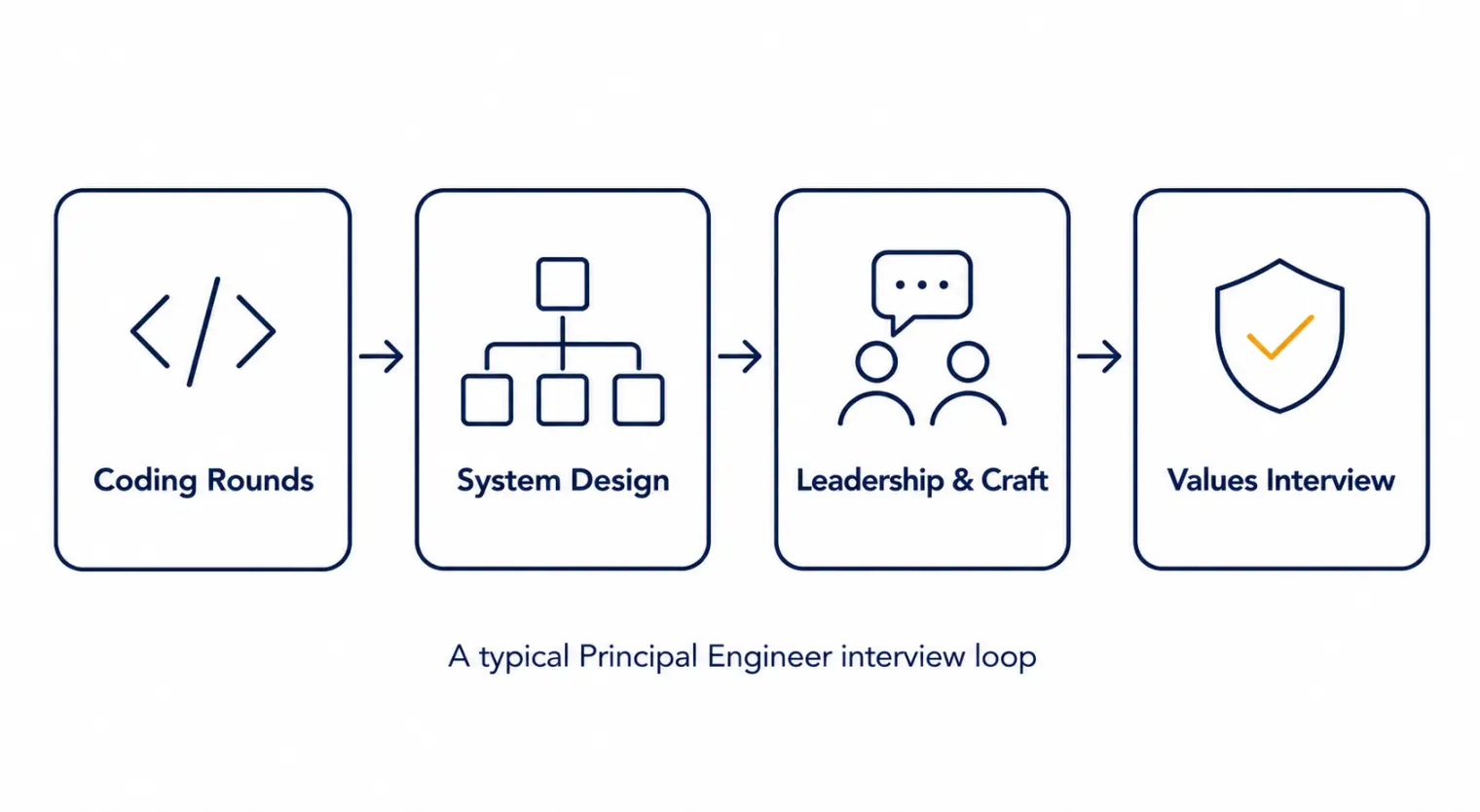
Most companies don't publish their internal loop structure, but a few do. Atlassian's public Principal Backend Engineer interview guide lays out a five-round structure across three stages — two 60-minute coding rounds, a 60-minute system design round, a 60-minute leadership-and-craft round, and a 45-minute values interview — that's fairly representative across the industry. The coding rounds are a gate, not a differentiator; the system design round is scoped to organizational constraints rather than a single service; and the leadership-and-craft round focuses on how you've driven technical decisions across teams.
What that structure implies for your prep time: coding practice should be enough to clear the bar comfortably, not maximized. The system design and leadership rounds are where loops are actually won or lost — and they're the rounds candidates under-prepare for because there's no LeetCode-style repository of "Principal system design questions" to grind against.
System Design at Organizational Scale
A Staff-level system design answer solves the problem in front of you. A Principal-level answer solves it while explaining what it costs three other teams, and why that cost is worth paying.
Concretely, that means your answer should be ready to address:
- Buy vs. build under real constraints — not "we could build this in-house," but what it costs in headcount you don't have, and which vendor risk you're accepting instead
- Migrating off a legacy system under political and budget limits — the honest version of "just rewrite it," including whose roadmap gets delayed while you do
- Latency vs. consistency tradeoffs tied to a business number — not "eventual consistency is fine here," but what specific SLA or revenue metric that tradeoff actually threatens
Interviewers at this level frequently leave the design question deliberately open-ended — not because they haven't thought about the "right" answer, but to see whether you ask about the constraint that matters (budget? headcount? a compliance deadline?) before you start drawing boxes. Freezing when the constraints aren't handed to you upfront is one of the most common ways strong Staff engineers stall out in a Principal loop.
Influence Without Authority, at a Bigger Radius
Cross-functional negotiation shows up in every senior technical interview, but at Principal scope, the "cross-functional" list gets longer and less friendly: not just your product manager, but a peer engineering org's VP who has a competing roadmap, a security team that can veto your timeline, and finance signing off on the budget line.
The story that lands here isn't "I convinced them" — it's the mechanism. What did you do when a stakeholder had a legitimate, opposing incentive, and how did you find (or fail to find) a path that didn't just route around their objection? Interviewers are explicitly listening for whether you can win an argument on the merits without having the org chart to force it.
"Why Principal, and Not Staff?"
This question — or some version of it — shows up in most Principal loops, and it's the one candidates most often answer with the wrong shape of evidence: years of tenure, a list of systems built, scope of past titles. None of that answers the actual question.
What does answer it: a specific decision where you were the one who had to be right, because the cost of being wrong wasn't contained to your own team. Tell that story, including the part where you were partially wrong and what you did next. An interviewer who hears you own the messy, second-order part of a decision — not just the clean version — is hearing Principal-level judgment, regardless of your title history.
Incident Postmortems and Operational Judgment
Almost no generic interview-prep listicle covers this, but it comes up constantly in real Principal loops: walk me through an incident, and what changed afterward that wasn't just "we added a runbook." At this level, interviewers want to hear about systemic fixes — a review process, a design standard, an on-call structure change — that reduced the class of failure, not just the one instance. If your postmortem story ends at "we fixed the bug," it reads as an IC answer, not a Principal one.
Mentoring and Multiplying Impact
Staff-level impact is usually still measurable through what you personally ship or unblock. Principal-level impact increasingly comes from what other engineers — people you don't manage — do differently because of something you pushed for: a design review bar you raised, a platform abstraction that made a whole category of bug impossible, a mentoring relationship that turned a mid-level engineer into someone who now runs their own Staff-scope projects. Have a concrete story ready where your fingerprints are on someone else's growth or someone else's system, not just your own.
How AI Practice Actually Helps Here
There's no single "correct" answer to design a payments platform for 10x scale under a legacy constraint — so live AI interview assistance at this level isn't about feeding you the right answer. It's closer to what a genuinely good mock interviewer does: injecting a new constraint mid-answer ("legal just added a compliance requirement — what changes?") so you build the muscle of restructuring a tradeoff on the fly instead of freezing when the ground shifts under you. Tools like AceRound are useful for that kind of live, adaptive practice — surfacing the scale numbers and tradeoff framing to cite in the moment — but they don't replace having actually made the calls before. No tool compensates for a candidate who hasn't operated at this scope; the honest use case is sharpening how you articulate judgment you already have, not manufacturing judgment you don't.
If you're not sure whether you're ready for a Principal loop at all, it's worth first reading how the level below is actually evaluated — our Staff engineer interview guide covers the scope-and-influence bar in detail, and most Principal candidates are Staff engineers deciding whether the jump is real. For the system-design half specifically, our Cloud Architect interview guide goes deeper into scoring org-wide infrastructure tradeoffs.
FAQ
What's the actual difference between a Staff and a Principal engineer interview?
The technical bar overlaps heavily — both loops test system design and coding competence. The real difference is scope: a Staff loop checks whether you can set direction for a problem area spanning a few teams; a Principal loop checks whether you can do that across an entire org or product line, often with budget, legacy-system, and cross-company-priority constraints layered on top.
Is coding still part of a Principal engineer interview?
Usually yes, but it's a gate, not a differentiator — most published Principal loops still include one or two coding rounds. Almost every candidate who reaches a Principal loop clears the coding bar; almost nobody clears the loop on coding alone.
How do I answer "why should we hire you as Principal and not Staff"?
Don't answer with years of experience or a list of systems you've built. Answer with a specific decision you made that other teams, or the company's budget, had to live with, and what happened when you were wrong about part of it.
What if my interviewer seems less senior than me, or asks a question that feels too basic?
Answer it fully anyway, then use the follow-up room to add the org-scale layer the question didn't ask for. How you handle a question you've outgrown is itself part of what's being evaluated.
How long does a Principal engineer interview loop take?
Most published loops run 4-6 rounds across coding, system design, a leadership-and-craft round, and a values or culture interview, often spread across one or two days.
Can AI actually help with Principal-level interview prep?
Not by feeding you a "correct" system design — at this level there usually isn't one. Live AI practice is good for the same thing a strong mock interviewer gives you: someone pushing back mid-answer with a new constraint, so you build the habit of restructuring a tradeoff answer on the fly.
Author · Alex Chen. Career consultant and former tech recruiter. Spent 5 years on the hiring side before switching to help candidates instead. Writes about real interview dynamics, not textbook advice.
Related Articles
The SQL Technical Screen: What Interviewers Actually Watch You Do Live
The SQL technical screen is a live, shared-editor round, not a take-home. Here's the format, what interviewers watch for beyond correct output, and how to prep.

The Palantir Forward Deployed Engineer Interview: What Decomposition Tests
Palantir's FDE interview has a round most candidates never expect: decomposition. Here's what it actually tests, and why AI tools are banned in the room.

The Byteboard Interview at Google, Waymo & Dropbox: What CoreEval Tests
Byteboard swaps algorithm trivia for a two-part take-home assessment. Here's what CoreEval measures, who uses it, and where AI tools actually fit.