Tell Me About a Time You Managed Up
Answer 'tell me about a time you managed up' with a real STAR story, not corporate-speak — three manager archetypes and sample answers included.

TL;DR: "Tell me about a time you managed up" asks for proof that you can proactively adjust to a manager's style, blind spots, or pressure points before anything becomes a conflict — it's a different question from "tell me about a time you disagreed with your boss." The strongest answers name a specific manager pattern (disorganized, conflict-avoidant, or under pressure from above) and show one small, repeatable habit you built around it. Below: three ready-to-adapt STAR scripts, one for each pattern.
Type "managing up" into a search bar and you'll eventually find a piece literally titled "Managing Up™ Sucks." The writer's complaint is fair: in a lot of workplaces, "manage up" is code for "quietly do part of your manager's job so their weaknesses don't become your problem." If that's the version rattling around your head when an interviewer asks this question, you're not wrong to be a little skeptical of it.
As career-advice writer Alison Green puts it, the friction usually looks mundane in practice — "your manager isn't responsive enough to email, or cancels meetings at the last minute, or changes her mind after you thought a decision had been made." That's the raw material this question is actually testing, not office politics.
But the question isn't asking you to confess that you covered for an incompetent boss. It's asking something narrower and more useful: can you read how a specific person operates, and adjust your own behavior so the two of you work better together? That's a real, teachable skill — and it's distinct enough from "handling conflict with your manager" that top interview-prep sources treat them as two separate question types.
What "Managing Up" Actually Means (and What It Isn't)
Managing up is proactive, ongoing relationship management aimed at your manager specifically — anticipating their blind spots, communication style, or pressure points before they turn into a problem. Harvard Business Review's research on the topic frames it as managing the relationship for mutual benefit, not managing your manager's actual job.
That distinction matters for how you answer:
- It is not "tell me about a time you disagreed with your boss." A disagreement story is about a single moment of conflict and how you resolved it. A managing-up story is about an ongoing pattern you noticed and a habit you built to work around it — no confrontation required.
- It is not "tell me about a time you managed down." Interviewers sometimes ask both in the same loop specifically to see if your instincts change based on who holds more power in the room — a signal Amazon's own leadership-principle interviewers are known to probe for.
- It is you noticing something true about how your manager operates, and changing your own behavior — not theirs — to make the working relationship function better.
If your instinct is still "isn't this just doing extra work to compensate for someone else?" — hold onto that skepticism. It's exactly the instinct that keeps most candidates' answers vague. The fix isn't a better definition of managing up; it's a specific enough story that the vagueness has nowhere to hide.
Why Interviewers Ask This
Three things are being tested at once:
Observational judgment. Did you actually identify a real pattern in how your manager works, or are you inventing one on the spot? Vague answers ("I always kept my manager updated") signal the latter.
Initiative without overreach. Did you solve the friction yourself, or did you wait for your manager to fix it — or worse, go around them? The best answers show you closing a gap quietly, not staging an intervention.
Self-awareness about power dynamics. Do you understand that "managing up" means adjusting your behavior, not changing your manager's? Candidates who describe fixing their manager's flaws directly (correcting them publicly, taking over their decisions) usually raise a flag rather than a green light.
Three Manager Patterns, Three STAR Answers
Generic advice here tends to collapse into one template: "I understood my manager's goals, gave proactive updates, and built trust." It's not wrong, it's just interchangeable — the same five sentences could describe five different jobs. A better way to prepare is to identify which pattern your own manager story actually fits, then build the STAR answer around the specific friction, not the generic virtue.
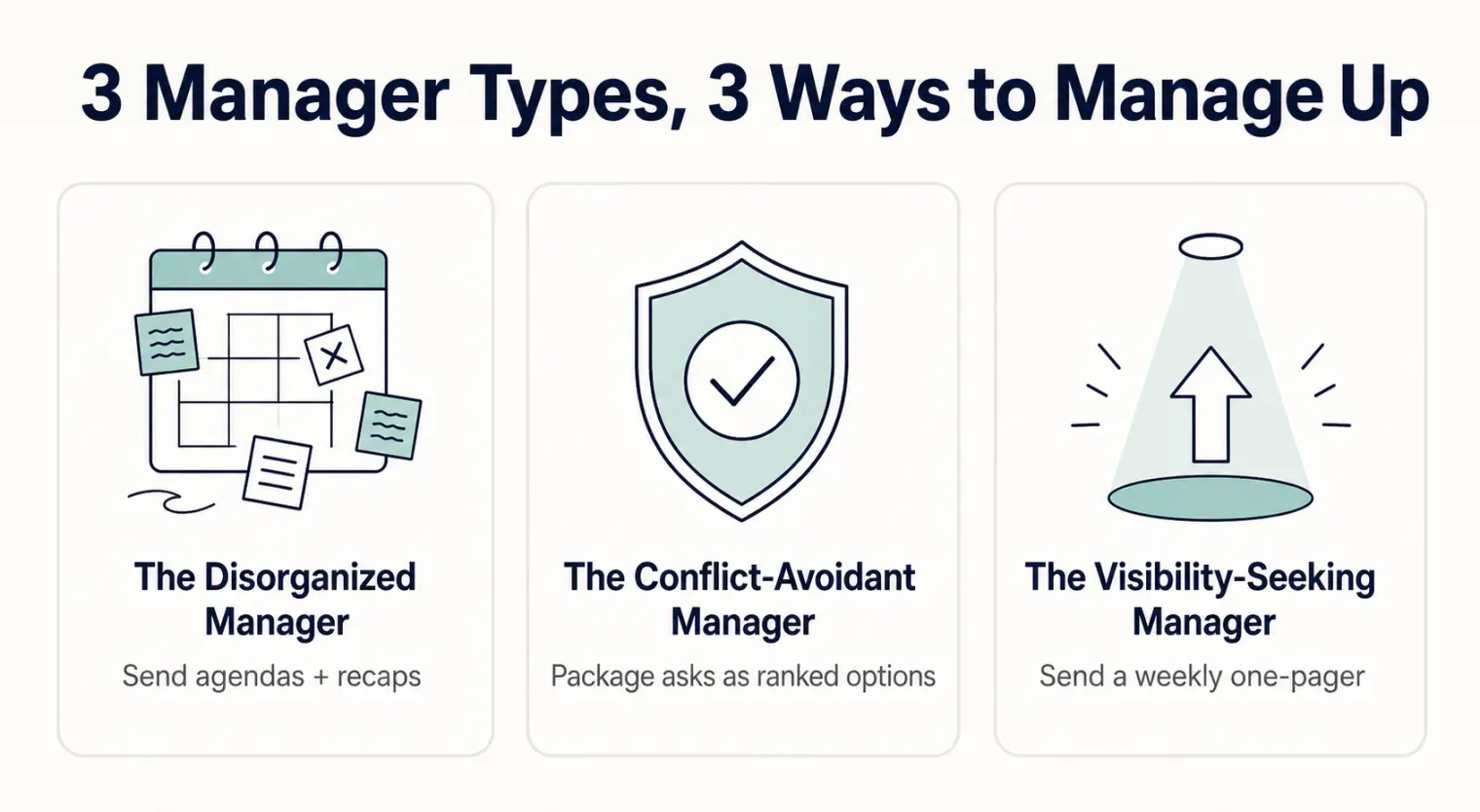
The Disorganized Manager
Situation: My manager ran a small cross-functional team and was excellent at strategy but chronically double-booked, which meant meetings got rescheduled last-minute and handoffs between the design and engineering side of the project kept slipping.
Task: I needed deliverables to stay on track without it looking like I was correcting my manager's calendar in front of the team.
Action: I started sending a short pre-meeting agenda 24 hours ahead of every recurring sync, and a two-line recap afterward listing decisions and owners. I also offered to own the shared project calendar directly, framing it as "one less thing on your plate" rather than a fix for a problem.
Result: Missed handoffs dropped to almost zero over the next quarter, and my manager started delegating more scheduling and coordination work to me — which became a talking point in my next performance review.
The Conflict-Avoidant Manager
Situation: A client kept expanding scope on a project without a corresponding change in budget or timeline, and my manager — who disliked pushing back on clients directly — kept absorbing the extra work into the team's plate instead of renegotiating.
Task: I needed my manager's approval to renegotiate scope, but a vague "can we talk to the client about this?" ask wasn't going to get traction with someone who avoided that conversation.
Action: I packaged the ask as three ranked options — extend timeline, add budget, or cut a specific deliverable — with a clear recommendation, so my manager only had to approve a decision rather than have the harder conversation of framing the problem themselves.
Result: The renegotiation happened within a week instead of dragging on for another month, and my manager started asking me to pre-package similar asks before other client conversations.
The Visibility-Seeking Manager
Situation: My manager reported into a director who ran tight, high-pressure leadership reviews, but my manager was often out of the loop on the day-to-day wins and risks happening on our team.
Task: I wanted my manager to walk into those reviews looking informed, without me micromanaging what they said or turning it into extra meetings for the team.
Action: I built a one-page weekly summary — three wins, one risk, one ask — written so my manager could forward it upward without editing.
Result: My manager was specifically praised in a leadership review for "staying on top of the details," and I was given more autonomy on prioritization as a direct result.
A Reusable Framework for Your Own Answer
Once you've picked the pattern closest to your real experience, keep the story tight:
- Name the specific behavior, not a vague trait. Not "my manager was busy" — "my manager double-booked recurring meetings roughly once a week."
- State what you changed about your own behavior, not theirs. The habit you built is the actual answer to the question.
- Keep the result measurable if you can — fewer missed handoffs, faster approvals, a specific comment in a review. If you don't have a number, a specific observed change in behavior (yours or your manager's) works almost as well.
- Don't editorialize about your manager's weaknesses. "My manager wasn't great at X" reads as criticism even when it's true. Frame it as a pattern you adapted to, not a flaw you tolerated.
Saying this cleanly out loud is harder than writing it down — most people notice the wording gets clunky the third time they try to compress a real work situation into four STAR beats. Running the answer out loud against a mock interview, with AceRound's live prompts nudging you back on structure when you drift into vague "I always communicated proactively" territory, catches that before the real interview does.
Common Mistakes to Avoid
- Turning it into a disagreement story. If your example is really about a conflict you resolved, that's a different question — answer it as one, or pick a different example for this one.
- Making your manager the villain. Even a mild "my manager just wasn't organized" lands worse out loud than it does in your head. Frame the pattern neutrally.
- Staying abstract. "I adapted to my manager's communication style" tells the interviewer nothing they can picture. A pre-meeting agenda, a shared calendar, a one-page summary — concrete artifacts are what make the story credible.
- Confusing managing up with doing your manager's job. If your story involves making decisions that were actually your manager's to make, reframe it — the skill being tested is influence, not usurping authority.
FAQ
What does it mean to "manage up" at work? It means proactively adjusting your own communication and work habits to fit your manager's style, workload, and pressure points — not changing what your manager does, but changing how you work with them so friction doesn't build up.
Are you better at "managing up" or "managing down"? Interviewers sometimes ask this specifically to see whether your approach shifts based on who has more positional power. A strong answer shows the same underlying skill — reading how someone works and adjusting to it — applied in both directions, even if you have more natural experience in one.
How would you ensure your relationship with a manager is always constructive? Name a repeatable habit, not a personality trait. "I send a short recap after every 1:1" is a better answer than "I'm a good communicator," because it's something an interviewer can actually picture you doing consistently.
Describe a situation where you had to work with a manager whose communication style was very different from yours. How did you adapt? This is functionally the same question with a style-mismatch framing instead of a workload framing. Use the same STAR structure: name the specific mismatch (they wanted async updates, you defaulted to talking things through live, for example), and the concrete habit you built to bridge it.
Tell me about a time you had to persuade your manager or a senior leader to support an idea that mattered to you. This is a persuasion-specific variant. The strongest answers here show you doing the thinking your manager would otherwise have to do themselves — pre-packaged options, a clear recommendation, the risk already thought through — so saying yes is easy for them.
Isn't "managing up" just doing extra work to cover for a manager's weaknesses? Sometimes it can tip into that, and it's a fair thing to be wary of in a real job. But the version interviewers are testing for is narrower: noticing a real pattern and building one small, sustainable habit around it — not quietly absorbing your manager's actual responsibilities.
For a related but distinct question, see our guide to answering "tell me about a time you disagreed with your boss". For the underlying framework both questions rely on, our STAR method guide walks through structuring any behavioral answer from scratch. And if the real challenge is saying any of this fluently under pressure, AceRound's live interview practice gives you real-time prompts while you rehearse, not just a script to memorize.
Author · Alex Chen. Career consultant and former tech recruiter. Spent 5 years on the hiring side before switching to help candidates instead. Writes about real interview dynamics, not textbook advice.
Related Articles

Does Cursor Allow AI in Interviews? Anysphere's Two-Sided Policy
Cursor's maker bans AI in round one to test raw skill, then hands you an 8-hour paid project where using AI well is the entire grade. Here's how the two rounds actually differ.

The Internal Transfer Interview: What Actually Changes at Google and Amazon
Fewer rounds doesn't mean lower stakes. How Google and Amazon's internal transfer mechanics — tenure rules, manager notification, bar raisers — actually differ from an external hire.

Databricks Interview: The Concurrency Round Nobody Warns You About
Databricks runs a full hour on multithreading alone, and reportedly grades system design in a Google Doc, not a whiteboard tool. Here's what candidates say.